Editorial
The Medium of the Cross
by Chanon Kenji Praepipatmongkol
This essay is part of the website built on the occasion of the exhibition Fragments of a Crucifixion at the Museum of Contemporary Art Chicago, May 25–November 3, 2019.
First, consider the crosshairs. Consider this contemporary sign of the cross that unremittingly frames black lives in the United States.
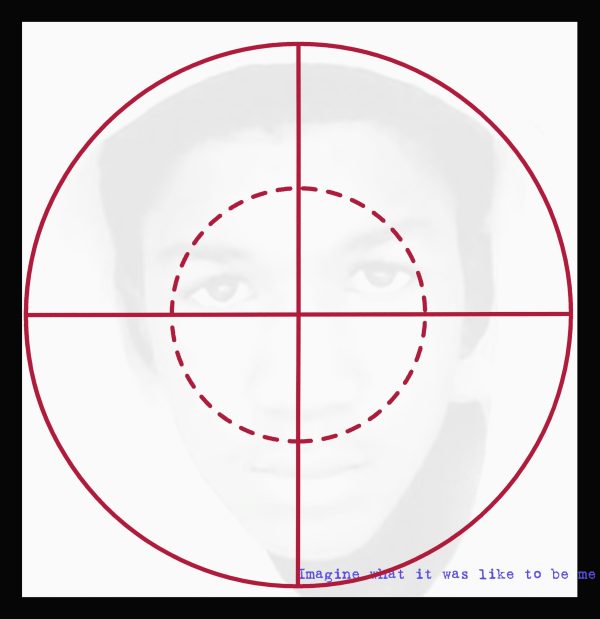
Then, consider Imagine [Trayvon Martin], a work Adrian Piper created in 2013. From behind the red crosshairs peers a faded black-and-white image of Trayvon Martin, the 17-year-old African American teenager who was shot and killed in 2012 by neighborhood watchman George Zimmerman. Distributed freely online by Piper and subsequently exhibited in museums, Imagine [Trayvon Martin] provokes intense reactions, particularly from those who feel implicated by its message: “Imagine what it was like to be me.”
What is so striking about the work’s demand on viewers is that it forces self-identification in stark terms. “For some,” Larissa Pham writes, “it’s all too easy to imagine what it would like to be Trayvon; for others, it’s a forced self-examination, a posthumous exercise in empathy.”[1] James Hannaham goes further, pronouncing that the work “seemed directed toward people who don’t spend as much time identifying with Trayvon Martin as I do.”[2] To Nico Wheadon, Piper seems cruel in making this “injurious provocation,” when just beyond the museum awaits, in her words, the precarious reality of “my very black, American life.”[3]
But Piper is more than a producer of mnemonic devices and empathic tools. For decades she has exploited the uneasy distance between the privileged world of institutionalized art and the social reality of black lives outside its walls.[4] Perhaps this is what the artist wants viewers to do: to mind the interval between the frames. While Martin’s visage initially appears as the singular target of attention, a longer look reveals that things are slightly askew. Piper placed the crosshairs off-center, with the four cardinal points set at asymmetric and unequal intervals to the border. It is this black band around the edge of the image that provides a sense of space and a measure of distance—that implies there exists a vantage point outside the circumscribed view of the police’s crosshairs. The black border holds space for a perspective in which whiteness is neither the center nor the frame.[5]
Fragments of a Crucifixion attempts to make room for another perspective, one that displaces the view through the crosshairs with a consideration of life and death through a religious lens. We need not look far for signs of faith. No one was as vocal about the spiritual significance of Martin’s life and death as his mother, Sybrina Fulton.[6] Over the course of Zimmerman’s highly publicized trial in 2013, Fulton shared her Christian testimony with the world every day, as she tweeted prayers and passages from the Bible alongside photos of her child. On day 12 she wrote, “When Christ is the center of your focus, all else will come into proper perspective.”[7] For Fulton, it is through the intermediary sign of Jesus’s cross that Christianity’s most gripping promise is born: that violence can be changed by faith into suffering that is not in vain.
In bringing voices of faith to bear on artworks, Fragments of a Crucifixion proposes that contemporary art is not so secular a realm that religious and spiritual narratives cannot penetrate it. Centered on works in the MCA’s collection, the exhibition gathers a number of works that may appear to have more to do with race than religion. But the exhibition’s interpretive materials—whether wall labels, public programs, or this publication—aim to reveal the often-invisible religious and spiritual currents that animate these works of art. Doing so connects contemporary artists in the show to a long line of artists who have used the crucifixion as a powerful symbol to address the experience of racial violence in the United States.[8] The exhibition explores the continuing relevance of the sign of the cross, for it is through this sign that contemporary artworks might come into focus as icons, emblems, and relics of public mourning today.
The idea for a digital publication to accompany the exhibition grew out of a desire to engage the heterodox language of faith that pervades recent responses to the violence inflicted on black people in this country. Since 2013, activists associated with the Black Lives Matter (BLM) movement have shared texts, images, and symbols drawn from multiple faiths to hold a space of remembrance for those murdered, and to reclaim the sacredness of lost lives.[9] But in a departure from the rhetoric of the Civil Rights era, many of BLM’s most visible figures have presented the movement’s religious orientation as part of a broader set of queer and indigenous commitments.[10] This collection of essays was conceived in this spirit of inclusivity and intersectionality, with the hope of fostering public discussions around religion and race that are not defined by already-given subject positions (e.g., black versus non-black, Christian versus non-Christian).
The publication brings together artists and scholars committed to exploring the relationship between art, spirituality, and social justice. It features inquiries at once deeply personal and critical, and which traverse the terrain of art history, theology, moral philosophy, queer theory, and performance studies. Xiao Situ argues for the potential of contemporary art to make visible “what Christ’s activity might look like in the present day.” She uncovers in Titus Kaphar’s Ascension (2016) a resonance between the image of crucifixion, the legacy of lynching in America, and recent protests by athletes against police brutality. Phoebe Wolfskill’s conversation with artist Joyce J. Scott explores Scott’s often sardonic yet deeply religious approach to figuring black bodies—an approach that imbues histories of racial violence with unexpected levity and spiritual hopefulness. My interview with Paul Pfeiffer addresses the strange temporal loops and disjointed Biblical narratives in his video works as elements of an aesthetic that complicates the desire for resolution. Anni Pullagura and Josh Chambers-Letson present approaches to history that refuse the inevitability of origins and endings. They offer meditations on art’s capacity to hold space for the wayward passing of time—the delays, suspensions, and projections that allow for life to continue.
These authors place the matter of faith at the center of their discussions, yet elude clear distinctions between the religious and the secular. The compelling question then becomes not what set of beliefs we subscribe to, but rather why, how, and when we choose to believe that one interpretive frame edges out or invalidates another.
Notes
1. Larissa Pham, “This MoMA Show Asks You to Confront Racism—Both in Strangers and Yourself,” Garage Magazine, April 3, 2018.
2. James Hannaham, “Adrian Piper,” 4Columns, May 4, 2018.
3. Nico Wheadon, “Adrian Piper: From Passing to Purple,” Brooklyn Rail, May 1, 2018.
4. For resources on Piper’s artistic practice and career, see Adrian Piper: A Synthesis of Intuitions, 1965–2016 (New York: Museum of Modern Art, 2018) and Adrian Piper: A Reader (New York: Museum of Modern Art, 2018).
5. On “holding space” through art, see Helen Molesworth, “Art is Medicine,” Artforum 56, no. 7 (March 2018).
6. Elizabeth Dias, “The Christian Witness of Trayvon’s Mother,” Time, July 15, 2013.
7. Sybina Fulton, Twitter, June 25, 2013, 11:02 am, twitter.com/sybrinafulton/status/349543220730015744.
8. See James Romaine and Phoebe Wolfskill, eds., Beholding Christ and Christianity in African American Art (University Park: The Pennsylvania State University Press, 2017); Edward J. Blum and Paul Harvey, The Color of Christ: The Son of God and the Saga of Race in America (Chapel Hill: University of North Carolina Press, 2012); and James Treat, Around the Sacred Fire: Native Religious Activism in the Red Power Era (New York: Palgrave Macmillan, 2003).
9. Vincent Lloyd, ed., “Religion, Secularism, and Black Lives Matter,” The Immanent Frame, September 22, 2016.
10. Josef Sorett, “A Fantastic Church? Literature, Politics, and the Afterlives of Afro-Protestantism,” Public Culture 29, no. 1 (2017): 17–26.