Editorial
"However the image enters"
by Anni Pullagura
This essay is part of the website built on the occasion of the exhibition Fragments of a Crucifixion at the Museum of Contemporary Art Chicago, May 25–November 3, 2019.
however the image enters
its force remains*
There’s an odd sort of rehearsal that attends the public loss of minoritized life in the United States. In a white supremacist state, headlines make mourning routine, unexceptional. Names transform into hashtags and movements, becoming something extra-ordinary in the perfect ordinariness of their occasion in general speech. Ordinary because, as contemporary discourse would will us to believe, black and brown and queer kids have always been dying, at once daily and #neveragain.
Or, maybe, this is just how their always-dying feels, how feeling is made around the overwhelming cost of living exactly as the technologies of oppression work so hard to compel us to live. Maybe this insistence of normal operating standards is the odd sort of rehearsal we commit ourselves to each day, moving steadily to the beat of “merely” surviving. That surviving, when others don’t, or can’t, is what it costs us to witness, over and over, the extraordinary violence of endless recurrence.
How does something endlessly recur?
Not reoccur—for as many as we have lost since, before, and with Emmett Till, it is not the same loss, even if it may feel, to some, like a refrain—but recur: to go/come/be back. The form may be different, but its happening is the unbearable imminence we keep bracing for. A tending to an endless end.
How does an artwork endlessly recur?
For Felix Gonzalez-Torres, we might say that endlessness belongs with the artwork—that is, how the art works. What makes “Untitled” (The End) (1990) work is the event of its working endlessly; the artist entrusts this event to the work’s caretakers, whether the museum, the owner, or the collector. My copy of “Untitled” (1992/93), which I took from the exhibition Nothing Stable Under Heaven at the San Francisco Museum of Modern Art in 2018, still hangs on my bedroom wall, riddled with pushpin holes at corners that are so frayed the paper has become crumply soft like worn fabric.[1] I have not decided, yet, when and how I will remove the paper from the wall.

There’s no reason to think that Gonzalez-Torres predicted this sort of indecision with the caring for his stack works—he called them “true public sculpture”[2]—which, like the candy spills, are meant to be taken and replenished in each installation.[3] Others, meanwhile, think of this caring as a tending, a waiting, not of an end, but of a going on—that the paper stacks witness our goings on simply by being themselves endlessly going on. We know, of course, that to be asked to go on is really a political act of survival, and that such an ask itself asks, “What are the politics of tending the embers of the witnessing art object or text?”[4] Art historian Adair Rounthwaite’s evocation of “embers” is suggestive, anticipating and still delaying its own end. “The stacks of paper, or piles of candies are indestructible,” Gonzalez-Torres told artist Tim Rollins in 1993, “because they can be endlessly duplicated. They will always exist because they don’t really exist, or because they don’t have to exist all the time.”[5] Here is an acknowledgment of a way of being that cannot be made a category for being because it quite simply exceeds it: the stacks, monumental and accumulative, look like they could go on, sturdy and fed, tended to by those who have agreed to replenish the papers to their ideal height. They look like they could, and maybe that’s the point.
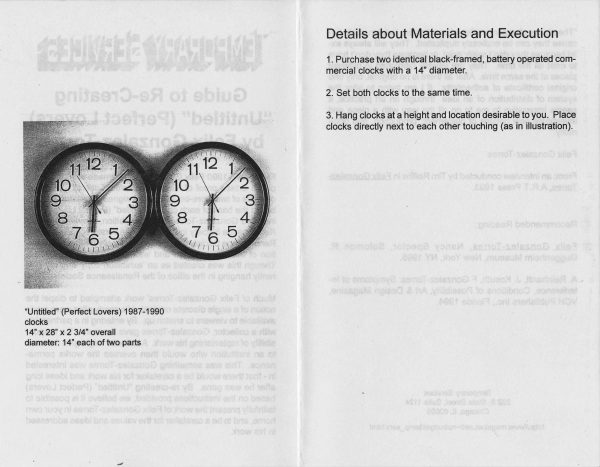
Mónica Amor names this rejection of an end of the art’s work a refusal of “the possibility of the absolute,” one that long attended Gonzalez-Torres’s practice. Whether by stacks or spills or clocks, Gonzalez-Torres created art that doubles as an active locus of thinking relationally to “that space between waters, between lands, between skies in which momentarily we suspend our precise location to find ourselves neither here nor there.”[6] Maybe it is this very space of being called forward, the space of endlessness, that is the radical claim. Maybe it is enough to perceive the stacks’ replenishing as a comforting promise of delay, of suspension—one that makes it possible for us to take the sheet of paper, to eat the piece of candy, to hang the two clocks, and to do this for ourselves and by ourselves, and as many times as we like, or want, or need, or care.
Said Gonzalez-Torres, thinking with Bertolt Brecht: “This is not life, this is just a theater piece. I like that a lot: This is not life, this is just an artwork.”[7]
“hard, but not this hard.”
Here’s another kind of tending, and another kind of endless end:
The endless copy in Adrian Piper’s Imagine [Trayvon Martin] (2013) speaks to its free distribution in an open acknowledgement of the collection and dispersal that is implied in Gonzalez-Torres’s stacks and spills, if the caretaker so allows. The medium line of Piper’s work stipulates this a little differently:
Available for free download using the following link: http://adrianpiper.de/art/Piper2013Imagine[TrayvonMartin].zip.
With this introduction of digital interfaces and free replicability, here is an endlessness speaking out of labored time—that is, a speaking up into possibility and a speaking out of turn, of thinking like an anti-capitalist. Materially, this occurs in the free taking of the “free” copy, lifting the nearly square sheet from its siloed, wall-stationed, and pedestaled stack, the way visitors to the artist’s 2018 retrospective at the Museum of Modern Art would or should have after crossing into that last great room preceding the orderly exit to the sixth-floor lobby. Would, because many did, including myself, although unlike “Untitled” (1992/93), I did not keep this one long. Should, because presumably many didn’t.
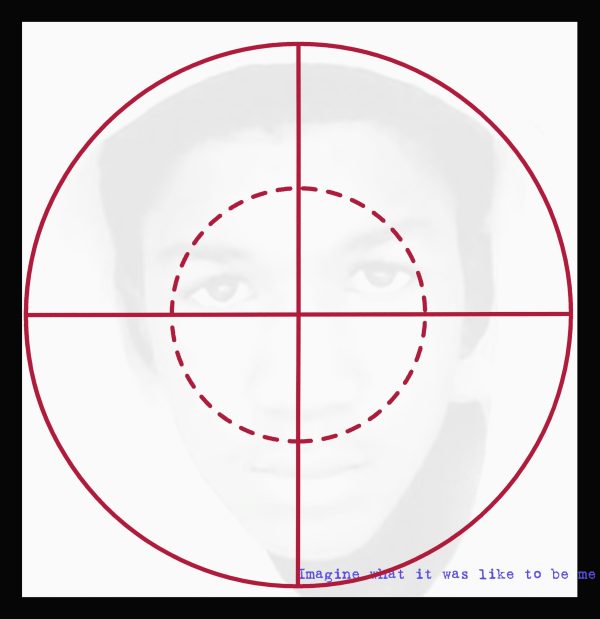
Regardless of whether or not one received the physical work, one would have received the image. In it, Martin looks at us, watchful and wide-eyed and endlessly 17. A reproduction of a photograph that circulated widely in the aftermath of Martin’s shooting death in 2012, here, his hoodie is burned off a page printed with a thick black border, the brightness and contrast set to an extreme combination of fade and blur. All we really see is the faint suggestion of Martin’s face under a red circle target and, in the bottom right, bright blue type: “Imagine what it was like to be me.”
The “me” in this case must be Martin, we think; Piper allows for such a conclusion. She also allows for others. The “me” sinks into the black border, the only word to do so, while the first part of the line—“Imagine what it was like to be”—rises up. Is this what Martin’s image thinks being is or was or could have been: this endlessly copied dream? Does he still think of being free? Do we?
“For some,” writes Larissa Pham, “it’s all too easy to imagine what it would have been like to be [Martin]; for others, it’s a forced self-examination, a posthumous exercise in empathy.”[8] Posthumous—that odd rehearsal. As though an exercise in empathy’s slipperiness could only ever be meaningful in a second scene of violence, as Saidiya Hartman has speculated—as though empathy’s rehearsal of moving thought into emotion can be found not in the first act of violence but in its endless recurrences, because “the act of ‘witnessing’ [is] a kind of looking no less entangled with the wielding of power and the extraction of enjoyment.”[9]
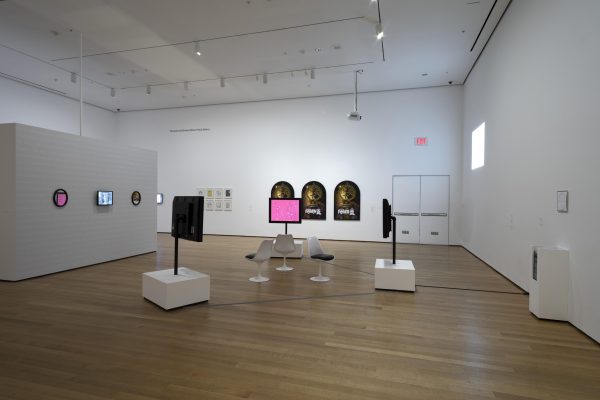
At MoMA, Imagine [Trayvon Martin] was stationed between two sets of artworks comprising a portion of Piper’s ongoing Everything series and behind a trio of chairs and video monitors showing the Pac-Man Trilogy (2005–8). The former, in fact, enveloped the room—its repeated phrase, “Everything will be taken away,” everywhere insisting, in the very reading of the text, that we have already imagined the taking, the everything, and the away into which we don’t follow.
It is easy to pass this taking by, to deceive ourselves that we are the ones who take. If this isn’t clear enough, the video monitors placed before the stack of free papers return us to Piper’s deliberations of Kantian philosophy, in which attentive, undistracted reason becomes the faculty by which Enlightenment is achieved. In a recent essay for Artforum, Piper warns us that “in both thought and action, we sacrifice our freedom to see and think clearly and to act consciously when we allow our interests and desires to cramp, distort, or suppress our impartial awareness of self, action, and world.”[10] The Pac-Man Trilogy offers three ways to reckon with this sacrificial distraction, variously exploring the deceptive nature of the pack mentality in endlessly recruiting new members; how consciousness is not only linked to sentient life but recurs in form and energy; and the difficulty of overcoming the desire to fulfill desire, even when the source is withdrawn.[11] To witness these experimental modes in the same frame that we witness, see, and take Imagine [Trayvon Martin] heralds something like a critical return of what the witnessing, the seeing, the taking, and the imagining means. Here we are, back again, and for why?
Says Piper: “Easy Listening Art occupies its own modest niche in one’s consciousness and does not divert one’s attention from more pressing or immediate pursuits. It does not make trouble; instead it makes nice.”[12]
Perhaps Imagine [Trayvon Martin] says, in return: There is nothing nice about the way you imagine being me.
and wherever I looked that summer
I learned to be at home with children’s blood
One final tending, one final end:
Jason Lazarus began his photography series 2004–present for a deceptively simple reason: “I [wanted to] create discrete conceptual gestures that, as an amalgam over time, propose expanded photography’s capability to bear witness.”[13] There is no suffering of fools in such a statement; Lazarus doesn’t bother to salvage the photograph or its presentation as an art object. His emphasis remains with the expanded, with expanding photography, and expanding what we think of when we think of expanding photography’s capability. The challenge should reel us, as the works in the series do, but quietly. We see a shot of a leafy treetop against an overcast sky (The top of the tree gazed upon by Anne Frank while in hiding [Amsterdam], 2008); a pink paisley wallpapered ceiling (Above Sigmund Freud’s couch, 2008); a woman clutching a jacket around herself while standing on a windy street at dusk (Claire awaiting 15 minute HIV test result [Chicago], 2010). They are large photographs, sequenced neither according to the time of the photograph’s making nor the time of the subject’s image, nor by the size or date of printing. They are, as Lazarus titles it, a collection of the present, presenting.
Standing at the Grave of Emmett Till, day of exhumation, June 1st, 2005 (Alsip, IL) (2005) is the first work made in the series. Emmett Till was 14 when he was lynched for looking/speaking/being wrong in Mississippi in 1955. The story of his murder, the all-white jury acquittal of his murderers, and the decision of his mother, Mamie Till-Mobley, to hold an open-casket funeral ensured Till’s infamous place in a thoroughly American story of anti-black racism. Even now, we still talk of Till, of what happened to him, of what we did. “We can’t seem to lay Till’s body to rest,” says Shawn Michelle Smith, who writes that Lazarus, a white photographer, attempts to work out this very problem in his photograph.[14] Taken at the exhumation of Till’s body in 2005—part of an effort by the US Department of Justice to put an end to the racist rumors that Till wasn’t Till—the image shows the ground at disproportional odds to a bright blue sky. This sunny horizon lures and baits us, stills us, distracts us, as we witness through the photograph what Lazarus saw that day: a grave being emptied.
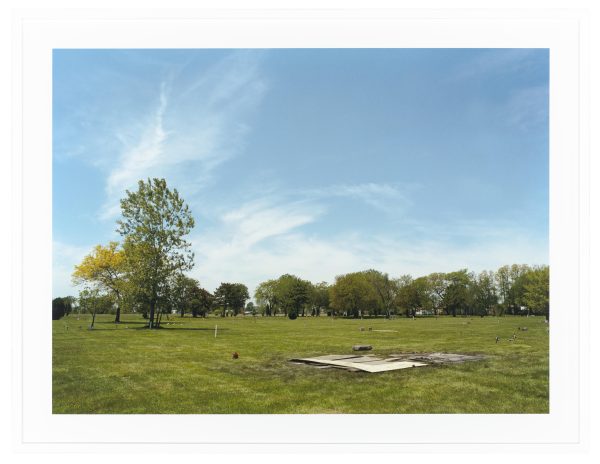
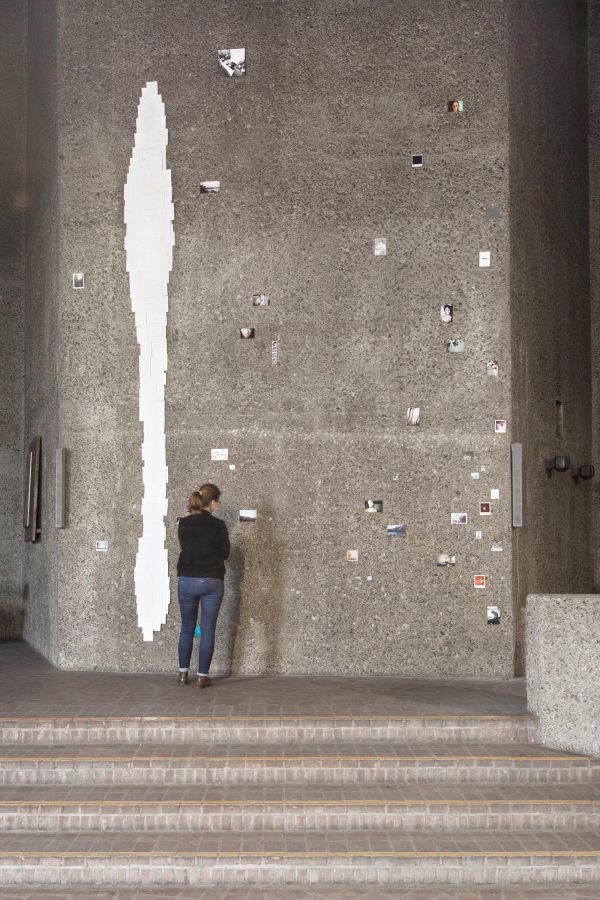
To not look at the grave is entirely possible. The ratio of sky to grass to tree to grave almost appears to encourage this. There is so much else to see if we want to look away instead. This desirous looking elsewhere, in fact, is a guiding premise for Lazarus. A later series, titled Too Hard To Keep (2010–present), often abbreviated by the artist as T.H.T.K., began from an invitation to anyone anywhere to send Lazarus photographs that you couldn’t look at anymore; he would tend to them for you. Of the collection, Lazarus explains: “I feel like there are kindred spirits and orphaned or shadow images that don’t know where to live.”[15] Installed several times since the open archive began in 2010, Lazarus follows faithfully the wishes of his donors. Some photographs are pasted to walls in groups, others isolated, many stacked, and several pasted in reverse, presenting their backs to us all. In truth, T.H.T.K. doesn’t really care what you see.
Does Standing at the Grave care? (Is it strange to assign the labor of care to the photograph?) The title—which places the image in a context of meaning only as this title can—suggests that Lazarus cared enough to stand there and to preserve his standing there, if we can think of the bodily presence of attending and attendance, of witnessing, as a form of care and a stand to attention. If he calls himself into the making of the photograph by this title, there is no expectation that we do the same. There is only the sky, and the ground, and the grave—this endless attendance we continue to make to Till. “Lazarus’s latter-day photograph asks us to see this long history of image making and of repetition and return,” writes Smith. Everywhere we look, when the looking is about the endless exceptionality of disposable black life, it is a looking that recalls Till even now, some 64 years later, “his body, his ghost, his photographs.”[16]
Says Lazarus: “Part of the point of the image is the inability to in any way visualize the initial terror and the ensuing historical arc that still continues — it is un-photographable.”[17] What a privilege it is to be unphotographable, to endure what is unphotographable. What a privilege it is to end a knowing. To look at this and think: I don’t want to see this anymore.
I wade through summer ghosts
betrayed by vision
To speak of endlessness is to speak of an evacuated time (or time, evacuated). That without end, to be rehearsed and returned, to and with and towards, defeats the logic of the end, refuses the arrival that promises to come, to pass. Instead, endlessness is a continued passing and continuously passing us by, a time for thinking the event of time.
Of the strategies, devices, and refusals that black women made (and make) to keep going on, Saidiya Hartman writes in Wayward Lives, Beautiful Experiments of the “revolution in a minor key”: the insistence, open and unnoticed, to imagine “other ways to live and never [fail] to consider how the world might be otherwise.”[18]
To live, to survive, in a world not yet over, because the world isn’t ending. It’s not even close.
Notes
* This and subsequent headings excerpted from Audre Lorde, “Afterimages,” 1981, in The Collected Poems of Audre Lorde (New York: W. W. Norton, 1997).
1. This exhibition takes its title from James Baldwin, “The Creative Process,” in Creative Process (New York: Ridge Press, 1962). Here, Baldwin diagnoses the role of the artist as not merely knowing, but revealing, that “there is nothing stable under heaven.”
2. Robert Storr, “Interview with Felix Gonzalez-Torres,” ArtPress (January 1995): 24–32.
3. Greg Allen notes that not all the stacks works were made—or at least are made now—to be replenished. There are 43 stack works and 3 are not replenishable. Greg Allen, “Art Sold Separately: Why Are People Buying Free Felix Gonzalez-Torres Posters?” Greg.org, May 26, 2018.
4. Adair Rounthwaite, “Split Witness: Metaphorical Extensions of Life in the Art of Felix Gonzalez-Torres,” Representations 109, no. 1 (Winter 2010): 37.
5. Tim Rollins, “Felix Gonzalez-Torres: Interview,” in Felix Gonzalez-Torres (New York: A.R.T. Press, 1993), reproduced in Temporary Services, “Guide to Re-Creating ‘Untitled’ (Perfect Lovers) by Felix Gonzalez-Torres,” 2000.
6. Mónica Amor, “Félix González‐Torres: Towards a Postmodern Sublimity” Third Text 9, no. 30 (1995): 69.
7. Rollins, “Felix Gonzalez-Torres: Interview,” reproduced online at Artpace San Antonio, Artpace.org.
8. Larissa Pham, “This MoMA Show Asks You to Confront Racism—Both in Strangers and Yourself,” Garage, April 3, 2018.
9. Saidiya Hartman, Scenes of Subjection: Terror, Slavery, and Self-Making in Nineteenth-Century America (New York and Oxford: Oxford University Press, 1997), 22.
10. Adrian Piper, “Reality Check: Where is Enlightenment? Adrian Piper Responds,” Artforum 56, no. 10 (Summer 2018).
11. “Current Conceptualisms,” Conceptual Paradise, Kunstraum.leuphana.de, 2010.
12. Adrian Piper, “Goodbye to Easy Listening,” 1990, in Adrian Piper, Out of Order, Out of Sight, vol. 2, Selected Writings in Art Criticism, 1967–1992 (Cambridge, MA: MIT Press, 1996), 176.
13. Jason Lazarus, “2004–present,” jasonlazarus.com/projects/2004-present/.
14. Shawn Michelle Smith, “The Afterimages of Emmett Till,” American Art 29, no. 1 (Spring 2015): 22.
15. Exposure Magazine, “Eavesdropping on the Conceptualists: Jason Lazarus & Mishka Henner in Conversation,” Medium, September 29, 2017.
16. Smith, “The Afterimages of Emmett Till,” 26.
17. High Museum of Art, “Is the Next Dr. King Making History Right Now on Your Instagram Feed?,” Medium, February 1, 2018.
18. Saidiya Hartman, Wayward Lives, Beautiful Experiments: Intimate Histories of Social Upheaval (New York: W. W. Norton, 2019), xv.