Editorial
Titus Kaphar's Ascension and Colin Kaepernick's Kneel
by Xiao Situ
This essay is part of the website built on the occasion of the exhibition Fragments of a Crucifixion at the Museum of Contemporary Art Chicago, May 25–November 3, 2019.
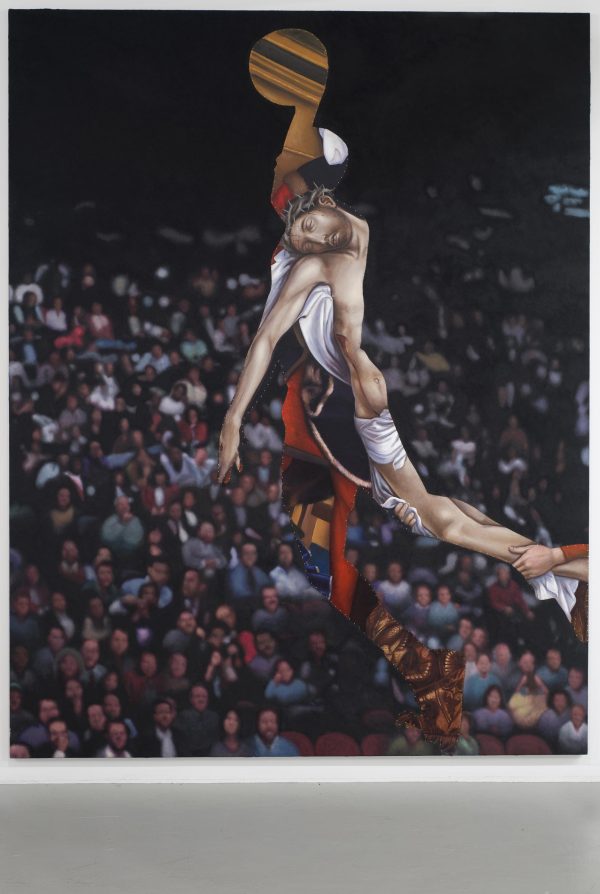
Ascension (2016) by Titus Kaphar (b. 1976) is a larger-than-life-size painting that articulates a basketball player’s leap into the air before a crowd of spectators. At the same time—and perhaps jarringly—it also depicts a crucifixion and a lynching. It can take a few minutes to survey in this single work these three distinct scenarios: the outlines of the basketball player’s body mid-dunk, the suffering of Christ on the cross, and the emergent form of a person being lynched.
I am compelled to reflect on Kaphar’s Ascension because it sheds light on a phenomenon that has profoundly affected the way I think about kneeling. Colin Kaepernick (b. 1987), the former quarterback for the National Football League’s San Francisco 49ers, began kneeling instead of standing during the national anthem in the fall of 2016. He cited systemic racism and police brutality against minorities as the catalyst for this act of protest. As he continued to kneel at games, and as other collegiate and professional athletes joined him, a national debate ignited over race, sports, and politics.
Kaepernick’s kneel was, to me, a deeply spiritual move. When I saw images of him kneeling, I instinctively thought about prayer, mourning, respect, and vulnerability. I was reminded of Jesus washing his disciples’ feet as recounted in the Gospel of John, and of the many times the Psalmist sings of bowing down before God. As someone with a chronic illness that makes mobility slow and challenging, I am by necessity very economical and deliberate with my own gestures, and I frequently reflect on the symbolic meanings of even the most mundane movements. Kaepernick’s kneeling therefore captured my attention. As an art historian, as the sufferer of a chronic illness, and as a person with spiritual and religious inclinations, I discuss here how Kaphar’s Ascension situates Kaepernick’s kneel in a broader spiritual, cultural, and historical context.
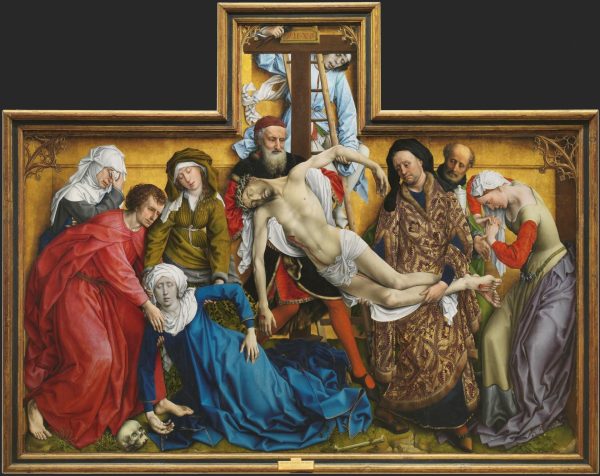
Kaphar’s Ascension is an explicitly religious painting. The title not only describes the upward trajectory of the basketball player’s body as he rises through the air, but also references, by way of opposing correspondence, the downward movement of Christ’s body lifted off the cross after his crucifixion. In fact, the image of Christ that appears in the interior of the basketball player’s silhouette is a painted quotation of Rogier van der Weyden’s 1435 Descent from the Cross, one of the most famous depictions of the crucified Christ in Western art. Kaphar thus brings together two bodies and two opposing forces in one human figure. Jesus’s pale right arm and right leg slip into the contours of the basketball player’s left arm and left leg; Jesus’s downward-tilting head rests beneath the basketball player’s upward-looking profile. The artist yokes the two bodies together through pictorial, material, and performative means: by employing brass nails to anchor van der Weyden’s Christ to the athlete’s form, Kaphar at once recalls and evokes the act of Jesus’s crucifixion and the nails used to pin him to the cross.
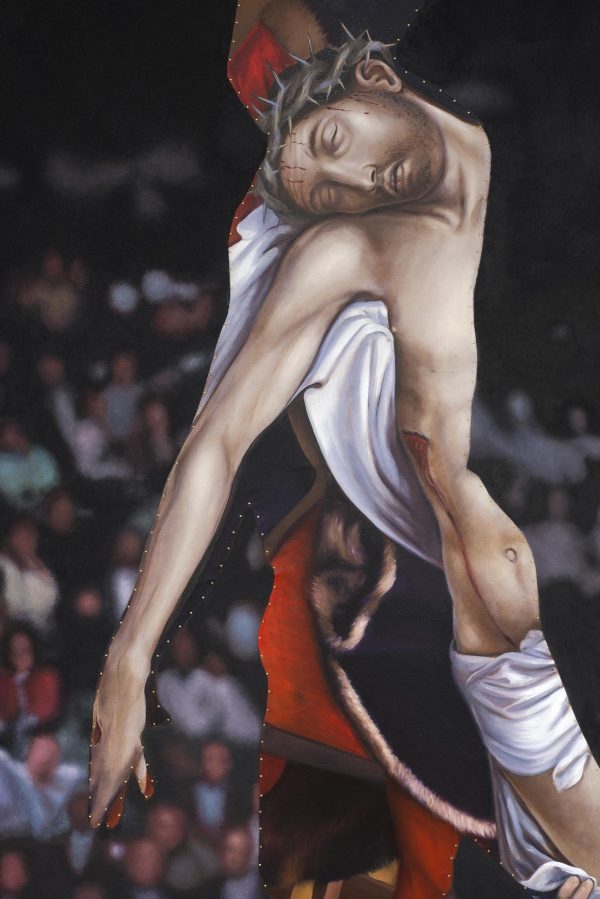
The silhouette comprises not only Christ and the basketball player, however, but also a third human form—that of a person being lynched. Christ’s crown of thorns encircles the basketball player’s neck as though a spiky noose. Red fabric from van der Weyden’s painting becomes a thick trail of downward-flowing blood. The athlete’s lifted right arm doubles as the taut vertical of a hangman’s knot. Simultaneously pulled up into the air and weighed down by his own body, the lynching victim suffers the forces of both ascension and descent.
There are haunting similarities between Christ’s crucifixion and the lynching of black people in the United States. In his 2011 book The Cross and the Lynching Tree, theologian James H. Cone reflects:
The cross and the lynching tree are separated by nearly 2,000 years. One is the universal symbol of Christian faith; the other is the quintessential symbol of black oppression in America. Though both are symbols of death, one represents a message of hope and salvation, while the other signifies the negation of that message by white supremacy. Despite the obvious similarities between Jesus’ death on a cross and the death of thousands of black men and women strung up to die on a lamppost or tree, relatively few people, apart from black poets, novelists, and other reality-seeing artists, have explored the symbolic connections.[1]
Kaphar is active as one of Cone’s reality-seeing artists. Ascension‘s merging of three figures in one invites echoes of the doctrine of the Trinity, calibrating the experience and value of each figure to a point of equality and mutual empathy with the other two. The basketball player, the crucified Christ, and the lynching victim share in each other’s suffering and victory. By featuring van der Weyden’s Christ in particular—which is a very white, Eurocentric-looking Jesus—Kaphar’s painting challenges the ubiquity of this portrayal of Jesus in Western art and confronts assumptions about both where and with whom Jesus’s identification and compassion lies. Kaphar has touched upon the presumed whiteness of Jesus in previous paintings, most notably in Holy Absence I (2012) and Holy Absence II (2014). The appearance of Christ in Ascension, however, frames the athlete’s and the lynching victim’s experience in a particularized black Christological narrative.
In religious studies, Christology is the branch of theology that examines the person and nature of Christ as he is depicted in the canonical Gospels. Black Christology, in particular, probes how Jesus’s life, suffering, and resurrection speak to the specific historical contexts, lived experiences, and ontological concerns of black persons and their communities. Following this line of theological analysis, Christ’s blackness is defined by his identification with and concern for black persons’ bodies, minds, and souls—not only with regard to historical and ongoing suffering and oppression, but also in terms of traditions and expressions of joy, resilience, and aspiration toward existential and spiritual liberation. The Jesus of black Christology is a Jesus born into a poor, marginalized, and oppressed minority group under the rule of the Roman Empire. Jesus’s care and ministry among the most vulnerable and neglected individuals in society earned him scorn, rebuke, and ultimately public execution from state authorities. The movement he instigated emerged out of a spirit of protest, calling for unconditional love and redemptive justice for the poorest and most powerless peoples in first-century Palestine.[2]
While the connection between crucifixion and lynching may therefore seem apparent in Kaphar’s painting, the basketball player’s relationship to these two figures may seem somewhat more oblique. First, I need to address my own assumption of the basketball player’s blackness. By presupposing the racial identity of Kaphar’s athlete, I am admittedly participating in racial profiling. The basketball player’s very form invites the potential for precisely this mechanism of generalization in that it is literally a profile—a silhouette comprised of outlines and contours. Nothing in the silhouette’s interior explicitly indicates the figure’s racial or ethnic identity, and yet my association between this particular physical stance and black athleticism in basketball has been powerfully shaped by popular visual discourse and the cultural perpetuation of stereotypes. More specifically, the shape of the basketball player’s body is strikingly reminiscent of the image of the Jumpman, Nike’s logo for the Air Jordan brand of sneakers and sportswear inspired by basketball legend Michael Jordan (b. 1963). For me, the correspondence between the iconic Jumpman logo and Jordan’s legacy as a paradigm of black athletic virtuosity is so ingrained that it invariably operates in Kaphar’s painting.
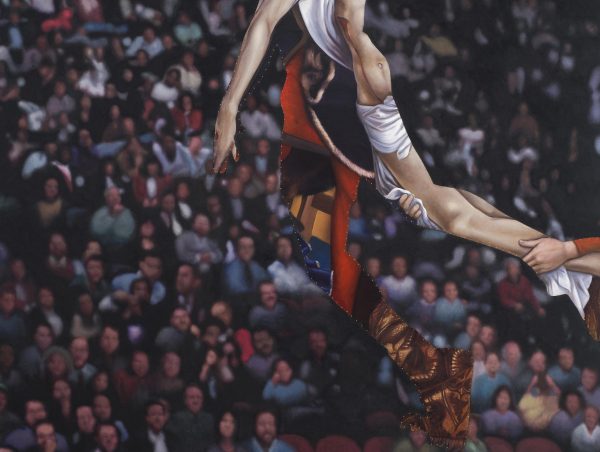
So what, then, is the relationship among this athlete and Christ and the lynching figure? In van der Weyden’s original painting, a man dressed in black and gold gently holds Jesus’s legs aloft as this man and others carry him down. In Kaphar’s canvas, however, these same two hands have the appearance of grabbing onto the athlete’s legs and dragging his body down. Considered through the context of history, this gesture might point toward the legacy of slavery and the forms of systemic racial oppression that emerged after Emancipation, when arbiters of white culture continued to exploit the emancipated black population as sources of labor, entertainment, and economic revenue by maintaining positions of power and influence in the institutions that oversaw and leveraged the productivity and performance of black bodies.
In his landmark 1969 book The Revolt of the Black Athlete, sociologist, former athlete, and civil rights activist Harry Edwards asserted that systemic racism has been built into the very heart of American collegiate and professional sports. The emergence of black athletics after Emancipation was an extension of black exploitation and commodification—especially that of bodily labor over intellectual pursuit. “From the perspective of many white coaches and athletic directors,” Edwards observed, “the world does not need black doctors, sociologists, chemists, dentists, mathematicians, computer operators, or biologists.”[3] White cultural prioritization of the black body over the black mind—and indeed, over black wholeness in general—extends to the athlete’s voicing of care and concern about the rights and wellness of black communities: “Whites may grudgingly admit a black man’s prowess as an athlete, but will not acknowledge his equality as a human being.”[4]
Edwards published The Revolt of the Black Athlete one year after sprinters Tommie Smith and John Carlos raised the Black Power salute during the US national anthem at the Olympics awards ceremony in Mexico City. Smith and Carlos raised their arms to protest the racism and injustice that they witnessed and experienced as black citizens in the United States. For their display of activism, Smith and Carlos received significant ostracism and career retribution from the US sports establishment in the years that followed. Like Jack Johnson, Paul Robeson, Jackie Robinson, Muhammad Ali, and many other black athletes who were politically outspoken, Smith and Carlos paid a steep price for publicly voicing their discontents.[5]
Kaphar’s Ascension seems to suggest that despite the fame, adulation, and financial reward black athletes may enjoy, institutional white hands still maintain a grip on their ankles. The silhouette of the basketball player contains within its interior the shadows of lynching and the suffering of Christ, and the athlete’s ascension is thus a compromised transcendence: any adoration and payment he receives might come at the price of certain other sacrifices that stem ontological wholeness and full humanity. (This athlete is, after all, shown in part and not in whole, appearing as a silhouette in profile rather than a fully depicted figure with specific, particularized, or individualized features.) In contemporary sports writing, the term “greenwashing” describes the suppression or silencing of an athlete’s black identity while idolizing their talent and profitability. While “greenwashing” is a term employed in the sectors of economics and environmentalism to describe the marketing of environmentally sustainable products and practices, in the context of racial politics in sports the word refers to the racial or cultural erasure that can occur when a sports authority or sponsoring company discourages a black athlete’s expression of black identity.[6] Although a predominantly white sports establishment and media might praise a black athlete for his physical performance, sports or team authorities might try to regulate or downplay his expressions of allegiance to or identification with black culture, heritage, or politics. In this light, the basketball player’s silhouette in Ascension differs from the Air Jordan Jumpman logo in one detail affecting full freedom of movement: while the Jumpman’s legs are splayed wide open to form an exuberant upside-down V, the two white hands grasping the left leg of Kaphar’s athlete seem to force his knees to bend uncomfortably.
When Colin Kaepernick began bending his left leg in order to kneel during the national anthem, his gesture seemed to bear a Christological dynamics of ascension and descent—a Gospel physics of crucifixion and resurrection. “I am not going to stand up to show pride in a flag for a country that oppresses black people and people of color,” Kaepernick said: “To me, this is bigger than football and it would be selfish on my part to look the other way. There are bodies in the street and people getting paid leave and getting away with murder.”[7] Kaepernick was referring to the many black lives that were cut short by fatal police shootings in recent years: Trayvon Martin, Tamir Rice, Jordan Davis, Rekia Boyd, Michael Brown, and too many others. As author and NBA veteran Etan Thomas discusses in his interviews with NFL and NBA professionals, many athletes were deeply and personally affected whenever another police shooting had taken a black life or another police officer was acquitted after firing shots.[8] For some, these events reminded them of their own youthful experiences of being profiled or violently handled by members of law enforcement. For others, these fatalities provoked concerns for their own children who might be vulnerable to such treatment. For many of those whom Thomas interviewed, such incidents of police brutality forced them to reckon with the centuries of insidious anti-black sentiment that has shaped American institutional systems to criminalize black bodies. Although some of them wanted to address these racist systems through the platform of their high visibility as professional athletes, they were also concerned about possible career retributions should they voice their concerns or take actions of protest.
While many fans and observers who supported Kaepernick began kneeling, there were others who exerted a strong backlash. “Shut up and play!” became as fervent a mantra as “I’m with Kap.”[9] Regardless of the divided opinions among the American public, Kaepernick ultimately paid a heavy professional price for his continued activism. In the seasons following the end of his term with the San Francisco 49ers, not a single NFL team hired him despite his status as one of the best quarterbacks in the league. Whether or not NFL owners intentionally coordinated this effort, it was clear that the league had effectively shut Kaepernick out of professional football.
For protesting against systemic racial injustice, Kaepernick risked his career as a professional athlete. While he filed a grievance asserting that the NFL owners had colluded to shut him out of the league due to his protests, Kaepernick also leaned more deeply and purposefully into his work as an activist. He began wearing shirts that listed the names of victims of fatal police brutality. This act of visual and performative aesthetics of resurrection uses his living body to memorialize the once-living bodies of the victims. People who see the victims’ names on the shirts may then say their names, learn about how they lived and died, and bring into communal consciousness their memories. This activism of remembrance and memorialization enacts what some Christian liturgists might call “anamnesis.” Anamnesis is the Greek word for remembrance or memorial. In liturgy, anamnesis usually describes what happens during the Eucharist or communion, when bread and wine are blessed and administered as an act of remembering Jesus’s last words and actions at the Passover feast now commonly known as the Last Supper: “Here, eat, this is my body; here, drink, this is my blood. Do this in remembrance of me.” Anamnesis occurs when the eating and drinking are done and remembrance is made. Theologian M. Shawn Copeland expands this characterization of anamnesis in her 2010 book Enfleshing Freedom: Body, Race, and Being, describing anamnesis as the intentional remembering of the dead. It obliges those who inherit the stories of the victims to do what they can to end oppression in the present. It forges solidarity among people and affirms the interconnectedness between humanity and Christ.[10]
Kaepernick has made his works of activism intensely communal, focusing on solidarity and remembrance. He founded, organizes, and participates in the Know Your Rights Camp for young people: a teaching program adapted from a series of seminars designed by the Black Panther Party for Self-Defense in the 1960s. Although Kaepernick is known for being disarmingly quiet and soft-spoken, he regularly addresses his concerns about social justice issues in ways that draw exponential attention and action.[11] Kaepernick is, in effect, reshaping his public identity and personal purpose from athlete to activist, offering a transformed icon for his followers.
Kaepernick’s openness to embracing this new role as an activist is critical. His post-NFL identity is one of the most Christological aspects of his story, and many aspects about his biography bear well under the pressures of a Christological narrative. Tattooed on his arms are Psalm 18:39 (“You armed me with strength for battle; you made my adversaries bow at my feet”) and Psalm 27:3 (“Though an army besiege me, my heart will not fear though war break out against me, even then I will be confident”).[12] In an interview recorded for the Daily Sparks Tribune in 2013, Kaepernick credited his faith for helping him through challenges he faced throughout his football career:
I’d ask God what his plans are for me. What is God trying to do with me right now? For me, there were times where I’d wonder if I was in the right place and in the right situation, and you have to fall back on God in situations like that and trust him and know that his plan is perfect for you. . . . I think God guides me through every day and helps me take the right steps.[13]
This quote suggests that, for Kaepernick, his kneel may have felt like a matter of not only being in the right place and situation, but also intuiting that he was the right one to do it. In American football, “taking a knee” describes a technical strategy. During the last few seconds of a game, the winning team’s quarterback can kneel while cradling the ball until the play clock runs out. This move effectively halts further action that would unnecessarily disadvantage the winning team. While other players can also kneel at various moments throughout a game, “taking a knee” is so closely associated with the quarterback that the move has come to be known as the “quarterback kneel.”[14] Considering his position as quarterback, it seems appropriate—perhaps even fateful—that Kaepernick adopted kneeling as his form of protest. His kneeling was an extension, or rather, transformation, of a key move in his repertoire as a quarterback.[15]
Just as Kaphar’s art often collapses different periods in time to show more visibly the full nature of particular events and circumstances, Kaepernick’s story offers a chance to see what Christ’s activity might look like in the present day, as well as the places where Christ might reside and the people for whom Christ might work. In Cone’s landmark 1975 book on black Christology, the theologian points out the importance of holding together Jesus’s wasness and isness: “Truth is more than the retelling of the biblical story. Truth is the divine happening that invades our contemporary situation, revealing the meaning of the past for the present.”[16] Cone furthermore describes Jesus as one “whom me meet in our social existence,” and that for Christians, “our interest in Jesus’ past cannot be separated from one’s encounter with his presence in our contemporary existence.”[17] Theologian Kelly Brown Douglas adds an even more topical meaning to black Christology, singling out contemporary activism as perhaps the most inclusive and enduring embodiment of Christ’s activity today: “Christ can be incarnate wherever there is a movement to sustain and liberate oppressed people.”[18] This does not necessarily mean that Kaepernick is a new Jesus or like Jesus, but rather that the movement he initiated by kneeling carries the flicker and flow of the spirit—and that flow is where Jesus and God reside. Jesus abides in and rides on the dynamism of the downward and upward movement that occurs when people kneel; it takes many people moving together to body forth the spirit of God.
Along the lines of black Christological thought, recent events have unfolded such that the circumstances and activities of Kaepernick’s isness are suffused with Christ’s wasness. Kaepernick’s movement of generating care and concern for black lives honors Christ’s incarnation in each body and soul. For an artist like Kaphar who is fluent at juxtaposing time periods, suturing together wasness and isness, and engaging the past by scrutinizing the present in his art, the Christological nature of black athletes’ stories is something to be surfaced in works like Ascension. The realm of sports is not so secular or contemporary that history’s shadows and religious narratives cannot penetrate it. By compressing Michael Jordan’s Jumpman and a lynching victim with van der Weyden’s Christ—and beyond that, by bodying forth this Trinitarian portrait in the age of Kaepernick—Kaphar reveals why and how a simple act such as bending one’s knee might, in Kaepernick’s words, be “bigger than football.” Bending one’s knee is about insisting on the uncompromising worth of black lives—not as sources of labor, economic gain, or cultural consumption, but as fully human and fully divine incarnations of God’s ceaseless love and creativity.
Notes
1. James H. Cone, The Cross and the Lynching Tree (Maryknoll, New York: Orbis, 2011), xiii.
2. For introductions to black Christology, see James H. Cone, Black Theology and Black Power (Maryknoll, New York: Orbis, 1997); James H. Cone, The Cross and the Lynching Tree (Maryknoll, New York: Orbis, 2011); Kelly Brown Douglas, The Black Christ (Maryknoll, New York: Orbis, 1994); and Kelly Brown Douglas, Stand Your Ground: Black Bodies and the Justice of God (Maryknoll, New York: Orbis, 2015).
3. Harry Edwards, The Revolt of the Black Athlete, rev. ed. (1969; repr., Champaign, IL: University of Illinois Press, 2017), 17.
4. Edwards, Revolt, 6. For discussions about white cultural prioritization of the black body over the black mind in the history sports and education reform, see Howard Bryant, The Heritage: Black Athletes, a Divided America, and the Politics of Patriotism (Boston: Beacon Press, 2018), 25–31, 40–42, 70, 79, 133–34, 166, 192–99, and 228.
5. For moments of black athlete activism and costs or punishments thereof, see Bryant, Heritage, xiii–xv, 3–6, 14–18, 4–53, 115, 216, and 221–29.
6. For the greenwashing of sports heroes, see Bryant, Heritage, 82–85, 90, 94–97, and 220–21.
7. Colin Kaepernick, quoted in Steve Wyche, “Colin Kaepernick Explains Why He Sat During National Anthem,” NFL Media, August 27, 2016; Christine Hauser, “Why Colin Kaepernick Didn’t Stand for the National Anthem,” New York Times, August 27, 2018.
8. See interviews in Etan Thomas, We Matter: Athletes and Activism, Edge of Sports (New York: Akashic Books, 2018).
9. For the “shut up and play” response to Kaepernick’s kneel and other athlete protests, see Bryant, Heritage, 3–9, 10–13, 42–43, 173–76, 185, and 188.
10. M. Shawn Copeland, Enfleshing Freedom: Body, Race, and Being (Minneapolis: Fortress Press, 2010), 100.
11. Bryant, Heritage, 15 and 19.
12. For Kaepernick’s spiritual and ethical awakening, see Angela Denker, “Colin Kaepernick and the Powerful, Religious Act of Kneeling,” Washington Post, September 24, 2017; and John Branch, “The Awakening of Colin Kaepernick,” New York Times, September 7, 2017.
13. Damian Tromerhauser, “Faith Based: Former Nevada Standout Speaks at Local Church about Life, Athletics,” Daily Sparks Tribune, January 16, 2013.
14. The “quarterback kneel” is described in the Official Playing Rules and Casebook of the National Football League, Rule 7, Section 2, Article 1 (c): “An official shall declare the ball dead and the down ended . . . when a quarterback immediately drops to his knee (or simulates dropping to his knee) behind the line of scrimmage.”
15. Army veteran Nate Boyer played an important role in Kaepernick’s decision to kneel. See Billy Witz, “This Time, Colin Kaepernick Takes a Stand by Kneeling,” New York Times, September 1, 2016.
16. James H. Cone, God of the Oppressed, rev. ed. (1975; Maryknoll, New York: Orbis, 1997), 99.
17. Ibid., 102 and 111.
18. Kelly Brown Douglas [Kelly Delanie Brown], “God Is as Christ Does: Toward a Womanist Theology,” The Journal of Religious Thought (1989): 16.