Editorial
I Wish to Reveal: A Conversation with Joyce J. Scott
by Phoebe Wolfskill
This essay is part of the website built on the occasion of the exhibition Fragments of a Crucifixion at the Museum of Contemporary Art Chicago, May 25–November 3, 2019.
Sculptor and MacArthur Fellow Joyce J. Scott uses the physical properties of her materials—which include beads, glass, fabric, and found objects—to speak to America’s brutal history of race relations. Scott’s embellished and magnified black bodies render physical violence palpable, allowing for visceral and intellectual responses that prompt greater awareness of our collective racial past and present. Her body of work is stunningly beautiful in its materiality yet simultaneously cutting in its sociopolitical critique, bridging the gap between aesthetic innovation and humanitarian activism. In contemplating the inhumanity of the historical treatment of the black body in America—and, indeed, bodies worldwide—her work pushes us to regain our humanity.
Fragments of a Crucifixion focuses on artists who obliquely reference the crucifixion of Jesus in their work as a symbol of racial oppression (among other forms of oppression), and Scott’s work fits squarely into this dialogue. While Scott’s work is not featured in the exhibition at the MCA, attention to her sculptures and wearable art augments the show’s focus on contemporary artists’ use of religious themes to address injustice. I’ve met and enjoyed multiple phone interviews with Scott in preparation for writing my article “‘Comedy, Pathos, Delight, and Horror’: Joyce J. Scott and the Racial Body,” which will be published in the forthcoming arts issue of Callaloo: A Journal of African Diaspora Arts and Letters. My article investigates Scott’s creation of distorted and hyperbolized bodies in works including Rodney King’s Head Was Squashed Like a Watermelon (1991), Cuddly Black Dick #3 (1995), and Still Funny: Mammy/Penis (2011), with a particular attention to how Scott’s figuration and themes challenge both stereotypes of the black body and the propriety of the art object itself. The article foregrounds Scott’s use of satirical humor and caustic wordplay as a means of addressing difficult subjects. The conversation recorded below takes a new direction by focusing on religious and spiritual signifiers in Scott’s work. We discuss the artist’s religious background, her concerns about racial and other forms of violence, her interest in global religious practices, and her approach to “fragments” as a theme and aesthetic trope.
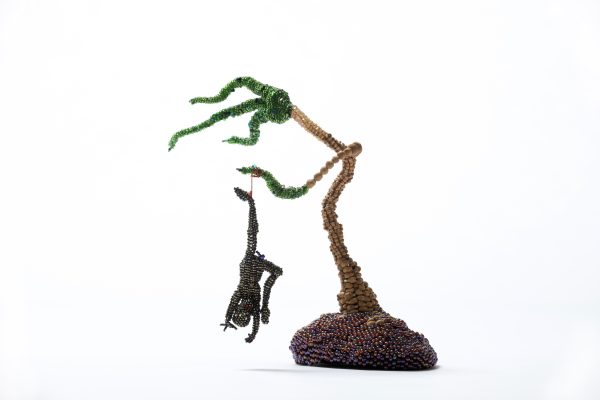
Phoebe Wolfskill: I want to start with a piece from 1987 that you titled Catch a Nigger by His Toe. This piece is rather small but eye-catching and beautiful in its application of different textures and sizes of beads. When you examine the depiction of the tree in this work, you notice that it has claw-like fingers and attached to them a black man hangs upside down, which immediately suggests lynching. He’s upside down hanging by his foot, and the title references the nursery rhyme “Eeny meeny miny moe.” So there’s implied violence against black bodies on multiple levels. What motivated this work? How did it come to you, and how do you imagine your viewer responding to this piece?
Joyce J. Scott: I think it was very clear then and is very clear now how race and racism—how hatred among people of different ethnic groups—has saturated our culture. It’ll take a very, very long time to dispel this, if we ever do. I don’t have any reason to tiptoe around our horrendous behavior toward each other. We don’t really give thought to taking someone’s life. We’re ready to take the physical life or to kill the emotional life. That’s just dastardly.
PW: And is that why you render this not just as a straightforward lynching but link it with the nursery rhyme, which is more psychological?
JJS: Yes. And that phrase is one that both black people and white people say. I grew up with it. So to me it is internally absorbed and repeated. As an artist I’m creating something that I want you to look at: the idea that someone’s spirit can be so greatly disrupted. And remember that in all of these situations, everybody is injured as a result. There’s an old saying about slavery that nobody is ever free. If you sit on somebody’s head, they can’t go anywhere, but neither can you.
PW: Right. So when I was growing up, I always knew “Catch a tiger by the toe.” But when my mom was growing up, which was the 1940s and fifties, she remembers—
JJS: “Catch a nigger by the toe.”
PW: Yes. She admitted this to me with some embarrassment a couple of years ago. She was a white girl growing up in New Orleans, and that’s what she learned.
JJS: That was a while back. But that we may still be doing very similar things is what I’m pissed about. We’ve had time to evolve out of certain behavior. Somebody wanted to be the boss or make other people subservient to them. I guess humans have been doing that for a long time. The idea, though, that we are now at a point when we don’t have to do that and we’re still doing it means it’s something with us—that it’s spiritual, or, you know, a soul problem. That can be another word for it. It’s directly related to Western culture, although it’s not like every culture didn’t have it. We just seem to have systemized it and held on to it in a different way. But we have the ability to change, and we need to change.
PW: I’ve read that you grew up in a Pentecostal church. What did that experience mean to you, and how does it inform your work?
JJS: Best thing ever. My parents were from North and South Carolina. The preacher at our storefront church was my godfather. When I became accepted into the congregation he preached with me in his arms. I did street ministry with them, and that was a great primer to being an actress. It is just surrounded and bathed in a kind of love that takes you outside of yourself. Something that delivers you—you’re delivered into another place. Faith is an interesting thing. You have the crazy stuff for which you do not necessarily have a lot of proof. But you’re still pursuing it. And that is really what church meant to me. It helped develop me as a person who believed in the future and faith. Because you know this is a storefront church led by people who didn’t read and write very well. It was celebratory because it’s the belief that you don’t have to be locked into what you are—that you can change and you’re not alone. Another thing about faith is that you’re not alone.
PW: Are there particular crucifixion scenes in the history of art that have stood out to you or inspired you in some way?
JJS: I went to graduate school in Mexico and traveled around Central America. Actually, I have been blessed to travel the world. The crucifix is about really praising someone who’s dying in front of you. But I recall the ones that are made by artisans in different places, where someone has hand carved a religious object or made it out of straw. I also have a couple of West African crucifixes that I’ve used in my work, and it’s just the way that they so beautifully engaged with the wood. They allow the wood to speak in tone instead of painting it. Let the wood talk to me. That’s a very powerful work for me. And you know I love going into an Italian church! I mean, there are flowers around and then it’s covering up his genitalia, but there’s enough exposed so you could see his muscularity and all that other stuff. And the nails, darling, the nails!
PW: Are there certain biblical stories and images that particularly spoke to you as well? Because when I look at Catch a Nigger by the Toe, the man in the piece is hanging upside down, and what I thought of was The Crucifixion of St. Peter (1600), which was rendered by Caravaggio with Peter attached to a cross and being lifted upside down with his bare feet jutting crudely into the viewer’s space. Was that something you thought about when you made your own work?
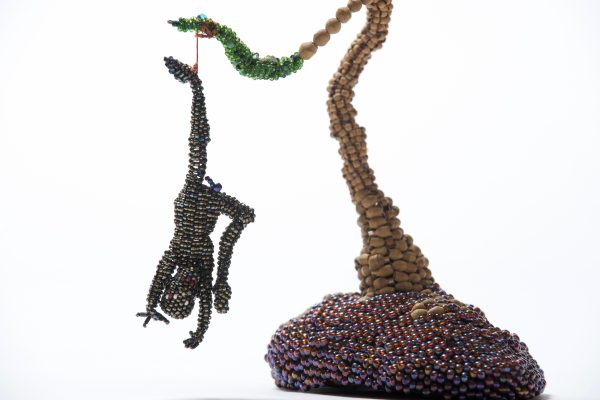
JJS: Not that Caravaggio necessarily. I’m someone who went to a million years of art school. I studied a lot of European art and Asian art. In the old days we didn’t study a lot of African art or Native American art. That was my quest. So a person being hung upside down. That’s an old piece from 1987, and I don’t remember all of the exact details. But one finds that kind of thing throughout history and throughout images all over the world. So for me it is a kind of global approach to what it must be like to be tortured like that.
PW: I see. In your body of work more broadly there are numerous references to violent episodes from the Bible, like the crucifixion or the apocalypse. You reference these biblical themes many times, but through a translation into contemporary life. Do you see spiritual elements or possibilities for redemption—that there’s the reality of violence, but also the possibility of salvation?
JJS: Absolutely. That’s why Buddha plays such a big part in my work. Because he wasn’t a god. He was a human who worked very hard to evolve into this person who was in a state of not only reverence but also a kind of spiritual change that allowed him to be one with everything. And I believe that humans have the ability to evolve and change. I think we’re very, very young. I think of the Earth as a squillion years old. If we’re really young and pugnacious and hardheaded like kids, then we won’t easily evolve and change to become more mature and do things right. You know we’re always looking for voodoo and everything else to make that happen; we are self-medicating with drugs and everything else to find that place. I don’t know if we know how to do it, but you know love is not an easy thing. Love is both the easiest and the hardest thing to attain. And empathy for others is the easiest and the hardest thing to do. So when you see a lot of my work, it’s about just trying to find the route to that.
PW: I’ve seen global religions represented in your work: a focus on Shiva and Buddha, among others. So you’re looking to various cultures and how they take on these kinds of questions?
JJS: Well, it’s because we’re just human. This really is humanity to me. I wouldn’t expect somebody in India to be doing Jesus Christ necessarily. It’s not that Christians aren’t there, but that’s not the basic culture. I would expect them to go on that quest through their own cultural realm. It doesn’t mean, though, that I think less of it. It’s just like, “Oh, that person has six arms, I wonder why.” I’m always very hungry to find out how humans have dealt with these questions. It’s also how I like many religions or thought processes in which there is something that’s happening and something that isn’t. Something that’s up and something that’s down. How many cultures believe in the underworld being under the water, and how they do that? It’s all very interesting to me.
PW: I also sense skepticism in your work. I’m wondering if you think your work is more about questioning one’s beliefs than believing itself?
JJS: I don’t know if I’m skeptical as much as I might be cynical. Sometimes. And I’m incredibly sarcastic and sardonic. I think that we are asses—we’re really messed up in our inability to be wonderful to another human being. So I’m cynical sometimes. But you know love is the easiest and the hardest thing to do. You know it’s easy to say, “Oh, I’m going to give something to a homeless person, but I don’t want them living next to me.” Or, “I believe that everybody should have their rights, but I don’t want any black people in my neighborhood.” It’s some kind of human thing. We don’t seem to be able to work that out very well.
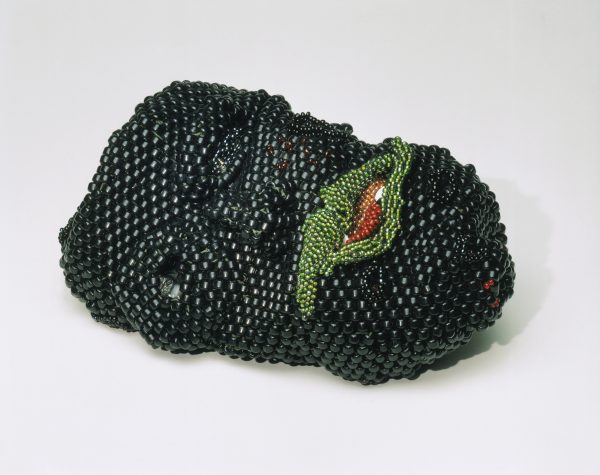
PW: I asked you in an earlier conversation—probably a couple of years back—about another work, Rodney King’s Head Was Squashed Like a Watermelon. The color palette is black, green, red, and white, and I always assumed this choice of colors effectively conflated the head with the watermelon. But you mentioned to me that it was a reference to the four horsemen of the apocalypse. The idea of the apocalypse also appears in the later, related piece Three Graces Oblivious While Los Angeles Burns (1992), which features King’s decapitated head at the top of it. Are there works about the apocalypse within the history of art that have particularly struck you? If you look at the history of Christian art, for example, there’s so much artistic freedom in scenes of hell and the apocalypse, whereas images of the Christ child are often more standardized. There wasn’t the same kind of iconographic freedom. So are there particular apocalyptic images that inspired you?
JJS Fire is very frightening to me. So reading about fire in the Bible is terrifying. And drowning in the Bible is terrifying. That we’ve been having tsunamis and things lately, in our world—it’s pretty amazing to me. We’re frailer than we think we are. And I don’t know if we realize that when we talk about the end of the world, we’re really not talking about the end of the world. We’re talking about the end of us. The world will be just fine without us.
PW Regarding the exhibition’s focus on fragments—so much of your work presents a fragmented body. In both of the Rodney King pieces, for example, the figure of King is decapitated. Why do you think that’s a prominent part of your work? What is it that motivates you to deal with the body as a set of fragments?
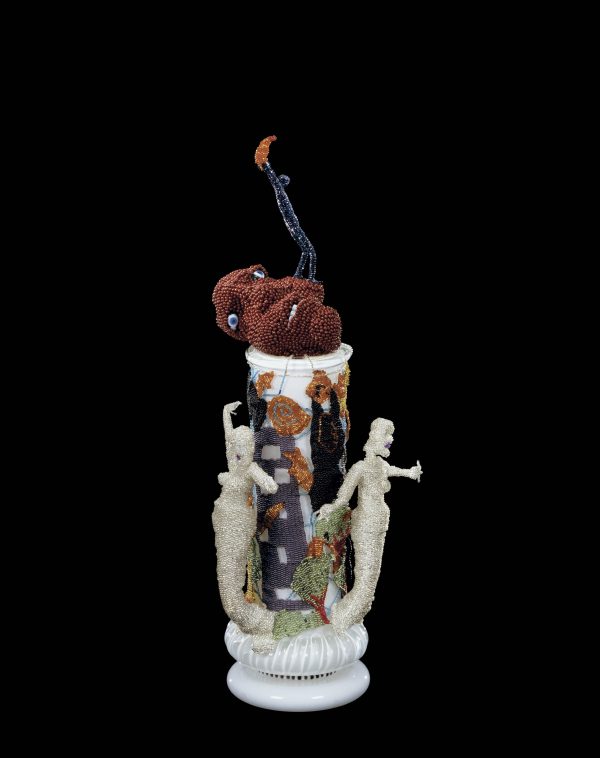
JJS: You know there’s something frightening about a body that’s in parts and not together. And there’s also the importance of the fragment. Maybe the arm is the most important part for that piece, let’s say, so that’s what I’m working on. Although in the last show that I did, we had a lot of full figures. But there’s still a lot of armless things. If I’m working with a gaffer—if we’re doing glass—we’ll get to a head and a torso. For me that opens it up to decide whether I’m going to put arms on, and then how to make the arms and what the arms can do. It is also about the idea that if someone doesn’t have arms, it means they cannot control things.
PW: So I’m thinking of these fragments: the heads, the detached phalluses. I’ve written about that in my other article on your work. There’s also the work that’s at Dartmouth College’s Hood Museum, Mammy Under Undue Influence (2007). The figure’s skin is almost like a garment that’s come undone, and another body is underneath it. They’re very tactile pieces, but disruptive because the skin or the body is torn apart.
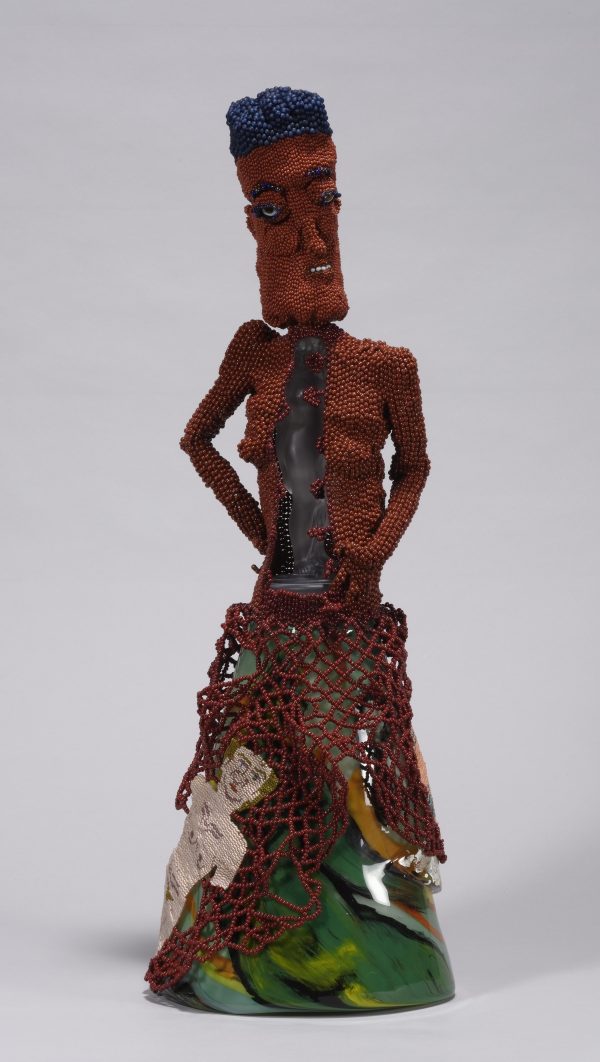
JJS: But see, you’ve just said it: they’re disruptive. They’re meant to be disruptive. They’re meant for you to see this beautifully crafted thing and come up and be shocked. Yes.
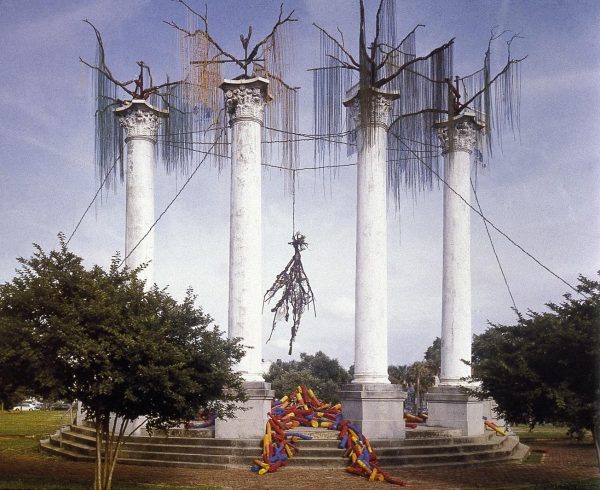
PW: There’s a piece that you made for the 1991 Spoleto Festival in Charleston, South Carolina, titled Believe I’ve Been Sanctified. This was a large-scale, site-specific work in Charleston. I believe some 40 percent of the Africans that entered this country came through the port of Charleston.
JJS: And my mom is from South Carolina.
PW: I’m from Columbia, South Carolina, actually. And you know, Charleston is a place that has yet to reckon with this history. In Believe I’ve Been Sanctified, you used existing columns from an old Charleston museum’s ruins, and then you attached beautiful-looking beads that recall weeping, like weeping willows, and then you’ve got a figure in the center hanging by its neck.
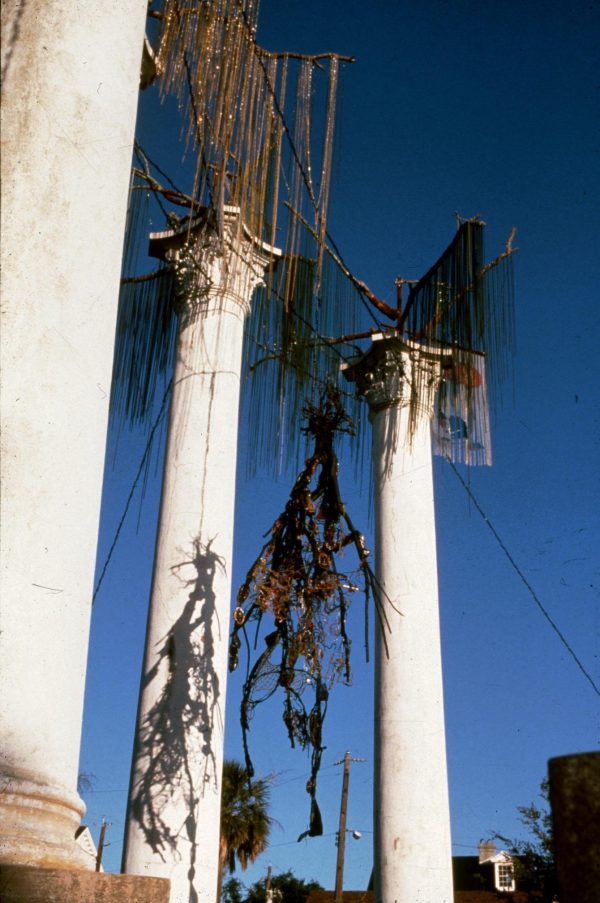
JJS: You know I can tell you about that piece—that was my first really giant work. It was maybe 15 or 17 feet tall. And it was when someone said, “Okay, you can do it. Okay, we’ll pay for it. Oh, okay, you’re going to do what? How many yards of beads—you’re gonna what?” At the bottom of it there is a funeral pyre. This person—or this entity—is being lynched. Also the tree is upside down. It’s over a pyre that was lit in the night like an opera stage. I actually intended to come and sing there at night. But it was vandalized immediately.
PW: How did people respond to this? What happened after it was vandalized?
JJS: Well, the only thing that was rigged was the light, so everything else was good. I was told there was a homeless man living under the building. There was an opening under it, and he was angry about the light. I’d taken over his space. And he broke it. Another thing I heard was that they used that site for weddings, and somebody was upset because they wanted their wedding there. For all I know a bunch of artists didn’t like it and they went and broke it. What do I know? It was vandalized.
PW: What inspired the title Believe I’ve Been Sanctified? Rather ironic, it seems. Can you talk about that?
JJS: I think it has a lot to do with burning—burning candles, people being burned in effigy, people actually being burned as a punishment. That’s what I think with all of those things.
PW: Wow. And what are the very bold colored pieces underneath that make up the pyre? The burning pieces?
JJS: Wood. They were done for me by a college student. I said that I wanted a bunch of wood and that I wanted this color. They got it for me when I got there.
PW: What were some of the other responses to the work? This is a loaded geographical space, it’s a huge piece, and it’s in the public.
JJS: While I was installing it, I never said it was a lynching. People would come up, and I’d say, “I’m still working on it,” because I thought that if I said it was a lynching I might not get it through to the opening. People were really enamored by its size and use of beadwork. They may see beads all the time, but beads hanging from trees at the top of an old building is different.
PW: You’ve made necklaces throughout your career—these very elaborate art pieces that can be worn. Back in 1981 you had a lynching necklace.
JJS: And some are about women being killed. Some are about overt racism.
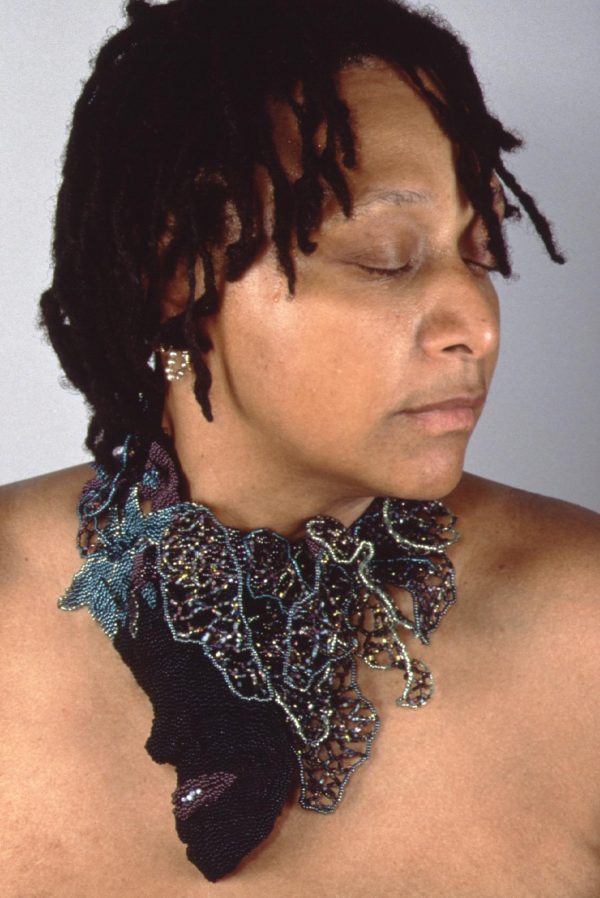
PW: Right. These figures are often fragmented or violated in some way. Thinking about lynching and the noose around the neck that figures elsewhere in your work, one wonders if these necklaces are heavy objects. Is the work to some extent a literal reminder of the narrative taking place? I’m thinking of the weight of the noose as a physical presence that you feel as you move around.
JJS: Well you have to make an emotional and physical commitment to wear work like that.
PW: I’m sure.
JJS: But beads are surprising how? Because they are made out of glass. If you have enough of them, they do tend to have weight to them. They also have a temperature to them. They are something that can be two-sided, as in life. If they’re really beautiful and filled with commentary, then you’re going to have people who are going to come up and engage you. And that’s the whole thing about whether or not you can actually be engaged by others. Because if you’re wearing something about lynching, then are you ready to be ass whipped? Are you ready to be engaged with people in that manner? So for the wearer, it’s a stand with both of your feet on the ground. That’s why some buyers really love them but will never wear them. I say, “I made it to be worn.” They’re like, “Yeah but I don’t have the chutzpah for that.”
PW: But you wear them.
JJS: Absolutely.
PW: Do you get questions or comments from strangers?
JJS: Sure. One of the things is that people sometimes want to buy something off me. Because they know it’s a commodity. Sometimes I think it’s because I’m black, and that’s another image for people. It’s also people wanting to be disruptive, and I don’t get too upset about that. But it is running right into your personal space, right up where your titties are.
PW: Yes, it’s very personal.
JJS: Now that’s a certain power I have. Because people forget. And then they ask, “Is this the one who was just killed?” referring to one of many recent black deaths. Yes, this is a necklace about it.
PW: A more recent piece is the Lynched Tree (2011–15) for Prospect.2 in New Orleans, where the sculpture was actually positioned in the tree. I saw it in the MOCA Cleveland show, where it was positioned differently because it was in a gallery space. But it’s a nude female figure with glass and other materials spilling out.
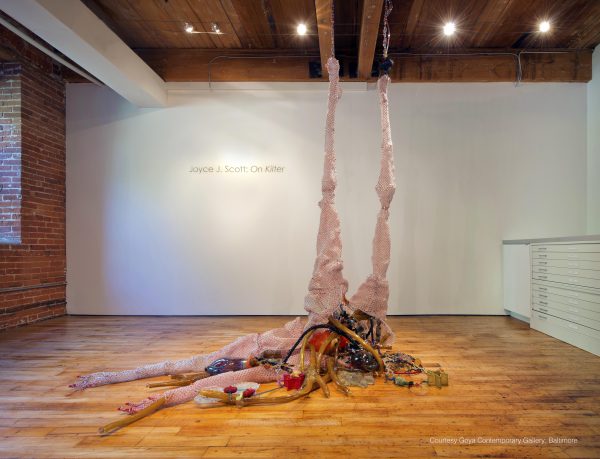
JJS: The figure is a haint, which is a ghost in the South. You know what a haint is? The haint was placed up in a tree for that installation.
PW: So is that what she is? A ghost?
JJS: Or she is many things. She’s a chameleon, and she becomes that kind of thing. She’s a ghost. In the piece at Tulane she was in the tree and falling from her neck with glass branches. And I don’t even know what that was about. So instead of her being lynched, she lynched the tree. She really has been this portal. She has things pouring from her body, but she also relates to prayer, perhaps.
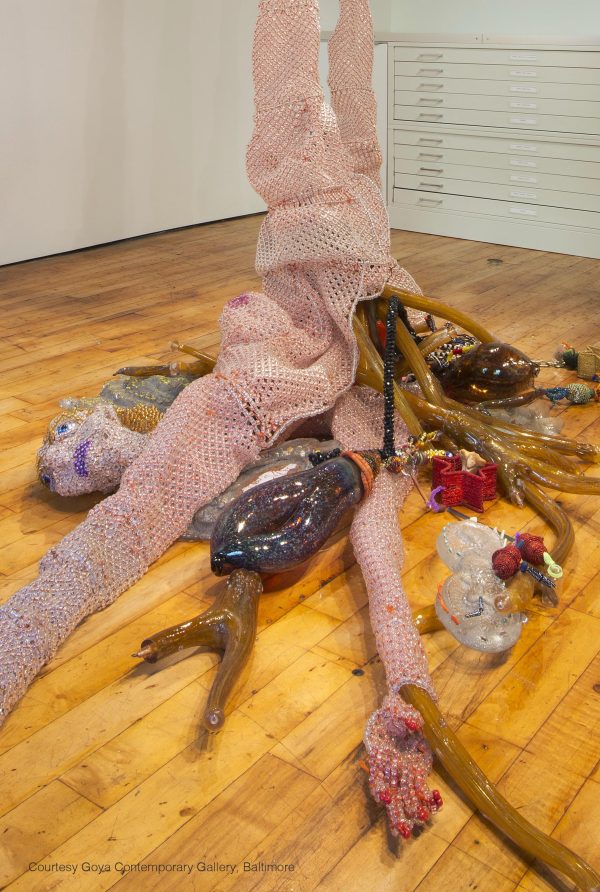
PW: That’s really interesting. I read her more as a violated figure, perhaps because of the title and because of what I saw.
JJS: I certainly think that’s part of it. But you know when I look at these—when I look at what I do and know what I do—they’re not only of the moment. If there’s a human there, then that human had an entire life before that. But I like that it could be whatever it is for that person. If they are mollified. If they are frightened. If they define beauty. Or if they wonder how the hell I did it. Whatever comes to them is what I want them to have.
PW: Yes, well I found this interesting because of her scale but also because she’s a pink female, and that seems to be less common in your work. So I guess she’s to be read as white. Was it the operation of the haint that made you choose that color?
JJS: I think it’s because you can’t tell me what to do. You can’t tell me I can’t make white people.
PW: Absolutely.
JJS:I believe in my work. I believe that I should be able to stand up for it. And so I will take images and do imagery that is frightening even to me when I’m making it, but it doesn’t mean that I’m going to back off from it.
PW: Regarding larger themes of the violence of humankind—not just in terms of specific races and genders, but more broadly based in relationships of power and control—does it sometimes become too difficult to address these themes? Does it become too overwhelming?
JJS: Usually I work on more than one piece at a time, so I’m not just dwelling in one work like that. I have my own kind of therapeutic methods that help me get around it, but I am an African American woman who lives in Baltimore in the inner city. There’s no way I can squirm out of that. I need to be consistently on the cusp of creating something and really forcing my head to work at optimum speed, in ways that we’re told we can’t do. To be in command of yourself and try to go beyond what’s usually expected of you, and then to have the ability and the context to do it—that’s the amazing place to be. I feel incredibly blessed to be an artist in that way. I don’t believe that artists are the only ones with it. But I think we’re the ones who command the space, and we’re the ones who stand up and take it as our life force.
PW: Do you see art as a spiritual practice?
JJS: Absolutely. Or I’d be dead, or I’d be a mass murderer or something. I have a really great sense of humor. I make money off of it as well. Many times it allows me to get anger out, and humor out, and things out. There are all kinds of things you don’t want to say to another person, and you need another vehicle. Art is that. It’s so great for that.
PW: Does your art preach? But maybe that’s the wrong word. I mean, obviously you’re making ethical points and pushing self-evaluation. But do you seek to convert in a way?
JJS: That’s out of my power, and what would I be converting someone to? I don’t necessarily have any answers right. But I wish to educate. I wish to reveal. Because my best voice is as an artist. I use my ability to say, “Did you see it this way? Have you ever thought about it that way?” That’s what I wish to do.