Editorial
“Untitled” (The End): Queer of Color Living After the Apocalypse
by Joshua Chambers-Letson
This essay is part of the website built on the occasion of the exhibition Fragments of a Crucifixion at the Museum of Contemporary Art Chicago, May 25–November 3, 2019.
for Victor and Josh
i
For some time we hung above our bed two sheets from Felix Gonzalez-Torres’s 1990 paper stack “Untitled” (The End). The sheets of paper that make up “Untitled” (The End) form a rectangular plinth that rises to an ideal height of 22 inches. Each sheet is a rectangular white expanse with a black band of about one and a half inches wrapping the border. As people encounter the work they can take away these sheets, diminishing the sculpture in size unless the exhibitor or owner ensures its replenishment.

The End: as in, death. While it’s not uncommon to find the paper stacks compared to minimalist sculpture, Susan Tallman notes that they also evoke tombstones.[1] Gonzalez-Torres gestures towards death, mourning, and grief throughout his body of work, including a number of the stacks such as 1990’s “Untitled” (Death By Gun), which offers a visual catalogue of (the highly racialized and gendered nature of) US gun deaths. But death is also a thematic possibility in 1992’s “Untitled” (Republican Years), which offers a revision on the single black border of “Untitled” (The End) by adding and setting within it a thinner black band. For Robert Storr, the black-banded works evoke a funeral announcement.[2] Perhaps a funeral for the end of the Republican Years, as 1992 marked the end of 12 years of Republican control of the White House. Perhaps a funeral for all the deaths that occurred as a direct result of the policies of the Reagan and Bush administrations.

The United States saw AIDS deaths reach over 120,000 in 1990. This was also the year public health authorities reported that black and brown women—under 20 percent of the nation’s population at the time—constituted more than 70 percent of women living with AIDS. The End: Republican Years as a mass grave. Republican Years as an ongoing period that marked and marks the end for too many black and brown women, trans, and queer folk.
Gonzalez-Torres’s sheets of paper look like giant funeral announcements without any text. But you can write the names of your own dead within them. When hung on the wall, the black bands wrapping the periphery of the sheets of “Untitled” (The End) suggest black frames around white canvases or projection screens. So project your dead, but also the living, into them as well. There is the way that the black band with a white center formally mirrors whiteness as it occupies the center of the frame, as in popular portraits of the first wave of the AIDS crisis.[3] On such occasions, black and brown life and death is held at the margins. Held at the periphery. Held. Contained but still held on to so it can mark the limit and function as a surplus reserve to be consumed and cast aside. But if we see in “Untitled” (The End) a frame and a projection screen, it is the richness of black and brown life in the time of proliferating deaths and endings that I choose to cast into the center of the frame. Doing so, I imagine the stark white center giving way to rich hues of black, brown, and every other color.
Sometimes I’d look at the sheets from “Untitled” (The End) hanging above the empty bed—itself marked by the imprints of absent bodies—and imagine that the sheets were portraits of Gonzalez-Torres and his lover, Ross Laycock. Gonzalez-Torres first materialized “Untitled” (The End) in 1990. This was around the time that Laycock was dying from AIDS. Near the end they lived together in Los Angeles, and as Gonzalez-Torres wrote of that time, “Ross and I spent every Saturday afternoon visiting galleries, museums, thrift shops, and going on long, very long drives all around L.A., experiencing and enjoying the ‘magic hour’ when the light makes everything gold and magical in that city.”[4] The End: “Ross was dying right in front of my eyes. Leaving me.”[5]
Here’s what I like to imagine: In the center of one frame is a portrait of Felix. In the center of the other is Ross. Both are full with the fullness of living. Both are basking in light “that makes everything gold and magical.” I know what Laycock looked like because Gonzalez-Torres used photographs of his lover in some of his works. This includes a work made in the wake of Laycock’s death: the haunting “Untitled” (Ross and Harry), 1991, comprised of a grainy, ghostly photograph of a shirtless Laycock playing fetch with a dog. A little googling and you can find a snapshot of the couple together at a beach: Gonzalez-Torres looks regnant at the center of the frame, Laycock just beside him. Both are sporting sunglasses as they bathe in light.
When I imagine their portraits taking up the center of the black frame, I like to imagine the photographs were taken during the “magic hour.” Which is to imagine that their photographs were taken by Star Montana, a photographer who stages the brownness and queerness of life in Los Angeles as it bathes in the city’s “gold and magical” light. Montana was born in the Boyle Heights neighborhood of Los Angeles and would have been three or four around the time Gonzalez-Torres resided there. In one series Montana produced stunning portraits of people in East Los Angeles: brown people in the center of the frame, held in the light of the magic hour. As Juana María Rodríguez has described it, “Montana’s subjects—the strangers and friends that populate her vision of East Los Angeles—enter her light and present themselves to their futures ancestors.”[6] Another end, since the magic hour comes at the end of the day. By offering up her photographs for “future ancestors,” Montana seems to suggest that endings give way to other beginnings. This is something black and brown folks know a thing or two about, having become ourselves in the wake of any number of apocalypses: the proliferating ending of worlds brought about by the destructive and overlapping forces of colonialism, racial capitalism, cis-heteropatriarchy, and white supremacy.

To think of the pieces of “Untitled” (The End) as portraits of our own lost ancestors, who should have been our peers and mentors, was a way of remembering something that we couldn’t forget anyway. My partners and I are the children of the Republican Years and the Clinton Years (which were, in their own Gingrichian way, still the Republican Years). If the manifestly phobic environment of the 1990s taught us to believe anything about our sexual selves in those sexually formative years, it was that queer sex = death. Following Essex Hemphill and Marlon Riggs, we learned to live, with each taste and exchange of fluid, with this thought: “Now we think / as we fuck / this nut might kill us. . . . This kiss could turn to stone.”[7]
It’s hard. You internalize that kind of thing. Start to think of yourself as the inevitability they tell you that you are and cannot let yourself continue to be: death, disease, racial and sexual monstrosity. It gets to be a lot. The pressure builds up and maybe you cut away to bleed the messiness out. Or maybe you come up with new ways of loathing yourself and of forgetting that you’re doing other people’s hating of you for them. Or maybe you try to follow the command issued by someone else’s desire for you not to be. When the struggle is real, the death drive is realer. Under these circumstances the bed (and the sexual landscapes akin to it) can be zones of powerful transgression, worldmaking desire, danger, and self-denying shame all at once. The bed is a place where the pains and pleasures of brown, black, femme, and queer fleshiness get caught up in any number of ends and endings.
The End: the vagina, the rectum, or some other terminal port of entry as a (pathway to the) grave, yes, but also towards the excesses and pleasures of being and of being with.[8] So we hang this reminder of someone else’s end above the bed and we think as we fuck: “Look, here we are living and loving instead of loathing. Here we are holding onto each other but also holding onto those who aren’t here anymore.” Because when we think as we fuck “this nut might kill us” and that this kiss “could turn to stone”—and when we fuck under the sign of Felix and Ross (who aren’t here anymore)—in a queer kind of way we are keeping in mind the ones whose ends we are living after. Keeping them in mind, which is to say, keeping some part of them alive and in our bodies as we think as we fuck.
Which is a queer mode of reproduction, if you think about it.
A queer of color mode of reproduction.
ii
If I am projecting queer, trans, femme, black, and brown life onto the sheets of paper hanging above the bed, I am also thinking of black feminist theorists working at the intersections of black, queer, and lesbian thought—such as Audre Lorde, Hortense Spillers, Sharon Patricia Holland, and Amber Jamilla Musser—who have taught us about the ways in which the erotic becomes overdetermined by the effects of racialization, histories of racial objectification, and interlocking technologies of racial and sexual subjection.[9] As Musser writes, “some people circulate as highly charged affective objects, while simultaneously being positioned outside of the parameters of normative sexuality and subjectivity. We see this acutely in the ways that black women are positioned as the ‘fleshy limit of theory.’”[10] Within the orders of white supremacy, racial capitalism, colonialism, and cis-heteropatriarchy, the sexualities of women of color, queers, and trans people are commonly understood to demarcate the limits of normative sexuality. They function as the aberrational limit against and through which white, patriarchal, and heteronormative genders and sexualities are defined as universal, moral norms. Or such sexualities may be framed as a dead end, making the people who practice them contagiously dangerous subjects who are “wrong” insofar as they are a threat to the vitality of whiteness’s purity complex. Queer, black, and brown practices of desiring, living differently, being otherwise, and being with are detained at the margins defining whiteness.
So linger on the black band that wraps the limit of the black-banded works. And linger on the color black. “Untitled” (The End) is accompanied by instructions for the owner or exhibiting party on how to materialize the piece. In the “Manifestation Guidelines” supplied to the Museum of Contemporary Art Chicago by the Felix Gonzalez-Torres Foundation it is specified that the ink used for the work’s original manifestation was “Pantone: Extra Black U.”[11] Isn’t blackness (as well as brownness and queerness) always already conceived of as sort of extra? One might think here of Glenn Ligon, following Zora Neale Hurston as he fills a white canvas with a blackening abstraction of the thought: “I feel most colored when I am thrown against a sharp white background.” A similar tension between black and white surfaces connects “Untitled” (The End) and “Untitled” (Republican Years). But where Ligon’s repetition of Hurston’s phrase suggests, as Huey Copeland notes, the way in which “projective investments in racial filiation tend to cloud African American voices,” the starkly segregated, black–white dynamics of “Untitled” (Republican Years) and “Untitled” (The End) depict an order in which filiation is altogether impossible; black is divided from white and held at the periphery. Blackness at and as the limit.
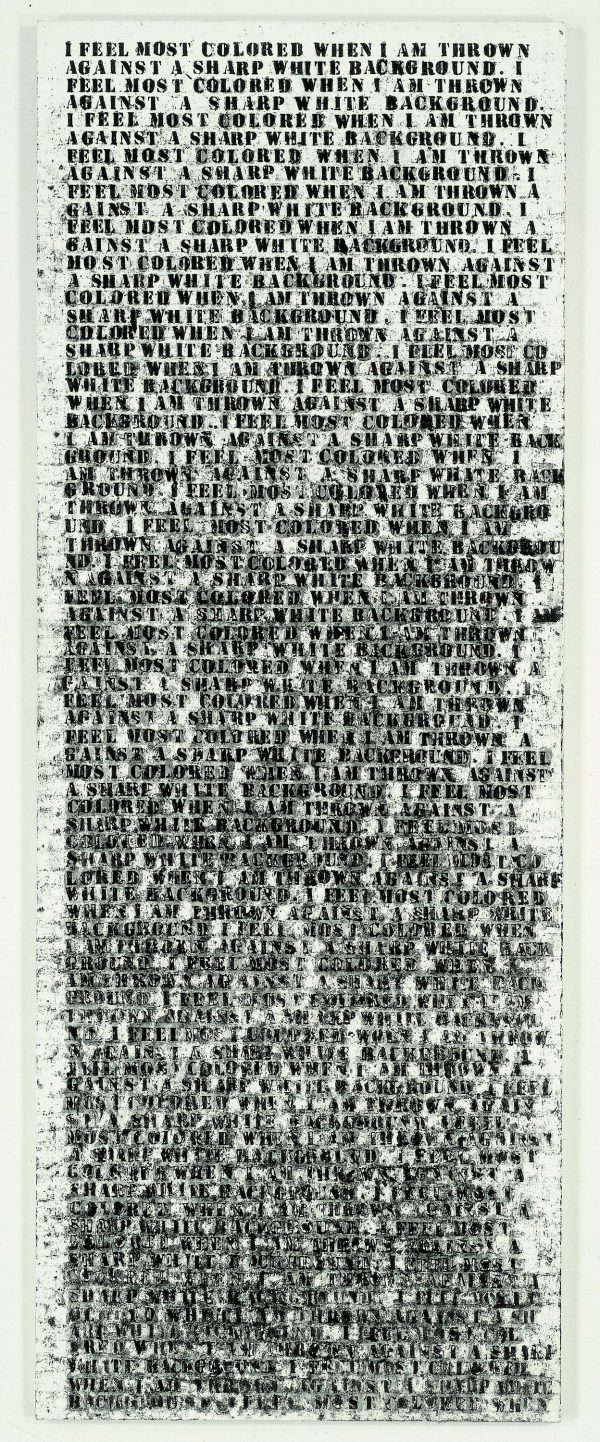
The End: an ongoing apocalypse in which blackness is held at the margin and periphery by a sharp white center that defines its purity by means of this marginalizing effect. A sharp white center that secures its claim to power by means of this delimitation, detention, and peripheralization of blackness. To describe the Republican Years as the end is to gesture to the mounting piles of wreckage illustrating those years’ ongoing impact on black and brown life: the AIDS crisis and its disproportionate effects, mass incarceration, the dismantling of public assistance, the ongoing redistribution of wealth upwards alongside ongoing military expansion (both in and out) of the nation’s violently policed borders. I’m only naming a few.
But also, The End: as in, This is over. We are done with this. We’re going beyond this. We have always been going beyond this. Which has something to do with blackness as, among other things, a collectivity of (un)being beings and a practice of going beyond all known being. Describing the original manifestation of “Untitled” (The End), the “Manifestation Guidelines” relay that “The border bled to the edge on all four sides of each sheet of paper.” Here, blackness cannot be contained by the pale gravitational center of whiteness. This blackness at the margin insists on going beyond. It exists in excess of and, yes, sometimes bleeds to the edge.
Extra Black. To think of blackness as excess or as the act of exceeding is resonant with what Musser describes as “brown jouissance”: “These forms of otherness—excess forms of embodiment—are central to what I call brown jouissance. In contrast to an ecstasy that imagines transcending corporeality, brown jouissance is a reveling in fleshiness, its sensuous materiality that brings together pleasure and pain.”[12] Which is another way of capturing what I mean when I refer to the thought had while fucking under “Untitled” (The End). The End: of Felix, of Ross, Marlon, Essex, and the more than 319,800 people who were dead from AIDS in the United States by the time it took Gonzalez-Torres from us on January 9, 1996. But, also, fucking after the end.
iii
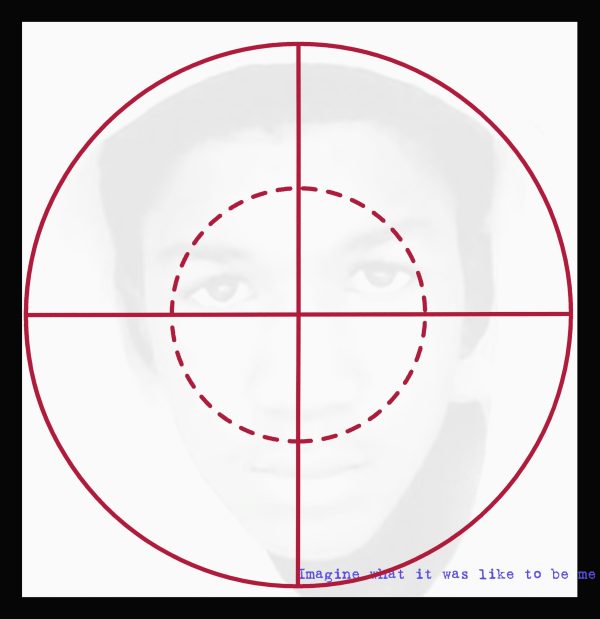
Imagine if all the people living after that particular and ongoing ending were to gather in front of “Untitled” (The End) and project into it the images of the people they were missing and yet to miss. Imagine how quickly that white space would become full with the figures of people whose stories and bodies have been held at the periphery and delimited at the margin. How quickly the space would become dense with black, brown, and other color-rich tones to paint a million different portraits of other ways of being together while “reveling in fleshiness, its sensuous materiality that brings together pleasure and pain.” Imagine that these projected figures would exceed and bleed past the limits of the frame, densely populating the stark white center to open up the potential for something new to emerge. This potential would emerge through a transformation of the space so radical that we might lose all sense of, and need for, a center or margin in the first or final place.
But imagine, also, that all of this could happen in a fashion that did not at the same time “cloud” into abstraction femme, trans, queer, black, and brown voices, bodies, and lives. Imagine that each projected figure or combination of figures might hold on to all of their singularity and particularity. What if they were remembered as they were and as they wanted to be at the same time? And what if they could still be in relation to the incommensurable plurality of any number of commons through which they moved: the brown commons; the black commons; the queer of color commons; the commons of black feminism and of women of color feminisms; the upon, over, and undercommons. Imagine, then, a being-singular-plural of femme, trans, queer, black, and brown life that is full with generative surplus and excess. A being-singular-plural that is tangled together and apart in fleshy embrace, transforming the bounded white rectangular expanse into an endless, shimmering, and opaque surface that is apparent but not transparent, grasping but ungraspable, knowing but not knowable, and rich with all the yearnings of, for, and in the New.
Imagine what that would look like and feel like. Then wonder that it is not.
iv
The End: a beginning waiting for its title.
Notes
With thanks to Kelly Chung, Tavia Nyong’o, Chanon Kenji Praepipatmongkol, Sheila Majumdar, and David Olsen.
1. Susan Tallman, “The Ethos of the Edition: The Stacks of Felix Gonzalez-Torres,” in Felix Gonzalez-Torres, ed. Julie Ault (Göttingen, Germany: Steidl, 2006), 123–33.
2. Robert Storr, “When This You See Remember Me,” in Felix Gonzalez-Torres, ed. Julie Ault (Gottingen, Germany: Steidl, 2006), 5–37.
3. See Tony Kushner, Angels in America: A Gay Fantasia on National Themes (New York: Theatre Communications Group, 1993); and Leo Bersani, “Is the Rectum a Grave?,” October 43 (Winter 1987): 97–222.
4. Felix Gonzalez-Torres, “1990: L.A., ‘The Gold Field,’” in Roni Horn: Earth Grows Thick, 65–69 (Columbus, OH: Wexner Center of the Arts, 1996), 68. I tell a version of this story in Joshua Chambers-Letson, After the Party: A Manifesto for Queer of Color Life (New York: NYU Press, 2018).
5. Gonzalez-Torres, “1990: L.A., ‘The Gold Field,’” 68.
6. Juana María Rodríguez, “The Streets in Afterglow,” Aperture 232 (2018).
7. Tongues Untied (1989), directed by Marlon Riggs.
8. For more on the queer of color valences of “being with” see: Being With: A Special Issue on the Work of José Esteban Muñoz, Social Text 32, no. 4 (Winter 2014).
9. See Audre Lorde, Sister Outsider: Essays and Speeches (Berkeley, CA: Crossing Press, 2007); Hortense J. Spillers, “Mama’s Baby, Papa’s Maybe: An American Grammar Book,” in Black, White, and in Color: Essays on American Literature and Culture (Chicago: University of Chicago Press, 2003), 203–29; Sharon Patricia Holland, The Erotic Life of Racism (Durham, NC: Duke University Press, 2012); and Amber Jamilla Musser, Sensual Excess: Queer Femininity and Brown Jouissance (New York: NYU Press, 2018).
10. Musser, Sensual Excess, 9.
11. The “Manifestation Guidelines” for “Untitled” (The End) (1990) were supplied to the work’s owner by the Felix Gonzalez-Torres Foundation and are included in the Museum of Contemporary Art Chicago’s document file for the work.
12. Ibid., 3.