Editorial
In Conversation with Paul Pfeiffer
by Chanon Kenji Praepipatmongkol
This essay is part of the website built on the occasion of the exhibition Fragments of a Crucifixion at the Museum of Contemporary Art Chicago, May 25–November 3, 2019.
Paul Pfeiffer is one of the most visible artists who emerged at the turn of the millennium. With his mesmerizing digitally manipulated video works, Pfeiffer won the Whitney Museum’s Bucksbaum Award in 2000, the largest private art prize in the world at the time. Through cutting and retouching found footage, he grapples with the viewer’s relationship to an ever-accelerating deluge of images circulating around the globe through mass media. While Pfeiffer’s critical engagement with media representations of race and gender has been the subject of numerous interviews, less attention has been paid to religion’s relevance to his exploration of body politics. Indeed, the relationship among spectacle, celebrity, and religion figures prominently in Pfeiffer’s work, whether in comparisons of sports stars and biblical personages (Four Horsemen of the Apocalypse, 2000) or fans of Justin Bieber and followers of megachurches (Incarnator, 2018).
The conversation below takes its departure from Pfeiffer’s work Fragment of a Crucifixion (after Francis Bacon) (1999), a centerpiece of the MCA exhibition Fragments of a Crucifixion and the inspiration for its title. The second part of the interview delves into Pfeiffer’s relationship with religion, which is at turns art historical, ethnographic, and deeply personal. Exhibition curator Chanon Kenji Praepipatmongkol and the artist discuss a range of projects spanning Pfeiffer’s career, beginning with his participation in Asian American art shows of the early 1990s and ending with his recent research into histories of slavery at the University of Georgia.
Chanon Kenji Praepipatmongkol: Could you, briefly, describe your work Fragment of a Crucifixion (after Francis Bacon) (1999)?
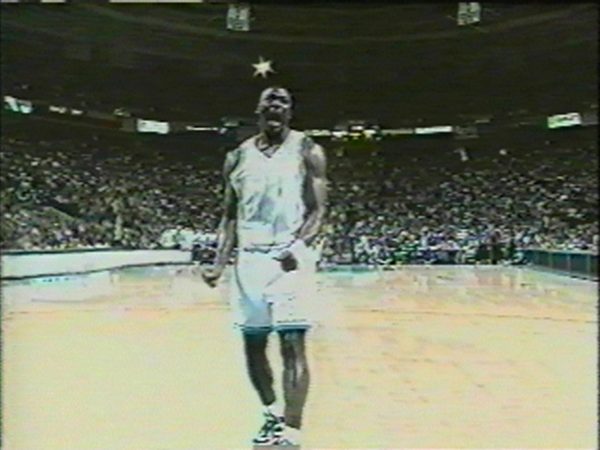
Paul Pfeiffer: I would start with the title. Fragment of a Crucifixion comes from a painting by Francis Bacon made in 1950. In Bacon’s version, two figures are suspended on a cruciform-shaped armature, which is surrounded by a vast, spatial void. The figures appear to be disintegrating. One has a screaming head, which Bacon imported from the early Russian film Battleship Potemkin (1925). Its arms are raised and outstretched, recalling the iconography of the crucifixion in religious paintings. My video came from the experience of watching a basketball game and being reminded of Bacon’s painting. The basketball court is the armature, the dome of the arena is the spatial void, and at the center are the suspended figures of the basketball players. There’s one basketball player in particular: he’s just made a slam dunk, and he’s celebrating by screaming. I took one or two seconds of video footage of this moment and looped it. And by looping it, the scream continues infinitely, so it becomes ambiguous as to whether it’s a scream of pleasure or a scream of pain. That’s where I stop.
CKP: What you describe as the psychological experience of the work and the manipulation of that psychological experience seems so central to the work. When I approached it, initially, seeing the smallness of it and the handle of the video projector jutting out, my first thought was that it makes reference to sculpture. There’s a smallness and an almost fetishistic quality to its physical nature. But when you watch the video for a while and see this basketball player stuck in a loop, the reference then turns to painting: the stasis that is painting. Thinking in terms of physical medium, though, it is video. The work really eludes a distinction of media. What you’re getting at is how all of these media references can be used to manipulate the quality of attention that the work then holds. How do you feel about that kind of description?
PP: In a sense, the viewer’s attention is the real material to be shaped. I’m generally interested in the phenomenology of different media and how these relate to the context of art-making. My understanding of phenomenology has to do with the proposition that reality does not exist in an already-given state outside ourselves. It’s actually produced in the interface of perception. The production of knowledge and the study of the limits of understanding, in some ways, have to start with this interface. This is precisely the point where media can manipulate perception.
I recently spoke with a philosophy teacher who said he believed that, properly speaking, philosophy ends with the emergence of phenomenology, which I found astounding. It was his way of saying, “I’m not interested in phenomenology; that’s no longer philosophy to me.” For him, it’s the tipping point where you go from classical philosophy to something like criticism. There’s a hierarchical relationship, he’s saying: philosophy is serious, criticism is not as serious. The dividing line is phenomenology.
CKP: I read phenomenology as a moment when philosophers began to admit to a kind of lived experience that did not necessarily depend on analytical propositions or strictly delineated beliefs. It is something that needs to be thought of at the interface of psychology and the world, and how that relates to embodiment of, say, brown bodies or black bodies.
PP: Or the queer body. To me that is getting to the central point. That, to me, is the matrix of the body.
CKP: Can I push you further in that direction? Fragment of a Crucifixion puts the body on this loop that, on the one hand, shows really intense human emotions—jubilation, ecstasy, anger, pain. It’s intensely human and intensely psychological. But there’s a flip side to it, which is that after you watch it for a while, the loop turns the human into something extremely mechanical and inhuman, becoming energy that’s stuck. How do you think of these intertwined concepts—the human, the inhuman, and the mechanical?
PP: Your question makes me think of Jacques Lacan. Specifically, the idea that in the developmental process of every child, there’s this thing called the mirror stage that signifies the moment when the child, this sentient being, recognizes itself in the mirror. This is associated with ego formation. What’s interesting to me is that there is a period of months from birth to a certain age before the mirror stage when that ego formation is incomplete. At this point, sensory experience is fragmentary; there is not a unified selfhood to contain sensory experience. It’s just in fragments: the mother’s breasts, a hand, an eye. There isn’t a structure yet to organize it into a sense of wholeness. Although we think of a kind of sensual, essential humanness as something that you’re born with, the implication of Lacan’s studies is that people are actually born not human. They become human at the point where the ego is formed. And even then, it takes time for it to develop to a point when the child is educated enough to claim to be fully socialized. In Michel Foucault’s terms, there is a process of discipline and punishment to get to a state of full human formation. In short, I feel that the relationship between the human and the inhuman, or the not-human, is much more troubled than we usually think.
Please excuse me for intuiting this connection, which feels way too general, but to me this is also a Buddhist lesson, or at least it reminds me of certain Buddhist lessons that I’ve been exposed to through Lawrence Chua. There are certain meditations intended to focus your attention on the idea that you are born into the trauma of blood and shit. Whatever that is, it is not properly thought of as human in the sense of a civilized, socialized being. At the point of birth, we’re more like an animal than a human, to put it one way. You can say that to focus on such things is a kind of regression. Why focus on aspects that we’ve moved past? We’ve adopted a civilized nature. But in becoming civilized, human identity also becomes racialized or gendered in a hierarchal way. To me it is very interesting to imagine the possibility of identifying with something other than the aspiration to assume human identity in a hierarchical sense.
CKP: It’s fascinating how you’ve put it. Your comment about regression and the inhuman or prehuman returns me to your interest in the stadium as an archetypal space in human history. It seems that we’re returning to a prehistoric arena, reenacting a primal violence and our being drawn to that spectacle of violence.
PP: It’s intriguing to think of identity formation on a primeval level, going back to the abstract codes of classical architecture—the most ancient patterns of thought in the Western tradition—to investigate the roots from which enduring distinctions such as human/nonhuman were first formulated. It’s not just ancient history. These are patterns of hierarchical thinking that endure into the present. The multicultural movement of the 1990s was an important moment of politicization for me, providing a way to challenge the limits of Eurocentric history. The ways that they were being formulated in the 1990s seem too easy to co-opt, too limited, not to go far enough. The idea of finding an alternative in these more abstract codes was something powerfully intuitive to me.
Worlds in Collision
CKP: I understand that you grew up in several places—Hawai’i and the Philippines, among other places—in part because of your parents’ work with the Methodist Church. Could you speak about this religious story of your childhood?
PP: I was born in Hawai’i, at a moment when my father had gone back to school at the University of Hawai’i and was working on his PhD in ethnomusicology. He was doing his fieldwork as I was growing up, and every summer he would go to the Philippines and make field recordings of indigenous musicians in the southern Philippines, mostly Mindanao. From as early as one or two years old, I was traveling back and forth periodically between Hawai’i and the Philippines because of my parents’ involvement with music education and performance in both places. While he was doing his field recordings, we stayed at my grandparents’ place in Dumaguete City, which is the home of Silliman University. It was founded in 1901, and my grandparents and my parents were associated with it. Silliman is a Protestant university, which is very unusual in the Philippines, an overwhelmingly Catholic country. Later on, my family actually moved from Hawai’i to Dumaguete, where my mom became the director of the music school at Silliman. At that point, I was going to high school at Silliman, which is a liberal arts education with a pretty central Protestant religious component.
CKP: You eventually moved to the States to do your BFA in San Francisco and MFA in New York City. I was looking back at articles on your work from the early 1990s and was struck by your close involvement with the Filipino-American community and magazines like Filipinas. What was that period like?
PP: I moved to New York from San Francisco in 1990. Just before I moved, by happenstance, I attended an event called “Worlds in Collision” at the San Francisco Art Institute (SFAI). It was a conference of artists of color organized by Carlos Villa, a Filipino-American artist who lived for a long time in New York but then settled in San Francisco and was teaching at SFAI. The event really galvanized my consciousness of the intervention into art history that was coming from a very diverse group of artists—there were artists of color, but also queer artists and artists with a feminist discursive background. It was very moving to me. In retrospect, up until that point, I had a lack of investment in art history. I remember struggling to stay awake in art history classes at the Art Institute, but I remember feeling riveted at “Worlds in Collision.” These were people who could be my uncles and aunts talking about art history! It was the first time I really experienced that. The conference set the stage for what happened when I moved to New York and what became known as the multiculturalism movement. In 1990 in New York, there was a huge debate going on about the canon—the cultural canon. The Culture Wars were playing out, and the excitement at the time was in these kinds of organizations. ACT UP. The Guerrilla Girls. Living in the East Village, that’s where the action was. I jumped in.
CKP: In New York, one of the early events you participated in was Santo Niño Incarnate, a sculptural installation commissioned and curated by Cee Scott Brown in 1994 when he ran the Art Matters Foundation. Can you describe how the project speaks to that charged moment of multiculturalism?
PP: I suppose we’re talking about my network at the time. I was hanging out with the Asian-Pacific Islander caucus of ACT UP. That caucus was trying to make sense of how to build a politicized awareness of the AIDS crisis: how it was playing out in first-generation Asian immigrant communities, and how it would make sense culturally to bring this conversation to them. We worried that they were being left out of the ACT UP conversation.
I remember the project you mentioned, Santo Niño Incarnate, where I used the image of the Santo Niño but rendered it in transparent resin. I was thinking of it as a specific Catholic icon, but by rendering it transparent in a way, it became even more open to a proliferation of readings. I went around asking the Asian-American LGBTQ community to contribute photographs of themselves with loved ones, which I then cast inside these transparent statues. The idea was to take that aspect of Catholicism that has to do with an openness to all parties. At some point, I discovered that the roots of the word “catholic” are Greek, relating to ideas of universal or common experience, or to an attitude of all-embracing acceptance of diverse customs. These roots predate the use of the term Catholic in reference to the Christian church, and the even later use of the term to delineate the notion of a “true” church distinct from other “untrue” churches. In a very intuitive way, to take this very popular and accessible image of the Santo Niño and further explode it meant thinking of it as something that could be individualized and could contain the widest possible range of content.
Given that I was coming from a Protestant background, there was this moment in the 1990s when I started to specifically gravitate towards the possibility of utilizing Catholic imagery as a way of speaking about things. I remember telling my family a little bit about what I was doing. Or actually, maybe they just saw pictures. I made this sculpture of the Virgin Mary with a kind of cape made out of silver condom packets. The silver of the condom packet is very seductive to me visually. It was playing off the abstract reflective quality of that silver material and, obviously, the provocation of the sexual association. I remember when I showed it to my mom, her response was, “Why are you doing that? We’re not Catholic. Protestants don’t believe in the Virgin Mary. Why are you doing that?” Somehow, eventually, a picture of that sculpture ended up on her wall. I guess she got over it.
CKP: What you’re talking about—your interest in the shiny surfaces of the condom wrapper—seems to be particularly of that moment. Artists of color didn’t want to be pigeonholed as merely ethnic artists. Layering body, sexuality, and religion allowed you to arrive at something more.
PP: There was an interest in eluding the limits of a very categorical identity-based discourse of the time, which I have to say, coming from Hawai’i, seemed particular to the East Coast. It wouldn’t make sense to have this conversation in Hawai’i or even California. If, like me, one was raised moving between Asia and the United States and Hawai’i, the idea of subscribing to this identitarian politics seemed too prescriptive. The adoption of the religious image was an attempt at scrambling that.
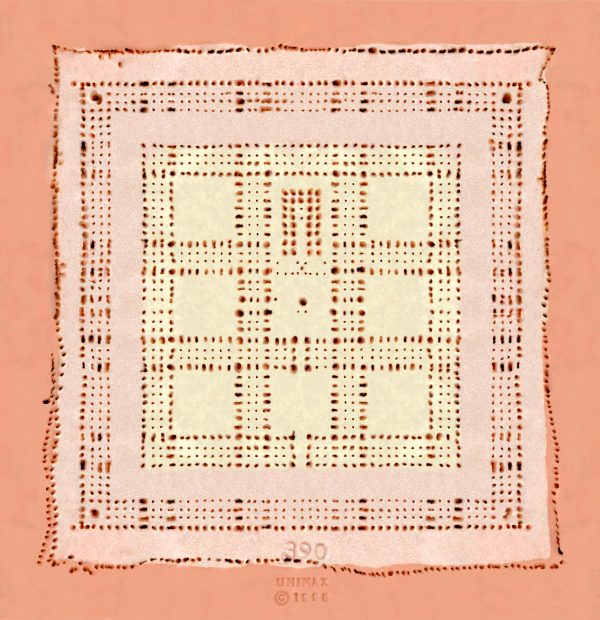
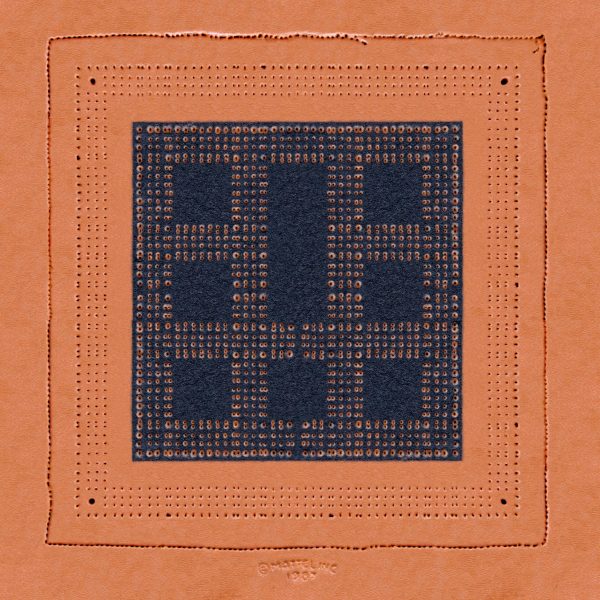
CKP: One of your early works that dealt with religious imagery was the series Temple of Solomon—photographs of Mattel dolls with their hair parted to reveal a geometric pattern, which looks like an architectural floor plan. What struck me about this series was this inscription of something that has deep religious connotations onto a contemporary commodity object—dolls that reproduce archetypes of the blond, brunette, or ebony. This is a strange and powerful collision.
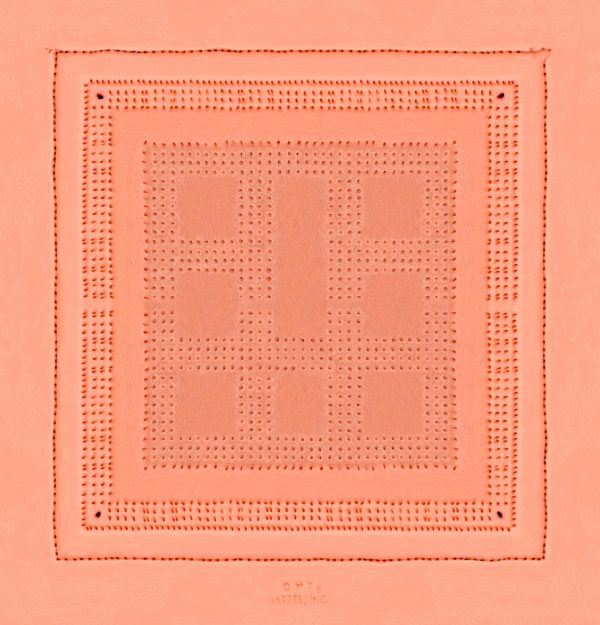
Carousel: Temple of Solomon images - Full Size Images
PP: I love connecting these dots. There’s a certain point where the extension of the exploration of religious iconography led to looking at ground plans of basilicas. I remember reading one treatise on classical architecture in particular, a book called Architectural Principles in the Age of Humanism (1949) by Rudolf Wittkower. The central point was that the principles explored in the Renaissance were being recycled from antiquity in a very conscious way. There were ideas about the most primary proportions and tropes in architecture that, as it turns out, were not just architectural, but were more broadly aesthetic principles that applied equally to music, painting, and really all the arts. The agenda of the Renaissance really had to do with wanting to see themselves as the inheritors of certain aesthetic codes that, in a sense, were fundamental as far back as one can go in Western culture. The figure of the stadium or coliseum started to emerge as something very important, because in these books of classical architecture, it was one of the principal building types. It also connects to something that, at the time, I considered to be one of the most important contemporary architectural formulations: Madison Square Garden. Aesthetic codes aren’t just about the design and decoration of buildings, but they describe on an abstract aesthetic level the essence of cultural identity.
This blew my mind. Coming out of the identity politics of the 1990s, here was an articulation of what I was intuiting in adopting religious iconography: that there’s another deeper level of identity one could tap into and use as a kind of language to speak about the construction of experience, of reality, and of individual and group identity. To me it was very exciting—the idea of picking up this 2,000-year-old language that I somehow had access to through my own religious upbringing. It really makes identitarian politics look superficial. There’s also an idea that working in the language of abstract aesthetic code, one could scramble Western artistic conventions by injecting the equivalent of silver condom packets—these seemingly incongruous elements that have been systemically defined as other or simply excluded.
CKP: I am curious how your interest in the historical structure of aesthetics intersects with your investment in understanding the present tense, that is, the visceral and intense qualities of contemporary aesthetic experience. For instance, I’m thinking about your early video work like The Pure Products Go Crazy (1998), where there’s looped footage of a woman plunged head-down into the sofa shaking, as if in a demonic possession. I take this to be a different way of understanding deep aesthetic codes, perhaps filtered through The Exorcist and American gothic narratives.
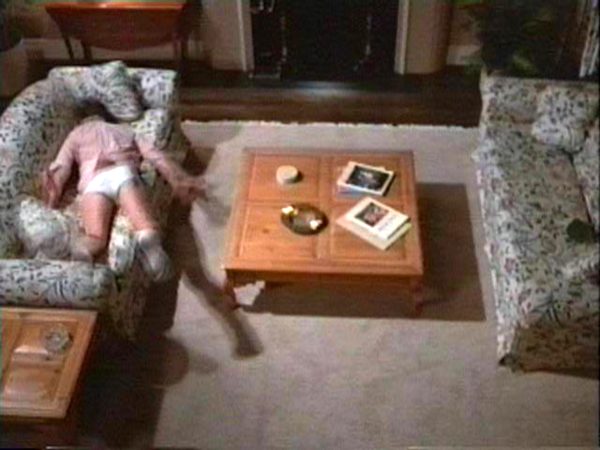
PP: On a certain level, my experience of growing up in a Christian university was centered around music, which was nothing if not visceral. I would even make the connection that although I am not a musician, there’s a relationship between the video image and music in that they’re both time-based media. Since I did not come from a film background, I only started working in video when it was accessible through desktop editing software. The most obvious structural experiment in digital video was to simply scroll back and forth or to create a loop and loop a video. That was my entry point. I think now about that loop structure as one which has to do with repetition, and there’s an association of repetition with prayer and meditation—the use of both visual and auditory repetition to create states of altered consciousness. In an unlikely way, growing up in a family that was centrally involved in the production of music in a religious setting led intuitively to an interest in the way that visual and auditory media can be used to shape perception on an experiential level, on a non-didactic emotional affective level.
CKP: I would like to ask about your current project on college football in Georgia. This is such a charged moment to consider the intersection of sports, religion, and race, given the controversy around Colin Kaepernick kneeling and the repercussions of that episode in national politics. Could you speak more about your interest in football in the current moment?
PP: It started when I accepted a visiting faculty position at the University of Georgia for two and a half years. I was interested in some of the culture and literature coming from there. In college I read W. E. B. Dubois’s The Souls of Black Folk and found it very relevant, particularly the notion of double consciousness, which has become a fundamental aesthetic category within the black literary lexicon. What does that mean? I went down there and found that the history of the South is still extremely present. There’s the sense that in every conversation, just underneath the surface, people from the South are aware that the world sees them in a particular way, and they feel that they have to answer for it. It’s this kind of enforced self-awareness of history exerted from outside, but then internalized.
It so happened that when I went down there, in the beginning of 2016, there was a student-organized exhibition on view that was about the history of slavery at the University of Georgia. As it turns out, the university figures centrally in that history.
It just unfolded from there. Then I discovered that in December 2015, just before I arrived, a construction crew at the university had accidentally, well, they were doing construction at the parking lot, and they unexpectedly exhumed 105 bodies. It turns out that the parking lot was built over a burial field for slaves, which was adjacent to the official cemetery, where slaves weren’t buried. The university accidentally dug it up. They weren’t sure what to do with it, so they tried to take an anthropological route and dealt with the bones as artifacts and reburied them. Respectfully, they thought. But they didn’t bother to ask the Athens community if there were any descendants there. So I basically walked into a storm.
The strange coincidence is that there is a number of underground rivers on the Georgia campus. One of them runs right under the stadium, and it exits in one corner of the official cemetery, which is adjacent to the stadium. It turns out that this underground river beneath the stadium exits at the exact place that these bones were transferred. So now, all of these things started running together.
CKP: There’s such a deep sense of history that as soon as you scratch the surface, there’s a million other things that need to be uncovered.
PP: Then I found out that in the 1970s the marching band would play certain songs associated with the Confederate Army, which became an explosive point for the student body and led to riots. They had to create a university law that these songs would never be played again. It goes on and on. It’s all so connected in the end. Or discovering that the lead quarterback is the descendant of slaves in Georgia.
CKP: In the project you’re working on, are you dealing with these histories in some way?
PP: The central focus of the project is actually the band, specifically the band playing during the football game. At halftime they do maneuvers in the field, but during the game they sit in the stands and provide a kind of emotional soundtrack. If you turn your back on the game and just observe the band doing that, it’s extraordinary. The rules of college football are that every football team has a band, and the band always plays, but they’re not allowed to play when the ball is live. As soon as the ball stops, they begin to play immediately because they want to hype the crowd. The way the band director put it is that if they don’t hype the crowd, they’re in danger of being replaced with a prerecorded soundtrack. They train to be able to start and stop suddenly. That’s the way they perform—they never finish a song. If you turn your back to the game and just watch the band, it’s a strange performance of constant interruption. Loud band followed by silence, and then loud band again. It’s going in and out of silence and the loudest possible sound.
CKP: It feels like we’ve come full circle, in the sense that we started our conversation talking about your father doing his degree in ethnomusicology. There is something ethnomusicological about your current project, recording sounds that are devotional in a sports context. It’s also ethnomusicological in capturing sounds that are accented in a certain way because of the weight of history.
PP: It’s definitely an inspiration for me, having grown up with some closeness to a community of ethnographic researchers—not just my father or my parents, but professionally, they’re part of an academic community at the University of Hawai’i as well as at Silliman University. In fact, my father was one of five people in the first PhD class in the ethnomusicology program at the University of Hawai’i. His teacher was a woman—her name is Barbara Smith, and she started the program. I talk to her a lot now.
I have also become aware that there’s an increasing literature and dialogue around the relationship between ethnography and anthropology and contemporary art. Because of where I’m coming from personally, this is extremely intriguing. In the 21st century, with the proliferation of cameras, there’s a kind of universalization of the problems of anthropology, in terms of what happens when living people become the subjects of the gaze, a study, or a representation. I would say that what used to be thought of as the plight of the ethnographic subject is becoming an almost universal condition in the age of social media or reality TV.