Exhibition
Kerry James Marshall: Mastry
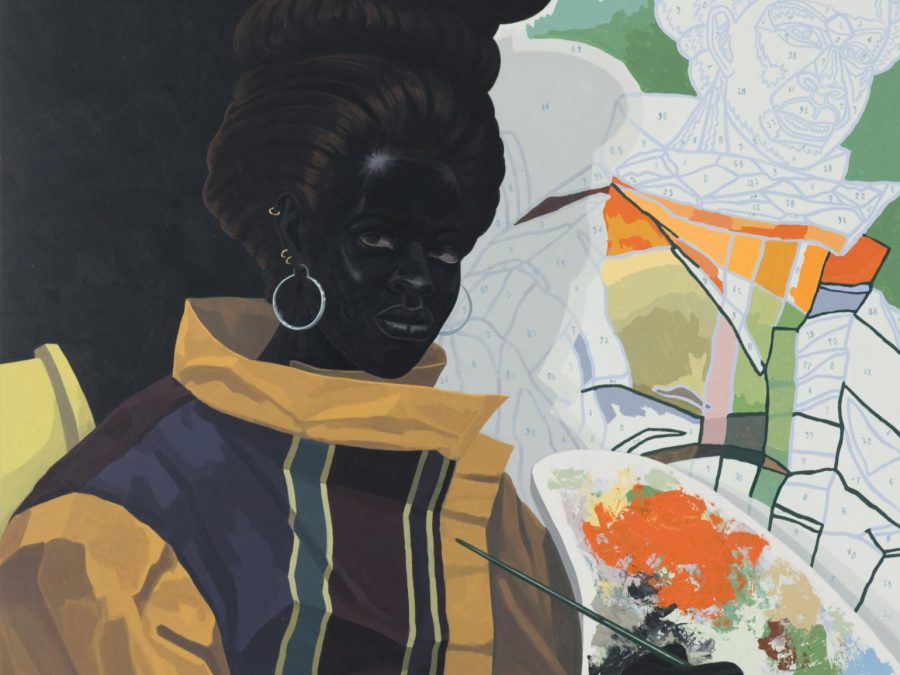
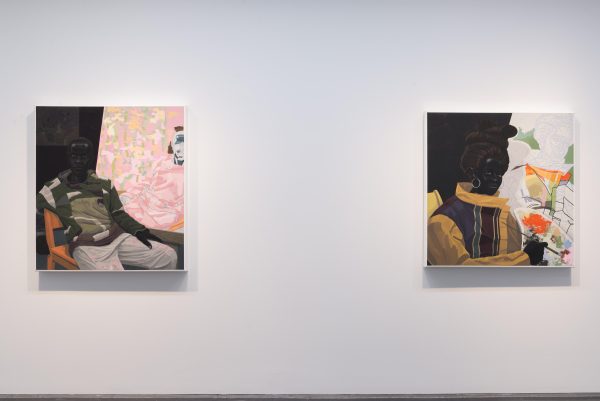
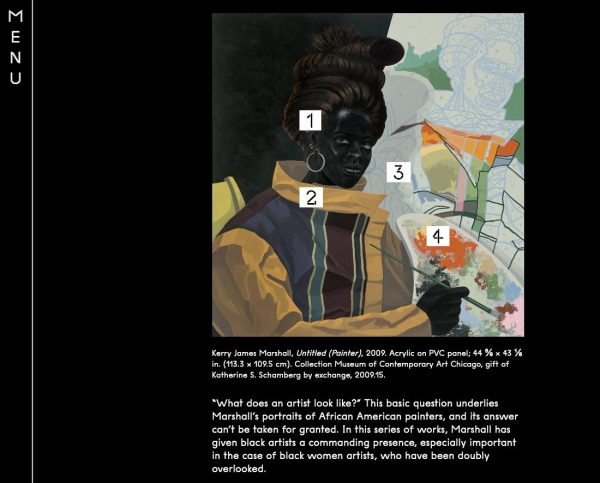
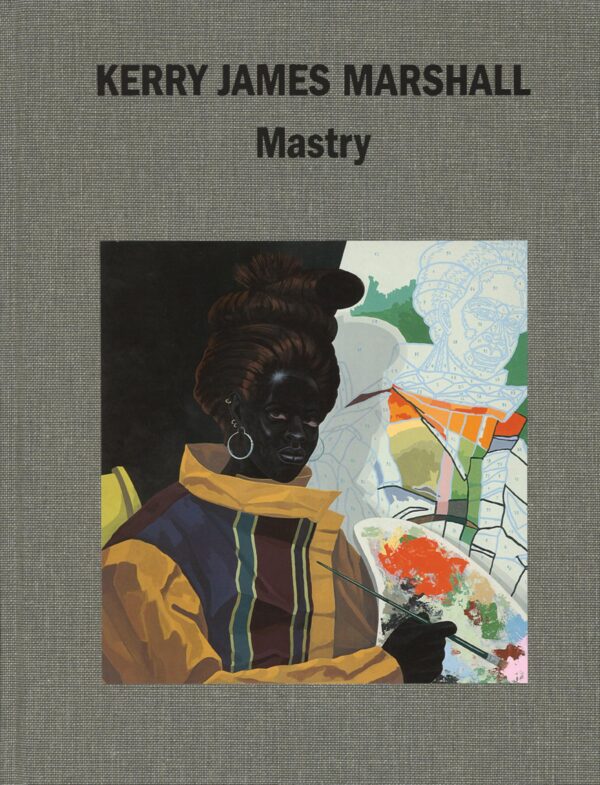
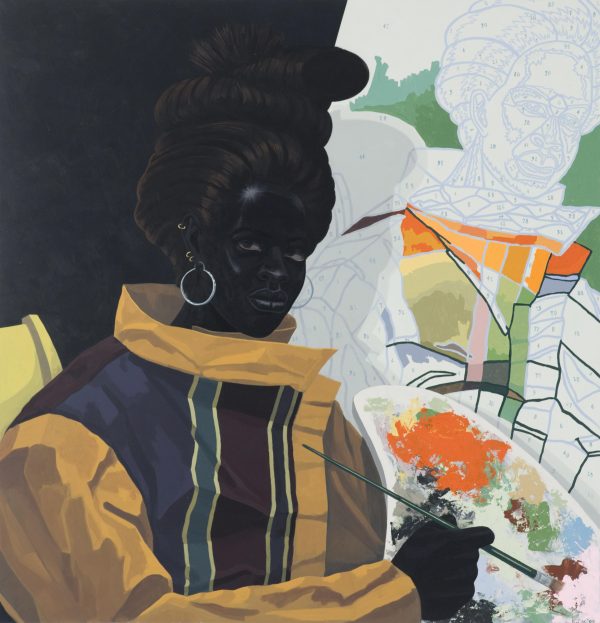
Kerry James Marshall, American, b. 1955, Untitled (Painter), 2009. Acrylic on PVC; 44 5/8 × 43 1/8 × 3 7/8 in. (113.4 × 109.5 × 9.8 cm). Collection Museum of Contemporary Art Chicago, Gift of Katherine S. Schamberg by exchange, 2009.15.
Photo: Nathan Keay © MCA Chicago
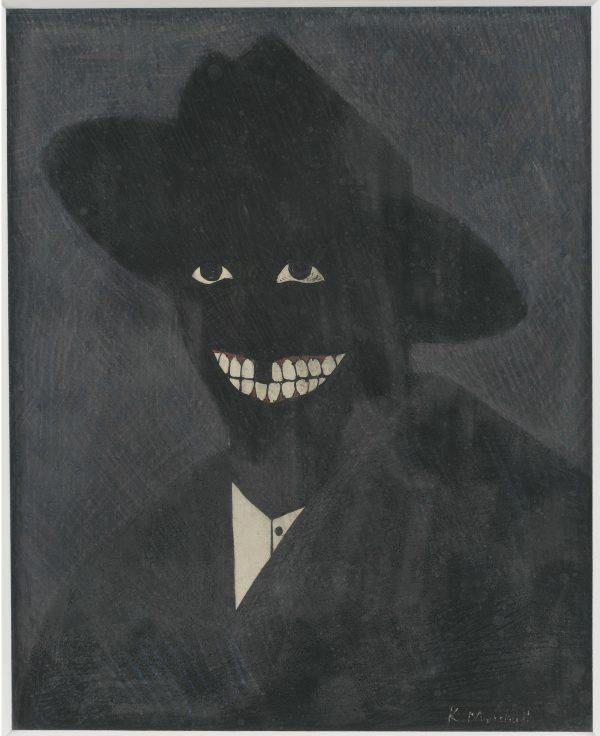
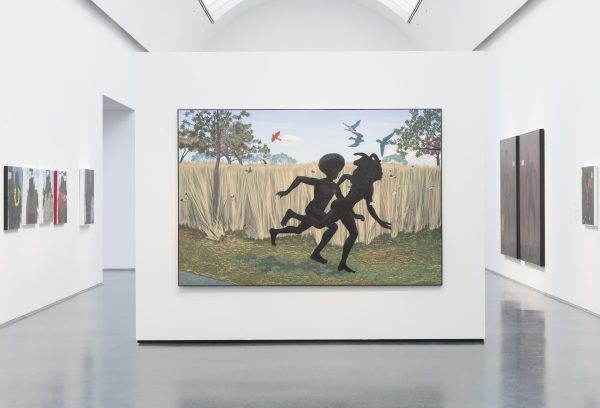
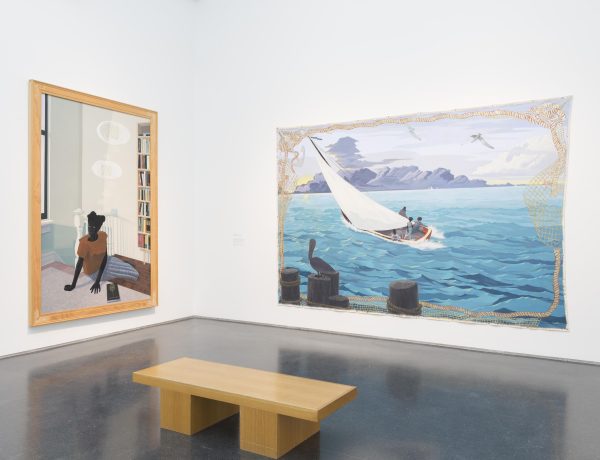
The MCA is honored to present a major museum survey of Kerry James Marshall (b. 1955), one of America’s greatest living artists. The exhibition focuses primarily on Marshall’s paintings made over the last 35 years, from his seminal inaugural statement Portrait of the Artist as a Shadow of His Former Self (1980) to his most recent explorations of African American history.
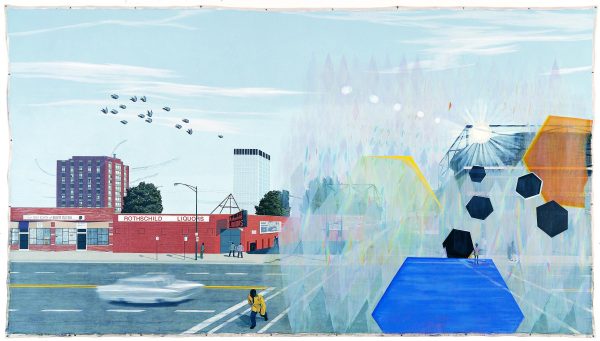
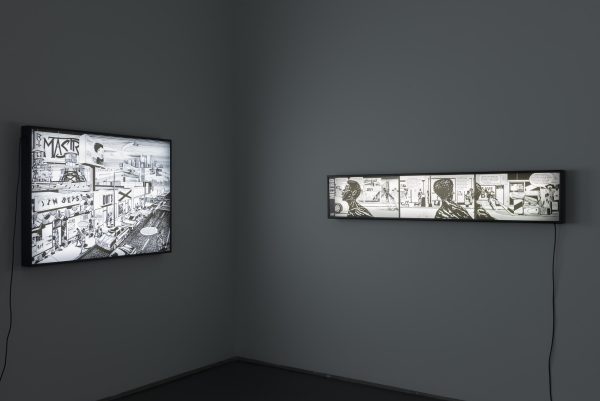
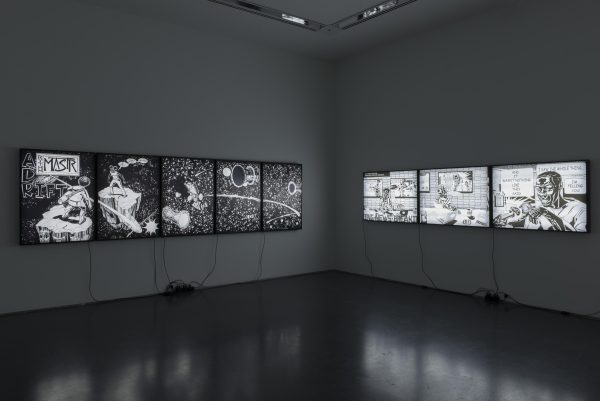
Born before the passage of the Civil Rights Act, in Birmingham, Alabama, and witness to the Watts riots in 1965, Marshall has long been an inspired and imaginative chronicler of the African American experience. Best known for his large-scale paintings featuring black figures, defiant assertions of blackness in a medium in which African Americans have long been “invisible men,” Marshall’s interrogation of art history covers a broad temporal swath stretching from the Renaissance to 20th-century American abstraction. He critically examines the Western canon through its most canonical forms: the historical tableau, landscape, and portraiture. His work also touches upon vernacular forms such as the muralist tradition and the comic book, as seen in his comics-inspired Rythm Mastr drawings (2000–present), in order to address and correct the “vacuum in the image bank”—in other words, to make the invisible visible.
Carousel: Gallery - Full Size Images
Marshall studied in Los Angeles with acclaimed social realist painter Charles White and participated in the residency program at the Studio Museum in Harlem. He has received solo exhibitions throughout Europe and North America and his work has been included in such prestigious international exhibitions as the 1997 Whitney Biennial, the 2003 Venice Biennial, the 2009 Gwangju Biennial, two Documentas (1997 and 2007)}, and the 1999 Carnegie International. His paintings are in private collections and foundations as well as major public collections including the MCA’s.
Kerry James Marshall: Mastry is co-organized with The Metropolitan Museum of Art and the Museum of Contemporary Art, Los Angeles, and cocurated by former Manilow Senior Curator Dieter Roelstraete; Helen Molesworth, Chief Curator at LAMOCA; and Ian Alteveer, Associate Curator at The Met; with the assistance of Karsten Lund, former Curatorial Assistant, and Abigail Winograd, former Research Associate at the MCA. It travels to The Metropolitan Museum of Art, October 25, 2016–January 29, 2017, and the Museum of Contemporary Art, Los Angeles, March 12–July 2, 2017.
A comprehensive monograph accompanies the exhibition, featuring essays by each of the curators; Lanka Tattersall, assistant curator at LAMOCA; as well as a new essay by Kerry James Marshall in addition to previously published essays by the artist.
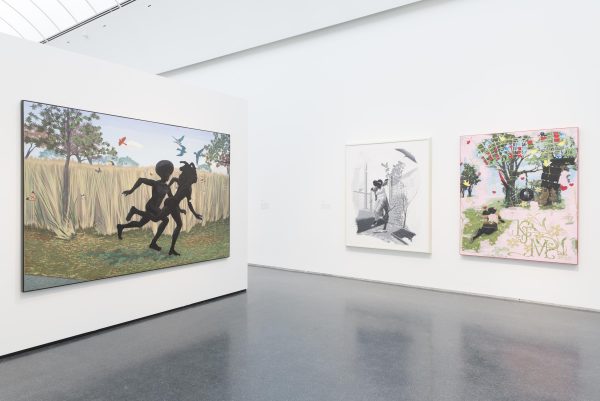
Carousel: Installation Views - Full Size Images
Related Events
-
-
-
Events
MCA Talk: Kerry James Marshall in Conversation with Sarah Thornton at EXPO CHICAGO
Sep 24, 2016
2:30 pm–2:30 pm
-
-
-
-
-
-
-
-
-
-
-
-
Gallery Text
-
For the past 36 years, Kerry James Marshall (b. 1955) has been driven by a mission to address the absence of black artists and subjects in the history of art. Like many African Americans born during the civil rights movement, Marshall’s worldview and artistic practice have been shaped by questions of racial representation. He has committed to fillingthe walls of museums with black figures, depicting black people almost exclusively and telling stories about black lives and history on a grand scale.
To compete with the great artists from past centuries while expanding the possibilities of representation, Marshall has methodically mastered a wide range of techniques and remixed almost every tradition of painting from the past 500 years. He takes on many of the genres of art—including history painting, landscape, portraiture, and abstraction—carrying the traditions of painting into the present. To do this, he incorporates references to history, pop culture, contemporary life, and his hometown Chicago. He also reenvisions how African Americans are depicted, mixing black pigments to create his own set of tones for the skin and features of his subjects. In his richly detailed paintings—complex, beautiful, and relevant to the challenges of our time—it pays to look, look closely, and look again.
The unique spelling of the exhibition’s title comes from Marshall’s Rythm Mastr, a comics series about a black superhero. Mastry alludes not only to art history’s so-called old masters and Marshall’s own mastery of art techniques but also to the relationship between slaves and masters in American history that lies at the crux of this country’s founding and resonates even today.
-
Atrium
Kerry James Marshall
(American, b. 1955)Happy Revolution Day, 2016
Vinyl wallpaper
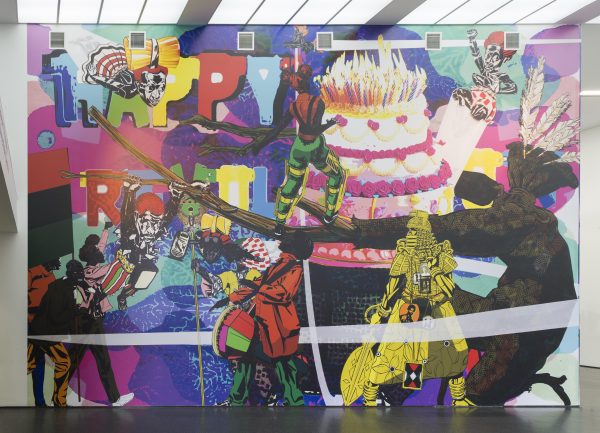
Courtesy of the artistThis mural was designed by Kerry James Marshall for the MCA’s lobby wall to accompany survey exhibition Kerry James Marshall: Mastry, on the fourth floor. The title Happy Revolution Day is obscured by a throng of activity, as people celebrate a holiday in honor of social and political change. The complex composition incorporates elements from other works by the artist, including African statuettes that come to life in his Rythm Mastr comics project and vivid splotches that echo his abstract Blot paintings. One of the pendants worn by the samurai figure bears a photo of Marshall himself as a younger man.
Room 1
Invisible Man, 1986
Acrylic on canvas
Rennie Collection, Vancouver, CanadaMarshall titled this painting after Ralph Ellison’s literary classic Invisible Man, first published in 1952. It tells the story of an African American man who recognizes that he is invisible in a racist society. Marshall has described reading Ellison’s novel as the single most powerful experience of his intellectual life. Like Ellison’s narrator, the figure in this painting is rendered as self-aware of his own invisibility, his exaggerated blackness contrasting starkly with a cartoonish, toothy grin.
Two Invisible Men (The Lost Portraits), 1985
Acrylic on board with wood frame
Collection of Martha KoplinInvisibility is Marshall’s core concern in this painting. The artist has brought together two contrasting figures as if to represent the opposite ends of the color scale, with white being the sum of all colors in the rainbow, and black being the absence of all light.
Throughout his career, Marshall has developed his own techniques for rendering black figures, using pure black pigments. Here, the figure on the right is painted in a flat black without any shading.
A Portrait of the Artist as a Shadow of His Former Self, 1980
Egg tempera on paper
Steven and Deborah LebowitzMarshall achieved a momentous breakthrough in this self-portrait, turning away from his art school experimentation with abstraction and collage to embrace representation. From this point on, he would depict almost exclusively black people in his work.
In this painting, Marshall played with the tension between visibility and invisibility, powerfully presenting a black self against the background of art history’s exclusion of black artists and subjects. From a young age, Marshall studied the great works of art history, learning a wide range of techniques and compositional strategies. This work is painted in egg tempera, an outmoded technique used in the early Renaissance.
Portrait of the Artist & a Vacuum, 1981
Acrylic on paper
Nasher Museum of Art at Duke University, Museum purchaseMarshall draws attention to African Americans’ everyday lives in this work, which includes a replica of his first painting of an “invisible man,” Portrait of the Artist as a Shadow of His Former Self. The unplugged appliance also hints at how the people responsible for cleaning are often overlooked or invisible themselves.
Silence Is Golden, 1986
Acrylic on panel
The Studio Museum in Harlem, gift of the artistThe figure in Silence Is Golden looks like a flat black shadow, nearly indistinguishable aside from the white of his eyes and teeth. The title of the painting stresses the value of silence, perhaps ironically, as the grinning figure presses his fingers to his lips.
Alongside the portrait, Marshall painted four abstract motifs. This may imply that choosing to make abstract paintings rather than portraying black individuals who have been marginalized in the history of art is itself a form of silence.
Black Artist (Studio View), 2002
Ink-jet print on paper
Collection Museum of Contemporary Art Chicago, gift of Robert and Sylvie Fitzpatrick, 2006.9Black Artist (Studio View) is one of the few photographs included in this exhibition. It depicts the artist himself, sitting in almost total darkness in front of the mural-sized painting 7 am Sunday Morning, which is displayed elsewhere in the exhibition.
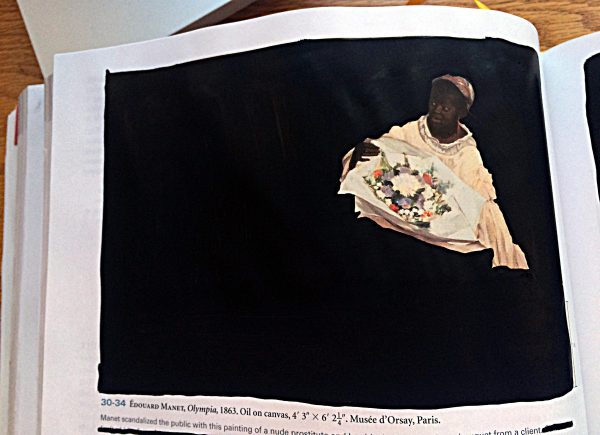
Like the other works in this gallery, this photograph addresses themes of visibility and invisibility—who is seen and who is not—and suggests that obscurity is a reality that black artists have to contend with.
Room 2
When Frustration Threatens Desire, 1990
Acrylic and collage on canvas
Collection of April Sheldon and John CasadoAt the center of this painting is a magician, levitating a woman off the ground. At his feet lie symbols or talismans of bad luck—all of which are black. Inscribed in the background, or perhaps floating in the air, are various number charts, glyphs, and voodoo vévés (ritual symbols). A newspaper ad, collaged on the right side, offers a clue to what’s at stake: it promotes the services of a fortune-teller, Sister Debra, who claims to be “The Guiding Light to your Power and Success.” When the path to a good life is thwarted or when frustration threatens desire, Marshall’s painting suggests, the supernatural may become a more attractive way.
They Know That I Know, 1992
Acrylic and collage on unstretched canvas
AnonymousMarshall reimagined the biblical story of Adam and Eve, a venerated subject in the history of European art, recasting the world’s first couple as black. The Garden of Eden appears as a grove of “family trees” labeled with different races, evoking history’s obsession with establishing ethnic lineages. Tellingly, only white faces appear among the branches, as if the heights of civilization, as once commonly conceived, exclude other people entirely.
In the biblical tale, a snake (also pictured here) tempts Eve to taste the fruit of the Tree of Knowledge of Good and Evil, and God expels the couple from Paradise. Marshall’s title They Know That I Know may suggest the moment before their fall from grace, but he does not specify what they have learned—and who is meant by “they” or “I.”
Voyager, 1992
Acrylic and collage on unstretched canvas
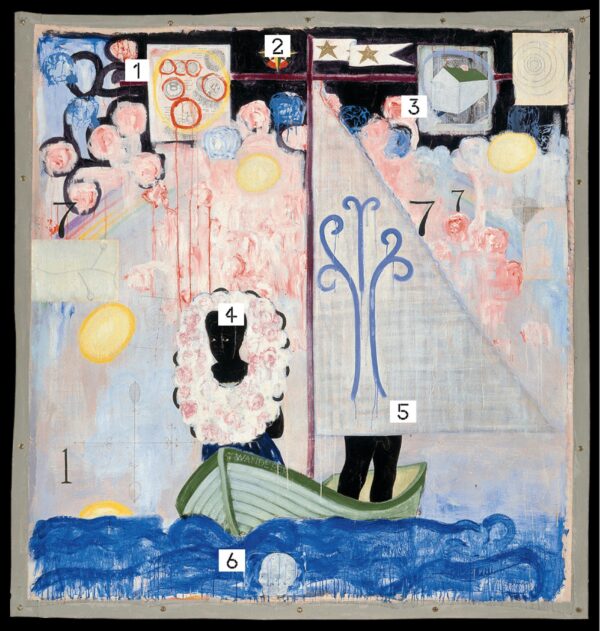
National Gallery of Art, Washington, Corcoran Collection (Gift of the Women’s Committee of the Corcoran Gallery of Art)This painting depicts the ship named Wanderer, which violated the Slave Importation Act of 1807 by bringing human cargo from Africa to the shores of Georgia. This was Marshall’s first foray into history painting, traditionally regarded as the highest academic form of visual story telling. Two black figures aboard the ship are surrounded by symbols of all types: Haitian vévés connected to voodoo practices (seen on the boat’s sail and throughout the canvas), diagrams of fetuses, a skull referencing the 60 to 80 individuals estimated to have died en route, and a shotgun house (a long, narrow house, popular in African American communities in the South that dates back to 1810). Many of these references illustrate the cultural crossover from premodern Africa to modern America.
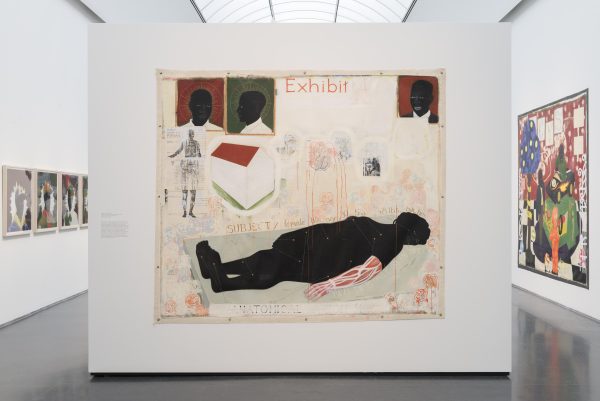
Beauty Examined, 1993
Acrylic and collage on unstretched canvas
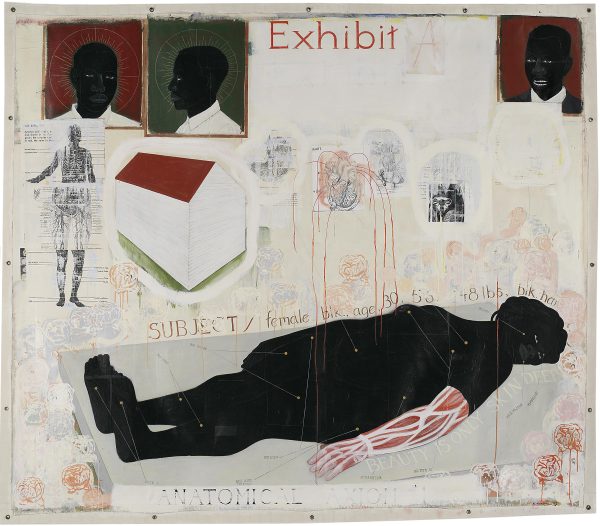
Collection of Charles Sims and Nancy Adams-SimsThis work is an early example of Marshall’s interest in updating art-historical precedents for contemporary political purposes. It is modeled in part after the famous large-scale painting by Dutch master Rembrandt van Rijn, Anatomy Lesson of Doctor Nicolaes Tulp (1632), which depicts a group of surgeons observing a public autopsy. The “beauty” examined in this particular painting, however, is that of a black woman—an anomaly in a history of art dominated by white artists and subjects. Marshall included various anatomical graphics, black portraits, and the label “Exhibit A” in the top of the canvas, as if to provide evidence in a case for black beauty, or a case against the prejudices of (white) ideals of beauty.
Room 3
Slow Dance, 1992–93
Mixed media and acrylic on unstretched canvas
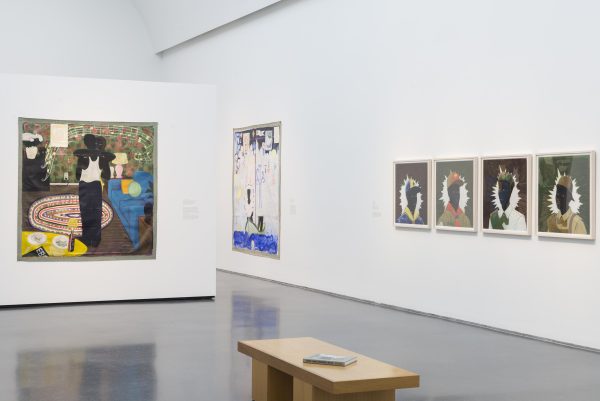
Lent by The David and Alfred Smart Museum of Art, The University of Chicago; Purchase, Smart Family Fund Foundation for Contemporary Art, and Paul and Miriam Kirkley Fund for AcquisitionsSlow Dance and Could This Be Love (opposite in this gallery) are among Marshall’s first works to foreground African American domesticity and romance. In this painting, a young couple sways in the middle of a living room while the song “Baby I’m for Real” by the Originals plays on the stereo. The everyday scene includes a half-eaten dinner on the table, as well as other details that signify a rich interior life, rife with expectation and desire.
At the same time, Marshall painted the rug at an odd angle, and a decorative pattern appears as wallpaper and a motif on the surface of the painting. These embellishments both introduce elements of abstraction and draw attention to the painting’s construction.
Brownie, 1995
Cub Scout, 1995
Scout (Girl), 1995
Scout (Boy), 1995
All acrylic, collage, and mixed media on board
Collection Museum of Contemporary Art Chicago, gift of the Susan and Lewis Manilow Collection of Chicago Artists, 2003.28–31Marshall’s portraits of boy scouts and girl scouts are depicted against radiant, halo-like backgrounds that evoke the superhero comics Marshall collected in his youth. The paintings also suggest that the sense of youthful aspiration and civic participation that scouting promises isn’t ensured as they enter adulthood.
Bang, 1994
Acrylic and oil on unstretched canvas
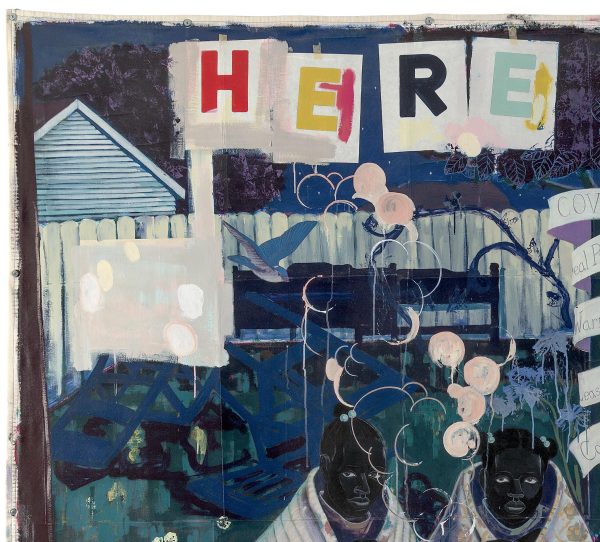
The Progressive CorporationBang depicts three African American children standing in a backyard as the sun sets over a residential neighborhood, complete with picket fences. An idealized scene of the Fourth of the July, it questions who is fully included in the life of the nation and who benefits from its greatest ideals.
The banner near the bottom of the painting evokes the proposed unity at the heart of American democracy. And yet the banner in the sky, held by doves, introduces a measure of doubt: the slogan “Resistance to Tyranny is Obedience to God” may recall the defiance of the original American colonists, but both tyranny and resistance might have different faces today.
Could This Be Love, 1992
Acrylic and collage on unstretched canvas
The Bailey Collection, CanadaCould This Be Love portrays a young couple in a well-furnished bedroom. Various details in this work—some painted, some collaged—suggest the beauty and empowerment of black women. Notice, for example, the brochure on the ground, the statuette on the nightstand, and the floating phrase “La Venus Negra” (or black Venus) above the candle. The song lyrics in the air are from Mary Wells’s 1962 Motown hit “Two Lovers.” What at first sounds like a risqué song about a woman with two lovers reveals in the final verse that it’s about two aspects of the same man.
Campfire Girls, 1995
Acrylic and collage on unstretched canvas
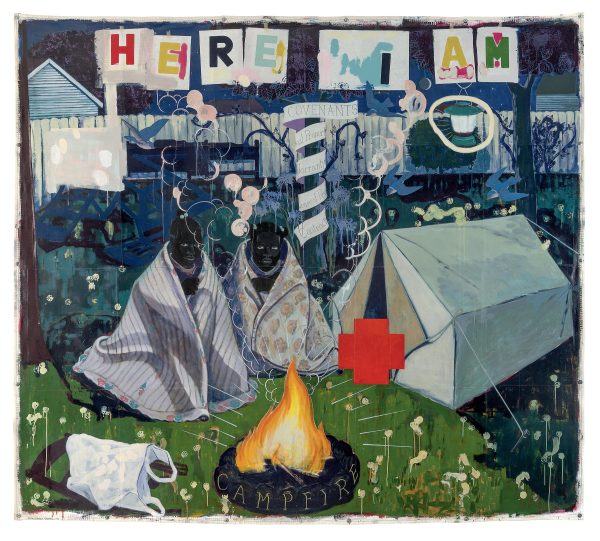
Collection of Dick and Gloria AndersonThis painting followed The Lost Boys, which was made two years earlier. The background statement “Here I Am” brazenly asserts the girls’ confidence in the life and times ahead. Set in a bucolic urban or suburban environment, pictured frequently in Marshall’s work in the mid-1990s, this painting is an early example of the artist’s interest in creating positive images of black everyday life.
The Lost Boys, 1993
Acrylic and collage on unstretched canvas
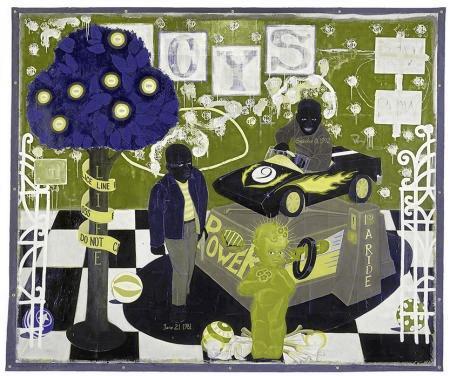
Collection of Rick and Jolanda HuntingFor much of the early 1990s, children were a recurring subject in Marshall’s paintings. The lost boys depicted here may represent the countless young black lives lost to inner-city violence. Symbols of childhood—the arcade car ride, toy balls, and letter blocks—are interspersed with signs of violence: the 9 mm bullets and “Police Line Do Not Cross” garland creeping up the Tree of Life. The scene is based on a story Marshall read in the Los Angeles Times about a boy shot by police in his home when his toy gun was mistaken for a real one. The tragedy is hinted at in the pink toy gun in the center figure’s left hand.
Room 4
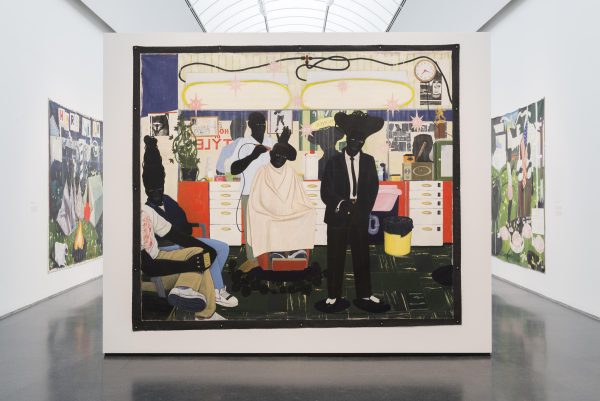
De Style, 1993
Acrylic and collage on unstretched canvas
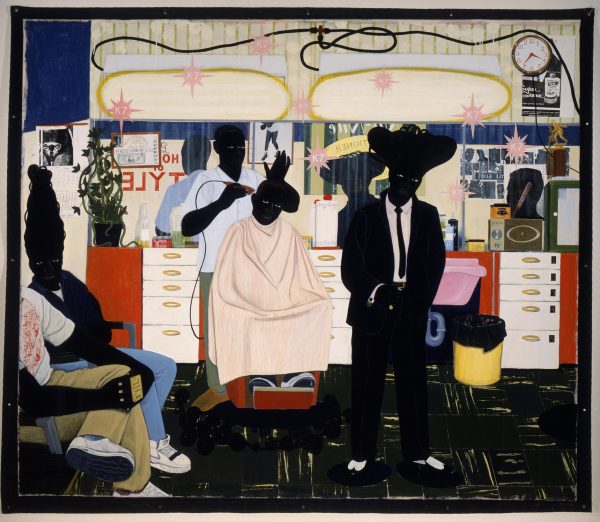
Los Angeles County Museum of Art, purchased with funds provided by Ruth and Jacob BloomDiscussing De Style, Marshall has said, “I think it’s important for a black artist to create black figure paintings in the grand tradition. Artworks you encounter in museums by black people are often modest in scale. They don’t immediately call attention to themselves. I started out using history painting as a model because I wanted to claim the right to operate at that level.”
The title echoes the name of the barbershop (visible in the mirror), but it also recalls De Stijl, the Dutch modern art movement often associated with Piet Mondrian. In fact, Marshall wove in Mondrian’s signature colors—red, blue, and yellow—as if turning the barbershop scene into one of his predecessor’s geometric abstractions.
Fittingly, given its scale and ambition, De Style was the first of Marshall’s works to enter a museum collection: the same year he completed the painting, it was acquired by the Los Angeles County Museum of Art—a museum Marshall frequented as a child.
Lost Boys: AKA Lil Bit, 1993
Acrylic and collage on unstretched canvas
Collection of Madeline Murphy RabbThis painting commemorates a “lost boy” of black America. Marshall rendered the youngster in the style of a religious icon, with a halo of graffiti and abstract markings of paint. The title of this series of works calls forth memories of the characters in J. M. Barrie’s literary classic Peter Pan, or The Boy Who Wouldn’t Grow Up (1904).
Self-Portrait of the Artist as a Super Model, 1994
Acrylic and mixed media on canvas, mounted on board
Collection of Craig Lathrop and Jennifer RoblinIn this painting from 1994, the artist portrays himself as a golden blonde supermodel. With this work, Marshall addressed the invisibility of women in a man’s world and a black person’s subjection to white standards of beauty. Like many great artists before him (from Rembrandt to Van Gogh, to Cindy Sherman), Marshall returned to the self-portrait time and again: his career in art took off with a self-portrait, he has photographed himself in the studio, and later he painted a series of portraits of painters that likewise could be seen as exercises in self-portraiture.
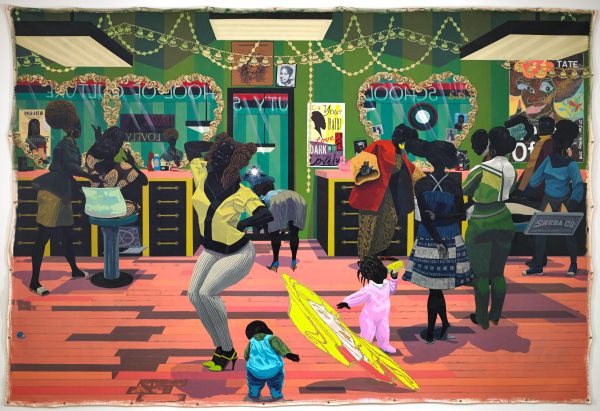
School of Beauty, School of Culture, 2012
Acrylic on unstretched canvas
Collection of the Birmingham Museum of Art; Museum purchase with funds provided by Elizabeth (Bibby) Smith, the Collectors Circle for Contemporary Art, Jane Comer, the Sankofa Society, and general acquisition fundsSchool of Beauty, School of Culture can be seen as a sequel to Marshall’s regal barbershop scene, De Style, revisiting a theme he painted nineteen years earlier. Like De Style, it translates an everyday locale into a grand history painting. It also demonstrates Marshall’s evolving mastery of the genre.
Woven amid the lively arrangement of figures are wide-ranging cultural references: The salon features posters of musician Lauryn Hill and contemporary British artist Chris Ofili. The play of mirrors recalls Diego Velázquez’s oil painting Las Meninas (1656) from the Spanish Golden Age, and the slanted shape at the bottom mimics Northern Renaissance master Hans Holbein’s The Ambassadors (1533), reimagining that painting’s distorted skull as the blonde head of Disney’s Sleeping Beauty.
Room 5
Past Times, 1997
Acrylic and collage on unstretched canvas
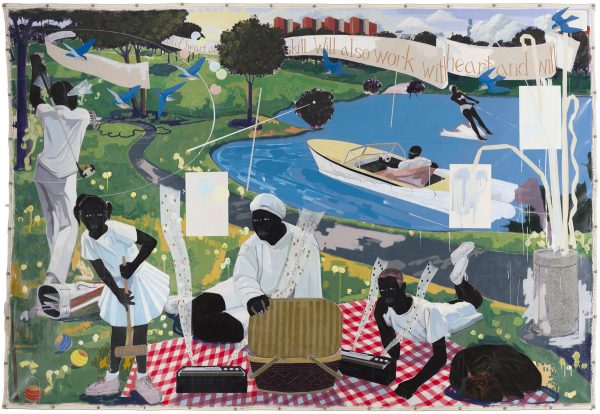
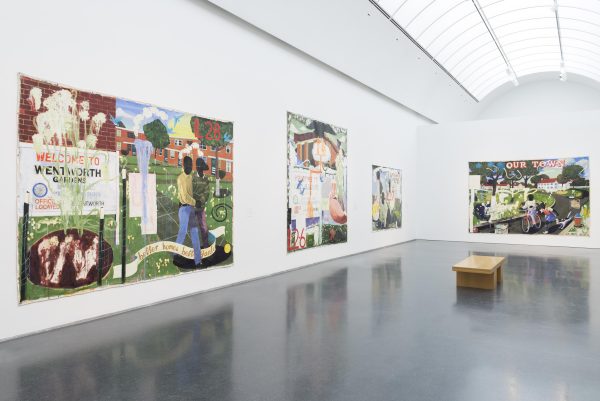
Metropolitan Pier and Exposition Authority McCormick Place Art Collection, ChicagoMarshall painted Past Times as an ode to the shared public space of the city of Chicago, identifiable by its signature buildings in the background. High-rise towers appear in the distance, but the focal point is an urban pastoral scene, filled with green grass and blue water. The African American figures—all dressed in white—are engaged in various forms of recreation.
The painting depicts leisurely pastimes, but the title points to the past. In this respect, the perfect scene might suggest a history that hasn’t happened yet or a projected desire. The family in the foreground calmly looks at the viewer as if just interrupted. The songs on their radios suggest two divergent outlooks: a runaway imagination and a reality check—“with my mind on my money and money on my mind.”
Untitled (Altgeld Gardens), 1995
Acrylic and collage on unstretched canvas
Collection Nerman Museum of Contemporary Art, Johnson County Community College, Overland Park, KansasPart of Marshall’s series of modern-day landscape paintings, this work commemorates another postwar public housing project, Altgeld Gardens on Chicago’s far South Side. The painting incorporates statistical data tracking “Aid for Dependent Children” in a pie chart to the left of the figure, alluding to the plight of those living in many such projects. Marshall has named Giorgione’s Renaissance masterpiece The Pastoral Concert (1509) as one influence among many on the conception of the Garden Project series. Marshall reimagines Giorgione’s arrangement of figures in a landscape surrounded by symbolic elements.
C.H.I.A., 1994
Acrylic and collage on unstretched canvas
Private collection, Los AngelesIn the Garden Project series, Marshall portrayed housing projects as romantic idylls—picturesque projections of what they could have been, or preludes to what they turned out to be. Rockwell Gardens, depicted here, was built by the Chicago Housing Authority (CHA) in the late 1950s on the city’s Near West Side. (It was eventually demolished, beginning in 2003.)
The title is a play on words, referring both to the CHA and Chia Pets—the terracotta animals popularized in the 1980s. In each painting in the Garden Project series, Marshall integrates specific facts about life in public housing; here the Chia Pet figurine in the lower right emanates a variety of demographic statistics.
Better Homes, Better Gardens, 1994
Acrylic and collage on unstretched canvas
Lent by Denver Art MuseumThe young black couple in this painting appear to have achieved the American dream of “better homes, better gardens.” In it, Marshall combined the tradition of landscape painting with images of black domestic bliss and romantic love. Images like this one are not normally associated with public housing projects such as Wentworth Gardens, which exists not far from the artist’s home and studio on Chicago’s South Side. Like many other paintings made during this period, Better Homes, Better Gardens features the “bluebird of happiness,” a symbol of peace, love, and harmony, in tandem with graffiti, the language of bureaucracy (IL 2-8 is the official designation of the public housing site in the state of Illinois), and signs of urban decay.
Our Town, 1995
Acrylic and collage on unstretched canvas
Crystal Bridges Museum of American Art, Bentonville, ArkansasIn this work, the largest of the Garden Project series, children frolic in the foreground on what looks like a peaceful sunny day. In the distance, their mother waves attentively, whether blessing their excursion or calling them home. Immediately to her right, however, a row of windowless white houses complicates the picture of perfect familial happiness, leading us to suspect that the title might be ironic.
Our Town is one of the last paintings in which Marshall used an intricate language of semi-abstract marks: the blotches, splotches, and splashes on the surface of the painting that are often associated with art after abstract expressionism.
Many Mansions, 1994
Acrylic on paper mounted on unstretched canvas
The Art Institute of Chicago, Max V. Kohnstamm FundIn each of the paintings gathered in this room, Marshall has mastered the art-historical genre of landscape painting to confront the failures of public housing projects in mid-twentieth-century America. He updated the romantic idealism of the landscape genre (for instance by Italian and French old masters such as Giorgione and Watteau) to depict contemporary African American realities.
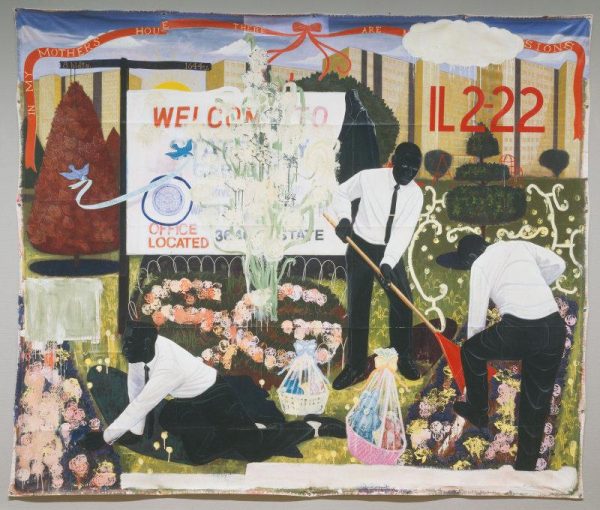
The title of this painting alludes to a biblical verse, “In my father’s house are many mansions,” (John 14:2). A group of smartly dressed young men tend a garden outside a row of public housing blocks on Chicago’s South Side. The partially obscured sign, which reads “Welcome to Stateway Gardens,” is surrounded by flowers and birds. Along with the Easter baskets, these details suggest the promise of rebirth. But looming in the background are boarded-up windows, signs of changing postwar socioeconomic circumstances that led to the public housing projects’ eventual closure.
Watts 1963, 1995
Acrylic and collage on unstretched canvas
Saint Louis Art Museum, Museum Minority Artists Purchase FundPart of Marshall’s Garden Project, Watts 1963 is the only painting in the series that features a location tied overtly to the artist’s biography. Marshall’s family relocated from Birmingham, Alabama, to the Watts neighborhood of Los Angeles in 1963, when he was nine years old.
Two years after the Marshalls moved to the public housing project Nickerson Gardens, large-scale riots broke out in the neighborhood. The arrest of a black motorist escalated tensions and led to an encounter between police and a growing crowd that drew national attention.
Room 6
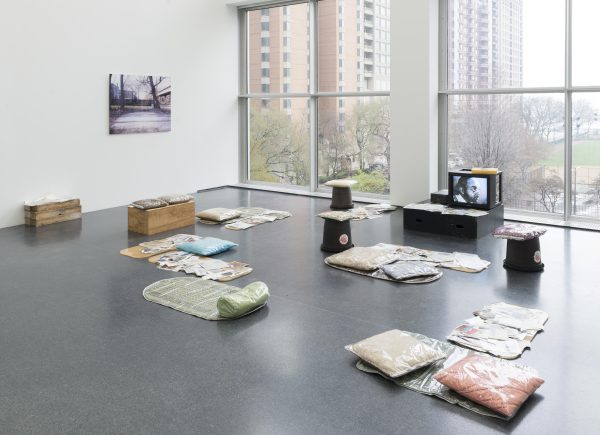
Baobab Ensemble, 2003
Milk crates, cinder blocks, found objects, and ink-jet prints on paper
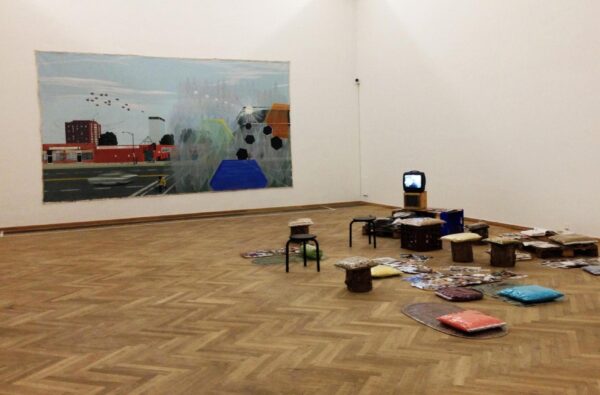
Courtesy of the artistThis room is taken over by the artist’s personal image archive, which you are invited to leaf through at your leisure. To house these materials, Marshall has created a gathering space with seating, recalling an ancient African tradition of councils meeting underneath a Baobab—a broad-trunked, tropical tree native to Africa. The images included here are culled from art history as well as the mass media. A few minutes of looking will demonstrate what Marshall has identified as the absence or invisibility of black people in our visual culture both high and low.
Room 7
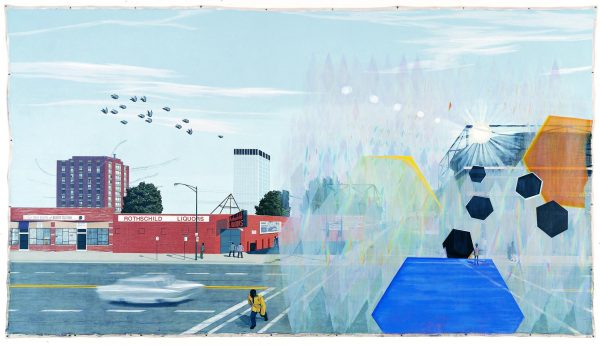
7 am Sunday Morning, 2003
Acrylic and collage on unstretched canvas
Collection Museum of Contemporary Art Chicago, Joseph and Jory Shapiro Fund by exchange, 2003.167 am Sunday Morning depicts a block of Chicago’s Bronzeville neighborhood near Marshall’s studio and is based on multiple photographs. Song lyrics rise out of the windows of an apartment building, including lines from Marvin Gaye’s “What’s Going On”; Robert Johnson’s “Cross Road Blues”; Jackie McLean’s “Dig”; and three gospel songs.
Bronzeville, a largely African American neighborhood, has a storied history. Various musicians, writers, and cultural leaders—such as Louis Armstrong, Gwendolyn Brooks, Lionel Hampton, Ida B. Wells, and Richard Wright—have lived there. Marshall chose to paint this street as he might have seen it on any bright Sunday morning, lending his attention to life there as it is today.
Heirlooms and Accessories, 2002
Ink-jet prints on paper in wooden artist’s frames with rhinestones
Lent by The David and Alfred Smart Museum of Art, The University of Chicago; Purchase, Smart Family Fund Foundation for Contemporary Art, and Paul and Miriam Kirkley Fund for AcquisitionsIn Heirlooms and Accessories, Marshall used a photograph of a lynching of two African American teenagers murdered in Indiana in 1930. He chose not to focus on the victims. Rather, he highlighted three female spectators in individual pendants that look like nooses, echoing the hanging of the two young black men and marking them as “accessories” to murder.
Memento #5, 2003
Acrylic and glitter on unstretched canvas
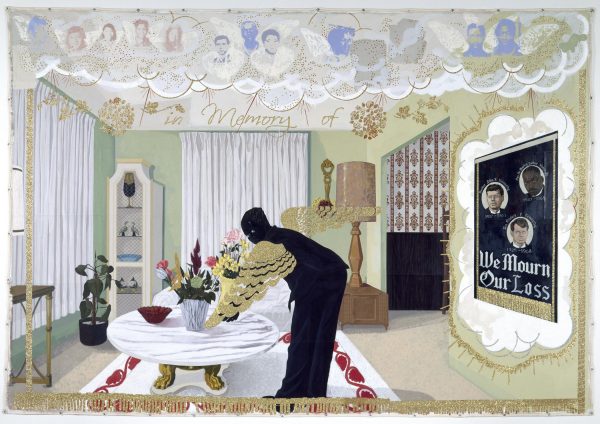
The Nelson-Atkins Museum of Art, Kansas City, Missouri (Purchase; Acquired through the generosity of the William T. Kemper Foundation—Commerce Bank, Trustee), 2003.24In Memento #5, painted six years after Souvenir I, the same historical figures appear: John F. Kennedy, Robert F. Kennedy, and Dr. Martin Luther King Jr., along with Malcolm X. Their faces hover above a female figure who appears to draw the curtain on a glorious but no less traumatic era. Both paintings demonstrate the artist’s interest in the décor and ornamentation typical of mid-century, middle-class African American homes.
Marshall’s choice of black and white and shades of gray in this work borrowed from the technique of grisaille, an early Renaissance method of rendering a scene in a single color. It also evokes a black-and-white photograph, as if it were an image from the past. The grid of glitter on the painting’s surface disrupts the nostalgic scene, drawing a curtain on the figure.
Souvenir I, 1997
Acrylic, collage, and glitter on unstretched canvas
Collection Museum of Contemporary Art Chicago, Bernice and Kenneth Newberger Fund, 1997.73After completing the Garden Project, Marshall embarked upon an ambitious new series, this time centered around the legacy and remembrance of the civil rights struggle in the mid-1960s. The artist called these paintings either mementos or souvenirs, and a sadness permeates these domestic interiors.
In Souvenir I, a figure fitted with angelic wings mourns the loss of the martyrs of 1960s American idealism: John F. Kennedy, Robert F. Kennedy, and Dr. Martin Luther King Jr. In the glittering cloud above is a phalanx of historical witnesses who bear testimony, among them Malcolm X, Black Panther activist Fred Hampton, and the four young victims of the 16th Street Baptist Church bombing that prompted Marshall’s family to leave his native Birmingham in 1963.
SOB, SOB, 2003
Acrylic on fiberglass
Smithsonian American Art Museum, Museum purchase through the Lusita L. and Franz H. Denghausen EndowmentA lone female figure gazes outward, turning away from a well-stocked library of titles related to Africans’ and African Americans’ quests for self-determination. A book on the floor in front of her is titled Africa Since 1413, a reference to the first European expeditions to Africa. The book doesn’t exist, though if it did, it would have told the many tragedies of colonial rule. The young woman seems to lament the loss of a future that never materialized—hence her “sobs” and eponymous curse, “son of a bitch.”
Room 8
Vignette, 2003
Acrylic on fiberglass
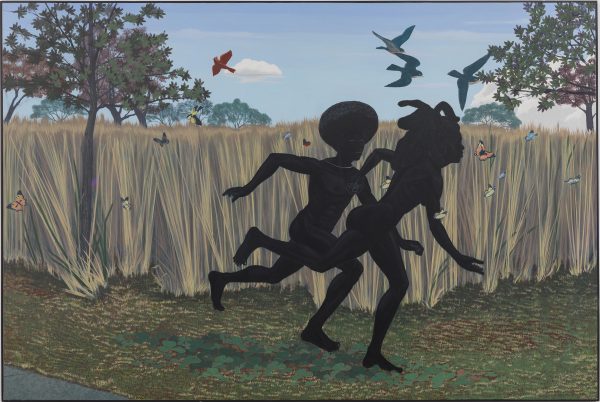
Defares CollectionMarshall’s variation on the art-historical tradition of depicting Adam and Eve is part of a series of paintings focusing on love and romance in everyday African American lives. In contrast to typical remorseful scenes of the fall from Eden (for instance, Massacio’s Expulsion from the Garden of Eden from 1425), the butterflies and bluebirds around the nude black couple foreshadow a happier outcome. Expulsion from Paradise may signal “going home” to Africa: the male figure dons a necklace with a pendant in the shape of Africa, in colors that suggest the Pan-African flag.
Untitled (Vignette), 2012
Acrylic on PVC panel
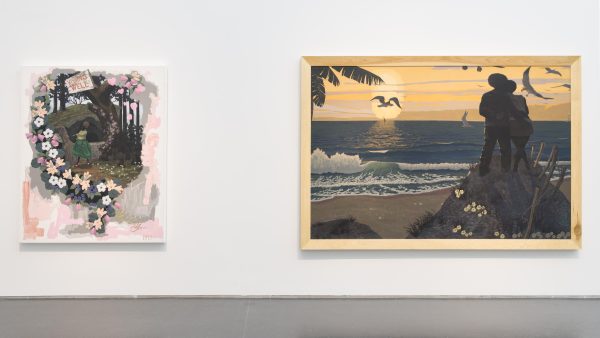
Collection of Martin Nesbitt and Dr. Anita BlanchardIn this work, part of a series of vignettes painted between 2005 and 2012, Marshall drew on the history of rococo painting, a highly decorative style of art popular in eighteenth-century Europe. Marshall used rococo elements, such as the pastel palette, and the romantic subject of a couple lying on a lush carpet of a grass, along with artist’s signature in glitter, to produce an idyllic scene of black life. The notes floating alongside birds and hearts, identifiable as music to Stevie Wonder’s “My Cherie Amour,” add to the sentimentality of the scene. In contrast, Marshall inserted symbols of black resistance, such as the closed fist atop the woman’s pink Afro comb and the Pan-African flag leaning against the tree to complicate this otherwise saccharine image.
Vignette IV, 2005
Acrylic on PVC panel
Susan and Lew ManilowVignette (Wishing Well), 2010
Acrylic on PVC panel
Collection of Nick CaveMarshall’s Vignette paintings lavish attention on scenes of African American love and romance, a type of subject matter that has largely been excluded from the history of Western painting. In these works, Marshall irreverently employed an ornamental style and an effusive sentimentality in the spirit of rococo paintings from eighteenth-century Europe. Notably, the rococo period brought about new ideas about love and marriage (now easy to take for granted) with a greater emphasis on individual freedom.
Gulf Stream, 2003
Acrylic and glitter on unstretched canvas
Collection Walker Art Center, Minneapolis, T. B. Walker Acquisition Fund, 2004This work is named after the dramatic maritime tableau by American realist painter Winslow Homer, The Gulf Stream (1899), which depicts a rudderless boat manned by a solitary black man on a rocky sea surrounded by sharks. Marshall’s seascape, in contrast, presents a sunny scene of four black figures at leisure on calm waters. It belongs to a series of works in which Marshall countered the dominant negative depictions of contemporary black life with images that are emphatically upbeat.
Untitled, 2008
Acrylic on fiberglass in artist’s pine frame
Private collection, courtesy of Segalot, New YorkIn this painting, Marshall embraced kitsch—the overdone, gaudy, or sentimental style of art, often ironically appreciated for its lowbrow quality. The painting’s primary intent, however, is dead serious: to show pictures of black love rarely found in mainstream media depictions of African American lives.
Room 9
Rythm Mastr, 1999–ongoing
Lightboxes, ink-jet prints on Plexiglas
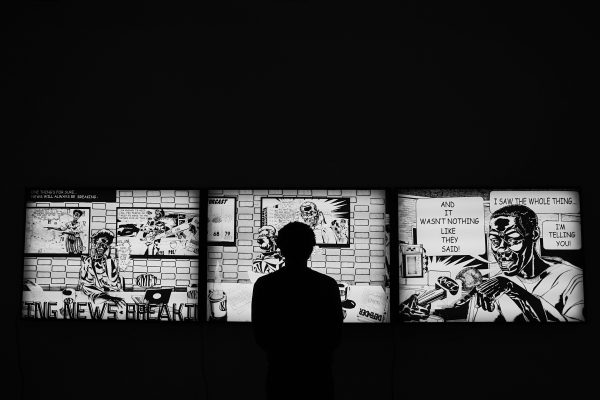
Courtesy of the artistMarshall approached another art historical genre in Rythm Mastr, an evolving comics project that weaves an epic tale involving African American characters. The saga unfolds in Chicago, based on a single neighborhood around Marshall’s studio, where the city’s housing projects were being closed. A rich variety of storylines—some fantastical, some familiar—emerge from this often-neglected urban context.
Rythm Mastr has appeared in different formats since 1999, including a serial in the Pittsburgh Post-Gazette, and in various art publications. Marshall intends to turn the series into a graphic novel and ultimately an animated feature film. Conceived to transition to the big screen, the panels in the strips have a widescreen format and are displayed in illuminated lightboxes to give them a cinematic feel.
Room 10
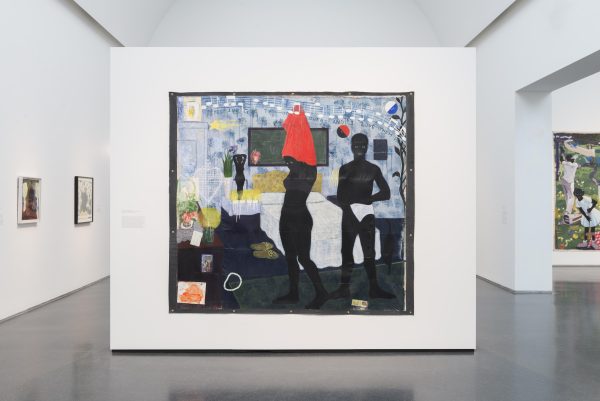
Black Painting, 2003–06
Acrylic on Plexiglas
Private collection, courtesy of the Blanton Museum of Art, Austin, Texas, and Jack Shainman Gallery, New YorkMarshall’s first explorations of monochrome abstraction, an approach to painting popularized in the 1950s and 1960s by Ad Reinhardt and Barnett Newman among others, resulted in this aptly titled black tableau. Black Painting is an early example of the tension between abstraction and representation in Marshall’s work. Marshall infused the all-black canvas with details drawn from recent black history, specifically the civil rights and Black Power movements. Look for two almost invisible figures in the bed, the banner bearing the silhouette of a black panther in the top right, and the book by political activist Angela Davis on the nightstand to the left.
The Actor Hezekiah Washington as Julian Carlton, Taliesin Murderer of Frank Lloyd Wright Family, 2009
Acrylic on PVC panel
Hudgins Family, New YorkIn many of his portraits of real people, Marshall affirms the long history of resistance to slavery and inequality. At times he also examines the role violence has played in the pursuit of liberty. In this painting, Marshall raised the specter of violence more ambiguously and indirectly.
Julian Carlton, a servant of Frank Lloyd Wright, set fire to the famed architect’s estate, killing members of his family. Marshall chose not to depict Carlton himself, however, offering instead a portrait of Hezekiah Washington—a fictional actor playing Carlton in front of a backdrop of Wright’s designs. Washington inhabits the unseemly role of the murderer with a hard gaze directed downward, as if to suggest that even pretending to be a black man killing a white man is taboo.
Frankenstein, 2009
Acrylic on PVC panel
Private collection, courtesy of David Zwirner, New York/LondonBride of Frankenstein, 2009
Acrylic on PVC panel
Private collection, courtesy of David Zwirner, New York/LondonThese two paintings challenge conventional conceptions of beauty and its relative opposite, monstrosity, read through the literary prism of Mary Shelley’s 1818 classic of gothic literature, Frankenstein. The double portrait also has art-historical precedents, most notably Lucas Cranach the Elder’s early sixteenth-century portraits of Adam and Eve. The virtuous biblical pair are rendered here as a monster and his bride, recalling retrograde social conceptions of blackness as somehow deviant.
Still Life with Wedding Portrait, 2015
Acrylic on PVC panel
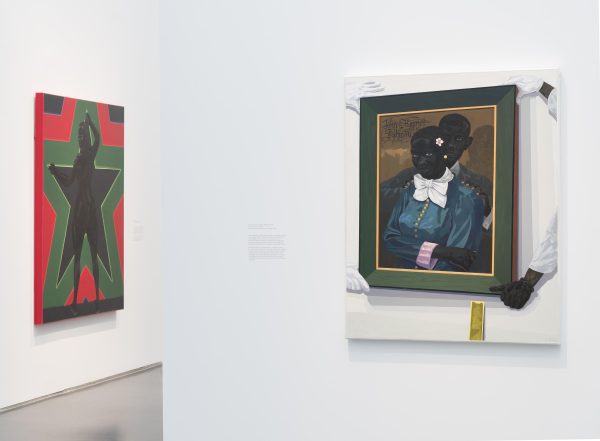
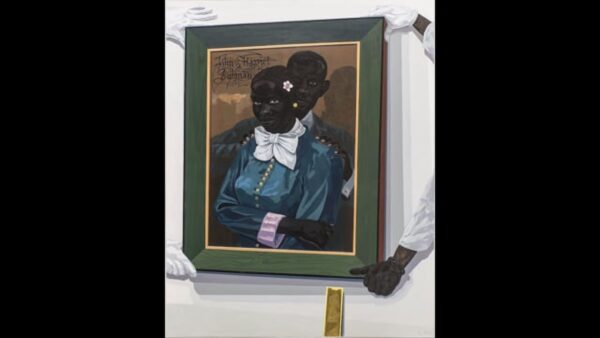
Jay and Gretchen Jordan, Chicago, IllinoisIn this painting, Marshall imagined a wedding portrait of a young Harriet Tubman—the famous abolitionist and escaped slave—and her first husband, John. Marshall hinted at Tubman’s interior life, presenting her as someone’s beloved wife and not simply the stalwart resistance hero portrayed in standard histories. At the same time, Marshall also connected Tubman to more recent events. Four hands position the couple’s portrait on the wall: three wear the standard white gloves used for handling art, but the fourth is clad in leather, reminiscent of the black-gloved salute that the athletes Tommie Smith and John Carlos raised in protest while receiving medals at the 1968 Summer Olympics.
Portrait of Nat Turner with the Head of His Master, 2011
Oil on canvas
Private collection, courtesy of Segalot, New YorkThis portrait is part of a series of paintings depicting historical black figures. Nat Turner led an 1831 slave rebellion in Virginia that resulted in the deaths of sixty people, including his white owner. Turner defiantly confronts the viewer head-on, nonchalantly holding a bloodied axe, with the severed head of his former master on the pillow behind him. Marshall’s painting recalls Renaissance and Baroque depictions of heroicized biblical decapitations, such as David with the head of Goliath or Judith with the head of Holofernes.
Stono Group; “Jemmy Cato,” 2012
Stono Group; “Jemmy,” 2012
Stono Group; “J. C. Kato,” 2012
Stono Group; “Kato,” 2012
All acrylic on PVC panel
Private collectionThe paintings here commemorate the Stono Rebellion, a slave uprising near Charleston, South Carolina, in 1739. After killing many of the whites opposing them, most of the participants were killed themselves. All four portraits depict the same person, the revolt’s captured leader, who was identified by different names. The series pictures him on the gallows at dawn, the sky growing brighter as his execution draws near.
The clothing recalls the type worn by the sixteenth-century European royals—more typical subjects of grand portraits like these. The red, black, and green motif comes from the Pan-African flag designed by Marcus Garvey in the 1920s, here they connote Black Power and solidarity.
Room 11
Portrait of a Curator (In Memory of Beryl Wright), 2009
Acrylic on PVC panel
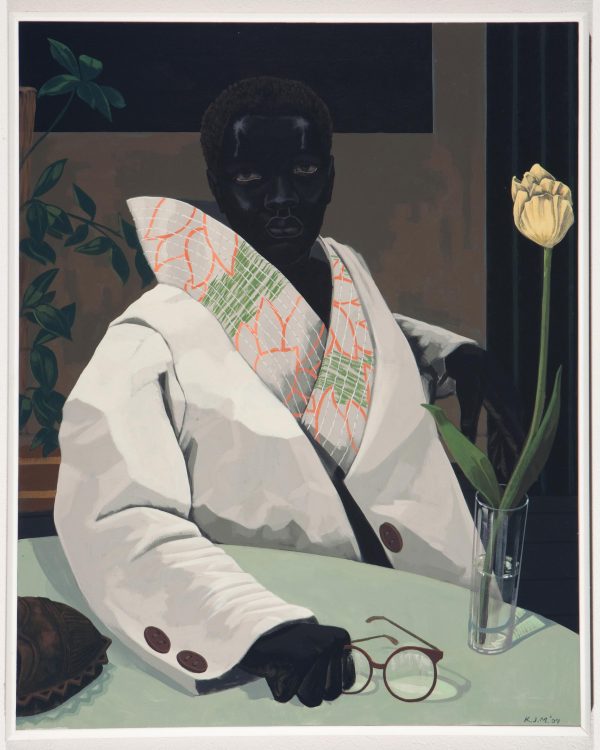
Penny Pritzker and Bryan Traubert CollectionMarshall’s Portrait of a Curator (In Memory of Beryl Wright) presents an elegant woman with a strong gaze, seated casually beside a yellow tulip. This work diverges from his other paintings of real people, in part because it depicts a contemporary figure rather than someone from the more distant past. Marshall dedicated this portrait to Beryl Wright, a pioneering African American curator who worked at the MCA from 1991 to 1994 and advocated for black artists during her career before ending her own life in 2000.
Untitled (Painter), 2010
Acrylic on PVC panel
Harvard Art Museums/Fogg Museum, Richard Norton Memorial Fund and purchase through the generosity of Nancy B. TiekenIn this painting, the African American artist holds up an oversized palette, which at a glance looks like an abstract painting in the middle of the figurative portrait. The great promise attached to modernist abstraction in the twentieth century often meant something different for artists of color.
As Marshall has observed, many African American artists held “a belief that abstraction would emancipate them and their artworks from racial readings.” This notion of abstraction as a means of achieving artistic freedom shadows all of the painters in Marshall’s series. At the same time, his very choice to depict them embodies an inverse belief—foundational to his work—in the vital importance of populating museums with black figures.
Untitled (Painter), 2010
Acrylic on PVC panel
Susan and Lew ManilowThis painter, like the others depicted in this gallery, is working on paint-by-number set. At first this might seem to belittle him as a hobbyist, but the paint-by-number system enables anyone to paint—even those who never thought they had the ability to make art. By not following the prescribed colors, these artists are also making the system their own.
Paint by number is a cultural phenomenon that arose in the 1950s, alongside the stirrings of the civil rights movement. Attuned to this meaningful coincidence, Marshall conjured the presence of African American artists who are seen painting themselves into being.
Untitled (Painter), 2009
Acrylic on PVC panel
Collection Museum of Contemporary Art Chicago, gift of Katherine S. Schamberg by exchange, 2009.15“What does an artist look like?” This basic question underlies Marshall’s portraits of African American painters, and its answer can’t be taken for granted. In this series of works, Marshall has given black artists a commanding presence, especially important in the case of black women artists, who have been doubly overlooked.
Marshall’s paintings of artists are not portraits so much as idealizations of the artist in his or her studio. They portray majestic figures, palette in hand, who stare confidently at the viewer. By picturing these idealized figures, Marshall works to redress the historical absence or omission of black artists.
Scipio Moorhead, Portrait of Himself, 1776, 2007
Acrylic on PVC panel
Courtesy of Paul and Dedrea GrayIn this painting Marshall created an imagined self-portrait of a real African American artist, Scipio Moorhead, who was active in the 1770s. Few if any images of Moorhead exist in the historical record. Everything we know of his legacy is based on Phillis Wheatley’s first book of poetry, published in 1773 while she was a slave in Boston. The book’s title page illustration is an engraving of the writer, reportedly modeled on a painting by Moorhead. The engraving remains the only visual proof, however tenuous, of Moorhead’s existence. Marshall’s fictional scene creates a parallel between the painter and the poet, each glimpsed in the act of creation.
Room 12
The Land That Time Forgot, 1992
Acrylic and collage on canvas
Columbus Museum of Art, Ohio; Museum Purchase, The Shirle and William King Westwater Fund and the Derby FundThis painting was created in 1992, two years before the official end of the Apartheid regime in South Africa. It includes a portrait of the seventeenth-century Dutch founder of Cape Town Jan Van Riebeeck in the top right corner, amidst references to diamond and gold mining—South African industries that depended on white exploitation of black labor. The springbok portrayed in front of the entrance to a gold mine is rendered in the style of the martyred Saint Sebastian seen in many Renaissance paintings; other references include hunting scenes that were a popular motif for Renaissance and Baroque tapestries.
Stigma Stigmata, 1992
Acrylic and collage on luan panel
Collection of Eric and Cheryl McKissackIn Stigma Stigmata, a black woman with a glowing halo and scratches on her face is painted in the style of a medieval icon. Images of two white women—taken from the covers of vintage Harlequin Romance novels and a frequent motif in Marhall’s works—take the place of saints looking down on her from the upper corners. The title conflates two related words: stigma signals a mark of disgrace in society associated with a certain quality or action, while stigmata has a religious connotation, recalling the holy wounds of those blessed by God.
The cross is the quintessential Christian symbol, but in this form, as a red cross, it is associated with care of the sick or wounded, and used by the international humanitarian organization of the same name.
Chalk Up Another One, 1992
Acrylic and collage on chalkboard
Rennie Collection, Vancouver, CanadaChalk Up Another One is one of a number of early works in which Marshall painted on a found object—in this case a chalkboard—rather than on canvas. With eyes rolling back in his head, the figure appears in a state of ecstasy or duress, while red concentric circles on his forehead resemble both a target and a seer’s third eye.
On the surface of the chalkboard, Marshall has pasted an illustration of a human heart from a medical textbook, while the handwritten text on the chalkboard lists college football bowl games and network news channels. The painting brings together these pieces with a degree of ambiguity, and the title might refer either to a victory or another victim of an unspecified plight.
Woman with Death on Her Mind, 1990
Acrylic and collage on book cover
Collection of Charles Sims and Nancy Adams-SimsWoman with Death on Her Mind, like other paintings Marshall made in the 1990s, reimagines traditional religious paintings while hinting at the supernatural powers of art. Painted on a book cover, it may bring to mind the Book of Psalms or other devotional texts, while also nodding to folk artists who used whatever materials were close at hand.
The imagery in the painting echoes a number of traditions from the history of art: the skull evokes seventeenth-century Dutch still lifes, which often feature symbols of death to prompt contemplation of mortality. The ornate gold background recalls Byzantine icons, early Christian depictions of sacred figures used in prayer.
The Ecstasy of Communion, 1990
Acrylic and mixed media on leather
Collection of Betye SaarMarshall stated early on in his career that “all great art was in essence religious art.” In the late 1980s and early 1990s, he began working on a series of paintings featuring religious motifs borrowed from Western art history. The black saint portrayed in this painting is modeled on the martyred Saint Sebastian, who was frequently portrayed in Renaissance and Baroque masterpieces being pierced by arrows. Marshall depicted the figure’s heart as a Haitian voodoo symbol and used the target shape to evoke a religious icon’s halo. The bull’s-eyes conjure the mid-twentieth-century paintings of Jasper Johns and Kenneth Noland.
The Face of Nat Turner Appeared in a Water Stain (Image Enhanced), 1990
Mixed media on wood
Eliot and Kimberly Perry CollectionNat Turner led a rebellion of slaves and free blacks in Southampton County, Virginia, in 1831. Born into slavery in 1800, Turner claimed to have received messages from God in the form of visions and signs in nature. Marshall effectively turned Turner into “Saint Nat,” as if his portrait miraculously appeared in the wood grain (as the label states), like the apparitions of Jesus in the Shroud of Turin and on Veronica’s Veil.
So This Is What You Want?, 1992
Acrylic and collage on unstretched canvas
Collection of Daryl Gerber Stokols and Jeffery M. Stokols, Aventura, Florida, and Chicago, IllinoisContinuing Marshall’s exploration of religious symbolism, this painting depicts a young black woman with a halo around her head—the trademark of a saint. Appearing naked, with a red cross over her heart, Marshall’s saint holds up a diagram of a woman’s uterus from a medical textbook, while the small faces of four white women float around her. These contrasting elements, both collaged and painted, complicate the representation of a sacred figure and could have a variety of meanings—suggesting the intrusion of cultural pressures, societal prejudice, desire, or doubt.
Eschu from the African Powers series, 1989
Woodcut and monoprint on paper
Collection of the artistEschu (or Eshu), depicted in this image, is the Yoruba deity of crossroads or transitions (originating from an area that is now Nigeria and Benin). During the course of the transatlantic slave trade, the figure of Eschu was merged with that of a Catholic saint, meaning that this god of crossing also made a passage between cultures.
In the 1980s, Marshall methodically explored a range of techniques, developing his tool kit as an artist. The woodcut technique, used here, is often associated with Albrecht Dürer, one of the leading artists of the Northern Renaissance.
The Archeologist’s Dream: Fossil Prints of Early Man Awash in Moonlight, 1982
Collage
Collection of the artistAt the End of the Wee Hours, 1986
Cut-paper collage, acrylic, and charcoal on paper
Collection of the artistMarshall has described his early experiments with collage as efforts to better understand how pictures are made. Collage as a method—the combination of elements from different sources—continues to be fundamental to his work. In more recent paintings, Marshall mixed various references (from art history, American history, or pop culture) within a single image in a way that is still founded on the unifying logic of collage.
The titles of these two early collages also suggest the scope of Marshall’s cultural interests and knowledge. The Archeologist’s Dream alludes to the study of ancient cultures through their material remains. The title At The End of the Wee Hours recalls the refrain from an influential book by anticolonialist poet Aimé Césaire.
Room 13
The Academy, 2012
Acrylic on PVC panel
Collection of Dr. Daniel S. BergerThe black figure’s militant pose is modeled after an iconic photograph of black athletes John Carlos and Tommie Smith raising their gloved fists during the 200-meter race medal ceremony at the 1968 Olympic Games in Mexico City. Marshall transposed this enduring symbol of the Black Power movement from Olympic runners to an artist’s model posing in the studio or classroom—primary sites of artistic production—asserting black subjects and challenging white standards of beauty and nobility.
On Sale Black Friday, 2012
Acrylic on board
Private collection, ChicagoMarshall has said of this abstract work and a similarly titled painting Buy Black (both were exhibited in a New York gallery show titled Dollar for Dollar) that he was “looking at the way that the artwork as a commodity announces itself as a thing to be bought.” As such, these works constitute another dimension of the artist’s ongoing dialogue with art history and the art market—rendered in a color palette that was chosen for its political overtones—to question the confluence of money, power, agency, and visibility.
Small Pin-Up (Fingerwag), 2013
Acrylic on PVC panel
Private collectionIn this painting, Marshall wags a finger at the racial bias of pop culture, one that privileges white standards of beauty. The figure, although titled after the typical pin-up model, does not wear the conventional lingerie or assume the smiling pose of a seductress. Her confident gaze and admonishing gesture establishes her as a subject who refuses to be objectified.
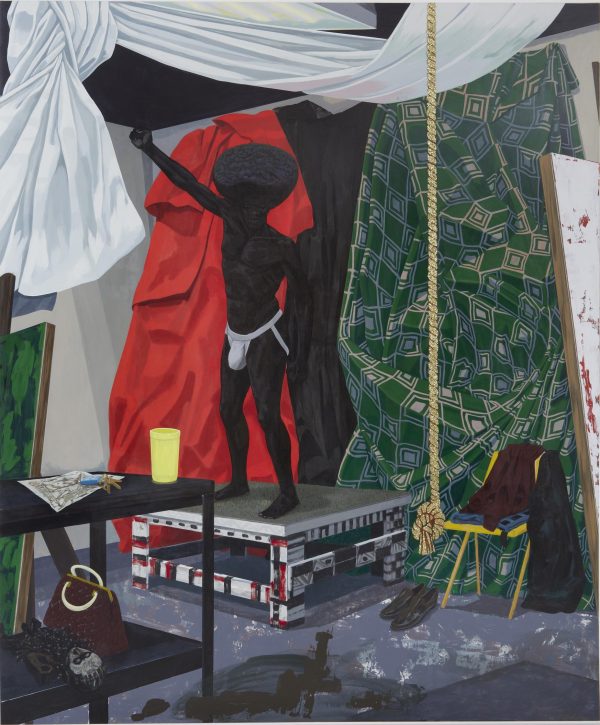
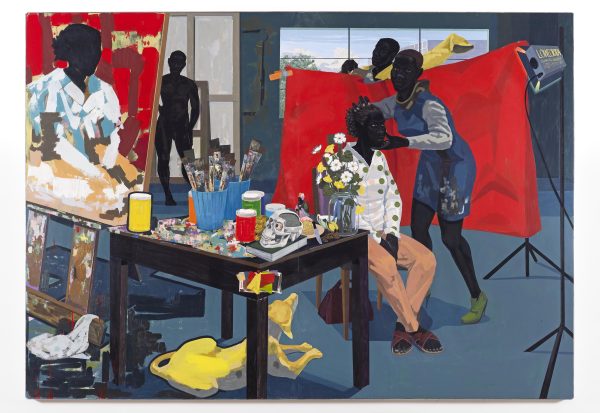
Untitled (Studio), 2014
Acrylic on PVC panel
The Metropolitan Museum of Art, New York. Purchase, Jacques and Natasha Gelman Foundation Gift, Acquisitions Fund and the Metropolitan Museum of Art Multicultural Audience Development Initiative Gift, 2015In this painting, Marshall continued the tradition of artists painting their studios or themselves at work, in particular referencing classic examples by Diego Velazquez, Las Meninas (1656), and Gustave Courbet, The Painter’s Studio (1855). With models posing and traces of the painter’s work—paintbrushes, lighting, stacked canvases—throughout the image, evidence of the artist’s presence remains. Yet Marshall’s tableau appears to be missing an artist. In portraying the studio, the artist not only depicted the site of art production but also the place where art history can be written—and revised.
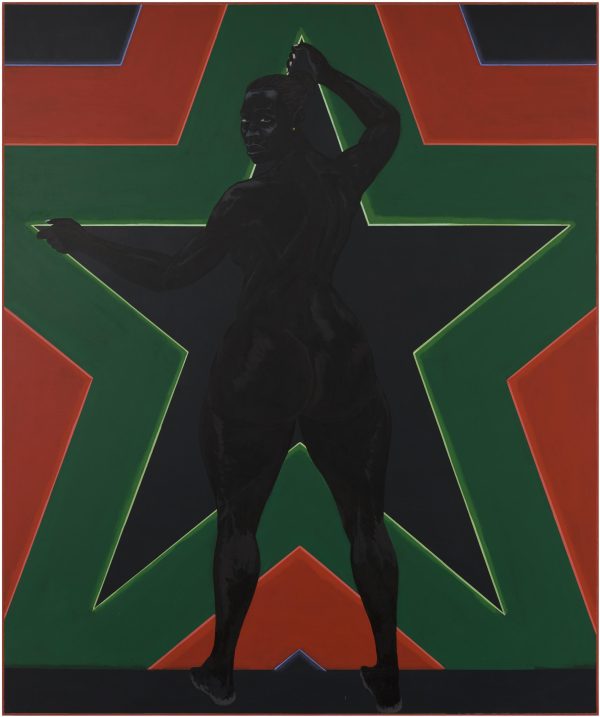
Black Star 2, 2012
Acrylic on PVC panel
Collection of Liz and Eric LefkofskyMarshall titled this work after the Black Star Line, a shipping company established by the political visionary Marcus Garvey, founder of the Universal Negro Improvement Association, in 1919 to transport people back to Africa and promote trade of African goods. Ships sailing under the Black Star Line flag later became potent symbols of the Back-to-Africa movement.
The geometrical patterning references mid-twentieth-century art history, in particular Frank Stella’s black-and-white paintings. The female figure asserts herself, however, as the painting’s real star, in this confident, defiant celebration of black beauty.
Room 14
Untitled (Mirror Girl), 2014
Acrylic on PVC panel
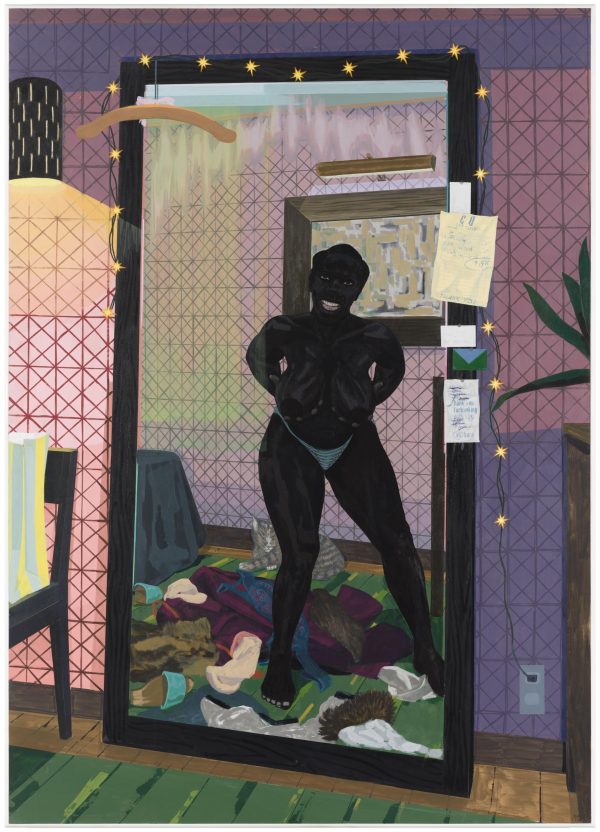
Museum of Contemporary Art Chicago, gift of Marshall Field’s by exchange, 2015.8As Marshall has observed, images of the black body as traumatized are common, but it’s rare to see representations of black people as self-satisfied individuals. In this painting, that’s exactly what is shown: a woman stands in front of her bedroom mirror, confident and pleased—she’s not posing for anyone but herself.
This work, like others in this gallery, represents a black subject involved in creating her own image, an image associated with beauty, desire, or joy. In doing so, Marshall has also drawn attention to the act of looking, setting up a complicated negotiation in the painting between the subject, the viewer, and the artist himself.
Untitled (Beach Towel), 2014
Acrylic on PVC panel
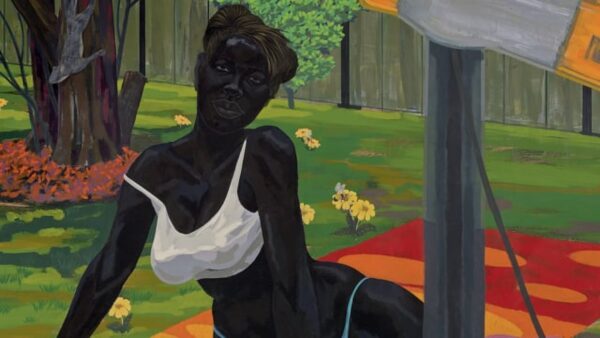
Private collection; courtesy of David Zwirner, New York/LondonIn this painting, the reclining woman appears to be the subject of a photo shoot—the pole and orange clamp in the foreground suggest a setup for lighting. As Marshall has explained, she is actively participating in how she is portrayed, presenting herself to the photographer to be made into an image of desire.
In this and other recent paintings, Marshall has chosen to depict mundane scenes. These subjects reaffirm the normalcy of black lives and even find glamour in the ordinary. The challenge, in his view, is to make it so that images like this become unexceptional—subjects you can expect to see in museums and everywhere else.
Untitled (Club Couple), 2014
Acrylic on PVC panel
Collection of Mandy and Cliff EinsteinClub Couple captures a moment when a young man is about to propose. The stylish couple looks out at the viewer as if smiling for a friend’s camera, as the man holds a ring box behind his companion’s back. The square format of the canvas may bring to mind an Instagram photo.
This painting continues Marshall’s attention to black romance, echoing the Vignettes that appear earlier in the exhibition. Marshall is attempting to build a rich legacy of pictures depicting ordinary African Americans engaged in universal activities, both mundane moments and milestones. The paintings are beautifully, meticulously made, with complex compositions, requiring all the skills and knowledge of the medium that Marshall has developed over time.
Untitled (Blot), 2014
Acrylic on PVC panel
Rennie Collection, Vancouver, CanadaUntitled (Blot), 2015
Acrylic on PVC panel
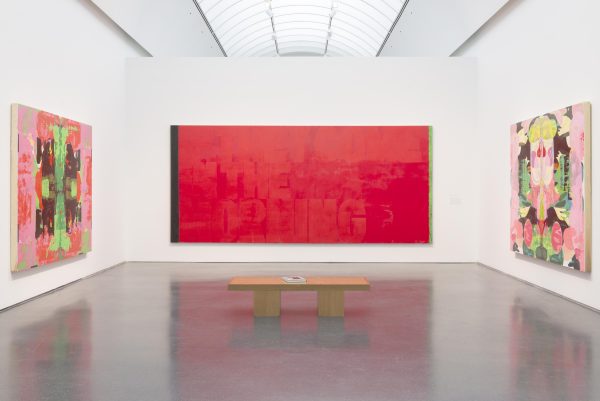
Collection of Guy LalibertéThese paintings resembling giant Rorschach-test blots were first shown in Marshall’s 2014 solo exhibition titled Look See, which posed the question of what it means to see and be seen. These blots may look like free-form abstractions but they are, in fact, meticulously executed representations of abstraction rather than the real thing. As Marshall has explained, “A blot is not an abstraction, really, because we know what it is. It’s a blot. And a blot is a particular kind of figure.”
Red (If They Come in the Morning), 2011
Acrylic on canvas
Rennie Collection, Vancouver, CanadaThis painting is one part of a triptych titled Who’s Afraid of Red, Black and Green—a reference to color field painter Barnett Newman’s Who’s Afraid of Red, Yellow and Blue (1966–70). Marshall’s color scheme is political: red, black, and green are the colors of the Universal Negro Improvement Association and African Communities League founded by political visionary Marcus Garvey in 1914. The pan-African flag has long symbolized African Americans’ aspirations for freedom and equality. Emerging from the red surface are words taken from a letter that American author James Baldwin wrote to political activist Angela Davis while she was in prison. Davis later used the phrase as the title of an anthology of revolutionary writings.
Related Content
-
Exhibition Website
Featuring a chronology, works in detail, and essays from the catalogue -
Books
Kerry James Marshall: Mastry
Hardcover; 288 pages. Copublished by The Museum of Contemporary Art Chicago and Skira Rizzoli, New York. -
-
-
Articles
Kerry James Marshall's Question
-
Articles
A Kerry James Marshall Playlist
-
-
Video
Kerry James Marshall: Harriet Tubman
Kerry James Marshall explains his decision to paint Harriet Tubman alongside her first husband John Tubman. -
Video
Kerry James Marshall: Portrait Black
In his Chicago studio, Kerry James Marshall shows us the seven customized shades of black he uses to paint his nuanced figures. -
-
-
-
-
-
Articles
Kerry James Marshall Outtakes
Our video editors picked out great footage left on the cutting room floor when producing the Kerry James Marshall: Mastry documentary. -
-


Funding
Lead support for Kerry James Marshall: Mastry is provided by the Harris Family Foundation in memory of Bette and Neison Harris: Caryn and King Harris, Katherine Harris, Toni and Ron Paul, Pam and Joe Szokol, Linda and Bill Friend, and Stephanie and John Harris; R. H. Defares; Andrea and Jim Gordon; the George Lucas Family Foundation; Liz and Eric Lefkofsky; Helen and Sam Zell; and Nancy and Steve Crown.
Major support is provided by The Andy Warhol Foundation for the Visual Arts; The Bluhm Family Foundation; David Zwirner, New York; the Ford Foundation; the Jacques and Natasha Gelman Foundation; the Joyce Foundation; the National Endowment for the Arts; and Phillips.





Additional generous support is provided by Dr. Anita Blanchard and Martin H. Nesbitt; Allison and Susan Davis; Stefan Edlis and Gael Neeson; Jack and Sandra Guthman; David Herro and Jay Franke; Jack Shainman Gallery; Gretchen and Jay Jordan; Anne L. Kaplan; Nancy Lauter McDougal; Robert Rennie and Carey Fouks; Marilyn and Larry Fields; Sara Szold; Cari and Michael Sacks; Eleana Del Rio and Koplin Del Rio Gallery; Lois and Steve Eisen and the Eisen Family Foundation; the Elizabeth Firestone Graham Foundation; Agnes Gund; Ashlee Jacob; the North Shore Affiliate of the MCA; the Robert Lehman Foundation; Ambassador Louis and Marjorie Susman; the Terra Foundation for American Art, on behalf of board member Nora Daley; Lynn and Allen Turner; Dick and Gloria Anderson; Dr. Daniel S. Berger; BMO Wealth Management; Dontrey Britt-Hart and Brett Hart; Mandy and Cliff Einstein; Denise and Gary Gardner; Helyn D. Goldenberg and Michael Alper; Paul and De Gray; Nickol and Darrel Hackett; Mary E. Ittelson; James W. Kenyon; Nancy Lerner Frej and David Frej; the Martin and Rebecca Eisenberg Foundation; Eric McKissack and Cheryl Mayberry McKissack; and Sylvia Neil and Daniel Fischel.
