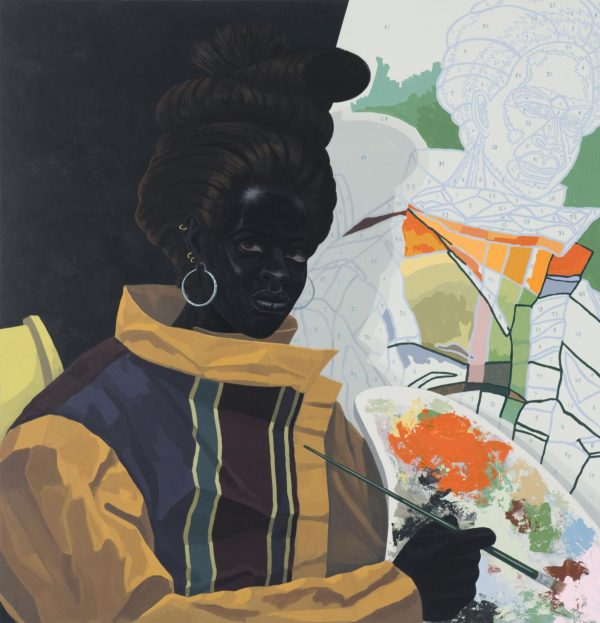
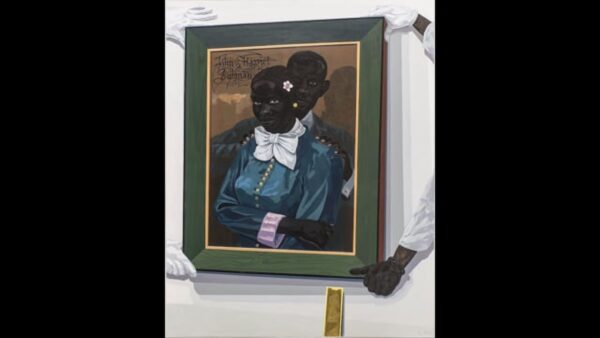
Locate for me somewhere in the history of painting an image of a black person that is self-satisfied and at the point in which they are indifferent to the perception of the spectator.
To me, those are important things to represent for a black figure. Because we don’t think of black figures being self-satisfied. Because the narrative of black presence is almost always traumatized.
Witness the Laquan McDonald video or the Eric Garner video or the Rodney King video—all those. It’s like that whole history of representation going all the way back even to the Without Sanctuary exhibition—I don’t know if you’ve seen that—but the whole history of lynchings and postcard images of lynching and stuff like that.
So we’re used to representations of the black body as a kind of traumatized body in one way or another.
What we’re rarely used to is the image of the black figure as a self-satisfied individual. So that’s what the painting The Woman in the Mirror is. Without all of the clothes and things that you dress yourself up with and you make yourself presentable to other people.
When you present yourself to yourself, are you satisfied with that self? I mean that’s a part of what that picture wants to suggest.
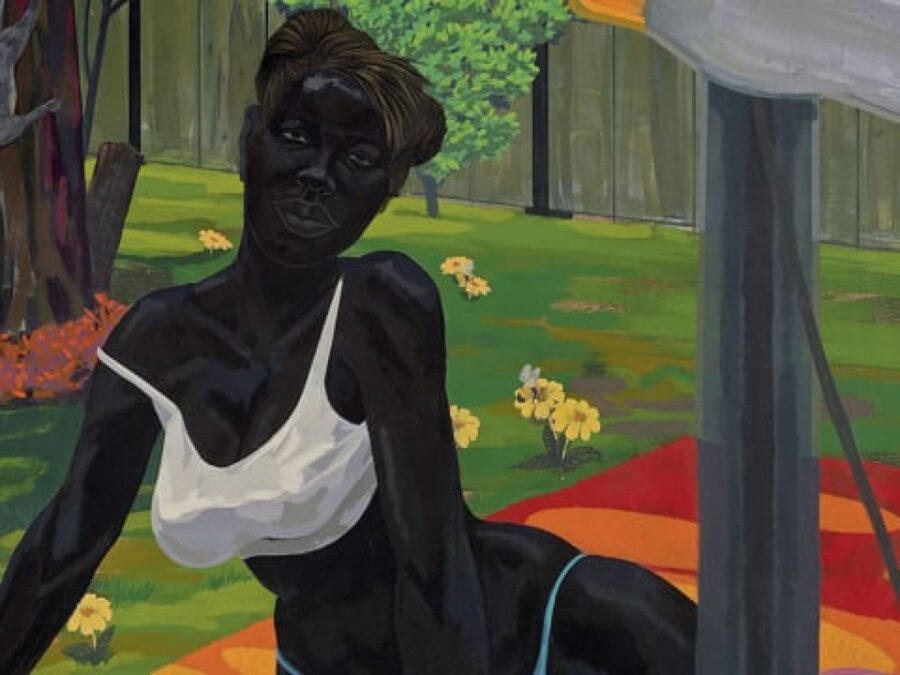
The girl on the blanket, she’s there with the apparatus of photographic representation around her. She’s presented herself to be made into the image of desire.
[laughs]
I’ll tell you, the man that cuts the grass here at the studio, he came and he saw that painting and he said, “Oh man, she is so cute.” He said, “she’s talking to me.” And I thought that was a beautiful response.
And that’s what I wanted somebody to be able to say about a picture like that.