Gary Simmons: Public Enemy
4th-Floor Lobby
-
For over three decades, Gary Simmons has created artworks that grapple with collective memory, uncovering aspects of cultural history that have been neglected, forgotten, or misrepresented. Simmons is an avid researcher and ravenous media consumer, and the recurring motifs that appear across his work reflect his tireless pursuit of the traces of racism and classism that remain hidden in plain sight within the visual and material culture of the United States. Excavated from sports, education, cinema, television, music, architecture, and art, these motifs point to the social and cultural institutions through which prejudice is conveyed and consumed, while underscoring the dynamics of invisibility and hypervisibility that inform personal and collective perceptions of race and class.
Every artwork by Simmons serves as an invitation to follow the artist down a rabbit hole of associations, yet each leaves out more information than it provides. This tension sets the viewer on a potentially destabilizing journey of relearning and self-reflection, punctuated with piercing questions: How is our shared past remembered? Which histories have we been taught to forget? What attitudes from the past stubbornly persist in the present? Simmons’s ghostly images do not provide answers to these questions, but they show us where to look, insisting that we reckon with the ways these half-forgotten narratives still shape the world we live in. Works in this exhibition contain symbols of racial violence, including nooses and Ku Klux Klan imagery.
Please enter the exhibition through the left-hand entrance, or visit additional artworks by Gary Simmons in the atrium and the nearby Turner Gallery.
Gary Simmons: Public Enemy is curated by Rene? Morales, James W. Alsdorf Chief Curator, and Jadine Collingwood, Assistant Curator, with Jack Schneider, Curatorial Associate. For more information about the exhibition and to view the wall texts on your phone, visit mcachicago.org/garysimmons.
Funding
Lead support is provided by the Harris Family Foundation in memory of Bette and Neison Harris, Zell Family Foundation, Cari and Michael Sacks, Nancy and Steve Crown, Hauser & Wirth, The Joyce Foundation, and Karyn and Bill Silverstein.
Major support is provided by the Bluhm Family Foundation; Ellen-Blair Chube; Jack and Sandra Guthman; Susie L. Karkomi and Marvin Leavitt; Kovler Family Foundation; Liz and Eric Lefkofsky; Gael Neeson, Edlis Neeson Foundation; Carol Prins and John Hart; and the Terra Foundation for American Art.
Generous support is provided by Dr. Anita Blanchard and Martin Nesbitt; Diane Kahan; Cheryl and Eric McKissack; Stephanie and Neil Murray; D. Elizabeth Price and Lou Yecies; the Rennie Collection, Vancouver; Nathaniel Robinson; and Joyce Yaung and Matt Bayer.
This project is supported in part by the National Endowment for the Arts.
-
At the heart of Gary Simmons’s practice is a dogged insistence on the necessity of confronting some of the darkest aspects of our collective past. Many of the objects, images, and narratives that comprise his core subject matter provide hard visual evidence of systemic oppression and a history of unfathomable violence. Throughout the process of organizing this project, we have grappled with incredibly difficult questions: What is the value in displaying such material? Can old traumas be resurfaced without reenacting harm?
Ultimately, we took guidance from the works themselves, following their conviction that by forgetting the past we risk repeating it. Amid a contemporary surge in efforts to deny and erase painful histories and their continued reverberations in the present, Simmons’s work serves as an urgent reminder of the stakes involved in the formation of collective memory.
—René Morales, James W. Alsdorf Chief Curator, and Jadine Collingwood, Assistant Curator
-
My name’s Gary Simmons. I’m an artist presently living in Los Angeles.
[music]
The exhibition’s called Public Enemy for multiple reasons. There’s the immediacy of it. The “public enemy,” obvious connection to early hip-hop. Public Enemy was always very important. The energy, the politics that they dealt with really lined up with a lot of what I was working on at the time. “Public enemy” also refers to the black male as being a targeted individual.
I focus on a lot of different topics in my work. I deal with masculinity. I deal with racism. I deal with classism, with childhood, and pedagogy. It’s difficult to predict how people are gonna react to the work. Some people line up with a lot of the ideas and some are pushed away. I think that that’s when you know you’re really hitting a tone is when you have this kind of multiple reaction to your work. I don’t think art should always be comfortable. I think that it’s my job as the artist to take you outta your comfort zone, and really question the way things operate, and your relationship to the world.
My work primarily focuses on . . . ghosts, traces, fragments. The space between abstraction and representation. It hovers between those two. There’s a blurring between there that asks the viewer to fill in those gaps personally. When dealing with erasure, it’s an attempt in some cases to erase a stereotype, and that image gets blurred. The viewer is called on to fill in some of those lines and gaps.
The wall drawings have a relationship to the architecture, like no other part of my work. A site visit is key. At that point, the space almost talks to me and tells me what is going to happen. So I’ll walk into, afforded the opportunities, to some amazing spaces. Some of them you walk in and it’s as if, “This feels like two lovers dancing in a room.” And so from there, the idea of a ballroom starts to develop, and I start to look for all the images of ballrooms, hundreds of images of ballrooms. I’m looking for that feeling of ghosts moving through space. I want it to feel as if those bodies are there for the viewer. The space tells me to create that drawing.
What you see when you see the wall drawing is the product of a performance that you never really get to see. There’s a lot of physicality to it. There’s a lot of literally blood, sweat, and tears. The types of gloves that I use, I go through tons of them. I’m almost in this zone that I can’t talk or speak to somebody because I’m so focused on the task at hand.
One of the things that I love the most about the wall drawings is that when the drawings are completed and the show and the exhibition is over, they become part of that institution. They get painted out. Often people will say, “Isn’t it really sad that these drawings don’t exist anymore?” And I usually tell them, well, actually they do exist. They’re just part of the room and you don’t see it anymore. The commentary on race, on politics, on whatever becomes part of the institution that it’s presented on, so it has a life after itself.
[music]
I go through all of that to give the audience fragments because those issues are already there in their memory bank. Instead of giving you the full question or the full answer, I’ll give you bits and pieces and allow you to piece it together yourself.
Some of the most important questions and some of the most painful issues are still present, and it doesn’t help to cover them up. I’m not a big fan of hiding things that are uncomfortable. You should have to confront some of those things. Issues of race that make people uncomfortable. Issues of politics that make people uncomfortable are still things that we’re still tangling with. We’re still dealing with them on a daily basis. Tucking those away or putting them in a closet doesn’t help to address that, or find a way to heal any of those things. Some of the most uncomfortable images in the exhibition are things that we’re still dealing with on a daily basis.
I hear a lot of reactions to a lot of that work. You know, there are people that can’t bear to be in a room with some of that work, and for me that’s successful. If I’m creating an image and it’s so uncomfortable that you can’t be in the room with that image, there’s something there that’s still bothering you, that’s still bothering us collectively. So . . . art isn’t always a pretty nice thing.
[laughs]
Sometimes it needs to punch you in the face.
[music]
-
Introduction
Gary Simmons’s project 1964 consists of three monumental wall drawings—two flanking the exhibition entrance and a third located in the stairwell gallery behind you. Together, the works incorporate fragments of cinema and architectural history, setting them against bold color fields of red, green, and blue.
Like Simmons’s other works, 1964 holds shifting, dissolving references to a complex visual culture. The color palette references the “RGB” of color television, a visual medium that quickly came to shape public consciousness when it first arrived in the mid-1960s, while the subjects of the works all hint at the political nuances of visibility—from the absolute transparency implied by Philip Johnson’s 1949 Glass House, to the 1964 World’s Fair’s vision of a city experienced from a passing car, to Alfred Hitchcock’s attempt to render vision physical in Marnie (1964). Simmons pictures all this in a style that hovers between presence and absence, emphasizing the ambiguities of vision and memory.
Notably, 1964 was both a pivotal year in the civil rights movement and the year in which Simmons was born. These intersections suggest the relationship between individual lives and the social and cultural upheavals that impel human history.
Lobby Artworks
Left of the lobby (north):
In the Blink of an Eye, 2006
Pigment and oil on panel
Planned acquisition, Museum of Contemporary Art ChicagoRight of the lobby (south):
Reflection of a Future Past, 2006
Pigment and oil on panel
Planned acquisition, Museum of Contemporary Art ChicagoWith these wall drawings, Gary Simmons considers the legacy of modernism, a movement that championed rationality, technology, and austerity as a means of achieving a break with the past. Each drawing depicts an iconic building designed by the celebrated architect Philip Johnson. On green, the Glass House, the private residence Johnson built in 1949 as an ode to formal transparency. On blue, the New York State Pavilion, designed for the 1964 World’s Fair in New York City. The fair was the brainchild of Robert Moses, the infamous urban planner who reshaped the city of New York in the mid-twentieth century. Over several decades, Moses spearheaded the construction of a dense network of highways and parkways that cut through many existing neighborhoods in New York, destroying communities that included many of the city’s poorest populations. Pairing these structures together, Simmons traces the migration of modernism from the intimate scale of the domestic dwelling to its eventual application at the massive scale of urban infrastructure.
Stairwell Artwork
In the stairwell gallery, near the video of Gary Simmons:
Marnie’s Nightmare, 2006
Pigment and oil on wall
Courtesy the artist and Hauser & Wirth.Marnie’s Nightmare refers to Alfred Hitchcock’s 1964 film Marnie about a woman who experiences an overwhelming emotional reaction whenever she sees the color red. Simmons focuses in on a single detail in the film: a chandelier hanging in the stately home of the male protagonist, who blackmails Marnie after catching her stealing money from his publishing company. For Simmons, the chandelier functions as a pointed indicator of class, marking the serial thief Marnie as an outsider in an affluent space. Simmons’s treatment also links this symbol with bodily sensation, presenting an array of wildly gyrating chandeliers on shocking red walls.
-
In the middle of the lobby:
Recapturing Memories of the Black Ark, 2014–ongoing
PA speakers, wooden stage, paint, and ratchet straps
Courtesy the artist and Hauser & WirthRecapturing Memories of the Black Ark consists of a stage and speakers that, when activated, serve as a venue for live performances. The speakers, which can be rearranged according to the performers’ needs or wishes, are encased with wood salvaged from the streets of New Orleans’s Tremé neighborhood in the aftermath of Hurricane Katrina. The objects bear the spray-painted traces of that history, just as they hold the memory of past performance activations. The title of the work, which references Lee “Scratch” Perry’s legendary Kingston studio, the Black Ark, builds on this past in order to evoke a dynamic of memory and renewal. Like Perry’s studio space—much of which he constructed using repurposed materials and DIY fabrication— Simmons’s installation provides a platform for artists to come together and forge new sound out of reclaimed parts.
Find more information about this work, including video of past performances, inside the exhibition and online, at mcachicago.org/blackark.
-
Wake, 2000
Artist web project
Commissioned by Dia Art Foundation for its Artist Web Projects series at diaart.org/simmons.The interactive internet project Wake consists of a sequence of nine photographs of empty dance spaces, including ornate ballrooms, baroque auditoriums, and chandeliered halls—architectural signifiers of class that Simmons explores in many of his works, such as Marnie’s Nightmare, seen nearby. Sections of the images appear and disappear as the viewer passes their mouse or finger across the otherwise white screen, preventing them from seeing any one image in its entirety. Here, the viewer is engaged in a process of erasure similar to the one Simmons carries out in his other works: with a swipe across the image, information blurs in and out—a visual metaphor of what it means to remember and forget.
Wake is accompanied by audio of two people humming well-known songs from past eras.
Turner Gallery
-
Introduction
In 1993, Gary Simmons installed painted backdrops in various locations around New York City, including the Rucker Park basketball court in Harlem and the African Street Festival in Brooklyn. Featuring many references to hip-hop of the day, including Dr. Dre’s album The Chronic, Public Enemy’s iconic crosshair logo, and Kool G Rap & DJ Polo’s single “Ill Street Blues,” the backdrops functioned as impromptu photo studios for members of the community. With camera in hand, Simmons would offer to take free Polaroids of passersby, letting them choose the backdrop, pose, and timing of the snapshot. Unlike more traditional modes of portraiture where the artist determines every aspect of the image, Simmons’s approach gives subjects greater agency over how they are represented.
For this restaging of the project, you are invited to take a photo of yourself, or with your friends, in front of the backdrops. Share your photos on social media: #GarySimmons @mcachicago.
Artworks
Counter-clockwise from the entrance:
Backdrop Polaroids, 1993
112 mounted and framed Polaroids
Collection of Liz and Eric LefkofskyScope, 1993
Latex on canvas and aluminum grommets
Courtesy the artist and Hauser & WirthChronic, 1993
Latex on canvas and aluminum grommets
Courtesy the artist and Hauser & WirthNubian Queen, 1993
Latex on canvas and aluminum grommets
Courtesy the artist and Hauser & WirthIll-Street Blues, 1993
Latex on canvas and aluminum grommets
The Joyner/Giuffrida CollectionBackdrop Polaroids, 1993
112 mounted and framed Polaroids
Courtesy the artist and Hauser & WirthBackdrop Polaroids, 1993
112 mounted and framed Polaroids
Courtesy the artist and Hauser & WirthHello My Name Is, 1993
Latex on canvas and aluminum grommets
Courtesy the artist and Hauser & WirthRoots, 1993
Latex on canvas and aluminum grommets
Courtesy the artist and Hauser & WirthFatpockets, 1993
Latex on canvas and aluminum grommets
Courtesy the artist and Hauser & Wirth
Room 1
-
Introduction
The works in this room imply absent bodies, prompting visitors to conjure their own mental images of the figures who might populate these settings. The only clues Simmons provides—golden sneakers, tap shoes hanging from a boxing ring, “Us” and “Them” robes—allude to racial exploitation within the sports industry and the mass media.
There is a deliberate paradox embedded in Simmons’s critique. Black individuals are often at the center of sports and media spectacles, their bodies rendered hypervisible to the viewing masses. By removing these figures from the scenes, Simmons suggests that, as Black bodies are sensationalized and marketed, the individuality of Black subjects is erased and replaced by racial stereotypes.
Artworks
Clockwise from the entrance:
Everlast Champion, 1991
Gold-plated sneakers
Jeffrey Mercer and Linda GlassLineup, 1993
Screen print with gold-plated basketball shoes
Whitney Museum of American Art, New York; purchase, with funds from the Brown Foundation, Inc. 93.65a-pLineup consists of eight pairs of gold-plated sneakers, which rest atop a low riser beneath a height chart like the ones used in police investigations. Close inspection of the sneakers reveals several well-known brands, including Nike, Reebok, Adidas, and Puma. Around the time this work was created, such brands were associated with mainstream hip-hop and heavily targeted their advertisements to young Black men. In this installation, Simmons connects these sneakers to the pervasive stereotyping of Black youth as violent and criminal.
Everforward . . . , 1993
Leather, metallic gold thread, satin, and laces
Edition of 20
Collection Walker Art Center, Minneapolis; anonymous gift, 2001Sketch for Step into the Arena, 1994
Charcoal on vellum
Courtesy the artist and Hauser & WirthUs & Them, 1991
Two embroidered cotton robes, clothes hangers, and coat hooks
Edition 1 of 3
Collection Walker Art Center, Minneapolis; anonymous gift, 2001, 1997.106.1-.6.In the middle of the room:
Step into the Arena (The Essentialist Trap), 1994
Wood, metal, canvas, Ultrasuede, pigment, ropes, and shoes
Whitney Museum of American Art, New York; gift of the Peter Norton Family Foundation 95.83a-gIn Step into the Arena (The Essentialist Trap), Simmons presents a scaled-down replica of a boxing ring, with tap shoes dangling from its ropes. The image on the floor of the platform illustrates the footwork for a traditional partner dance called the cakewalk. Performed with a comical sense of exaggerated formality, this processional dance was originally performed by enslaved people as a way of mocking the mannered dances of white slaveholders. Later, however, it became a common feature of racist minstrel shows, usually performed by white players in blackface makeup. By situating this diagram within the boxing ring, Simmons references the exploitation of Black individuals in sports, performance, and other forms of popular mass entertainment while alluding to how these arenas have often served as sites of resistance.
Room 2
-
Please be aware that sculptures in this room do not have cane-detectable barriers.
Introduction
Made in the late 1980s and early 1990s, the confrontational works in this room merge everyday classroom items with symbols of organized racial hatred. In the artist’s words, they were meant “to kick some shins”—to assault the sensibilities of a predominately white art world.
Arranged in the gallery to recall a classroom, these white-hued sculptures provoke ongoing considerations of the ways US education systems have been shaped by white supremacy. On one hand, Black students are often disadvantaged by a history of redlining—the racist segregation of neighborhoods and housing resources—and betrayed by criminalization and over-discipline. On the other hand, politicians today crusade to censor curriculum and ban books, attempting to hide the realities of the past and ignore the ways they continue to haunt the present.
Artworks
Clockwise from the entrance:
Big Dunce, 1989
Wooden stool and felt
Collection of Jeanne MeyersNoose Flag, 1991
Rope and aluminum
Private collectionNoose Flag combines two objects linked to US national identity: the noose, an instrument of lynching and a chilling icon of hate, and the flag, a symbol of the country and a common fixture around schools. In making this association, Simmons highlights how patriotic objects like the flag, and the rituals that glorify them such as the pledge of allegiance, obscure the dark episodes of racial violence that run through US history.
Disinformation Supremacy Board, 1989
10 white boards, chalk, and 5 desks
Courtesy the artist and Hauser & WirthIn Disinformation Supremacy Board, a set of writing desks face a row of narrow white chalkboards. A piece of white chalk rests at the base of each board, indicating a white-on-white application that would render any written text illegible. Here, Simmons brings to mind an educational system informed by a constricted, white worldview, impoverished by its exclusion of untold histories. The white writing surfaces merge with the white of the museum’s walls, implicating the venues through which art history is created in the same sins of omission.
Klan Gate, 1992
Cast concrete, wood, brick, and steel
Rubell Museum.Simmons modeled Klan Gate after the kind of gates that frequently mark entrances to elite campuses. In place of the decorative ornaments that typically sit atop these gate pillars, Simmons has installed a pair of Klansmen sculptures. The menacing statues loom as sentinels, serving a dual function as guards and figureheads of this school of hate. Situated at the entrance between two galleries, the gate highlights the ways social institutions like schools (and museums) have created literal and figurative boundaries of access, inviting some in while walling others out.
Six-X, 2022 (replica of 1989 original)
Cotton, embroidered patches, metal shelves, and hangers
Rennie Collection, Vancouver; courtesy Hauser & Wirth.Six-X consists of six child-size Ku Klux Klan robes hanging on a coatrack. The garments are size “6x,” a common fit for kindergartners and first graders. Although the imagined students are absent, the work evokes the daily classroom ritual of placing coats on the wall before sitting to begin morning lessons. Here, Simmons suggests that indoctrination into racist beliefs starts early in life, coinciding with many children’s first forays into the social sphere.
Note: This room exits through the sculpture Klan Gate.
Room 3
-
Introduction
In the early 1990s, Simmons began experimenting with images rendered in chalk on chalkboards. He soon developed what would become his signature technique: a striking “erasure” effect that he achieves by completing a drawing and then smearing it with his hands. By partially obliterating his images, Simmons imbues them with an eerie, obscure quality that evokes the imperfections of memory, both personal and collective.
A foundational conviction drives a large portion of Simmons’s work, which is that popular culture—with film and television as its most important vehicles—often disseminates the ideas and belief systems of white supremacy. In a series of white, green, and black chalkboard works, Simmons presents fragmentary images drawn from vintage cartoons: from the vagrant crows of Disney’s Dumbo (1941) to the Sambo, Mammy, and Pygmy characters in animated classics like Looney Tunes and Tom and Jerry. Based on racist caricatures and blackface performances from vaudeville and minstrel shows, these characters played on television for decades, spreading their content through generations of media consumers.
Artworks
Clockwise from the entrance:
White Chalkboard (Here’s . . . Honey), 1993
Charcoal and acrylic paint on chalkboard
Hort Family CollectionThe cartoon character named in the subtitle of White Chalkboard (Here’s…Honey) plays the role of girlfriend to Bosko, the titular character in a long-running animation series that first aired in 1929. Voiced by white actors, Honey and Bosko speak in stereotypical dialects and utter demeaning lines such as “Mmmm, dat sho is fine!” In this drawing, Honey appears in duplicate behind a row of nooses hung to resemble prison bars, a chilling reminder of how stereotypes can themselves feel like prisons—holding one captive to others’ perceptions of one’s identity.
Green Chalkboard (Crazy Conductor), 1993
Chalk, fixative, chalkboard paint, fiberboard, and wood
John Goodwin and Michael-Jay RobinsonGreen Chalkboard (Bal’ Head Bal’ Head), 1993
Chalk, fixative, chalkboard paint, fiberboard, and wood
The Vichie CollectionBlack Chalkboard (Double Grin), 1993
Chalk, fixative, chalkboard paint, fiberboard, and wood
Collection of Rebecca Heidenberg and Gregory SmithGreen Chalkboard (Toothy Grin), 1993
Chalk, fixative, chalkboard paint, fiberboard, and wood
The Studio Museum in Harlem; gift of Zoé and Joel Dictrow, New York, 2005.16Green Chalkboard (Triple X), 1993
Chalk, fixative, chalkboard paint, fiberboard, and wood
Whitney Museum of American Art, New York; purchase, with funds from the Drawing Committee 96.32a-b.Black Chalkboard (Two Grinning Faces with Cookie Bag), 1993
Chalk, fixative, chalkboard paint, fiberboard, and wood
Hort Family Collection
Room 4
-
Introduction
Beginning in the 1990s, Simmons started applying his distinctive erasure effect at a much larger scale. Created directly on gallery walls, Simmons’s wall drawings—such as boom, seen here, and the trio of 1964 works on view at the entrance to this exhibition—are ephemeral by nature: they exist in the world for only a brief time before they are painted over to make room for the next exhibition. The preparatory drawings assembled in this room provide a sample of the dozens of images that Simmons rendered at a large scale throughout this period.
Artworks
Clockwise from the entrance:
Desert Blizzard, 1997
Video installation. Edition of 10. 8 minutes, 4 seconds
The Art Institute of Chicago, gift of Donna and Howard Stone, 2022.361Sky Erasure Drawings, 1996/2002
Six chromogenic prints
Courtesy the artist and Hauser & WirthIn 1996, the MCA commissioned Simmons to create a public artwork commemorating the museum’s move from its former location on Ontario Street to its current facility. The commission resulted in a project titled Sky Erasure Drawings, for which a hired skywriter traced a sequence of five-pointed stars high above downtown Chicago. The star motif, which Simmons has returned to often, bears an open-ended association with wishing or dreaming and conveys a sense of wistful longing. In this skyborne iteration, the stars emerge in an achingly ephemeral form. Evaporating within minutes before spectators’ eyes, they evoke the fleetingness of memory.
Star Child, 2003
Oil and slate paint on canvas
Collection Museum of Contemporary Art Chicago; gift of William J. Hokin in honor of the MCA’s 40th anniversaryGhoster No. 7, 1996
Charcoal on paper
Courtesy the artist and Hauser & Wirthboom, 1996/2003
White pigment and pastel on blackboard paint–primed wall
Exhibition copy
The Museum of Modern Art, New York. Gift of the Friends of Contemporary Drawing and of The Friends of Education of The Museum of Modern Art, 1999Depicting the image of a cartoonish explosion, boom recalls the classic animated scenario in which warring characters disappear in a cloud of dust and smoke. Within the broader context of Simmons’s practice, the work suggests the idea of social tensions building up and coming to a head in the form of a violent confrontation. As with his other chalk-erasure drawings, boom emphasizes how cartoons often serve as children’s first introductions to social ideas: here, to violence as a fun, bloodless battle.
Untitled (Lannan Drawings), 1995
Charcoal and pencil on 10 pieces of transparentized paper
The Museum of Modern Art, New York. The Judith Rothschild Foundation Contemporary Drawings Collection Gift, 2005
Lake Gallery
-
The books assembled here relate to some of the themes and topics that inform Gary Simmons’s work. Alongside texts selected by the artist and museum staff are several titles chosen by scholars and cultural thinkers who were invited by the MCA to contribute reading lists in their respective fields of study. Building on topics Simmons explores through his work, including horror, sports, hip-hop, architecture, and education, their recommendations can be found on the bookmarks available in the stand nearby. You’re welcome to take a bookmark home with you or use it to mark your favorite passage in one of the books gathered here.
Find a full list of books at mcachicago.org/readingroom.
Room 5
-
Introduction
The works on view in this gallery reference Conquest of the Planet of the Apes (1972), a film premised on a power struggle between humans and hyper-intelligent apes. According to the filmmakers, the film serves as an allegory for racial conflict and the rise of the Black liberation movement in the United States.
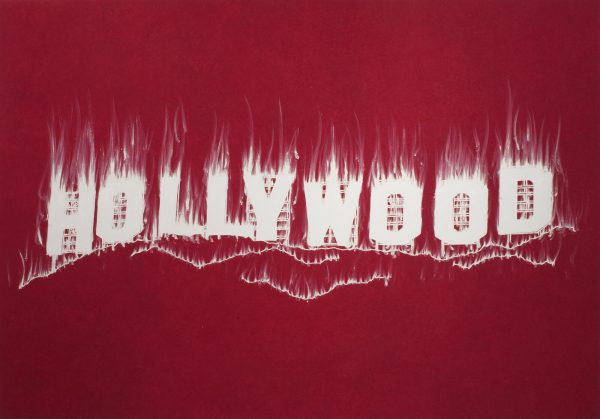
The film’s plot was loosely based on the Watts Uprising that had shaken Los Angeles seven years earlier. In 1965, Black residents of the Watts neighborhood in South Los Angeles revolted against the discriminatory abuse their community suffered at the hands of the police. Simmons draws out the connection between the film and the rebellion with works that depict dialogue from the film in the style of advertising signage in Watts. Simmons also uses his signature erasure method to evoke burning buildings and landmarks in Los Angeles near the location where Conquest of the Planet of the Apes was filmed.
Artworks
Clockwise from the entrance:
Skyline, 2008
Pigment, oil paint, and cold wax on canvas
La Colección Jumex, MéxicoHollywood, 2008
Pigment, oil paint, and cold wax on canvas
Rubell MuseumProperty Damage, 2008
Pigment and oil paint on gessoed paper
Courtesy the artist and Hauser & WirthSmoke Drag, 2008
Pigment and oil paint on gessoed paper
Courtesy the artist and Hauser & WirthDark Side, 2008
Pigment and oil paint on gessoed paper
Courtesy the artist and Hauser & WirthIt’s a Madhouse (Yellow), 2008
Pigment and oil paint on gessoed paper
Rita Krauss Fine ArtPut Away Our Hatred, 2008
Pigment and oil paint on gessoed paper
The Beth and Rick Marcus CollectionDogs & Cats, 2008
Pigment and oil paint on gessoed paper
Courtesy the artist and Hauser & WirthLike the other works in this room, these text-based paintings reference Conquest of the Planet of the Apes (1972), displaying charged quotes from the film using designs that resemble advertising signage found around the Watts neighborhood at the time of the 1965 Uprising. Simmons uses yellow and the red, green, and black color scheme of the pan-African flag—associated with the revolutionary Black liberation movement of that era—to add another symbolic layer. Here, the relationship between text and color is fraught with tension. While the narrative arc of the film bends toward reconciliation and conclusion, the historical reality on which it is based is anything but settled. The struggle against oppression that spawned the 1965 Uprising continues today, despite what Caesar, the leader of the ape rebellion in the film, says as he faces his defeated human captors:
“But now . . . now we will put away our hatred. Now we will put down our weapons. We have passed through the night of the fires, and those who were our masters are now our servants. And we, who are not human, can afford to be humane.”
Double Cinder, 2007
Pigment, oil paint, and cold wax on canvas
The Joyner/Giuffrida CollectionDouble Cinder is part of a series of paintings which depicts buildings and landmarks in and around the Los Angeles neighborhoods where Conquest of the Planet of the Apes (1972) was shot. In this painting, Simmons uses his signature erasure technique to render the famed Century Plaza Towers engulfed in flames, evoking a vision of the city consumed by social, racial, and economic strife.
Room 6
-
Please be aware that sculptures in this room do not have cane-detectable barriers.
Introduction
With this series of works on paper, arranged vertically like film strips, Simmons uses his ghostly erasure technique to evoke cinematic motion. Referencing horror classics such as Psycho (1960), The Birds (1963), The Texas Chainsaw Massacre (1974), and The Amityville Horror (1979), among others, Simmons reveals the ways on-screen fear can reflect real-life anxieties, both personal and political. Across these films, haunted structures serve as harbingers of doom or as receptacles of fear, where our social, racial, existential, and economic anxieties are borne out. Here, the physical spaces of horror are animated not by the monsters lurking within them but by the conditions of cultural fear that precipitated their construction.
Artworks
Clockwise from the entrance:
Untitled, 2001
Latex enamel on foam, fiberglass, copper tubing, and wood
Collection Museum of Contemporary Art Chicago; gift of the Cooper Family Foundation, 2003.4.a–fHere, Piggy Piggy, 2001
Latex enamel on foam, fiberglass, metal, and wood peach crate
Courtesy the artist and Hauser & WirthHere, Piggy Piggy is a sculptural caricature of the violent antagonists in Deliverance, a 1972 film about four Atlanta businessmen who take a canoe trip on a remote Georgia river and are attacked by a pair of local men portrayed as “hillbillies”—a derogatory stereotype of impoverished rural white people. The film dramatizes a symbolic fight for survival between urban and rural America, the elite and working classes. As Simmons explains: “the fears and stereotypes are all right there and inherent within the film. It’s about the fear of others.” Simmons transforms the film’s villains into comical yet unsettling bobblehead figurines, emphasizing their nature as outsize caricatures.
Mother, Oh Mother, 2010
Pigment, oil paint, and cold wax on canvas
Courtesy the artist and Hauser & WirthRockland Drive-In, 2010
Pigment, oil paint, and cold wax on canvas
Courtesy Rodney M. Miller CollectionBonham Theatre, 2010
Pigment, oil paint, and cold wax on canvas
Courtesy the artist and Hauser & WirthBonham Theatre is part of a series of artworks in which Simmons depicts the decaying marquees of derelict drive-in movie theaters, which the artist has described as the “architectural ghosts of our past.” Drive-ins proliferated across the United States in the 1950s and reached peak popularity in the 1960s, linking the idyllic fantasies embedded in Hollywood film with the symbolic freedom of the American automobile. While drive-ins offered spaces of leisure, imagination, and escape, Simmons’s ghostly painting also points to underlying histories of racial discrimination. Opened to the public in 1950, the Bonham Drive-In operated during the period of Jim Crow segregation in Texas. While the theater is long gone, its marquee still stands today, a haunting reminder of this period in history.
Amityville, 2010
Pigment and charcoal on paper
Courtesy the artist and Hauser & WirthGein House, 2010
Pigment and charcoal on paper
Noel E. D. KirnonTexas Chainsaw Massacre 1, 2010
Pigment and charcoal on paper
Courtesy the artist and Hauser & WirthStation to Station, 2010
Pigment and charcoal on paper
Neda Young
Room 7
-
This gallery is located on the left-hand (north) side of the sixth room: Haunting.
Clockwise from the entrance:
In This Corner, 2012
Graphite, paint, and paper on plywood
Courtesy the artist and Hauser & WirthBlue Black Uhlan, 2012
Graphite, paint, and paper on plywood
Courtesy the artist and Hauser & WirthWhile Simmons’s early boxing sculptures removed specific figures from view, the artworks here highlight individuals key to the social and political history of the sport. Leaning against the wall, plywood boards feature promotional posters referencing a 1938 match between Joe Louis, a Black heavyweight champion from the United States, and Max Schmeling, a German fighter. Due to the boxers’ respective nationalities, the US media seized on the match as a symbolic struggle between democracy and Nazism. The highly anticipated fight concluded after a single round, with Louis winning on a technical knockout. The historic triumph made Louis into a celebrated national personality, as Simmons explains: “a Black figure was embraced by America as a hero, which in any other place but the boxing ring was unheard of.”
High Post, 2013
Charcoal and paint on paper
Collection of Jack & Sandra Guthman
Room 8
-
Introduction
In this series of paintings, Simmons depicts the names of early Black film stars including Hattie McDaniel and Bill Robinson. Rendered in white, the vertically smudged lettering recalls the blur of end credits projected on a movie screen. The actors’ names hover over faintly legible film titles from their era, including Midnight Shadow (1939), The Blood of Jesus (1941), Law of the Jungle (1942), and The Gang’s All Here (1943). These films varied widely in their treatment of Black characters and are indicative of the complicated, racially fraught culture of early Hollywood that actors like McDaniel and Robinson had to navigate. Harkening back to Simmons’s earlier production, the paintings also feature ghostly drawings of some of the cartoon characters that appear in his chalkboard works from the 1990s.
Artworks
Clockwise from the entrance:
Body and Soul, 2017
Oil, cold wax, pastel, and spray enamel on canvas
Gina and Stuart Peterson CollectionLaw of the Jungle, 2017
Oil, cold wax, pastel, and spray enamel on canvas
Rennie Collection, Vancouver
Room 9
-
This gallery is located on the left-hand (north) side of the eighth room: Remembering.
Please be aware that a sculpture in the center of this room does not have a cane-detectable barrier.
Introduction
Inspired by the Black Ark—Lee “Scratch” Perry’s famous recording studio in Kingston, Jamaica, where he pioneered dub reggae—Simmons’s sculptural installation Recapturing Memories of the Black Ark serves as a flexible venue for live performances. The installation consists of a plywood stage and a set of speakers, made from wood salvaged from the Tremé neighborhood of New Orleans in the wake of Hurricane Katrina. Each time the work is installed, Simmons invites the exhibiting venue to program a local performance series in which the performers themselves are able to reconfigure and use the stage and speakers however they see fit. As Simmons explains: “At the end of [each] performance the speakers are left in place as a kind of ghost of that performance.”
Artworks
On the walls:
Bass Odyssey, 2016
Ultrachrome posters on wall
Exhibition copy
Courtesy the artist and Hauser & WirthIn the center of the room:
Lab Table Sound System, 2023
PA speakers, wooden table, and ratchet straps
Courtesy the artist and Hauser & WirthIn the video gallery:
The video on view here is a compilation of programs hosted on Simmons’s stage during previous exhibitions in New Orleans; San Francisco; Indio, California; and Los Angeles. For a schedule of new programs that take place throughout the run of Gary Simmons: Public Enemy, visit mcachicago.org/blackark.
Room 10
-
Introduction
In his most recent work, Simmons returned to figurative cartoon imagery after a hiatus of nearly thirty years. Whereas the characters that populate Simmons’s early chalkboard drawings tended to be spare, fragmented, and decontextualized, those featured in this room are rendered in greater detail. Rather than existing in a void, the characters are involved in relatively complex narrative scenarios: piloting a boat in a storm, typing furiously, or holding their arms up while yelling in distress. As light-hearted as these vignettes might appear, they take on weighty resonance when considered in the context of this tumultuous moment in history.
Marking the interval between the police beating of Rodney King in 1992 and the 2020 murder of George Floyd, Simmons’s revisitation of his earlier references underscores the weathered truth that while so much has changed, many things heartbreakingly stay the same. In this way, Simmons’s work insists that the memories that seem too contested or too traumatic to ever truly be settled are the very ones we must resolve to stare down.
Artworks
Clockwise from the entrance:
Rogue Wave, 2021
Oil and cold wax on canvas
Spector/Trachtenberg CollectionUntitled, 2020
Charcoal on paper
Courtesy Lily Blue SimmonsHold Up, Wait a Minute, 2021
Oil and cold wax on canvas
Private collectionLike many of his early chalkboard drawings, Simmons’s painting Hold Up, Wait a Minute features a partially erased rendering of Bosko, a Looney Tunes character whose appearance, mannerisms, and speech were derived from the blackface performances of vaudeville and minstrel shows. Translating his signature erasure technique to canvas, Simmons rakes his hands through wax and paint to create the impression of vibration, echoing the turbulence of our current moment.
Honey Typer, 2021
Oil and cold wax on canvas
Akatsu CollectionLet Me Introduce Myself, 2020
Oil and cold wax on canvas
The Vichie Collection