Transcripts | Faith Ringgold: American People
Story Quilt Transcripts
Story Quilt Transcript
-
Photoetching on silk and cotton with printed and pieced fabric
Richard and Ellen Sandor Family CollectionChange: Faith Ringgold’s Over 100 Pounds Weight Loss Story Quilt
January 1, 1986
In this year, 1986, I will lose 128 pounds. By January 1, 1987, I will weigh 130 pounds, or I’ll eat your hat. Min I’ve already eaten. Faith you will have been trying to lose weight since the sixties. For the last twenty, twenty-five years you’ve been putting yourself on diets, charting you lack of progress and gaining weight. For the next six moths you’ll be in California, away from everybody, the perfect place to make the CHANGE.
You always lose weight when you’re away from them. They lose weight when you’re away from them too. There’s a message in this. Never mind—you just know what you need. Peace of cake—I mean mind. It’s as simple as that. Aggravation makes you hungry. You are over controlling. Admit it! You took the test and passed—high. But you can CHANGE that too. Mommy can exchange her 100 pound burden for some peace and a life of her own. Whatever it takes to do it. It’s a first place pre-ority—I mean priority.
Use art to document the CHANGE: this quilt, a performance and a video of the entire weight loss process. Now you tell me how you’re going to explain not losing weight this time? I’ll say, “Well you see, there was a cute little pig moved in next door. Used to come over all cooked, ready to eat. I couldn’t keep my hands off his ribs.” No Faith—there are no excuses. You can’t gain it back. We’re talking total change this time: good nutrition, behavior modification, daily exercise, and hunger.
I know you don‘t want to admit it. When it comes to food you lack self-esteem. Like everything else you probably ate it, and can’t remember what it tasted like. Let’s face it. You’re quite good at eating large portions of food, gaining weight and talking to yourself about it. Well, the eating of large portions of food and the weight gain is over. But can we talk? Yes. I am out to prove something right here and now. I can CHANGE. I can do it. I can do it. I can CHANGE. I can CHANGE NOW.
1930–1939
In the 1930s folks had fried chicken and greens for Sunday dinner, and fried fish and potato salad on Friday. Your family had leg. Of mutton on Sunday, and fried fish on Saturday. Fried fish was the only food your mother fried when you were a kid ‘cause nobody ever heard of porgies cooked any other way. Because you had asthma and were allergic, you were on a health food diet of steamed vegetables, fresh fruit, lamb, chicken, veal, skimmed milk, corn meal gruel, and homemade lemon ice cream made with skimmed milk that tasted awful.
Your mother never allowed you to eat between meals. The kitchen was closed every evening after supper till breakfast the next morning. Years later you developed a fascination for late night eating by the light of the open refrigerator door. You thought those calories didn’t count. But what about the tell-tale evidence they left behind and in front?
Exercise was part of the day’s work for your mother; you were up before dawn in the norming; bathed, dressed, and out in the street; then back for lunch and a nap; out again, back for dinner and in bed before sundown. Vacations were spent on the beach in Atlantic City. But mother’s schedule was unchanged. While you were napping you could hear her snapping her fingers and dancing to William B. Williams radio program “It’s Make Believe Ballroom Time” while she did her housework. That was her aerobic exercise, and it took you all these years to figure that out.
[The following is a guide to overlapping photographs to the right of the text panel:
1. Faith 1931; 2. With Barbara 1937; 3. With Barbara at World’s Fair 1939; 4. With Barbara and Andrew 1931; 5. With Barbara and Andrew 1931; 6. On Beach in Atlantic City 1938; 7. With Mother 1934; 8. In buggy 1931; 9. With Andrew and Barbara at 3 year old birthday, 1938; 10. With Andrew on boardwalk in Atlantic City 1936; 11. With Barbara and Andrew 1937; 12. With Mother and Barbara (in sand) in Atlantic City 1934; 13. With Andrew and Barbara 1936; 14. Faith 1937; 15. With Barbara and Andrew, Orange NJ 1931; 16. With Andrew and Barbara in snow 1932; 17. With Barbara on beach in Atlantic City 1938. Photo credits: DeLaigle Studios.]1940–1949
By the 1940s we all had to clean up our plates for the starving children. That of course was right up your alley since you never left anything anyway. It was in those years that you discovered chocolate candy bars. They were a nickel then and as big as the ones that cost 50 cents today. All you really thought about in those years were chocolate candy bars, boys, make-up, and clothes.
Actually, you never really pursued your chocolate addiction past your teens, except for the time you thought of making chocolate candy as a business. You found it’s quite easy to make chocolate candy, and even easier to eat it all.
It’s lucky for you that you never learned to make pastry. The few times you tried it, the results were more useful as bricks you could throw in a real pastry show window. Some people would call that a sacrilege, and give you two to four years time. But you wouldn’t have minded if you could do it in a bakery. Some ideas are so bad you wonder how you entertained them even for a minute—like the one you had about making all your pastries so that you would at least have good nutrition. You made a pound cake that weighed more than you did. Industrial strength pound cake. You needed a saw to cut it. And you ate it. You had to steam it first, but you ate it.
[The following is a guide to overlapping photographs to the left of the text panel:
1. Mother, Barbara, S Husband, Jo Jo, and Faith on Easter 1949; 2. Faith 1947; 3. With Freda and Jimmy; 4. In 1948; 5. On boardwalk in Atlantic City, 194?; 6. With Bernice and Barbara in Atlantic City 194?; 9. Faith and Earl Wallace (married in him Nov. of 1950); 10. On day of graduation from high school June 1948; 11. Barbara, Mother and Faith 1948. Photo credits: DeLaigle Studios.]1950–1959
Women in the 1950s had to get married to leave home. Barbara was married first. Her wedding was beautiful; however, both of your marriages were terrible mistakes. You were still in college when you and your two daughters moved in with your mother after you divorce. All through the 1950s you were scantily dressed in tight, revealing dresses with matching 3-inch heels, a size too small; and you often amazed onlookers by falling down whole flights of stairs without injury.
You also modeled for your mother in her many fashion shows, and was her master of ceremonies which was more appealing to you. Being a model seemed an unnatural thing to do. You were a connoisseur of pork chop sandwiches—that was natural for you. Birdie (your soon to be second husband) often brought you a pork chop sandwich and some tutti frutti ice cream made from whole milk and cream when he came to call. That was love.
Pork chop sandwiches cost 75 cents. The were greasy and fried—better than steak. A date was to go to the movies or a concert or a dance and then to dinner at Sherman’s Barbeque or the Red Rooster on 7th Avenue for fried chicken and a drink. The next day after a date you were always sick with asthma. As a matter of fact, many times you got asthma before the date and had to go to the hospital instead; or you went out and got asthma on the way home and had to be carried upstairs. That was romance in the 1960s.
[The following is a guide to overlapping photographs to the right of the text panel:
1. Barbara’s wedding: top row, Andrew Jr. second from left, Andrew Sr. (Daddy) far right. Middle row, Faith, third from left, Barbara, fourth from left. Cheryle, Andrew’s baby, front center. 1950; 2. Faith modeling 1956; 3. Graduation MA degree. CCNY 1959; 4. With mother rehearsing for role as MC at fashion show 1950; 5. (Baby) Barbara with Faith and both grandmothers and paternal grand aunt. 1953; 6. Faith with (Baby) Michele 1952; 7. Faith modeling, 1956. Photo credits: George Hopkins.]1960–1969
In 1961 you discovered French bread and cheese, and wine with your meats in Europe, though you were brough tup to believe that people who drank wine were winos. The French, however, carried their wine well—that is, everywhere—they drank it like water. In Italy you acquired a refined taste for pasta, veal parmigiana, olive oil, and more wine. Café dining on the Via Veneto in Rome stimulated your palette and enlarged your waistline. Eating was fun but it was also therapeutic.
In the 1960s you found a lot of things to eat about. You were married again, had two teenaged daughters, developed a mature style of political art, began looking for a gallery, found one on 57th Street, and had your first one-person show. It was then that you began promising to lose weight. Pork was now a political issue. Baby don’t eat no pig, it’ll kill you!” the brothers said. But you did.
By now you were having wine with your pork chops and bread and cheese with your ribs. You had a doctor on West 56th Street that would dispense weight-loss pills by the week. Soon you stopped losing weight. You didn’t know you were supposed to increase the dosage in order to get the same effect. You increased eating instead and gained back all the weight you lost.
[The following is a guide to overlapping photographs to the left of the text panel:
1. Faith modeling probably for the last time 1965; 2. At wedding to Burdette—Michele, Burdette, Faith, Roy (best man), Barbara, Barbara (sister and daughter) 1962; 3. With Burdette 1962; 4. With mother, Barbara and Michele on S.S. Liberté enroute to Paris 1961; 5. Michele, Faith, Barbara and Mother enroute to Europe (without me) 1967; 6. In Studio 1968. Photo credits: George Hopkins.]1970–1979
In the 1970s food was a feminist issue and you were a fat feminist. Always looking for a quasi-politically correct reason to eat. And of course you found plenty of them. In the sixties it was being a wife and mother, the rejection of being a Black artist and other oppressions. In the seventies it was all that and being a woman too.
You didn’t have to eat over that. You didn’t solve anything by having two dinners at one meal, and don’t blame anybody. You used to say your husband, Burdette, made you eat so that no one else would look at you. And then you didn’t look at you either. You used to say you never served leftovers because your family hated them. Your family never saw anything they left over. You’d eat it all up while you were washing the dishes. You were so embarrassed that day when you entered a midtown restaurant eating cookies. “I’ll be back,” the waiter said, “when you finish eating.”
Remember the time you showed up at a benefit exhibition for an uptight political candidate? You posed with her not realizing you held a greasy bag of nuts. She slapped you on your hand and ordered you to “put that away.” At that moment you had the attention of several news media. You could have made the front page and the Nightly News that day, “Fat Woman Goes Nuts;” but you smiled, wiped your mouth, and put your nuts out of sight. Your clothes were no longer fashionable or fun, but a cover-up. One fall, you forgot to cover your knees from the early cold. You had pain in your knees so bad you could hardly walk. The pain travelled to your so that you had to crawl twisted and wincing to the doctor’s office. “Lose weight,” he said. Doctors are good at telling you to lose weight and how much to pay the nurse. What they don’t tell you is—How?
[The following is a guide to overlapping photographs to the right of the text panel:
1. Mother and Faith viewing collaborative piece at 10-year retro. 1973; in studio 1972; 3. In performance 1977; 4. At installation or morah at Women’s House of Detention Rikers Island 1972; 5. In audience of panel on women artists over 70 at Brooklyn Museum 1975; 6. In studio 1978. Photo credits: 1. R. Costello, Home News; 2. George Hopkins; 3. Barbara T. Wenders; 4. Rufus Hinton; 5. Carin Droohster Marx; 6. Ellie Thompson.]1980–1985
By the 1980s you had finally eaten yourself into a corner. The only way out was cold turkey without dressing. The wine with your meals at a nice restaurant had escalated to a barefoot binge before the TV. You tried a program of group therapy that met in different women’s homes. One day ten or fifteen of you 200-pounders-plus were sitting on straining chairs when the aroma of a serious pot cooking in the kitchen met your collective noses. You had visions of a mad rush to the door in which several women mangled while others of heavier poundage stampeded to the kitchen and literally ate it—pots all. You never went back. Over-eaters are not necessarily compatible. You found yourself sitting in the same room talking about your personal life with women you’d disagree with on every issue except pork. You needed special help.
The only problem you could solve was what to eat. For a while you were on a beans and rice diet. People have a way of knowing when you’ve made that choice. You didn’t lose any weight, but you did lose a few overly sensitive friends. Remember when you bought a 30 dollar bottle of cognac because the salesman thought you were Nell Carter of “Gimme a Break”? You actually asked for brandy but he heard cognac, and you couldn’t make her look cheap so you bought it. Now you can’t stand brandy and you can’t afford cognac. Then you heard Nell Carter was losing weight on a pasta diet. So, to keep “your” identity intact, you went on a pasta diet—all you can eat. In order to surprise yourself with a dramatic weight loss, you stayed off the scale for weeks. You gained 12 pounds on that diet. Surprised?
It was now time for a CHANGE. No more gimmicky diets. Let your body tell you what you need. After all that pasta you needed protein so you went on a fried chicken meal plan. It was health, as you recall, since the chicken was fried in corn oil. This time you tipped the scale at a whopping 258 pounds, and broke it. The scale was tired. That same day, Baby Faith came running out of your room screaming, “Granma your scale says I weight 258 pounds.” It is time for a CHANGE.
[The following is a guide to overlapping photographs to the left of the text panel:
1. Faith at Wooster College 1985; 2. In performance 1984; 3. Directing performance at Wooster College; 4. In political dress (made by Marquetta Johnson) 1984; 5. With Michele in 1980; 6. With Barbara and Burdette at Barbara’s graduation at CUNY 1981; 7. With Baby Faith and Woman on a Pedestal Sculpture; 8. At Artists Against Apartheid press conference 1984. Photo credits: 2. Tom Ferentz; 1, 3 Wooster College P.R.; 4. Peter Bellamy; 7. Fern Logan; 8. Beauford Smith.]October 1986 (Jan–Oct)
The worst part of being fat was squeezing yourself sideways through the subway turnstile: hobbling down the stairs to the train in hopes that it would still be there when you finally arrive, and that you would be lucky enough to find two seats. Together. It is difficult to change a lifetime of indulgence but there are some things you have learned. One is that you cannot eat meat. If you do you will want to have the gravy over some rice, some cake to neutralize the taste, some ice cream over that, and then the whole kitchen. Instead you must look for the lite label on foods you buy. Industrial strength is for cleaning.
But still, if somebody would offer a surrogate jogger, you would sit there on the beach in California or the park bench in New York City and applaud them as they run your lazy bones by, knowing you’d get the benefits. That would be a real high. Stay away also from people and situations that send you off the wall and straight into the refrigerator.
It is September 27, 1986, and though I have 40 pounds yet to lose I have lost 88 pounds. Today I am thinner than I have been in the last twenty years. I eat fresh fruit and vegetable sin stead of pasta and pork chops, and I exercise almost every day. I am out to prove something right here and now. I can CHANGE. I can do it. I can do it. I can CHANGE. I can CHANGE NOW.
[The following is a guide to overlapping photographs above the text panel:
1. Faith, September 28; 2. In the Spring; 3. With Burdette, Sept; 4. With Baby Faith, Baby Teddy, and Barbara; 5. In October; 6. On January 27 (beginning of weight loss program); 7. With Baby Faith and Burdette in September; 8. In September; 9. Received Honorary Doctor of Fine Art, Moore College of Art, Philadelphia, PA, June; 10. In front of The Purple Quilt, October. Photo credits: 1, 3, 4, 7, 8, 9, C. LOVE; 5, 10, Clarissa Slight; 6. Lifetime Health and Nutrition Center, San Diego, CA; 2, UCSD student.]Photo etching plates by Van Allyn Graphics, NYC. Printing by Lynn Rogan and Julie Amario of the Printmaking Workshop, NYC. Editing by Lisa Yi. Faith Ringgold © 1986 NYC.
Hear Coco Elysses sing two segments from this artwork: Mama Made Me Do It and I Hate to Exercise.
Additional Quilt Transcripts
-
Acrylic on canvas with pieced fabric
Baz Family CollectionWhenever I feel sad I think about the day Barn Door and me got married in the Secret Church in the Woods—Then I forget to be sad.
It was Aunt Emmy who took us to the Secret Church in the Woods when she and Uncle Tate got married. Barn Door and me were there but we were too young to know it was a secret. Everyone was so quiet we couldn’t hear what they were saying.
For our wedding, Aunt Emmy made all our clothes and got the same preacher who married her and Uncle Tate to marry me and Barn Door.
That day was a dream. I never thought we would have no preacher weddin’ in the woods. On our wedding I was cryin’ and praying we wouldn’t be caught. Everybody was cryin’ like somebody died. It was hard to be happy at our secret wedding then, but not now.
-
Acrylic on canvas, fabric
Courtesy the artist and ACA Galleries, New YorkThere was one of two things I had a right to: liberty or death. If I could not have one I would have the other, for no man should take me alive.
Words by Harriet Tubman, Auburn, NY, 1869
Painting by Faith Ringgold in NYC, 1972
Additional Story Quilt Transcripts
-
Acrylic on canvas with pieces fabric border
Courtesy the artist and ACA Galleries, New YorkSomeday I’ll tell Luther. But not now. After he’s home a while and the nightmares stop. Last night it was awful. Luther threw himself out of the bed and pounded his fists into the carpet, turned over the night table, and smashed the lamp.
And you think I should tell him the twins are not his? That the family resemblance he sees is his brother, Larry, not him. He would kill me. You haven’t heard the worst of his nightmares.
But I am not afraid of him because he always comes out of it when he hears me scream his name and realizes that he is home in bed with me; and that the war is over and that I am not the enemy.
That was the day the twins were conceived. I know that twins aren’t his because he can’t have children. He knows that too. It’s a family secret so nobody talks about it, but Luther has something wrong with him, a childhood injury.
They thought Luther was too perfect for love.
I woke up and found him with his face buried in his bleeding hands. He was weeping and shaking uncontrollably, pleading with someone not to kill us.
Most of the time he is the killer and he has his hands around my throat. Or he is flailing the air with my comb like it is a machete and calling me a “yellow-livered-son-of-a-bitch.” And he is screaming, “Take this for squealing you stinkin’ murderin’ scum.”
Luther loves me. I know he loves me. And as long as he doesn’t know what I did to him he’ll keep on loving me.
What would happen if one night he woke up and realized that I am the enemy; that while he was in Korea I was back here sleeping with his brother; that the day we got married I slept with his brother.
His mother told me before I married him that he would never have children. She thought that would keep me from marrying him. She even had his doctor there to confirm it. Unethical? Sure. But some people will do anything to prove a point.
They never thought I’d marry Luther for love, or that we really had loved each other from the first moment we met. And after all these years–the war, and everything else–we still loved each other.
Luther believes the twins were a miracle, and I let him believe it. Larry will never tell him otherwise. He enjoys the secret too much.
Larry hates Luther for being the good one. Luther is an angel always helping someone. His life is a mission of mercy. Everyone loves him for being so good. And now that we have a church of our own it won’t be long before the war will stop for him and he’ll sleep nights in peace.
But if I tell him about Larry and me it will destroy him.
It’s my secret. I may just have to die with it.
-
Silkscreen on silk with pieced fabric
Virginia Museum of Fine Arts, Richmond, Gift of Marion Boulton Stroud, 2001.252I will always remember when the stars fell down around me and lifted me up above the George Washington Bridge.
- I could see our tiny roof top with Mommy and Daddy and Mr. & Mrs. Honey our next door neighbors, still playing cards as if nothing was going on, and BeBe, my baby brother, laying real still on the mattress, just like I told him to, his eyes like huge floodlights tracking me through the sky.
- Sleeping on Tar Beach was magical. Laying on the roof in the night with stars and skyscraper buildings all around me made me feel rich, like I owned all that I could see. The bridge was my most prized possession.
- Daddy said the George Washington Bridge was the longest and most beautiful bridge in the world and that it opened in 1931 on the very day I was born. Daddy worked on the bridge hoisting cables. Since then, I’ve wanted that bridge to be mine.
- Now I have claimed it. All I had to do was fly over it for it to be mine forever.
I can wear it like a giant diamond necklace, or just fly over it and marvel at its sparkling beauty. I can fly, yes fly. Me, Cassie Louise Lightfoot, only eight years old and in the third grade and I can fly.
- That means I am free to go wherever I want to for the rest of my life. Daddy took me to see the Union Building he’s working on. He can walk on steel girders high up in the sky and not fall. They call him the cat.
- But still he can’t join the Union because Granpa wasn’t a member. Well Daddy is going to own that building cause I’m gonna fly over it and give it to him. Then it won’t matter that he’s not in their ole Union or whether he’s Colored or a half breed Indian like they say.
- He’ll be rich and won’t have to stand on 24 story high girders and look down. He can look up at his building going up. And Mommy won’t cry all winter when Daddy goes to look for work and doesn’t come home. And Mommy can laugh and sleep late like Mrs Honey and we can have ice cream every night for dessert.
- Next I’m going to fly over the ice cream factory just to make sure we do. Tonight we’re going up to Tar Beach. Mommy is roasting peanuts and frying chicken and Daddy will bring home a watermelon. Mr. and Mrs. Honey will bring the beer and their old green card table. And then the stars will fall around me and I will fly to the Union Building.
- I’ll take BeBe with me. He has threatened to tell Mommy and Daddy if I leave him behind.
I have told him it’s very easy, anyone can fly. All you need is somewhere to go that you can’t get to any other way. The next thing you know, you’re flying among the stars.
Transcripciones de la colchas narrativas
Transcripciones de la colchas narrativas
-
Acrílico sobre lienzo, recortes de tela impresa y teñida por reserva, y tinta
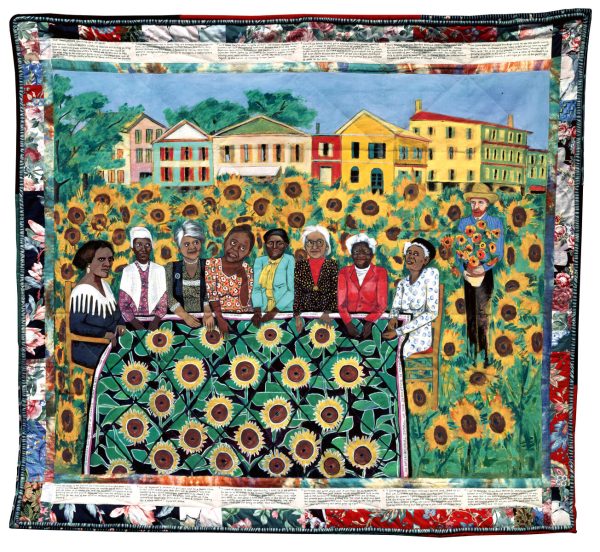
Colección Oprah Winfrey- La Sociedad Nacional de Costureras de Colchas de Girasoles de Estados Unidos se están reuniendo para confeccionar colchas en campos de girasoles de todo el mundo para promover la causa de la libertad. La tía Melissa me ha escrito para contarme sobre esto y dice: “Ve con ellas a los campos de girasoles de Arlés. Y por favor cuida de ellas en ese país extranjero, Willia Marie. Estas mujeres son nuestra libertad”, escribió.
- Hoy llegaron las mujeres a Arlés. Son Madame Walker, Sojourner Truth, Ida Wells, Rosa Parks, Mary McLeod Bethune y Ella Baker, una fortaleza del coraje de mujeres africanas estadounidenses, con energía suficiente para transformar la nación paulatinamente.
- Mira lo que han hecho, a pesar de su opresión: Madame Walker inventó el peine alisador de cabello y se convirtió en la primera mujer millonaria nacida en Estados Unidos que se hizo a sí misma. Tuvo más de 3000 empleados. Sojourner Truth abogó de manera brillante en favor de los derechos de las mujeres durante la esclavitud, a pesar de que no sabía ni leer ni escribir. Ida Wells denunció el horror de los linchamientos en el Sur.
- Fannie Lou Hamer hizo frente a perros policía, chorros de agua, palizas brutales y la prisión para poder inscribir a miles de personas en el registro de votantes. Durante la esclavitud, Harriet Tubman trasladó a más de 300 esclavos hacia la libertad en 19 viajes desde el sur en el ferrocarril subterráneo, y jamás perdió a un pasajero. Rosa Parks se convirtió en la madre del movimiento por los derechos civiles en Estados Unidos cuando se sentó en la parte delantera de un autobús segregado y se negó a moverse hacia la parte de atrás.
- Mary McLeod Bethune fundó el Bethune Cookman College, fue asesora especial de los presidentes Harry Truman y Franklin Delano Roosevelt. Ella Baker organizó a miles de personas para mejorar las condiciones de vivienda deficientes, las condiciones de trabajo y la educación de los consumidores. El viaje a Arlés fue para terminar La colcha de los girasoles, un símbolo internacional de la dedicación de estas mujeres para cambiar el mundo.
- El pintor holandés Vincent van Gogh vino a ver a estas mujeres cosiendo en los campos de girasoles.
“¿Quién es este hombre tan extraño?”, preguntaron ellas.
“Es un grande peintre”, les dije, “aunque está muy perturbado mentalmente”. Él sostenía un florero con girasoles, sin duda une nature morte, una naturaleza muerta, para una de sus pinturas.- “Es muy parecido al hombre que me pegó en la cabeza con una piedra cuando era chica”, dijo Harriet. “Haz que se vaya. Me recuerda a los esclavistas”. Pero él no se movía. Como uno de los girasoles, parecía crecer del suelo. Sojourner lloró sobre las costuras de su colcha por la pérdida de sus trece hijos, la mayoría vendidos como esclavos.
- Una de las hijas de Sojourner fue vendida a un esclavo neerlandés en las Indias Orientales, quien después se la llevó a los Países Bajos. “¿Este neerlandés podrá saber algo de eso? Debería pagar por todo el sufrimiento que nos generó su pueblo. Estoy preocupada por ti, Willia Marie. ¿Es este un ambiente natural para una mujer negra?” Preguntó Sojourner.
- “Vine a Francia en busca de una oportunidad”, dije. “Para mí no es posible ser artista en Estados Unidos”.
“Todas somos artistas. Nuestro arte es unir retazos. Lo trajimos directamente de África”, dijeron. “Era lo que hacíamos después de un arduo día de trabajo en los campos para mantener la cordura y la cama caliente, y para darle belleza a nuestra vida. Eso no era ser artistas. Eso era mantenernos vivas”.
- Cuando bajó el sol y fue el momento de partir, el pequeño hombre atormentado se encerró en sí mismo y adoptó la apariencia de los girasoles que estaban en el campo, como si fuera uno de ellos. Las mujeres habían terminado de unir sus retazos.
“A veces, es necesario parar y oler las flores”, dijeron. “Ahora podemos dedicarnos a nuestra verdadera labor, nuestro arte real: reconstruir el mundo”.
- “Debo volver a las vías del ferrocarril”, dijo Harriet. “Aún no somos todos libres, sin importar las leyes que aprueben. Sojourner lucha por los derechos de las mujeres. Fannie, por la inscripción en el registro de votantes. Ella y Rosa trabajan en favor de los derechos civiles. Ida está atenta para que no linchen más hombres. Mary Bethune les consigue educación a nuestros jóvenes, y Madame hace dinero arreglando cabelleras y nos da trabajo. Señor, sin duda estamos ocupadas”.
- “Estoy tan agradecida a mi tía Melissa, por haberme enviado estas mujeres”, dije. “El arte jamás podrá cambiar algo como lo han hecho ustedes. Pero puede ofrecer una imagen para que todo el mundo lo vea y conozca nuestra verdadera historia y cultura, a partir del arte. Algún día haré que ustedes también se sientan orgullosas de mí. Solo esperen y verán”.
“Lo vemos, Willia Marie” dijeron. “Lo vemos”.
Additional Exhibition Transcripts
-
[ENGLEWOOD, NEW JERSEY]
FAITH RINGGOLD: When I was a child, I had asthma and I was home a lot, not going to school. I might be home for a week recovering from an asthma attack, but I had all my schoolwork.
My mother would get my books and find out what my lessons were so I could keep up with my reading.
My mother often would give me a little scrap of cloth and I would make something. When I went to the City College of New York in 1948, they asked me what are you planning to be? Well, if you put it like that, I want to be an artist and I was told we don’t offer that degree to women, but one woman there said wait a minute, you can major in art and minor in education and be an art teacher. To be a teacher is a professional job that is popular among African Americans in the south because they had segregated schools. So in my family that was something that people did. My great-grandfather being the first, Professor B.B. Posey.
No matter how you turn it you always get those four words and a nice patter.
GRACE MATTHEWS: And a nice pattern. Okay, I’ll pin it and stitch it and we’ll take a look at it . . . .
I met Faith at University of California San Diego. I was in Faith’s drawing class. Faith asked if anyone was a photographer in the class and I was the only one who raised my hand. That was 17 years ago. Right now we’re working on a quilt about President Obama.
FAITH RINGGOLD: A good way to collaborate on something is to use this kuba design from the Belgian Congo.
There’s eight triangles in a square done in different ways, it’s just wonderful and you can do all kinds of stuff. You can have a lot of people collaborate together. You just need more units of words so that you can repeat them and there’s no limit to how many ways it can be. It’s just such a great design. I love it.
I studied a lot about quilts because I wanted to understand their origin… In the United States, the quilt was brought here by slaves from Africa. Slaves would make quilts for the master’s house and they could also make quilts for themselves to keep warm so it was a useful medium but it gave them an opportunity to be decorative and to use their design aspects so the Gees Bend quilts are a very good example of that. They put it together not even thinking about design, but they were creating these wonderful minimalist arrangements.
I remember when we used to go up on tar beach—which was the roof of our building—we could reflect and look at all of New York, the lights, and it was so beautiful. It looks exactly as it did when I painted it, you know how I made the tar roof and the way the tablecloth is. I had this family in mind: the adults will be playing cards and the children will be laying on a mattress. You can’t run around on the roof, children have to be calm, but you can be very happy because it’s so wonderful, you know, looking at the stars and the other buildings, and you could have all kinds of goodies to eat.
Cassie and BB, they’re patterned after people I knew as a child. BB was a little boy who was just adorable and Cassie was a young woman that I went to City College with. I wrote the story and the end of it when I said—I have told BB, because BB doesn’t know how do you do all this flying—I have told him it’s very easy. Anyone can fly, all you need is somewhere to go that you can’t get to any other way, and the next thing you know you’re flying among the stars.
When Judith Lieber, the pocketbook mogul, she saw it and bought it and then she donated it to the Guggenheim.
Tar Beach, my first book, came from the story quilt. They liked the story, so they wanted me to do a book. And I had already written the words, because the words are on the story quilt, so they just sent me a dummy book and put the words on each one of the 32 pages and I just went back and illustrated each one of those pages.
My second book, my editor said what about Harriet Tubman? I said, nice, okay so now my job is: What about Harriet Tubman?
Then when I can tell the story of who was Harriet Tubman, what did she do that was important—I get my characters. And then the third thing is the dialogue, and when I get all of that done, that’s my story, that’s my process.
When I got the commission to do the subway, I wanted to be in Harlem and I said I want it to be on 125th Street—because 125th Street was like the center of culture of Harlem. What made Harlem so famous and important is the people who lived there and went there, who built the African American cultural and historical significance.
The Teresa Hotel was a fantastic hotel and meeting place and Martin Luther King and Malcolm X came to Harlem. Actually, Malcolm X before he even became important, he lived on my corner.
A very important place was Abyssinian Baptist Church. I went there as a child. I would listen to Adam Clayton Powell talk and I think he politicized me, made me understand what it was I had to do as an African American and there wasn’t any women’s movement of any kind. I mean, he was actually talking to the men, but so was everybody. So I just had to, I had to translate, you know, I had to say well okay if this is what the guys should do, now what’s my role in it, what do I do? And that’s why in my foundation I am committed that children should learn about these great masters of African American art and when you can see yourself in the development of a culture, you can do it too because it’s only through these people that I knew that I could do it because people before me did it. You really do need those role models.
My goal as a young artist was to get past male chauvinist domination in the art world. That’s number one, because no matter whether I was with the African Americans or the white Americans, I was still a woman, and women are not supposed to make art. That kind of double struggle empowers me. It gives me a reason to move on and to tell that story.
These three were my students way back in the day. I told the kids. all right we’re going to do this bulletin board for Black History week. So I said, well what are we going to have on it?
And so Paula raised her hand and she said well, I’m going to bring in my brother’s latest book, Go Tell It On The Mountain, and I said well what’s your brother’s name and she said James Baldwin and I didn’t know him. He must have just started.
PAULA WHALEY: He had, exactly, because Mountain came out in 1953, all right, so we we came together in ‘55.
FAITH RINGGOLD: I got that book and I read it that was it. I read everything that James Baldwin wrote, one right after the other, and that helped me to change my art, because I wanted to do art that expressed what was happening to African Americans in America today.
DAWN FERRER: One thing I have to say that I remember about Faith is the compassion, the compassion that you had with all of us in the classroom. I remember if I finished, I remember saying I’m finished and you said no you’re not, you have color, you put all the colors in there, you have all of the beige or the white at the top. Let’s get the colors in. And I remember wanting to put those colors in but it was the way that you said it. It was the way that you circulated. You moved around and you had something to say to each of us.
NICOLE SETTLES: My children used to draw on the walls and I framed it. My relatives thought I had going mad but I was thrilled that these little people could do these things and you are a part of all this.
FAITH RINGGOLD: I wanted to create paintings that could be as large as I needed them to be. And I needed to be able to roll it up and place it in a trunk and send it all over the country. Then I would go and they would pay me to lecture. Artists need to be able to store their work, and the quilts have made that completely possible for me.
The first quilt, Echoes of Harlem, was made with my mother and I. My mother informed me that making a quilt was extremely difficult. When my mother passed away, the second quilt I wanted to make was a tribute to mother. I sat down and I created Mother’s Quilt.
Sonny Rollins used to come to my house to practice his saxophone. He’s a little kid, 12, 13 years old. He’s a year older than me. And my mother used to say, oh Sonny please, you’re disturbing my neighbors because he’d play off key, but didn’t upset him.
He taught me to be serious about my art. I learned that from Sonny Rollins. And then when he became older and more successful in the 60s, he would go up on the bridge and nobody could say anything. So I wanted to remember that and so I created Sonny’s Quilt with Sonny blowing on the bridge .
And I thought at that time, this personifies women. Bridges unite people across barriers, and that’s what we do with our families, we hurdle obstacles, we stay together, we pass it on, just like a bridge.
DAWN BROOKS DECOSTA: What’s special about our school is that we have this arts focus. We have a Harlem focus.
We feel like that has a lot to do with the self-esteem that is built in the students and so we try to weave in the arts into all of our subject areas because we feel like it enhances learning for the students.
FAITH RINGGOLD (reading): It was the night of the 24th of December in 1939.
DAWN BROOKS DECOSTA: Faith found me in Harlem. She was looking for a school to work with, and introduced me to her way of teaching art and teaching the cultural significance of art, and all the artists that the kids don’t learn about. She had this process where the kids would learn about an artist, learn about their lives, and then create art in the style of this artist using the same mediums that the artist would use. And the final component was that they would go see the work itself, the original work. And so once I started doing that with the kids through a grant that she had through the Anyone Can Fly foundation, I just found that by the time we finished, it would be a very rich looking piece.
STUDENT: Hello Miss Ringgold, it’s always been a dream to meet you.
FAITH RINGGOLD: Oh, thank you, I love that.
TEACHER: He is a very bright student but he has severe asthma so he wasn’t here when we gave out the papers but he has been so blessed to bring us our snack today, so he said this is his lucky day.
FAITH RINGGOLD: Well, you know I have asthma also.
TEACHER: Oh, my goodness.
FAITH RINGGOLD: Yeah I got asthma at two, when I was two years old.
I expected to have a problem, a big problem with making quilts in the fine art world but I did not. Everybody knows what a quilt is. That was so important in my career as an artist because it made people accept my work much better than they did before I started making the quilts.
-
Para ver una traducción al español de este texto selecciona “Español” usando el botón “Idioma” en la esquina inferior izquierda.
Tony Cokes (n. 1956, Richmond, VA; vive en Providence, RI)
Celebración negra, 1988[Rock music]
LETS HAVE A BLACK CELEBRATION
BLACK CELEBRATION TONIGHTA CELEBRATION IN SILENCE. A CELEBRATION
OF NOISE:
TO CELEBRATE THE FACT THAT WE’ VE SEEN
THE LACK OF ANOTHER BLACK DAY.YOU LOOK TO US.
YOU WONDER HOW WE CARRY ON WHEN
ALL HOPE IS GONE.OUR OPTIMISTIC EYES SEEM LIKE PARADISE
TO SOMEONE LIKE YOU.YOU WANT TO TAKE US IN YOUR ARMS,
FORGETTING WHAT YOU COULDN’ T DO
TODAY.THE LOS ANGELES REBELLION WAS A
REBELLION AGAINST THE COMMODITY,
AGAINST THE WORLD OF THE COMMODITY
IN WHICH WORKER-CONSUMERS ARE
HIERARCHICALLY SUBORDINATED TO
COMMODITY VALUES.LIKE THE YOUNG DELINQUENTS OF ALL
THE ADVANCED COUNTRIES, BUT MORE
RADICALLY BECAUSE THEY ARE PART OF
A CLASS TOTALLY WITHOUT A FUTURE, A
SECTOR OF THE PROLETARIAT UNABLE
TO BELIEVE IN ANY SIGNIFICANT CHANCE
OF INTEGRATION OR PROMOTION, THE
LOS ANGELES BLACKS TAKE MODERN
CAPITALIST PROPAGANDA. ITS PUBLICITY OF
ABUNDANCE, L-I-TERALLY.SITTING TARGET, SITTING PRAYING.
GOD IS SAYING . . . NOTHING.Boston
Universal NewsreelALWAYS . . . KNOWS THE PROSPECTS.
LEARN TO EXPECT . . . NOTHING.WHAT ARE YOU TRYING TO DO?
WHAT ARE YOU TRYING TO SAY?YOU’ RE NOT TRYING TO TELL ME ANYTHING
I DIDN’ T KNOW WHEN I WOKE UP TODAY.Universal Newsreel
VIOLENCE
24 DEAD IN NEWARK RIOTS
VOICE: ED HERLIHY[Inaudible]
NOTHING
O
NO
NOTHING
O
NO.
NOTHING
O
NO
NOTHING
O
NO.
Answer me. Talk. Can’t you move. Answer
me!THEY WANT TO POSSESS IMMEDIATELY ALL
THE OBJECTS SHOWN AND ABSTRACTLY
ACCESSIBLE BECAUSE THEY WANT TO USE
THEM.THAT IS WHY THEY REJECT THEIR
EXCHANGE VALUE, THE COMMODITY-REALITYPURPOSE AND THEIR ULTIMATE GOAL, AND
WHICH HAS PRESELECTED EVERYTHING
HOW SOON IS NOW?YOU DECREE TODAY THAT LIFE IS SIMPLY
TAKING AND NOT GIVING.IF I ASK YOU WHY, YOU’ LL SPIT IN MY EYE.
UNIVERSAL NEWSREEL
RIOTS DECRIED
PRESIDENT CALLS FOR LAW AND ORDER
VOICE: ED HERLIHYTHE STREETS ARE CRAMMED WITH THINGS.
IT TURNED OUT TO BE HELL.YOU KNOW WHAT HANDS ARE FOR. AND
YOU’D LIKE TO HELP YOURSELF.THROUGH THEFT AND GIFT THEY
REDISCOVER A USE THAT IMMEDIATELY
REFUTES THE OPPRESSIVE RATIONALITY
OF THE COMMODITY, REVEALING ITS
RELATIONS AND MANUFACTURE TO BE AND
UNNECESSARY.NO, YOU’VE NEVER HAD A JOB BECAUSE
YOU’VE NEVER WANTED ONE.
THE DEVIL WILL FIND WORK FOR IDLE
HANDS TO DO.LOOTING, WHICH INSTANTLY DESTROYS THE
COMMODITY AS SUCH, ALSO DISCLOSES
WHAT THE COMMODITY ULTIMATELY
IMPLIES: THE ARMY, THE POLICE AND
OTHER SPECIALIZED DETACHMENTS OF THE
STATE’S MONOPOLY OF ARMED VIOLENCE.WHAT IS A POLICEMAN?
HE IS THE ACTIVE SERVANT OF THE
COMMODITY, THE MAN IN COMPLETE
SUBMISSION TO THE COMMODITY, WHOSE
JOB IT IS TO ENSURE THAT A GIVEN
PRODUCT OF HUMAN LABOR REMAINS A
COMMODITY WITH THE MAGICAL PROPERTY
HAVING OF TO BE PAID FOR INSTEAD OF
BECOMING A MERE REFRIGERATOR OR
RIFLE-A MUTE, PASSIVE, INSENSIBLE THING
IN SUBMISSION TO THE FIRST COMER TO
MAKE USE OF IT.PEOPLE WHO DESTROY COMMODITIES
SHOW THEIR HUMAN SUPERIORITY OVER
COMMODITIES.THEY STOP SUBMITTING TO THE ARBITRARY
FORMS THAT DISTORTEDLY REFLECT THEIR
REAL NEEDS.THE FLAMES OF WATTS CONSUMMATED THE
SYSTEM OF CONSUMPTION.WHEN YOU SAY IT’ S GOING TO HAPPEN
NOW, WELL WHEN EXACTLY DO YOU MEAN?SEE I’ VE ALREADY WAITED TOO LONG AND
ALL MY HOPE IS GONE.AND IF YOU MUST GO TO WORK TOMORROW,
WELL IF I WERE YOU, I WOULDN’ T BOTHER.
FOR THERE ARE BRIGHTER SIDES TO LIFE
AND I SHOULD KNOW BECAUSE I’ VE SEEN
THEM, BUT NOT OFTEN.THE THEFT OF LARGE REFRIGERATORS
BY PEOPLE WITH NO ELECTRICITY, OR
WITH THEIR ELECTRICITY CUT OFF, IS THE
BEST IMAGE OF THE LIE OF AFFLUENCE
TRANSFORMED INTO A TRUTH IN PLAY.ONCE IT IS NO LONGER BOUGHT, THE
COMMODITY LIES OPEN TO CRITICISM AND
ALTERATION, WHATEVER PARTICULAR FORM
IT MAY TAKE.YOU ARE WALKING DOWN THE STREET BUT
NOTHING IS FAMILIAR.YOU ARE A CHILD WHO SWALLOWED HER
PARENTS TOO SOON: A BRAT, A BLANK
SUBJECT.YOU ARE THE VIOLENCE OF MOURNING
OBJECTS WHICH YOU NO LONGER WANT.YOU ARE THE END OF DESIRE.
Did you hear that? There’s music up there!
Did you hear that? There’s somebody here!ONLY WHEN IT (THE COMMODITY) IS PAID
FOR WITH MONEY IS IT RESPECTED AS AN
ADMIRABLE FETISH, AS A STATUS SYMBOL.LOOTING IS THE NATURAL RESPONSE TO
THE SOCIETY OF ABUNDANCE THE SOCIETY
NOT OF NATURAL AND HUMAN ABUNDANCE.
BUT OF ABUNDANCE OF COMMODITIES.
SITTING TARGET, SITTING WAITING.
ANTICIPATING . . . NOTHING.LIFE . . . IS FULL OF SURPRISES. IT
ADVERTISES . . . NOTHING.THE LOOTING OF THE WATTS DISTRICT
WAS THE MOST DIRECT REALIZATION OF
THE DISTORTED PRINCIPLE. “TO EACH
ACCORDING TO HIS FALSE NEEDS.” NEEDS
DETERMINED AND PRODUCED BY THE
ECONOMIC SYSTEM THAT THE VERY ACT OF
LOOTING REJECTS.BUT SINCE THE VAUNTING OF ABUNDANCE
IS TAKEN AT ITS FACE VALUE AND
IMMEDIATELY SEIZED UPON INSTEAD
OF BEING ETERNALLY PURSUED IN THE
RAT RACE OF ALIENATED LABOR AND
INCREASING BUT UNMET SOCIAL NEEDS,
REAL DESIRES BEGIN TO BE EXPRESSED IN
FESTIVAL, IN PLAYFUL SELF ASSERTION, IN
THE POTLATCH OF DESTRUCTION.YOU RANSACK AUTHORITY BY STEALING THE
WORDS OF OTHERS, BUT YOU ARE A SLOPPY
COPYIST BECAUSE FIDELITY WOULD MAKE
YOU LESS OF A NOTHING.YOU ARE NOT REALLY NOTHING: MORE LIKE
SOMETHING NOT RECOGNIZED AS A THING.
A THING, WHICH, LIKE THE CULTURE THAT
PRODUCED IT, IS AN ACCUMULATION OF
DEATH IN LIFE.THE END