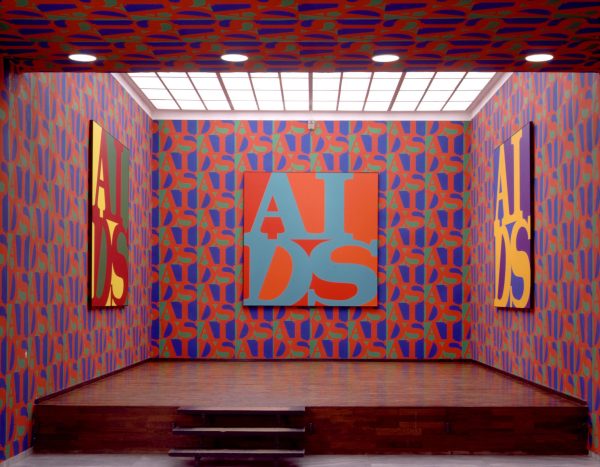
Editorial
This Will Have Been: Art, Love & Politics in the 1980s
Flexibound softcover; 448 pages, with 200 color illustrations. Published by MCA Chicago with Yale University Press.
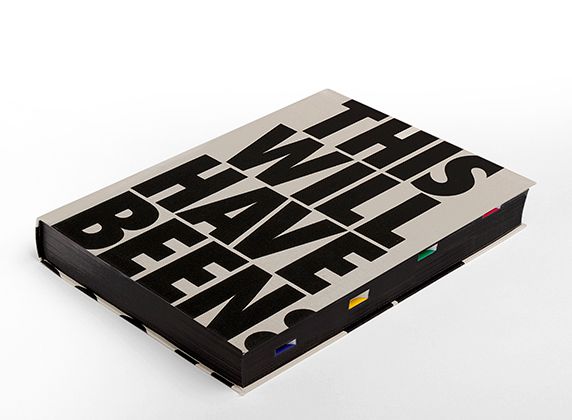
A striking accompaniment to the exhibition, the catalogue This Will Have Been: Art, Love & Politics in the 1980s chronicles canonical as well as nearly forgotten works of the 1980s, arguing that what has often been dismissed as cynical or ironic should be viewed as a struggle on the part of artists to articulate their needs and desires in an increasingly commodified world. The major developments of the decade—the rise of the commercial art market, the politicization of the AIDS crisis, the increased visibility of women and gay artists and artists of color, and the ascension of new media—are illuminated in works by Sophie Calle, Nan Goldin, Mike Kelley, Jeff Koons, Sherrie Levine, and Lorna Simpson, among many others.
Essays by leading scholars, including Frazer Ward, Kobena Mercer, Johanna Burton, Elisabeth Lebovici, Bill Horrigan, and Sarah Schulman, provide unique perspectives on the decade’s competing factions and seemingly contradictory elements.
Complete with critical texts on each object in the exhibition, this handsome volume brings into focus the full impact of the art, artists, and political and cultural ruptures of this paradigm-shifting decade. Featuring more than 200 full-color reproductions of works in a range of media, including drawing, painting, photography, and sculpture, This Will Have Been: Art, Love & Politics in the 1980s is an ambitious guide to this period of artistic transformation.
Essay
-
Until recently the art of the 1980s has often been regarded as a kind of embarrassment—excessive, brash, contentious, too theoretical, insufficiently theoretical, overblown, anti-aesthetic, demonstrably political—as though the decade were just too much. Cracks in this facade have appeared, to be sure. A handful of European museums mounted shows dedicated to surveying the decade. Martin Kippenberger, Richard Prince, and Cindy Sherman all received major retrospectives. Perhaps most notable was the 2003 Artforum double issue dedicated to that nettlesome decade; in his opening salvo guest editor Jack Bankowsky went so far as to say that, counter to the increasingly canonized work of the 1960s and 1970s, the art of the 1980s was an “open wound.”[1]
This Will Have Been (which covers the period from 1979 to 1992) neither attempts to tell a properly chronological story of the decade nor cleaves closely to the dominant art historical terms of the day. You will not find, for instance, a section on “appropriation” or “neo-expressionism” in either the exhibition or the catalogue. Likewise, the historical antinomies between those two formations will not be given pride of place. Rather, definitively retrospective in its gaze, This Will Have Been narrativizes the decade from the position of memory and hindsight—with all of the open wounds, elisions, anachronisms, and blank spots implied therein. Unavoidably, given the staggering loss of life experienced as a result of the HIV/AIDS crisis, pain attends the task. Again and again in organizing this exhibition I realized that I could never approach the material at hand as if I didn’t know about AIDS, as if there were an innocent “eighties” before the disease and its attendant political crisis came into full view toward the end of the decade. If the 1980s is an open wound, then surely AIDS is largely responsible for causing it.
This Will Have Been also contends that the eighties feel like an “open wound” because of the transformations brought about by feminism. This might help to explain how in 2007, when the art world’s “year of feminism” rolled around, the 1980s was a blank spot in the historicization of feminist art.[2] The early twenty-first-century revival of feminism in the art world was both the cause and effect of two exhibitions: WACK! Art and the Feminist Revolution, which covered the period from 1965 to 1980, and Global Feminisms, which started with the 1990s. Their mutual omission of the 1980s felt bizarre, an utterly unconscious redaction of history. Could the prevailing silence regarding the eighties vis-à-vis the recent reinvestigations of feminism also be seen as a symptom or cause of the “wound” that makes this period too difficult to discuss, too fraught to reassess?
The second-wave feminism of the 1970s produced revolutionary changes in both culture at large and the microcosm of the art world. It was the charge of the 1980s to assimilate these changes; to wit, when asked what the most important development of the 1980s was, Lisa Phillips, one of the most prominent curators of the period, responded quickly: “[W]omen finally got a seat at the table.”[3] In addition to the rise of women artists and arts professionals in the 1980s, the decade witnessed artwork that was deeply preoccupied with mass-media imagery and the role of the “image world” (the title of an important exhibition organized by Phillips). One result of this interest was a critical engagement with the mass media’s role in producing and maintaining the patriarchal construction of “woman.” Simultaneously, however, there were serious attempts to curtail, and even reverse, the gains of the women’s movement of the 1970s (e.g., the 1982 defeat of the Equal Rights Amendment and the decade’s long struggle over the sanctity of Roe v. Wade).[4] During the 1980s, feminism found itself in a squeeze play, attacked from the right by those who wished to stop its advances for social justice and challenged from within its own ranks by an increasingly theoretical and psychoanalytical version of feminism more interested in deconstructing the how and why of patriarchal forms of power than in gaining access to power within a patriarchal system. Added to this internal schism was the rise of emerging discourses of queer theory, identity politics, and postcolonial studies—all of which worked to destabilize any narrative blind to the compound properties of difference that make up our subjectivities. These new formations pressured existing discourses and practices of feminism to consider class, sexuality, race, and ethnicity in ways that ultimately challenged the very category of “woman” as a unitary and unifying concept. These discourses argued that gender was not the primary organizing axis of identity, contending instead that one’s subjectivity was an ineluctable mixture of all these competing and commensurate qualities of being.
This Will Have Been’s retrospective gaze is deeply informed by the matrix of AIDS activism and the challenges laid at the feet of Anglo-American feminism by writers and theorists more frequently associated with the early to mid-1990s. This Will Have Been argues, however, that these voices and ideas were nascent at the beginning of the 1980s and, more importantly, they were also being fleshed out in works of art and in art criticism (which was remarkably robust during this period), just as they were slowly forming in the minds of writers such as Judith Butler and Homi Bhabha. This exhibition suggests that much of the art of the 1980s was involved in a shared project of expanding our understanding of identity and subjectivity, exploring the possibility of politics in a mediated public sphere, and offering increasingly nuanced and complicated versions of history and memory. This Will Have Been presumes that works of art did not illustrate these ideas, but helped to create the conditions of possibility for both the most advanced theoretical writings of the period and the AIDS activist movement that profoundly shaped the end of the decade. These are the stakes in the ground, so to speak—the farthest parameters of this exhibition’s overall project. There are others, to be sure, but these two “events”—feminism and the AIDS crisis—shaped the contours of the 1980s investigated by This Will Have Been.
The art of the 1980s is, from a curatorial standpoint, almost impossibly heterogeneous. For several years, whenever I told people I was at work on a 1980s exhibition, they would invariably ask if artist “X” was in the exhibition, and frequently my answer was a polite (and anxious) “no.” Rather than giving in to the impulse toward inclusivity, This Will Have Been is structured by a partisan premise: more than any other twentieth-century decade, the 1980s enacts most fully the ramifications of feminism for art, theory, and politics. Or as Craig Owens would write: “Among the most significant developments of the past decade—it may well turn out to have been the most significant—has been the emergence, in nearly every area of cultural activity, of a specifically feminist practice.”[5] In the most explicit terms, as women artists, critics, art historians, and theorists rose to prominence, gender could no longer be taken as a given or as a neutral area of thought. Implicitly, feminist critique in the eighties often manifested itself through the registration, enactment, and belief in the mechanisms and power of desire. While the confluence of the civil rights movement, the anti–Vietnam War protests, the student uprisings of 1968, and the feminist movement failed to produce a full-blown political revolution, what could not be eradicated from the culture was an increasingly robust sense of agency and entitlement—a belief that individuals had the right to the pursuit of happiness, a pursuit that meant one’s personal desires would no longer be sublimated in the name of the family or the state. To be fully human, to be equal, was to have the power and freedom to enact one’s desires (even if one failed to achieve them). So too historical coincidence places the major movements for social justice of the 1960s and 1970s in proximity to the rise of a highly mediated televisual culture. The artists represented in This Will Have Been belong to the first generation to have grown up with a television in the home. They came of age in a culture shot through with visual regimes designed to promote desire across a variety of spectra: desire for objects, for lifestyles, for fame, for conformity, for anti-conformity. These two powerful social forces—movements for social justice and the rise of television—converged and matured in the art of the 1980s. There were hundreds, probably thousands, of artists working during the 1980s, but the ones included in This Will Have Been register and negotiate the effects of the above socio-historical phenomena.
The culture born of this nexus of desire, shaped by demands for equality on the one hand and the image world of the mass media on the other, makes desire both the cause and the effect for much of the art in this exhibition. Sometimes the desire is erotic, for objects or for bodies; sometimes the desire is for fame, for political change, for endings (e.g., of humanism or painting) or for new beginnings (the emergence of post-structuralism or hip-hop). But always coursing through the works chosen for this exhibition is a profound belief in the capacity of art objects—indeed, of culture in the broadest sense—to signify, enact, and enable these multifarious forms of desire. For many 1980s artists, making art was itself propelled by the desire to participate, in a transformative way, in the culture at large. This shared aspiration may be what prompted curator Ann Goldstein to refer to the 1980s as the “last movement,” the last time artists, however seemingly disparate their respective bodies of work may have appeared, nonetheless held in common a set of hopes and assumptions about the role of art in the public sphere.[6]
Because desire is such an important concept for the 1980s, it is worth an excursus into psychoanalysis—the methodology that has taught us the most about desire’s workings. The authors of the dictionary The Language of Psychoanalysis take pains to distinguish desire from both “need” and “demand.” Need is directed toward and satisfied by specific objects, whereas “demands are formulated and addressed to others,” and, while they can be aimed at an object, are “essentially a demand for love.” Desire “appears in the rift that separates need and demand.”[7] It is by nature about lack: one desires what one does not have. Desire forms in “relation to phantasy,” the realm of the imagination and the unconscious, and it is in these areas that desire most frequently erupts, demanding to be recognized. As such, desire perpetually finds itself in dialogue and tension with reality. For Sigmund Freud, phantasy is not defined as “an object that the subject imagines and aims at,” but rather “a sequence in which the subject has his [sic] own part to play and in which permutations of rules and attributions are possible.”[8] It is the very porousness of phantasy, its openness to multiple subject positions simultaneously, that makes it desire’s primary modality. Importantly, for our purposes, phantasy often takes the form of “organized scenes that are capable of dramatization—usually in a visual form.”[9] During the 1980s many artists influenced by feminism not only insisted on equal access to all aspects of civil society and social life (a focus for 1970s feminism, just as it was for the civil rights movement before it) but they also demanded equal occupation of the sites of phantasy. These artists thus claimed equality within the sphere of representation, the site within which desire is articulated in the overlapping realms of culture and politics.
As artists worked to understand an increasingly media-saturated world, decades of emphasis on abstraction gave way to increasingly figurative imagery. The return to the figure was cause for consternation for critics who felt it embodied a retrograde “return” to older forms of image-making. So too, many feminist artists and critics were troubled by the reemergence of the female nude, a genre sufficiently vexed by the burgeoning field of feminist art history. However, the figure did not only return in the guise of neo-expressionist painting or images of naked women. The figure was also frequently smuggled in under the critical rubrics of appropriation or identity politics, and it occurred as much in the emergent media of photography and video as it did in the historical medium of painting. And because figuration lends itself to a more explicitly narrativizing impulse, the art of the 1980s was marbled with scenes of phantasy and desire, as the figure invariably invited projection and/or identification on the part of viewers, artists, and critics. One overwhelming effect of this renewed deployment of the figure is that a startling array of images produced during the 1980s are concerned—either implicitly or explicitly—with a working through of sexual difference in the face of the feminist challenge to patriarchy; this can be seen in the feminist critique of appropriated mass-media images dealing with the construction of gender, or in neo-expressionist painting’s recourse to a frequently naked and vulnerable body. In retrospect, these works appear less antagonistic and more as mutual attempts to make images of the new social relations feminism was asking people to inhabit. Additionally, by the end of the decade, gay and lesbian artists had permeated the contemporary art scene with works that dealt with the specificity of queer desire, as part of a more generalized demand that such desires could no longer be kept quietly out of public view.
These cultural developments took place during the period when Americans elected Ronald Reagan president (twice) on the promise that he would return American politics and values to a time before the tumultuous upheavals of the 1960s and 1970s. For those interested in “family values,” such as members of the Eagle Forum, led by conservative activist Phyllis Schlafly, explorations of desire were hardly greeted as liberatory. Instead, for political conservatives, the exploration of desire on the part of women, people of color, and gays and lesbians was deeply threatening.[10] Ironically, for many in the art world, the suffusion of art with the narrative and figurative—impulses inherent to phantasy—was also problematic when compared to the previous several decades of abstraction.[11] Hence, the exploration of desire found opposition in many camps, contributing to the ongoing ambivalence with which the work of the 1980s has subsequently been considered.
Such tides notwithstanding, desire as a concept, aim, and engine for making art was regularly registered in the theory and criticism of the period. This was particularly the case among critics who were interested in feminism and sexuality and who had turned to the discourse of psychoanalysis to think through these issues. Craig Owens wrote that the visual field was “crosshatched by desire.”[12] Similarly, in the words of Mary Kelly, “[s]ince the fascination in looking is founded on separation from what is seen, the field of vision is also, and most appropriately, the field of desire.”[13] For Owens and Kelly, like many critics and artists of the period, desire and the visual go hand in hand. What passes unsaid in these accounts, however, is how desire’s imbrication in the visual is most potently connoted when the work in question is figurative or representational, i.e., when it plays out in phantasy the problems inherent to desire. (In other words, one doesn’t encounter the same talk of desire in discussions of abstraction of the 1950s, the serial production of the 1960s, or the linguistic turn in conceptual art of the 1970s.)
Like “the 1980s,” desire as an organizing principle runs the risk of being too easily generalized. Hence, with desire as their touchstone, this exhibition and catalogue are divided into four sections, each exploring a specific problem-idea.[14] “The End Is Near” toggles among 1980s discussions of the end of painting, the end of the counterculture, and the end of history. Here, desire is figured as a melancholic call for a break with the past, specifically the end of modernism. Fueled by a strong desire to stake out the new terrain of postmodernism, the artists in this section worked with an eye toward the history of art, as critical of its premises as they were deeply desirous of their place within it.
“Democracy” addresses the renewed interest in the street as a site for public intervention, the increasing awareness of the importance of the mass media, the growing prominence of South and Central American artists and artists of color, and the pervasive commitment to the political that shaped the period. In this section, desire is figured politically, often masquerading as a demand informed by immanent critique—a request that the powers that be remain true to their highest principles. Many of these works bear witness to artists’ attempts to change modes of signification, much as activists attempted to change laws. Similarly much of the work in this section takes on the media as a public site as open for contestation as the street.
“Gender Trouble” elaborates on the implications of the 1970s feminist movement by gathering works that interrogate and ultimately expand our sense of the social construction of gender roles. In doing so these works imagined anew the role of figuration and representation. As an emphasis on, and the importance of, the concept of sexuality (as distinct from gender) increased, desire frequently emerged as a way for artists to explore ideas of difference, rendering categories like “woman” heterogeneous rather than homogeneous. Artists featured in this section articulated how representation helps to construct and maintain notions of gender, and many works strove to unmoor gender from bodies and locate it instead within discursive systems of power.
In “Desire and Longing” artists working with appropriation techniques are held in relation to the emergence of queer visibility brought on by the AIDS crisis. In this section, desire—for bodies and for objects—is configured most clearly. At the same time, transformed by grief and mourning, desire became longing: for individuals lost, for a more just public sphere, and for a time before the crisis began.
The End Is Near
Woody Allen’s 1979 Manhattan begins with a montage of romantic black-and-white images of New York City, footage at odds with the voice-over that sputters with false starts as it proclaims the end of the city itself. Just three years later, in a part of New York largely unknown to the Woody Allen set, the young graffiti and rap artists in Charlie Ahearn’s Wild Style ruefully pronounced the hip-hop culture they had just created to be dead as early as 1982 (dead, that is, long before its entrance into mainstream culture). Narratives of the end were pervasive, and one “end” signaled by the 1980s was the end of the cultural and political experiments of the 1960s. Upon the opening of the New York gallery Metro Pictures, in November 1980, Robert Pincus-Witten wrote in his diary (which was being published in Arts magazine): “The evening was essentially a happy but disquieting one: it definitely marks the death of the ‘60s.”[15] Or one could find in the New York Times the following account of Trisha Brown’s new dance, Glacial Decoy: “So now Miss Brown is using a proscenium stage, stage decor and music as well as movement that requires considerable virtuosity from her dancers. In 1981, we have finally realized that the 1960s are over.”[16]
With the end of the sixties came a sense of something new as well, and the impulse to name it created a flurry of pithy monikers—neo-geo, appropriation, identity politics, neo-expressionism—each designed to identify both a group of artists and a type of practice. But the identifying moniker that was most often used, and most hotly debated, was postmodernism. No intellectual paradigm has been more synonymous with the decade, and the term’s current state of disrepair speaks volumes about the general ambivalence toward art of the 1980s. The prefix “post” signaled an end—but the end of what, exactly? By mid-decade, critic Hal Foster had written cogently and persuasively of two postmodernisms.[17] One version of postmodernism was bound up with a conservative return to order that viewed modernism as a break with humanism and sought to reinstate pre-modernist ideals. For Foster, artwork associated with this form of postmodernism took shape in several ways: through the reemergence of figuration, through a return to “older” modes of artistic production (i.e., a return to painting after two decades of the medium’s critical rejection by Minimalism and conceptualism) via an ahistoricizing use of pastiche, and, most of all, through a belief in representation’s transparency to meaning.[18] According to Foster, the other version of postmodernism regarded modernism as not having broken with humanism enough. Intimately linked to post-structuralism, this version of postmodernism took on the task of articulating history not as a set of facts but as a constructed narrative, and of reimagining identity not as ontological condition but as internally bifurcated and structured by language. For the thinkers and artists in this “camp,” postmodernism offered a constellation of ideas and strategies that saw representation as constructed (not transparent) and therefore as a series of codes to be dismantled in the service of critique. Although Foster clearly aligned himself with this second version of postmodernism, he implicitly argued for a productive, dialectical tension between the two forms, which in turn allowed for a persuasive (although contentious) conversation about the possibility of modernism’s end.
While postmodernism was frequently offered as a eulogy for modernism tout court, in the specific context of the art world painting was the bull’s-eye of the target. Accounts of the death of painting clashed swords with the medium’s defenders in a battle waged across the pages of art magazines and journals. Some accounts of painting’s death were vitriolic (Douglas Crimp’s 1981 “End of Painting”), while others offered a recuperative gesture, seeing in the medium’s outmodedness its very possibility (Thomas Lawson’s “Last Exit Painting,” also of 1981).[19] Either way, Gerhard Richter spent much of 1983 painting skulls in soft focus bathed in a dreamy yellowish light. He made eight canvases of this nearly hackneyed vanitas image, a simultaneously ironic and mournful mimicry of one of Western civilization’s most loved genres. This affective mix of irony and melancholia was shared by artists as diverse as Peter Halley, Mary Heilmann, Martin Kippenberger, Sherrie Levine, and Allan McCollum, all of whom engaged in the activity of marking the end of various ideas associated with modernist painting. Heilmann’s pink-and-black paintings of 1979, musically titled Save the Last Dance for Me and All Tomorrow’s Parties, allow the color scheme of punk and new wave to devour the modernist apotheosis of monochrome painting, “killing” the historical avant-garde with the brash new modality of punk. McCollum’s Collection of Ten Plaster Surrogates (1982–91) twists the monochrome into a form of serial mass production, making “paintings” out of plaster casts. Working a push-pull of form and content, McCollum’s Surrogates appear mass produced (they all have solid black centers and the same style of “frame”), yet each was laboriously hand-painted; furthermore, while they all look similar, each set of Surrogates is unique. Kippenberger’s 6. Preis (1987) is part of a series of paintings that announce their own “prize-winning” status, a conflation of the high-art ideal of the masterpiece with the amateur painter’s reward for juried exhibitions. Tongue-in-cheek, they also humorously skewer the artist’s desire for criticism and approbation (as each painting is judged and rewarded before it even leaves the studio) by folding each into the image of the painting itself. Both Halley and Levine reposition modernist geometrical abstraction (so many stripes and squares) in a dialectical relation to social conditions—be they the conduits of power most radically symbolized by the prison system (as in Halley’s Prison with Conduit, 1981) or the seemingly infinite repeatability of forms and gestures (Frank Stella’s stripe paintings) that governed art in the age of mechanical reproduction (e.g., Levine’s Chair Seat: 7, 1986).
The narratives of death and ending endemic to postmodernism were attended by different political and psychological valences. Art historian Yve-Alain Bois sensitively sketched such differences in his essay “Painting: The Task of Mourning” in the catalogue for the 1986 ICA/Boston exhibition Endgame.[20] Akin to Foster’s dual reading of postmodernism, Bois’s contention is that during the 1920s two responses dominated artists’ reaction to the endgame sensibility of the avant-garde: the first, a return to order, as evidenced by the post-cubist figurative paintings of Pablo Picasso; the second, a revolutionary embrace of the end of art’s bourgeois character, as signaled by the radical paintings that emerged in the wake of the Russian Revolution. Analogizing the 1980s and the 1920s, Bois felt that contemporary artists involved in narratives of painting’s death engaged in a form of “manic mourning,” as a way of deferring the more psychoanalytically motivated (and linguistically based) process of “working through” the very end being proclaimed.[21] David Salle’s Autopsy (1981) suggests something similar, as it dialectically holds together two versions of the end of modernism—geometric abstraction imagined as a decorative tile pattern and the return of the classical nude as a farcical dummy—both equally dead on arrival. And yet somehow the charge of their adjacency bestows an undeniable energy (a mixture of cruelty, irritation, and boredom that speaks, perhaps, to the intensity with which the pressures of the end were experienced by artists). Bois places the burden of working through painting’s various ends squarely on the artists. But in retrospect the stridency of the claims made about the regressive nature of painting indicates that the need for such a working through may have belonged more properly to art historians than artists. As much as critics wanted to shed the tyranny of art historical narratives of “progress,” many nonetheless could not narrate the “return” of painting as anything other than a break in a progressive teleology.[22] Regardless, Bois ends his essay emphatically: “[T]he desire for painting remains, and . . . this desire is not entirely programmed or subsumed by the market; this desire is the sole factor of a future possibility of painting, that is of a nonpathological mourning.”[23]
Another version of the end of modernism can be traced through the ongoing reception of Roland Barthes’s short, but crucial, essay, “The Death of the Author.” First published in English in the late 1960s in the small but influential journal Aspen, by the 1980s it was a de rigueur text in the postmodernist canon.[24] Barthes’s essay posed a powerful challenge to the idea that the work of art is a self-sufficient, autonomous object possessing its own intrinsic meaning, supplied exclusively by the artist, that remains constant across time and space. Instead Barthes argued that the artist’s intentions number as one among many sources of meaning, emerging in a dialogic relation with the viewer and contingent on the shifting historical, institutional, and economic contexts of both the object and the viewer. Louise Lawler’s Living Room Corner, Arranged by Mr. and Mrs. Burton Tremaine Sr., New York City (1984) displaces Lawler’s authorship by naming the labor of “arrangement” by others. Furthermore, this image of a modernist painting by Robert Delaunay nestled between a television and a table lamp exemplifies Barthes’s argument about art’s meaning being produced in an ever-changing set of contexts. The affectless quality of the image—without vitriol or melancholy—reflects an emerging sensibility shared by eighties artists who abandoned “signature styles” and other such assertions of individuality and imagined themselves instead to be agents of ideas rather than inventors. This idea (augured most deeply by appropriation, discussed later on), perhaps more than any other postmodernist idea, presented the greatest challenge to the modernist conception of art (i.e., its transcendence, autonomy, and novelty) and to the historical idea of what it meant to be an artist (i.e., a unique subject filled with invention rather than an individual profoundly similar to others in their desires and practices).
Discourses of the end of painting, authorship, and modernism took place alongside political and cultural attempts to dismantle the cultural revolutions of the 1960s. Under the administrations of Margaret Thatcher and Ronald Reagan, the attack on unions (a vestige of collectivism), the war on drugs (and the attendant soft militarization of domestic policy, specifically in African American neighborhoods), and the culture wars (in which the sexual liberation engendered by the feminist and gay rights movements was recast as “obscene”[25]) all signaled a desire to roll back the social and cultural advances of 1960s counterculture. At the same time, alternative and progressive segments of society also found themselves rejecting the transformation of the cultural revolution of the 1960s and 1970s into a “lifestyle” largely relegated to the sphere of consumer culture. Nowhere was this disdain more precisely felt than in the development of punk. Punk’s nihilism, its extreme do-it-yourself ethos, and its consummate refusal of commercial rock and roll, all combined to resist both hippie counterculture and any kind of “co-optation” by the market. (Punk was unplayable on commercial radio.) Further, punk offered a model of artists as untrained and diffident, set apart from the dominant culture not because of inherent gifts or emotional “sensitivities” but rather because they were profoundly alienated from their society. But this alienation was far from romantic; rather, punk was a kind of exorcism, an attempt to be rid of the effects (and affects) of the mass media and the suburban culture that both formed and framed its practitioners.
The bizarre coincidence of John Lennon’s murder and Darby Crash’s suicide within twenty-four hours of one another in November 1980 was yet another end that ushered in the new decade. Lennon, synonymous with the counterculture, was brutally gunned down in Manhattan by a troubled individual. Crash, the lead singer of the cult LA punk band The Germs, died of a drug overdose. That Crash would flame out so quickly signaled that punk’s liberating impulse, its desire to throw off the mantle of a moribund American counterculture, was possibly to be as short lived as many of its songs. Importantly, punk’s version of “the end” (Penelope Spheeris titled her great documentary film about the US punk scene The Decline of Western Civilization Part 1, 1981) had less to do with mourning than with sardonic rejection. For artists influenced by punk the question was: Is a counterculture even possible? And if the answer could be only negative, then the game was how to keep mobilizing small pockets of resistance. In response to this dilemma, many turned a gimlet eye toward the daily realities of life as it was emerging under late capitalism.[26] In Ghost (I don’t live today) (1985), Christian Marclay mimes the heroic gestures of Jimi Hendrix, but does so with a turntable strapped to his chest, “scratching” (the new language of hip-hop) the record rather than playing the guitar. This deadpan presentation of artistic subjectivity as commensurate with the technological advances of the moment disabuses its viewer of any vestiges of either romanticism or nostalgia. Raymond Pettibon’s drawings (many of which first appeared as record covers for the LA punk band Black Flag) mine the dark underbelly of California’s hippie culture, perversely crossing the wires of Hollywood gossip, texts cribbed from the Western tradition, and the base realities of post-1960s fallout (typified by his fascination with Charles Manson). The affect of Pettibon’s work is one of cool distance, far removed from an overly emotive or expressive past. Pettibon’s drawings strip away modernist hierarchies of high and low culture and instead offer all the linguistic detritus of culture with radical parity—a quote from Reagan has no more or less valence than one from Henry James, an image of Christ on the cross is treated in the same manner as a baseball player at bat. This emergent archival sensibility is echoed in Candy Jernigan’s Found Dope: Part II (1986), which gives the crack vials that littered her Lower East Side New York neighborhood the treatment once reserved for pressed flowers. Matter-of-fact in its approach, Found Dope documents the transformation of bohemia from an idyllic back-to-nature fantasy to the intractable reality of the larger economic forces of gentrification, poverty, and the drug epidemic of crack cocaine. As postmodernism heralded the end of humanist traditions, one was free to pick among the rubble and take what one found, not in a gesture of sublimation or mourning, but rather in the spirit of an affectless reportage.
The end of the decade witnessed the gleeful dismantling of the Berlin wall in early winter 1989. With its collapse came the end of the Cold War and the realignment of power, culture, and finance on a global scale. Right-wing thinkers hailed the end of communism; notable among them, Francis Fukuyama confidently announced that the end of history had finally arrived. It was only a matter of time, he argued, before we would all enjoy “the universalization of Western liberal democracy as the final form of human government.”[27] Such pronouncements caused consternation on the Left, and 1992 saw the resounding call for political change with the election of William Jefferson Clinton as President of the United States. For a brief moment, it felt as if all was not lost. And so with ends come beginnings. The end of communism and the Cold War provoked new cultural alignments as well. The fall of modernism to postmodernism led to significant recognition of artists who were women and people of color. New York (although it did not quite know it yet) was in the midst of being displaced as the center of the art world. Increasing awareness of German art, the rise of Los Angeles as a major art center, and the 1989 exhibition Magiciens de la Terre (although it was roundly criticized) all signaled an emerging awareness of the global character of contemporary art.[28] A robust art market started to ameliorate the partisan nature of 1980s New York, ultimately giving rise to the pluralism that came to characterize the 1990s. Many 1980s artists began to make significant incomes that ultimately changed the tenor of the art world, as vestiges of bohemian life increasingly gave way to luxury lifestyles.[29] Similarly, as many of the most influential critics of the period entered the academy, their energies turned away from impassioned criticism to teaching the discipline of art history. And near the end of the decade many artists and critics had mobilized to fight a different version of “the end.” Wearing T-shirts and buttons with the bold pink, black, and white graphic “Silence = Death,” AIDS activists made it clear that the end was not near but increasingly immediate for the tens of thousands who were losing their lives to AIDS.
Democracy
The elections of Reagan and Thatcher ushered in a wave of conservative policies that profoundly affected the politics, culture, and economy of the period. Both were antiunion and pro-business, both remilitarized foreign policy—through direct military action in Grenada and the Falkland Islands—and Reagan’s policies abandoned the détente that had come to characterize the Cold War. Both leaders also engaged in a discursive and legislative rollback of the countercultural values put into place during the 1960s and 1970s. Notably, in the United States, the Republican Party removed the Equal Rights Amendment from its party platform in 1980, and the amendment’s 1982 failure to pass in Congress signaled a significant loss for feminism’s challenge to the liberal state. In 1984, halfway through the Reagan era, Fredric Jameson, one of the principle theorists of postmodernism, wrote: “[T]he great explosions of the sixties have led, in the worldwide economic crisis, to powerful restorations of the social order and a renewal of the repressive power of various state apparatuses.”[30]
Reagan’s efficacy as president was deeply intertwined with his canny use of the mass media, facilitated no doubt by his previous career as a Hollywood actor. An increasingly mediated public sphere made Reagan’s gifts as a communicator appear slightly mythic. As Michael Warner observed toward the end of Reagan’s second term in office, “more than any other, his figure blurs the boundary between the iconicities of the political public and the commodity public.”[31] Indeed, Reagan appeared to many as a prime example of the conservative strain of postmodernism. He appealed to a nostalgic version of the past deployed through a pastiche of historical tropes (the cowboy, the World War II hero), accompanied by a hostile relation to the forces of modernity. Nicknamed the “Teflon President” for his ability to escape unscathed from even the most barbed criticism, he seemed at times a simulacrum of a president. In one of the most enduring images of the decade, First Lady Nancy Reagan waves at her husband’s projected image during the 1984 Republican National Convention, as if she too had lost the ability to distinguish between her spouse and his representation.
Given the primacy of the televisual for the Reagan presidency, it should perhaps come as no surprise that his image was deployed by numerous artists of the period. Hans Haacke’s Oil Painting: Homage to Marcel Broodthaers (Öelgemälde, Hommage à Marcel Broodthaers), first presented in the 1982 documenta VII, issues a double rejoinder, on the one hand to documenta curator Rudi Fuchs’s conservative language about the role of art in society and, on the other, to the rising militarism of the United States under Reagan.[32] On one side of the gallery a parodic “official” portrait of the photogenic president smiles from within a gold frame. Directly opposite the oil painting is a large photo blow-up of an anti-Reagan protest, held a week prior to the opening of documenta in Bonn, Germany. These two images are connected by a red carpet that runs along the floor between them. The work places the viewer in the middle of a suite of potentially irresolvable dialectics: oil painting and photography; the pretense of art’s timelessness and the temporality of the day’s news; the trappings of official power and the power of the people. Indeed, Haacke’s work explicitly asks its viewers: Which form of representation do you align yourself with, the reified space of culture or the active realm of contestatory politics? Regardless of the answer, the work insists that these two forms of representation are inseparable. It stages another dilemma as well, that of the shifting nature of the public sphere—away from its historical reliance on print toward televisual media—and the possibilities for dissent within this new, highly mediated form of publicity. Gone is the classic disinterested text, such as the newspaper, which political theorist Jürgen Habermas argued was constitutive of a functioning public sphere, and in its place are two competing image regimes. If something remains from an older model of the public sphere, it is the opposition of two different spatial manifestations: the bourgeois space of the museum and the historically more “unrestricted” space of the street. Haacke’s work offers the street, and the potential of mass protest, as a stark alternative to the space of the museum. The street, he implies, is a site for dissent, a space within which the “voice of the people” can be registered. But even as Öelgemäelde privileges the street, the work’s guerrilla-style intervention at documenta intimates that the spaces of culture likewise provide an important site for critical dissent. And however much Haacke was himself politically aligned with the demonstrators, their image is radically circumscribed within the frame of a photographic negative (complete with sprockets running along each side), suggesting that mass protest will inevitably be represented, reformatted, and recontextualized by the forces of representation, which will ultimately control its meaning.
This complicated and conflicted understanding of the relations between the public space of the street and the public sphere of representation was nascent at the beginning of the decade. For many artists, the street represented a site outside the structures of power (however “true” or phantasmatic such a concept may have been); the idea of the street, in other words, retained an antithetical relation to the space of the museum and television. Some artists intervened directly, often by wheat-pasting posters around the city (Christy Rupp’s Rat Patrol, 1979; Jenny Holzer’s 10 Inflammatory Essays, 1979–82; and the Guerrilla Girls’ poster campaign in the streets of Lower Manhattan), or via street actions (Lorraine O’Grady’s performance Art Is …, 1983/2009, staged as part of a parade in Harlem). Each of these works approaches the street as a place where different (i.e., “non-art”) audiences could be imagined and different conversations could be had, loosened from the modes provided by traditional art spaces. Such sentiments were hardly universal, however, as many artists observed that the increasingly dominant role of television had already begun to replace the street as a primary site of discourse and power. In works by Gretchen Bender and Dara Birnbaum the television is both the medium and the message, used as much for its sculptural and filmic possibilities as for its subject matter. Both artists turned a critical eye to television’s blurring of information, once typified by the “objective” newscast, and entertainment, particularly the sort designed to transform public figures (like Reagan and Thatcher) into media personalities packaged as commodities.
As television became increasingly prominent (in large measure due to the rise of cable TV and the creation of CNN in 1980 as well as the Cable Communications Act of 1984, which deregulated the cable networks and fueled the expansion of the cable market) print media and street protest took on an increasingly ambivalent cast, particularly among artists concerned with explicitly political content. This is one way of looking at the work of Jean-Michel Basquiat and of Tim Rollins and K.O.S. Both artists imagine the space of traditional painting as a public wall, as if to drag the logic of the street into the space of the museum. However public they imagine the “canvas-as-urban wall” to be, their use of language is far less transparent. Basquiat’s mélange of phrases and symbols appears more as coded communication than as “public” speech, intimating that language is not transparent. This is Basquiat’s primary formal relation to graffiti culture; both art and graffiti display the way language is legible only to those who already understand it and thus creates a barrier between those who can read the code and those who can’t. Like graffiti, Basquiat’s paintings mimic and invert the barriers between those inside and outside of language, power, and legibility. In Tim Rollins and K.O.S.’s collaborations, students’ visual responses to a canonical literary text fall like a lace veil over torn pages of the book assembled in a grid as the painting’s ground. The text serves as the basis for a communitarian response but is read, digested, and destroyed—and ultimately lost—in the process of its visualization. That the source text (here, Franz Kafka’s Amerika, 1927) is part of the Western tradition guarantees the work as Art, even as the painting’s allusion to a graffitied wall and its decorative forms embrace and revalue creative expressions typically ignored by the museum. Such structural ambivalence lends the work an overall feeling of indeterminacy about exactly in which (or whose) realm this painting belongs.
The issue of belonging, of who has rights to what, where, and when, lies at the heart of the democratic enterprise. Such issues were to be sorely tested in the 1980s along numerous fronts. The rights of nations to determine their own sovereignty was of concern to many artists in both Latin America and the United States. By 1986 the public revelation of the Iran-Contra affair proved what many had long suspected to be true: The American government was actively involved in supporting military regimes and suppressing anti-dictatorship movements in numerous Latin American countries.[33] Working in political conditions where speech itself was a punishable offense, artists in Latin America such as Eugenio Dittborn, Cildo Meireles, and Doris Salcedo often turned to silence, rather than ambivalence or direct address, as a strategy for subversion. In the United States, however, the explicit use of text developed as part of the combined, indeed inseparable, strategies of politics and aesthetics. Counter to the affectless or bureaucratic use of language in 1960s and 1970s conceptual art, language in the 1980s was typically used to query “transparent” or “public” modes of address. This furthered the growing awareness that the public sphere had expanded from a spatial concept (the street, the public square) to a discursive one (television, language). Barbara Kruger’s work, for instance, uses the explicitly shared language of pronouns (“we” and “you”) to insist on language capable of interpolating all citizens. Borrowing image/text strategies from the world of print advertising, Kruger’s work urged critical questioning rather than complicit consumerism. Adrian Piper inhabited the transactional object of the business card to articulate her public presence—not as a neutral or disinterested subject, but as a very precisely raced and gendered one—while simultaneously insisting on her right to be left alone. Both Kruger and Piper imagine the public sphere as a space shot through with competing motivations with regard to privacy and publicness, and for them the work of art is a vehicle for interfering in the mechanisms of polite daily communication that presume homogeneity in the definition of publicness.
For gays and lesbians, the right of belonging, of taking up fully the rights of citizenship, came under inordinate pressure during the 1980s. Lari Pittman’s The Veneer of Order (1985) contests the constraints placed on the right of all citizens to participate in the public sphere as disinterested subjects. Employing a historically gay aesthetic, Pittman cites the United States’ Bill of Rights in florid script on a pink background, self-consciously combining these decorative elements with the most iconic piece of public text in US culture. Made in the shadow of the Bowers v. Hardwick decision (the Supreme Court ruling that upheld anti-sodomy laws in the state of Georgia), the painting can be seen as part of the growing dissatisfaction with the language of tolerance and the habits of secrecy surrounding gay and lesbian life. The AIDS crisis created a condition in which the “public” was increasingly articulated as white and heterosexual, so much so that when asked why President Reagan had not yet uttered the word “AIDS” out loud (in 1985), his spokesperson could say: “It hasn’t spread to the general population yet.”[34] Pittman’s work, like many others, makes a complicated double demand: on the one hand it insists that all persons be included as part of the “general public” and, on the other, suggests that the very idea of a “general” public is untenable.
By 1987 the AIDS crisis had reached extraordinary proportions. The misapprehension on the part of the news media, the government, and the medical establishment that the disease did not affect the so-called “general public” translated into murderous neglect, transforming a dire health situation into a political crisis. This crisis was met head on by the collective ACT UP (the AIDS Coalition to Unleash Power), the most important activist movement of the decade in the United States. In New York the artists and cultural practitioners involved in ACT UP brought all their theoretical and aesthetic acumen to bear on the group’s activities, changing the look and feel of street protest as a result. Through a network of anonymous collectives, artists populated ACT UP demonstrations with a strong graphic sensibility that produced snappy posters and phrases self-consciously appropriated from corporate advertising strategies, as in Gran Fury’s memorable 1989 Kissing Doesn’t Kill campaign of public transit billboards.[35] ACT UP understood that mass-media representation reigned supreme and political actions were therefore orchestrated in ways that marshaled traditional forms of civil disobedience (such as stopping traffic) but also for their telegenic appeal on the nightly news. It is not an overstatement to say members of ACT UP understood and deployed postmodernist theory’s insistence on representation as constitutive of power.[36] ACT UP made strides in reimagining what a highly mass-mediated public sphere might look like: a sphere dedicated as much to print media as televisual media, that was invested in the democratic potential of the street while recognizing that mobilizing the nonspatialized mass media was equally necessary for social change. Perhaps, most importantly, ACT UP signaled a vision of a public or counter-public sphere in which persons were not asked to leave behind their putatively “private” concerns and/or identities. Rather, ACT UP modeled a vision of a public sphere that could do more than merely represent (or, even worse, tolerate) the interests of ethnically marked, gendered, and sexualized persons, and sought instead a version of the public sphere capable of “mediat[ing] the most private and intimate meanings of gender and sexuality.”[37]
Gender Trouble
In the fall of 1980, The Dinner Party (1974–79) by Judy Chicago opened at the Brooklyn Museum of Art. The large-scale installation was on a worldwide tour and generated an avalanche of both critical and popular response. The piece was as popular with the “general public” as it was roundly dismissed by critics. The attacks came from both conservatives (Hilton Kramer felt the piece was closer “to an advertising campaign than to a work of art”[38]) and others (Clara Weyergraff felt the piece to be an instance of “brash vulgarity,“ designed to appeal “to the taste of the middle-class housewife”[39]). For many artists working at the time, the piece signaled the end of a certain set of feminist ideals: its “women only” exclusivity, its collective manufacture, its celebration of singular historical individuals, its use of traditionally feminized craft, its inclusion of only one woman of color, and, most of all, its presentation of just barely sublimated vaginal forms to represent the women at the table led to the charge that the work was essentialist—a reduction of the idea of woman to the biology of her genitalia. Beyond the claims of essentialism, The Dinner Party suffered critically for two other reasons: its affect of sincerity was out of step with the growing pervasiveness of Warholian irony, and its central strategy—of insisting on the equality of women’s place at the table of “greatness”—placed it precisely on the side of the humanist divide that postmodernism sought to unravel. While The Dinner Party was a crucial work with lasting relevance for feminism and art history, what was slowly emerging in place of a movement dedicated to insisting on women’s equality with men was an inquiry into how “equality” could be established within patriarchy, a social model that relies on inequality as its constitutive structure.[40]
In other words, for many artists and thinkers the questions central to feminism were dramatically shifting. The problem was no longer how women might enter society and culture as equal participants, but rather how patriarchy works in the first place—through what mechanisms and to what ends. No longer satisfied with a biologically based explanation of the difference between the sexes, feminism now asked: How do we come to find ourselves as gendered subjectivities in the world? What are the psychic ramifications of that gendering on our ideas and desires? Such questions were in sympathy with other paradigm shifts of postmodernism such as the radical contingency of meaning suggested by Roland Barthes’s “Death of the Author” and the general sense of a “crisis of cultural authority,” observed by Craig Owens, “specifically of the authority vested in Western European culture and its institutions.”[41] Indeed, it could be argued that new models of feminism were the driving force of this paradigm shift and that the feminism of “exceptional women” espoused by The Dinner Party, while meaning to be radical, was instead recuperative.
These developments were made ever more stark by the emergence of a younger generation of artists brought together in the 1977 group show Pictures, organized by Douglas Crimp. The catalogue essay (which subsequently appeared as an influential essay in the journal October) argued that an interest in psychoanalysis helped to demarcate the generational split between established 1970s artists and a group of emerging postmodernists (including Cindy Sherman and Sherrie Levine). Sherman’s Untitled Film Stills (1977–80) suggested that “woman” was but a set of performances and poses and subsumed any idea of “greatness” under the mantle of representation and spectacle. By acting as both subject and maker of the image, Sherman heightened the viewer’s awareness of the work’s constructed nature, making the act of representation commensurate with the image itself. For Crimp, Sherman and her peers were compelled to present identity “in such a manner and at such a distance that it is apprehended as representation—representation not, however, conceived as the re-presentation of that which is prior, but as the unavoidable condition of intelligibility of even that which is present.”[42] Such a hermeneutic signaled a move away from a politics of liberation to the politics of representation and was among the most crucial intellectual paradigm shifts of the period.
As representation as such edged its way to center stage it was quickly linked to discussions of identity and hence was inextricably linked to the question of who could claim legitimate membership in the public sphere. As Kate Linker would write, “[r]epresentation, hardly neutral, acts to regulate and define the subject it addresses, positioning them by class or by sex, in active or passive relations to meaning.”[43] Artists focused increasingly on the codes or grammar of representation: Far from seeing the framing devices of photography, the mise-en-scène of cinema, or the brushstrokes of painting as neutral conveyors of subject matter, artists took apart representation’s constitutive elements and, through dismantling them, articulated how such mechanisms worked to create, support, and convey meaning. For artists influenced by feminism, the task was to show how the structure of representation worked silently to shore up the power arrangements of patriarchy. For these artists and thinkers, patriarchy was in the groundwater of the culture, and language itself was saturated with its principles of inequity. In this manner of critique, the re-imagination of form was as crucial as the development of new subject matter.
An example of the commensurate nature of form and content can be seen in the great number of 1980s artists who worked with fragments, eschewing the unity of either image, subject, or body. Consider Lorna Simpson’s Necklines (1989) where the image is cut into tripartite panels, which are misaligned in the installation, refuting any wholeness of idea, image, or body. Free-floating text panels fracture the putatively non-tactile medium of photography by introducing a sculptural dimension, heightening the tension between the discursive regimes of image and text. Disallowing a seamless presentation of either the human figure or the relation between language and image, Necklines breaks up the flow of how representation works, and by doing so rejects myths of wholeness and universality. Simpson’s work, like that of many others, insisted that new narratives needed new forms, that art was an opportunity to alter the way we tell stories in order to change the stories we can tell.
Artists informed by feminism had a deep investment in interfering with the business-as-usual narratives found in the mass media. Many increasingly regarded the visual field (be it nineteenth-century paintings or advertising images) as shoring up the idea that the role of women is to be the object of representation and that “the gaze” (a term borrowed from psychoanalysis that implies the inherent voyeurism of the spectator) could be seen as masculine.[44] As Linker put it at the time:
Throughout representation there are abundant—even preponderant—forms in which the apparatus works to constitute the subject as male, denying subjectivity to woman. Woman, within this structure, is unauthorized, illegitimate: she does not represent but is, rather, represented.[45]
Jeff Wall’s Picture for Women (1979) traffics in such an argument. Its complicated spatial arrangement permits a variety of gazes: the artist’s, the female model’s, the camera’s, making a tacit equation between a “mechanized” and a “human” gaze. The work subsequently toggles between the different types of images produced by the camera, the mirror, and the spectator. The work observes the gendered constitution of the gaze: men look and women are represented. (That Wall’s picture should be so strongly evocative of Édouard Manet’s Bar at the Folies-Bergère, 1882, only heightens the picture’s claim to the historicity of the gaze and its function in Western culture.) At the same time, however, the picture contests the very status quo it observes, for the woman’s gaze is direct and steady. She looks at the viewer, and because of the mirror’s reflective surface, she also looks back at the artist, who, while looking at her, becomes the object of the viewer’s gaze. The doubleness of the gaze in this work is the “gift” established by careful preposition in the title. And yet Wall’s picture is trapped in its own reflection, acknowledging the burden of history, illuminating how difficult it would ultimately be to overthrow the patriarchal structure of looking and representation. This near impossibility notwithstanding, the shifting focus in the image serves to destabilize an essentialist reading (men = active, women = passive) and instead depicts the way in which one’s position shifts contextually, intimating that it is the positions themselves that are gendered and are therefore discursive rather than natural.
Like Wall, many artists invested in subverting the apparatus of representation made recourse to the history of images. Part of what they were after was an indication of how long-standing such ideas are and how deeply ingrained these apparatuses and images are in our daily culture, language, and collective unconscious. (Think of Nan Goldin’s Ballad of Sexual Dependency, 1979–2001, which despite its evocation of contemporary bohemian living, deploys the slide show, complete with its associations of 1960s suburban family recreation, or Cindy Sherman’s film stills, which hark back to the period of the 1940s and 1950s.) Hence Richard Prince’s appropriation of ready-made advertising images (already produced by the culture) allowed him to point to both the predominance of the gendered gaze and the repetition critical to its construction. Just as significantly, Prince’s cowboy series extended the feminist critique of representation to encompass the construction of masculinity, a subjectivity that could no longer stand as “neutral.”
The realm of photography proved incredibly fertile ground for artists interested in feminism. Contiguous with mass media, advertising, and pornography, it could not help but find itself in dialogue with the dynamics of representation and the gaze, as well as their role in the daily facilitation of gendered subjectivities. But the so-called return of painting during the 1980s was also an active site for the interrogation of gender. Painting experienced a much-discussed resurgence during the 1980s, and, like the photography of the period, much of it involved figuration. The return to the figure was vexed: for some feminists the return of the female nude signaled a regression to prior ideologically charged subject matter, and for some critics the reappearance of an expressionist “style” proved equally problematic. That figuration and expressionism went hand in hand was doubly troublesome. Expressionism’s language was that of brush marks and color, freed from the task of representation and thus available to offer an authentic and indexical guarantee of artistic presence. Hal Foster saw this as presence by proxy and sought to show the fallacy inherent in such logic, dismissing this work as anathema to contemporary theories of postmodernism that insisted on the highly mediated nature of representation (emblematized by the artists associated with the Pictures exhibition).[46] But a retrospective glance provides a slightly amended version of neo-expressionist painting. Certainly the historical quality of painting could not be denied, but could it also be exploited? In his self-portraits, Albert Oehlen did just that. Abusing the most overdetermined genre in painting, he depicted himself in varying states of abjection, as if to signal not only the impossibility of the medium but also its newly anxious relation to the “mastery” it had historically claimed. Irony reigns in Selbstportrait mit verschissener Unterhose und blauer Mauritius (Self Portrait with Shitty Underpants and Blue Mauritius) (1984); the figure holds in one hand the legendary Blue Mauritius stamp, the most highly valued stamp in the world of philately. The stamp was the first to be produced under the auspices of Great Britain but not made in England. It stands as a double symbol: on the one hand it emblematizes the fetish made of rarity and “firsts,” serving as an allegory for the market for painting. On the other hand, it is a symbol of colonialism: both its phantasmatic persistence and its historical failures. This doubleness is equated with the artist’s self-defilement, an abjection emanating from the equation of stamps and paintings or from the fear of not being able to produce an object capable of navigating the ruthless quality of world-historical trade in such fetishes. Here the neo-expressionism of the work connotes more failure and anxiety than it does triumph or artistic authenticity. Similarly, Eric Fischl’s Portrait of the Artist as an Old Man (1984) offers less a guarantee of artistic presence than a knowing, and melancholic, acknowledgment of the profound weakening of the patriarchal fantasy that had historically linked virile masculinity with painting. Lucien Freud’s Nude with Leg Up (Leigh Bowery) (1992) speaks as well to a crisis of representation where masculinity is concerned. Like Fischl and Oehlen, Freud’s paint handling is “masterful,” and the composition aims for pictorial totality by presenting a whole or unified subjectivity. But the pose of the figure is as baffling to behold as it must have been arduous for the model to perform; pinned on the floor between a bare mattress and a pile of dirty linen, Bowery’s massive form exudes more tension and boredom than luxe, calme et volupté. Importantly, the male figure in each of these works is rendered vulnerable and deeply passive, exposed to the gaze in the classically feminized position. While these artists were not engaged in the same project as those attempting to interfere with the sexist dynamics of representation as such, they presented the viewer with a (fairly recurrent) theme of masculinity in crisis, offering images of heroism, strength, and authenticity unraveling or undone, increasingly exposed as mythic rather than real.
Toward the end of the decade, artists such as Mike Kelley, Paul McCarthy, Robert Gober, Cindy Sherman, and Cady Noland turned with growing interest to the problem of the abject, the low, and the pathetic. Experimenting with the binary of clean and unclean, they used desublimation and degradation to sidestep the prison house of gender through a psychologically driven unmaking or remaking of the body.[47] Work investigating ideas of the abject existed in the slipstream of feminism’s challenge to patriarchal ideas of culture, exploiting the idea that terms like “genius” and “masterpiece” no longer signaled unique acts of greatness but rather the cultural preferences or tastes of a few, subsequently offered as “fact.” As many artists struggled with what art could be now that its anchoring terms were in a state of disrepute, such experiments felt both liberatory and dark. Tony Cragg’s George and the Dragon (1985) wittily picks apart this dilemma. Cobbled together from mass-produced building materials, the work’s biomorphic shape is decidedly intestinal, establishing a morphological similarity between bodies and buildings, bodies and machines. The title alludes to the time-honored hagiographic story, oft-painted and sculpted in the history of Western Art, an allegory of the triumph of virtue and beauty over the monstrous. Yet in Cragg’s work no such victory can be ascertained, and indeed the narrative impulse itself, so crucial to moralizing tales, is undone by bricolage and the allusion to base bodily functions. The composition of the work, a biofeedback loop of endless processing, rejects the progressive logic of beginning, middle, and end, offering instead the daily degenerative time of the body.
If the works of Cragg, Oehlen, Freud, and Fischl flirt with ideas of failure, abjection, and the crisis of masculinity, Paul McCarthy’s work takes these ideas to an even further extreme. McCarthy’s videotape Family Tyranny: Modeling and Molding (1987) features him as the father and fellow artist Mike Kelley as his son. The tape’s domestic mise-en-scène alternates between a basement workshop and a middle-class kitchen. In the spirit of a PBS “how to” program (think Julia Child), McCarthy demonstrates force-feeding a doll as the basic building block of parenting. Saturated with an implicit and menacing air of sexual perversion and potential violence, McCarthy substitutes condiments such as mayonnaise and ketchup—unctuous, slimy, and protean—for paint, as the tape quickly moves from humorous to disgusting, evincing a kind of tortured pathos. McCarthy’s messiness has the feeling of crisis about it. Looking like an artist with nowhere to go, trapped in the confines of a TV studio, performing father-son melodramas, the real drama of Family Tyranny is its enactment of the growing recognition that creativity itself cannot be divorced from the politics of gender. If the Pictures group confronted the matrix of gender, representation, and creativity with consummate coolness, then McCarthy, along with his fellow Los Angeles–based artist Kelley, linked the concept of creativity to the base materialism of the body, a decidedly unironic gesture that side-stepped the post-Warholian sensibility that governed 1980s New York. Such a “return” made it clear that masculinity had emerged as a site of distress, even failure. This processing of masculinity was not accidental. Kelley and McCarthy’s abject, sloppy aesthetic borrowed heavily from 1970s feminist art’s use of craft, as in Kelley’s Manly Craft (1989; see page 281–82) yarn objects, which hang abjectly on the wall like so many cast-off summer camp art projects. For artists working in Los Angeles the legacy of the Feminist Art Program at California Institute of the Arts (CalArts) was closer to hand, and the crafty, DIY, and separatist dimensions of feminist art were not as thoroughly dispensed with as they had been on the East Coast. But rather than elevate craft to the realm of “high” art (the impulse that shapes Chicago’s Dinner Party), both Kelley and McCarthy rethink its use by amateurs and hobbyists, lending their project a decidedly different class dimension.
While feminism continued to make gains in the academic and art worlds, the late eighties was in the process of giving birth to queer theory and identity politics. Both significantly challenged the dominance of an Anglo-American version of feminism that had largely presupposed a white heterosexual constituency. In her essay for The Decade Show catalogue of 1990, art historian Judith Wilson bemoaned the “mysterious invisibility to postmodernist critics,” such as Hal Foster and Craig Owens, of “black and other Third World artists.”[48] Artists and theorists, particularly those of color, contended that gender and sexuality were always already inflected by race and class and that there was no way to separate these powerful forces from other aspects of subjectivity and no way to make them hierarchical within any one individual. In the important 1990 essay “Postmodern Blackness,” bell hooks asserted: “Employing a critique of essentialism allows African-Americans to acknowledge the way in which class mobility has altered collective experience so that racism does not necessarily have the same impact on our lives. Such a critique allows us to affirm multiple black identities, varied black experience.”[49] The idea of linking postmodernism’s fractured and layered account of subjectivity with Blackness as it has been historically constructed in the United States complicated any kind of teleological version of subjectivity. For thinkers like Toni Morrison, postmodernism was less a rupture than a description of what had long been:
[I]n terms of confronting the problems of where the world is now, black women had to deal with “post-modern” problems in the nineteenth century and earlier. These things had to be addressed by black people a long time ago. Certain kinds of dissolution, the loss of and the need to reconstruct certain kinds of stability. Certain kinds of madness, deliberately going mad … in order not to lose your mind.[50]
The loss of (modernism’s) master narratives may have been experienced as a rupture, and indeed in the world of culture it was one, but Morrison and hooks remind us that the break was an epistemological one that registered the experiential quality of such formations that for many had long been operative.
The new ability to narrativize subjectivity as an ambivalent and ineffable mixture of socially determined forces made the emergent queer discourse of the performative possible. The 1990 publication of Judith Butler’s Gender Trouble and the art of the 1980s played a deeply influential role in this intellectual development. Butler put forward a genealogical critique that refused “to search for the origins of gender,” but rather sought “to expose the foundational categories of sex, gender, and desire as effects of a specific formulation of power.”[51] Her proposition was a riveting one. If our identities were an amalgam of several different components (class, race, sexuality) and each of those tributaries could be seen as the effects of the various arrangements of power, then, as feminists (a position Butler, Morrison, and hooks would all emphatically claim for themselves), they questioned the very centrality of the concept of woman to the field of feminism. Could feminism exist without such an anchoring ontological category? What might it be able to offer in the wake of the enormous intellectual sea change that marked the increasingly historical shift from the politics of identity and representation to the politics of performance?
Desire and Longing
By the 1980s Andy Warhol was no longer producing groundbreaking work. Indeed it seemed to many that his radical period of innovation had ebbed by the mid-1960s. Nonetheless in 1989 he was the subject of a full-blown retrospective at the Museum of Modern Art in New York. The delay in such an exhibition was due to MoMA’s notoriously slow acceptance rate but also to the fullness with which the Warholian proposition of appropriation had been received by the 1980s art world. Just as Marcel Duchamp did not become properly Duchampian until his reception in the 1950s by artists like Robert Rauschenberg and Jasper Johns, so too the full impact of Warhol may not have been registered until the appropriation artists of the 1980s.
A radical extension of the ready-made tradition, appropriation involved a host of tactics, from re-photographing the work of others (Richard Prince and Sherrie Levine) to the use of ready-made commodities or everyday objects as the basis for sculpture (Jeff Koons and Haim Steinbach) to the use of photographs as the basis for paintings (Marlene Dumas and Gerhard Richter). As the central formal device of postmodernism, appropriation served two major conceptual aims: First, it allowed artists to engage in immanent critique by deploying the language of society against itself in order to elucidate the manifestations of power in objects and images. Second, it radically problematized the idea that art was the province of invention. Rather, appropriation suggested that in a world structured by mechanical reproduction there could be no uniqueness and that authorship was never exclusively individuated but was engendered, supported, and made possible by shared languages, cultures, histories, and memories. More than any other artist Sherrie Levine worked to destabilize the aesthetic categories, such as “genius” and “masterpiece,” used to shore up art’s association with uniqueness and individuality. Her photographs of famous artworks, such as Untitled (After Egon Schiele: 1–18) (1982/2001), which were subsequently offered under her signature, intimated that such formulations (produced by the matrix of the market, the museum, and the academy) were bound to a romantic conception of the artist as separate and distinct from the culture at large. Against the notion of art’s autonomy, Levine’s work—as well as that of Louise Lawler—put forward the idea that networks of distribution and reception (rather than an individual genius) produced objects valued as masterpieces. Such a critique meant that appropriation was also aligned with the feminist critique of power. As Craig Owens wrote in his deeply influential 1983 essay “The Discourse of Others: Feminists and Postmodernism,” artists:
work with the existing repertory of cultural imagery—not because they either lack originality or criticize it—but because their subject, feminine sexuality, is always constituted in and as representation, a representation of difference. It must be emphasized that these artists are not primarily interested in what representations say about women; rather, they investigate what representation does to women.[52]
If critique was a central aim of appropriation, it also had the effect of re-situating its source images and objects within a new field of desire. In hindsight, appropriation also reveals the desire on the part of artists (and viewers) for ideas, positions, and objects that supposedly lie outside of the intellectual arena of advanced art and ideas—the desire for fame, greatness, or success. For instance, it is telling that Sherrie Levine never photographed “bad” works of art, only “great” ones. Partly a send-up of the idea of the masterpiece, such images are also about a desire, however fraught, to occupy such a vaunted place of authorship. Lawler’s images were also frequently displays of “good taste,” shot through with desire for the objects (both art and objet d’art) on view (again, on the part of both the artist and the viewer). Because of Levine’s and Lawler’s ambivalence toward conventional ideas of authorship, their work was frequently discussed in relation to Barthes’s “death of the author.” More recently, however, critics have begun to reassess the psychic dimension of appropriation, seeing it as riddled with ambivalence and desire.[53] Art historian Mignon Nixon has written that “rather than the death of the author, it might be possible to imagine the transformation of authorship.”[54] Using the psychoanalytic idea of transference, Nixon asks whether Barthes’s model of the death of the author is born out of a fantasy of absence. She argues that the production of meaning is necessarily a network of projections and counter projections in which the artist is never and can never be absent. Accounting for the presence and role of the artist in the dialogue between artist and object, artist and viewer, and viewer and object should be, Nixon suggests, part of how the artwork’s meaning is constructed. By pointing to the many ways in which Barthes’s essay is insufficiently dialogic, Nixon’s argument complicates the perhaps too-easy evacuation of the desires of both the artist and the critic in 1980s art criticism.
Teasing out the desire of artists may have been difficult at the time, because part of appropriation’s Warholian legacy is its use of diffidence to keep the desiring subjectivity of the artist in a kind of permanent suspension. Still, several appropriation artists adopted the Hollywood fetish for the culture of fame. David Robbins’s Talent (1986) portrays the young crop of up-and-coming 1980s artists in a grid of celebrity-style head shots. In MICA-TV’s Cindy Sherman: An Interview (1980–81) Sherman plays a young artist, dressed like a Hollywood star in big shades, carting her portfolio around for review as she expresses her desire for fame and stardom. In Ashley Bickerton’s Tormented Self Portrait (Susie at Arles) No. 2 (1988), his titular send up of the most romantic of all modern artists (Vincent van Gogh) can be seen as a tongue-in-cheek expression of his own desire for notoriety, akin to that of the corporate-logo-draped sports star. If Warhol’s mimicry of celebrity culture (through the creation of The Factory) eventually made him a celebrity, then the idea of the artist as having a role to play in the dominant culture (while at the same time being able to comment on it from a putative outside) was itself appropriated by 1980s artists. Rather than discount such gestures as being complicit rather than critical, it now seems possible to see these emulations or extensions of the Warholian principle as riddled with desire and ambivalence, as sites of struggle and pleasure rather than cynical capitulation and bad faith.[55]
As appropriation increased its hold on the artistic imagination, bringing with it an examination of desire and power and their relation to the gaze, another form of desire emerged as well. From the 1970s through the early 1980s, gay culture experienced an undeniable rise in the rhetoric of liberation, making the “closet” an increasingly untenable place to be. The politics of self-actualization and the feminist slogan “the personal is political” were being newly articulated by the gay rights movement through increasingly open expressions of sexual identity and desire. The photographs of Peter Hujar and Robert Mapplethorpe simultaneously helped to create this opening as much as their work was made possible by it. Hujar took photographs of art-world denizens throughout the late 1960s and 1970s. In the 1980s he took explicit photos of gay men. Quirky and sentimental (they feel decidedly bohemian), they are images by and for members of a downtown avant-garde and queer community. Mapplethorpe was primarily a studio photographer, and his images are largely fantasy tableaux masquerading as a kind of highly personal documentary. Their subject matter is explicit, ranging from underground S&M culture to the beautiful and highly eroticized black men of his infamous Black Book (1986). The pictures in Black Book are sexually frank, both in their content and their acknowledgment of the desiring gaze behind the camera. Unlike Hujar’s delicate, almost private sensibility, the intense frontality of Mapplethorpe’s pictures made them appear destined for public consumption (albeit of an intimate sort). So while the content may have been “new,” the structure of the images, which borrowed heavily from the upscale fashion photography of artists like Irving Penn and pornography, was familiar. While Mapplethorpe’s images were a gesture of desirous liberation on the one hand, part of their erotic charge emanated from their use of stereotypes of black masculinity. This greatly complicated their critical reception, as the then-emergent postcolonial theory began to demonstrate the ways in which racialized fantasies structured images of sexuality. As Kobena Mercer argued, openly drawing from feminism: “[W]hat is represented in the pictorial space of the photograph is a ‘look,’ or a certain ‘way of looking,’ the pictures say more about the white male subject behind the camera than they do about the black men whose beautiful bodies we see depicted.”[56] Despite being disturbed by the objectification of the black male subject, Mercer remained alive to his own desirous relations to the image, and in a second essay on Black Book relinquished the historian’s time-honored position of objectivity or silent mastery by introducing the problem of authorial “ambivalence and undecidability”[57] into the critical scenario. In doing so he cracked open, ever so slightly, the facade of critical omnipotence, allowing art criticism to be as ambivalent, contradictory, and nuanced as the art itself.
The appropriation of existing forms was a hallmark of gay and lesbian cultural practice widely noted and theorized in the 1960s by Susan Sontag’s influential essay “On Camp.” By the 1980s, however, camp was only one form of appropriation. Richard Dyer discussed the “gay appropriation of disco . . . in ways that may well not have been intended by its producers,”[58] and this description resonates with the logic of appropriation as it was being employed by visual artists: “The anarchy of capitalism throws up commodities that an oppressed group can take up and use to cobble together its own culture.”[59] Artists such as Deborah Bright and G. B. Jones did just that when they appropriated the genres of Hollywood cinema and Tom of Finland cartoons, respectively, producing images of lesbian and queer desire in a culture almost exclusively devoid of such images. In this version of appropriation, desire is twofold: the desire to make an image of one’s own erotic desire and the desire to insert oneself into an image, to occupy space in the field of representation. Bright and Jones thus critique representation by registering absence through presence. That they did so in such a performative guise—Bright play-acts Hollywood’s male romantic leads, and Jones uses gay male sexuality as an avatar for queer desire—were the as-yet-unread signposts on the way to Judith Butler’s Gender Trouble. Artists working in appropriation in the 1980s may not have had language with which to discuss the performativity of gender, but by occupying the roles and codes offered by mass culture and by tackling desire head on, their work implicitly tended to use appropriation as a form of performance. Craig Owens argued as much in his essay “Posing” for the influential 1985 exhibition Difference: On Representation and Sexuality: “[P]osing is a form of mimicry” in which “the subject poses as an object in order to be a subject.”[60]
Sometimes, however, the language of identity politics congealed around identities as either monolithic (e.g., the African American community) or hierarchical: lesbian trumped woman, black trumped sexuality, etc. As people of color, gays and lesbians, and women muscled their way into galleries, art magazines, and museums, their poses were frequently narrated as frozen, and identities—particularly marginalized identities—were reduced to sound bites, by both artists and critics. Independent film- and video-makers led the field in generating more nuanced and complicated representations of desire and identity across and between multiple “poses” or positions. Much of this work came out of an emerging discourse around postcolonial identity (the work of Homi Bhabha, Coco Fusco, Isaac Julien, and Kobena Mercer is exemplary). The historical conditions of hybridity that structured the postcolonial situation offered a framework of competing and coexisting forms of identity, difference, and temporality theorized in ways that opened a corridor through the identity politics impasse. As Bhabha would write in 1983, the stereotype is “an ambivalent mode of knowledge and power” that he felt could only be examined via a “shift from the identification of images as positive or negative, to an understanding of the processes of subjectification made possible (and plausible) through stereotypical discourse.” Bhabha’s text (with its self-acknowledged debt to feminism) argued that because ambivalence was a structural condition of subjectivity, the calcification of identity in the hands of critics on both the Left and the Right had to be challenged in favor of interpretations and narratives that sensitively approached the problem of identity through the nuanced lens of ethics (rather than moralizing tendencies toward good or bad images). Butler’s Gender Trouble amplified this type of hermeneutic: good-bad, female-male, black-white; such antinomies were no longer productive. Artists, as well as theorists, turned to increasingly polyvalent accounts of identity and subjectivity, necessarily messy and complicated, structured by internal contradiction and not prone to easy assessment. Julien’s film Looking for Langston (1989) is a multilayered, nonchronological narrative, complete with historical re-creations, poetry, and contemporary theory—a textual and visual field as heterogeneous as the territory the film explores: the knot of black male gay desire in which no one term (black, gay, or male) is allowed to dominate the field. Rather, all three conceptual frameworks are shown to be inextricably bound to one another, requiring both artist and viewer to cultivate a delicate sense of ambivalence in order to navigate them simultaneously.
The joyful and playful forms of appropriation of gay culture and the nuanced and highly dialogic use of images and forms in postcolonial work were to be sorely tested by the increasingly dire nature of the HIV/AIDS crisis. Representations of gay desire came under extraordinary stress as the medical establishment and the US government refused to acknowledge the extent of the growing health crisis in communities of gay men and people of color. As tens of thousands died, desire turned into the fear and rage that fueled ACT UP, but it also transmogrified into longing—for days past, for the presence of loved ones gone. Artists who had contracted the disease made works prior to their deaths that telegraphed this quick succession of affects and realities. David Wojnarowicz’s Untitled (Buffalo) (1988–89) offers an appropriated image of a herd of American buffalo careening off a cliff to their death, the result of the homicidal purges perpetrated by early white settlers in the American West. The image is a remarkable composite of emotional affects, ranging from rage, futility, and desperation to mourning and guilt. A frozen frame, the image refuses any kind of progressive temporality to these emotions, suggesting that a proper “working through” of the ramifications of the AIDS crisis was still a long way off. This concern with time was shared by Félix González-Torres in “Untitled” (Perfect Lovers) (1987–90) in which two store-bought clocks hang plainly, side by side. Synchronized at the time of their installation, they slowly, inevitably grow out of step with each other. The work, made at the height of the crisis, could not help but be seen as a condensation of the fears and apprehensions about the success of either love or life amid the devastating waves of death that permeated communities of gay men and people of color. Now, more than two decades later, at the time of this writing, these two clocks, ticking ever so slightly in and out of rhythm with one another, offer a model of history and subjectivity that This Will Have Been is an attempt at writing: there is never one story, one account, one sense of time that prevails. There is always more than one. The game—of history, of politics, of art, of love—is to figure out how to let the clocks strike differently without losing time.