Editorial
Last Audience: A Performance Manual #2
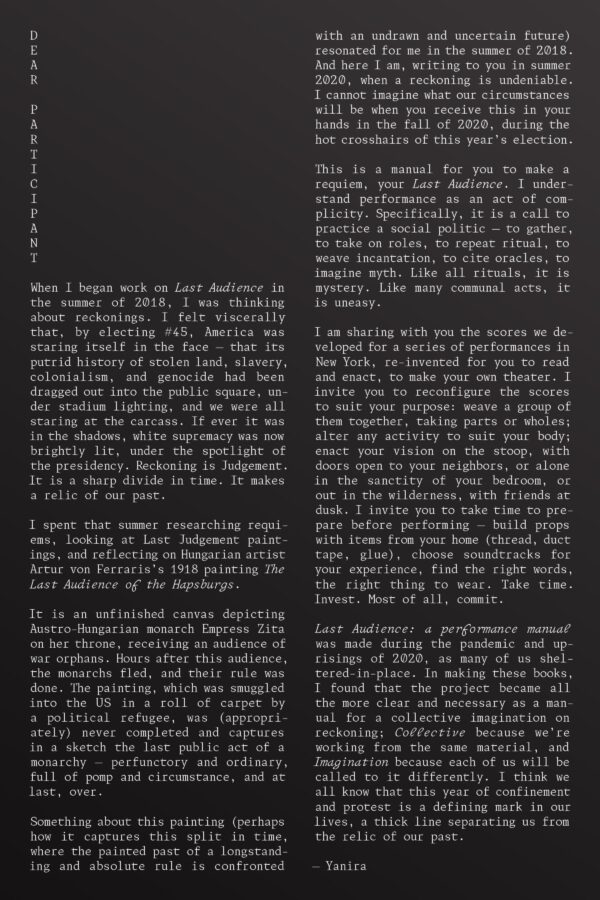
Delivered in the mail as a series of printed booklets or digitally as a PDF, Last Audience transforms audience members into performers in their own homes, guided by the artists’ voices through rituals of mercy, judgment, communion, and blessing. As participants stage their own interpretation of the artwork, they become both witness and creator, giver and receiver in an at-home performance of reckoning and transformation.
[sound]
DAVID THOMSON: Thank you for gathering and being here with us today. We would like to take a moment to acknowledge our communal heritage. We are all on unceded, stolen ground. We are inheritors of colonialism, slavery, and patriarchy. Tonight, we center our conversations on blessing. By “blessing,” we mean something very specific: a blessing as an act of protection. To bless is to hold. Tonight, we might ask ourselves: How do we hold each other in protection? We might imagine, for example, that to vote is a blessing, a mask is a blessing. When we imagined the community of Last Audience: A performance manual, we imagined it as a community together in solitude. In solitude in order to protect. We imagined a community making and creating and dreaming from a common source, in places far away from one another, but on the same page. In the same way that as a gathered audience we feel we are part of an experience, the manual and its scores could become a shared space that we all conjure. Tonight, we are going to begin by asking you to gather a few items that you may have in your home to make something together. Please gather a piece of cardboard—or any paper if you don’t have cardboard—a pair of scissors and something to make a mark with . . . crayon, Sharpie, paint, pen . . . I will give you a minute to gather these things. I will wait for your return.
[sound]
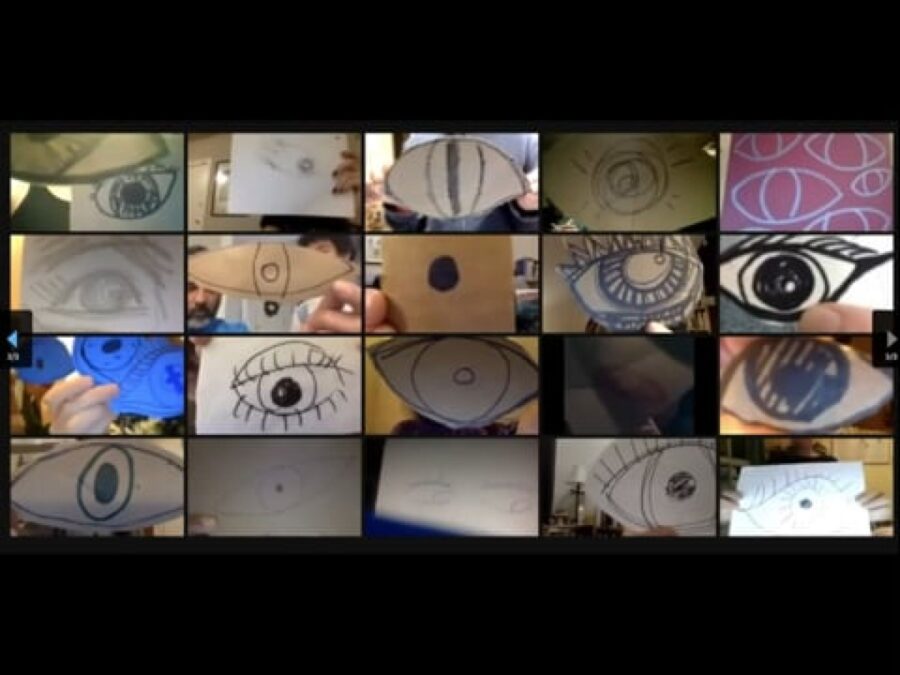
Let’s start. I am going to read from the seventh page in the “Blessing” manual. Draw eyes on cardboard. Use crayon, Sharpie, paint, charcoal. Draw lines, thick and graphic. Cut out these eyes so that they are separate from one another, each a separate eye. These eyes will cover a human. Take this moment to draw your eye.
DEVYNN EMORY: As you draw an eye, I will read to you from the ninth page in the “Blessing” manual. Compose a blessing: a blessing for the eye-covered human to perform. Is this a solitary or a group activity? It might be spontaneous. It might have a rough outline. It might be written out, memorized, practiced. It might be choreographed. It might be composed of words. It might be composed of gestures. It might be composed of sounds. A blessing can be spoken. Sung. A blessing can be danced. It can be all and some of these things. A blessing is an offering. A meal. A reminder. A wish. An act of grace. A warning. Protection.
[sound]
YANIRA CASTRO: In the blessing score, the eyes that you are making right now would all cover one human’s body, and that human would then perform a blessing. We are assembling on screen today, so we are going to turn all of our screens into a body with these eyes. I’m going to invite you to start your video. Now I’m gonna invite you to go to gallery view. And I want you to hold up your eye so that it covers your screen. And I’m going to invite you to hold it up so that we can make a record of this moment together. Please keep them up, and I’m going to let you know when the image has been captured. It might take a little while as the MCA team records this for us, but just take a moment to close your eyes and listen to the music that Stephan Moore has made for us today.
[sound]
YC: Keep them up.
[sound]
YC: Thank you. You can now stop your video. Artist Kathy Couch will now lead us with a blessing.
KATHY COUCH: See us. In all the ways that seeing can happen. See us. We gather with every soluble cell of our being here, humbly elemental, an ocean of small motions, moving in all directions at once we have come together, in breath together, each exhale a relief of release, each inhale a determined return to continuing, to carrying each other on. Every breath is an opening through a blessed opening. Each an opening that allows us to begin again. We draw in closer. We gather up every moat and note of each other being. That they might melt, no longer bordered or bound on the topography of our tongue into the geography of our lungs, maps memorized, secreted into ourselves, our cells, so that we may know always the safe way home, may know always when to plant the garlic, how to seed the pepper, how to be held but not buried by the earth. We surge up and swell with song, praising through every portal this blessing of belonging. This is a blessing of belonging.
PERSON 1: We are now going to open the space to share a few of your blessings. These can be spontaneous or planned, choreographed in any way that inspires you. If you wish to share a blessing, let us know by typing in the chat. One of the MCA crew will contact you in the chat to start your blessing. Remember to unmute if you are speaking, and you can choose to turn your video on or not. When you are done with your blessing, mute yourself and turn off the video if you’ve turned it on.
[bells chiming]
PERSON 2: If you prefer, you may also share your blessings in the chat.
[bells chiming]
PERSON 3 [singing]: Gratitude before me. Gratitude behind me. Gratitude to the left of me. Gratitude to the right of me. Gratitude above me. Gratitude below me. Gratitude behind me. Gratitude in front of me. Gratitude inside me. Gratitude all around me. I’m so grateful, I’m so grateful, I’m so grateful.
[bells chiming]
PERSON 4: Peace and joy. Love and lights. Sharing in energies.
[bells chiming]
PERSON 5: I’m offering a blessing. It’s to the tune of “Praise God from Whom All Blessings Flow,” however, the words have been updated and I’ve dropped them in the chat. So, it goes like this. I’ll try and sing. If you want to join me, please do. [singing] Praise earth from whom all blessings flow. Praise her all creatures here below. Treasure for all the children’s game. Praise forest, bees, and summer rain. Peace out.
[bells chiming]
PERSON 6: As you embrace this blessing, carry it forth, peace, love, light, energy, and resilience. Blossom, grow, ignite, and move us as we share and love and in light. Blessings be. Blessing are we.
[bells chiming]
PERSON 7 [singing]: A blessing you were born, and it matters what you do, what you know about, God is a piece [inaudible] Let the beauty of life be what you do, and you don’t have to do it alone.
[bells chiming]
Jorge Felix: My blessing will be in the form of a cup. I’m going to be calling my ancestors, my bloodline that takes me back to [inaudible] in Africa.
[hollow sound of a pestle thrust against a mortar like an instrument]
[JF speaks in a language that is not English over the hollow sound]
JF: . . . The protection of my ancestors are with me and I’m calling [inaudible]
TARA AISHA WILLIS: Thank you so much everyone. It’s really wonderful to hear and read and feel all that. My name is Tara Aisha Willis, I’m associate curator in performance and public practice here—”here” wherever we are—at MCA, and I am a light-skinned, mixed Black woman with tortoiseshell glasses and my hair is curly, down to my shoulders. I’m in front of a wall of a bunch of artwork and posters, including a poster of Toni Morrison and Angela Davis. Gibran, do you want to introduce yourself?
GIBRAN VILLALOBOS: Yes, of course. Hi, good evening everybody. My name is Gibran Villalobos, I am assistant curator at the MCA and this digital MCA. In your screen you’d see a brown-skinned man, dark hair, bearded with squared glasses and a blue shirt and behind me it a work of art with blue lines.
TAW: Thank you for that. So, we are really happy to be here with you all for this sort of closing event, at least MCA closing event for Last Audience, a performance manual. Of course, I’m welcoming you to this event part way through it already. But we really are excited to kind of close out the gathering aspects of this, at least in terms of what we are able to host with this moment to not only dig into some of the manual scores which you just got a little taste of but actually to really focus in on the recipe card that comes in the package of manuals that you received in either PDF form or maybe it was this form. And I will leave describing what that is to Yanira and Jorge, our wonderful guests tonight. But, these scores, really, are near and dear to my heart. Of course, I got to work on them with a canary torsi and all the collaborators involved, but also because in this time that we are living in, they invite us to consider how we take action together, alone sometimes, or at a distance and in proximity to each other. As Yanira says in the letter to participants that’s at the beginning of the manuals, this is my favorite part of the whole thing of course is— this might look familiar to you after what we just did. But, as she says in the intro, she sees performance as a call to practice social rituals. That’s a paraphrase. But I think this moment in this Zoom call is one example of that. So that’s sort of my way to—point to this. And while we get this conversation and food demonstration going, I encourage you all to put questions in the chat, maybe to put any experiences or words in the chat that—the experience we just shared together of doing that score and trying to translate it to Zoom, any feelings that that might have brought up or how that might have gone for you as we talk. So, Gibran, do you want to add anything to that?
GV: Nothing beyond that. I think that’s a great introduction for what we are about to experience tonight. And, should we just jump into some introductions?
TAW: Yeah, totally. So, I’ll ask both of you, Yanira and Jorge, to introduce yourselves, but I’m going to throw out my first question as I do that. So when you first start to answer it, you can introduce yourself. Super basic, I’m wondering what is the recipe that we are going to walk through today, and Yanira, specifically to you, why is it included in the manuals?
YANIRA CASTRO: So, I’m Yanira Castro, I’m light-skinned Puerto Rican woman. I’m in my kitchen. You see a white door behind me, some windows and the sink. I’m still swaying from those blessings. To have stayed in that even longer would have been beautiful. But then we would be here for a very long time. But the singing and the voices, thank you, thank you so much, it was just really beautiful. In talking with the MCA about how to connect these manuals to a virtual event, I really wanted to make them very concrete. And when we were discussing how to close off—not close off, but how to round the MCA experience part of this manual, the meal was something that, for Tara and I, was really potent. So, to answer your question: Sofrito, which we are about to do with Jorge, and I’m so excited Jorge is here with us to talk about sofrito, to tell us about its history, it’s a history that we both share, we are both Puerto Rican, we are both from the island, so I wanted to connect it to really physical tangible things. Because sometimes some of these ideas like “blessing,” or “mercy” can seem either distant or abstract. But in fact, they’re actually, really quite tactile. As you heard in the voice earlier, which belongs to David Thomson, who we are going to meet later on tonight, a blessing can be a mask, and the blessing can be a vote and that is something that Jorge and I are going to speak to as we do the sofrito because the vote is a very complicated thing for Puerto Ricans. So, blessings is a complex thing. Sofrito is a very complex thing. I’m so excited, Jorge, that you joined us today to share with us how to make it. Yeah, and as a gift and blessing to all of you tonight. So, Jorge, take it away.
JORGE FELIX: Indeed. Thank you, Yanira. Welcome to my kitchen and thank you for allowing me to join you virtually into your kitchen. As you said, it’s a blessing, for me in particular, cooking is something that I enjoy. It’s something that being here in the United States connects me to my heritage, to my past, to the memory of joining my mother and my grandmother in the kitchen. I’m the oldest son and grandson of my family, on this side of the Felix, [inaudible] so that’s the side of my family that I always was connected—food—a different appreciation for being in the kitchen, and from the beginning I was not taught, I was just there, and I learned by just looking and being engaged. So, sofrito has been used for quite some time. I came to the United States, to [inaudible] But, in the last five or six years, as a community, activists, I was trying to find another way to connect with people other than on the gallery space. So, somebody actually was—it didn’t come from me—another artist in the community knew about my passion about cooking and she was the one who suggested, “You should make sofrito in the street and let people gather around you and start talking and engage about issues” [inaudible] I’m not a performer. And I did it one day and it proved to be successful. My experience was of growth. It wasn’t just a performance, it was an experience of growth for me as an artist and also as a human because I start learning that sofrito is not unique for Puerto Ricans, it exists in all culture, it just has a different name. Tell me about your sofrito and how do you prepare it in your family?
YC: Well, my family, sofrito came out of a Goya plastic tub. So, it was something that I really wanted to learn about, so I actually took it upon myself to go and learn how to make it myself rather than to just purchase it at the local bodega—so I started making sofrito for myself in the last two to three years. And the difference every single time you make it is of course—it’s everything about the culantro that day, the peppers that day, but it was definitely a way to start connecting to, well, what does it mean to hold these ingredients and what are these ingredients about? And if you’ve read the card that came with the recipe, it talks a little bit about where the ingredients for arroz con gandules come from. But what Jorge taught me, which I hadn’t yet even thought about at that point, was that sofrito, in and of itself, went through a colonial history, which I think is really fascinating. So, I don’t know, Jorge, if you can share that with us a little bit. The culantro—and I talk about this in the card—the culantro and the aji pepper—this is what it looks like—these are indigenous to the island, indigenous to the Caribbean. This is a sweet and smoky pepper. There are other peppers all over the Caribbean, too. I was talking to David Thomson earlier, one of the artists, and in Jamaica this is a Scotch bonnet which is really hot, and they look very similar, but they taste completely different. The culantro, which some people might mistake for cilantro just because it’s got a similar name, couldn’t be any more different. I mean, Jorge, you had a beautiful way of talking about culantro.
JF: Oh yes. People do confuse because of the similarity in the name but it’s the “cu”, not “ci.” Cilantro is sweeter. Culantro is the way that Anthony Bordain, one of my heroes in the kitchen, said, “Culantro is in your face.” You cannot really compare it to cilantro. Culantro is pungent, is really strong, you need to know how to use it. One of these leaves pack such an aroma and if you don’t make sofrito and you decide to just put a couple of leaves in a big pot of soup, that’s going to fragrant and perfume your soup [inaudible]. Like you are saying, I start finding the similarities about them—not similarities—to tell the story of Puerto Rico in the way that sofrito evolved, like you were mentioning it. Please, you are closer to the screen. The culantro leaf, that is native of the Caribbean. As you can see, it’s kind of of serrated, and actually now, [inaudible] unfortunately due to genetic—
TAW: Engineering? Yeah?
JF: They have removed some of the spines. But really the wild one has a little spine on the edges. It could be really tiny spines that get into your fingers. And now we don’t have that. Now we have these also these huge, long leaves and in the wild, that’s not really how culantro lives. We now have the commercial. We still have the aroma, although sometime you find variation. The other ingredient is the beautiful, tiny aji dulce. As you can see, it looks like a little bell if you pick it by the—it looks like a little bell. And it’s entirely different from habanero and the Scotch bonnet also looks like the habanero, it’s bright. I also have to say it—the aji dulce gets white, yellow, red, and orange. The one I have here is green. It is still not ripe. You can use either one. It would be ideal if you can make a mix. But those are the two ingredients that make our sofrito—and when I say “our”, I mean Puerto Rican sofrito—is really distinct from any other in the Caribbean. We don’t have that kick of the spice. We use that sweet and pungent herb to make sofrito. Then later, with the arrival of Spaniards, we got the Spanish onion and the garlic. Those three ingredients bring another layer to our history and that’s the longest period of history in the Puerto Rican, it was 500 years of colonialization under the Spanish rule. And actually, just about the moment, the year where we gain our autonomy as an island and we were in the process of becoming separated from Spain and becoming independent, then the American invasion happened with the United States coming to the island, with yet another layer added to our sofrito. And then we have other herbs and we have other flavors added into our sofrito. And we get these—I’m not going to show the label, these type of sofritoes that come in—it’s gray, it’s not even really green, like a sofrito should be. So, we can tell the story, we can go into details about from where this ingredient come and how they arrive in the island and evolve the Puerto Rican that we are today. We are an American colony, a United States colony. We are American citizens—and only partial of the rights. As we were talking about the vote, we don’t vote, we cannot vote, we don’t have that right.
GV: That’s a great encapsulation of the history of sofrito, as you start to make this dish. I think you are going to start chopping and dicing some peppers and running it through the mill and, what I wanted to jump in and say was: Jorge, I was first introduced to your work as a community activist when you were working in Wicker Park in artist studios and co-ops and you really initiated a conversation about gentrification and the protection of neighborhoods, the protection of people. When I thought about inviting you to this conversation to talk to Yanira and to be a part of this project, it was because of the sofrito, the sofrito conversations being the slicing and dicing of these vegetables as you talk about the history and the complicated nature to voting, to community, to a lot of the topics that I think we are eager to hear about. Very quickly, can you tell us what you are doing now, almost like Food Network-style.
[laughter]
JF: Now sofrito has evolved. Even my grandmother has grown with the times, and now she uses food processor or her blender. And that’s how we make sofrito now. It’s a process. It’s even in the way that it’s done. But growing up, yes, I’m old—
[sound cuts out]
TAW: Your sound went away a little bit. Can you say that one more time?
JF: Sofrito can be something that you can make ahead of time and keep in your refrigerator for later. So, you don’t have to be chopping and doing sofrito every day.
GV: For those of us that are doing sofrito in the moment along with you, what are the things we need to do. Yanira, you’re also making sofrito tonight. What are some basic steps to get this cooking started?
YC: You have to chop everything. Because it’s all going to get mixed together. And what Jorge is doing, he’s mixing all those ingredients together through the mill. That was the way that his family did it. But before the mill, there was, and I think Jorge has a beautiful one that he can show, there was the pilón. Mine is made out of stone, but in Puerto Rico, they are made out of wood, usually. So, Jorge, please show us yours. That is the pilón I grew up with.
JF: Yes, this is a pilón. This is the way that, you can see, it’s a wood, like Mexico, but they have the stone of a molcajete I believe is the name of it, mortar and pestle. Of Africa, actually is the name that was used, they used local woods to make their own mortar and pestle. This is how pilón used to be made, originally, I’m not really sure that’s the way they make it on the island. So, by pounding slowly, and that’s how you make the sofrito. Again, no refrigeration. You will make a lot of sofrito—get a couple of peppers, a couple of leaves, mash it together and use it as a rub as the base for your flavoring for your flood or meat.
YC: Right, right, and that’s a—
JF: Yeah.
YC: No, you go.
JF: That’s the sofrito. And that’s how you do it. Yanira.
YC: So, what I was about to say, if you can think about like the origins of sofrito as being indigenous and it was the aji pepper and it was the culantro mashed into, with the pilón, by hand, it was a thicker substance, it was a little bit pastier. What I was really fascinated by is the diaspora sofrito, that you sent out, which has olive oil, I mean I gasped, I literally gasped, like “Olive oil? In sofrito?” The reason my mother started cooking with sofrito because when we moved to Jersey, there were no Puerto Rican markets anywhere. So, you know, she would have my grandmother send her the Goya from Puerto Rico so she could make her food because there was no finding any of this there. But what’s fascinating is other people substituted what they could in order to try to achieve what the sofrito was. So, the aji pepper became a red pepper. The way to liquefy it a little easier so you didn’t have to be with the pilón, because this takes a long time and with a lot of strength, was with olive oil. The process of colonization, the process of coming over to a new place, and how you try in some way to keep your culture alive through these other vegetables and fruits and ways of like getting to that thing called “home” is really fascinating to me. And for me personally it’s been a process of learning. It’s almost like going back. Okay, I’m not going to make my sofrito with red pepper, so how do I go back and find what those ingredients were, where it came from, and then I remember when I made it for the first time for myself, with the real things, I was like, oh, all right.
GV: While we chat, I wanted to invite everyone on the call, if you have questions, put them in the chat, and I’ll read some out. Just a funny note that somebody brought up, they recently saw a Trader Joe’s version of Italian sofrito. That is so funny. What does the word “sofrito” mean, do either of you know?
JF: Sofrito actually—the first mention of the sofrito word was in the twelfth century, in a book. Sofrito is nothing new. Sofrito is just the act of putting a blend of herbs or vegetables, aromatics to flavor something. In Puerto Rico it has become the word—”sofrito” has become the name, instead of being a verb, it’s a noun, the name that we put into our blend. But it is the same as in New Orleans, they have the holy trinity, that is . . . maybe somebody can help me here… that is—carrots. . .
GV: Celery, carrot, and onion.
JF: Correct. And then, in the Dominican Republic, they have a similar sofrito, but they add annatto. In Cuba, they use tomatoes, they smear. . . In Italy, well France, they use mirepoix, that is also three ingredients. So, every country it’s something that has become—[inaudible] South Asian sofrito, south east Asian sofrito, the Cambodian and Vietnamese and surprisingly, the herb for culantro is used a lot in India and those countries in the southeast, far. But they use then, turmeric, added to these, and galangal, I believe is how you pronounce the other herb that they use in their sofrito. So that’s what it is. Actually, the proper name for our sofrito is not even used that much in the United States by the diaspora, they use the word “sofrito.” It’s “recaito.”
YC: Recaito.
JF: Recaito. Recao is these, the native name for culantro.
TAW: There is kind of like— hearing you both talk about how diaspora shows up in the history or the different ways that different people have adapted to the situation or the country or the culture that they’re in, and then the actual ingredients themselves have these different histories over time. You know, there’s like a metaphor that I’m feeling or seeing or hearing of like not in the typical way that we talk about multiculturalism and this mixture, it’s so amazing, the melting pot, all of that, not in that way, but that even one dish or one base for many dishes can kind of hold all of this complication in it, and there is violence there and there is difficulty there as well as all of the tables that it’s been part of that people have gathered at. So, I’m curious also about how the two of you see that metaphor in the food, relating to the sort of situation of the quote unquote nation that we are allegedly in right now. You talked about blessing as a kind of protection or a kind of action for something else, something bigger or something outside of yourself, and I wonder is that a kind of participation or kind of gathering together. Is each of our blessings creating some kind of whole? Is each of our votes creating some kind of whole? What is the relationship there?
YC: That question. . . really complex. And my brain kept going to many different places as you were talking. I want to talk about that. I want to talk about that. So, you know, the complexity of these things I think run really deep and in really difficult ways. In Puerto Rico, and I don’t know if it was this way when you were there Jorge, but you grow up, at least my generation, and there’s this idea that you’re a mezcla, you are everything, you are African, you’re Spaniard, you’re Indigenous, and what it means to be Boriqua, what it means to be Puerto Rican, is to be all these things, all at once. That is something to be proud of and it is something that is beautiful, and it is spoken of with a lot of harmony. There is so much political history to that that we don’t have time for that right now. We can have a long discussion about that another time, why that way of defining what it was to be Boriqua came about, but it was important political choices that certain people made about how they wanted to represent Puerto Rico people to the United States. It is in some ways in contrast to the civil rights movement happening in the 1960s. The politicians in Puerto Rico were trying to say, “We don’t have that problem.” Now, of course, we do have that problem. So, it was this discussion of mezcla, of Boriqua, you are all these things, and in your families, at least every family that I know—and Jorge I think you spoke to this a little bit—you have the family side that is darker, you have the other side that maybe has lighter folks inside of it and there is all this talk about like, what is the mix. That gets really complex when you talk about food as well. Because the meal that we are going to have later, arroz con gandules—which the base of that is sofrito—is talked about as this kind of almost symbolism of what it means to be Boriqua, because it brings gandules from Africa, it brings the rice which came to the island from Spain via China. So, we can talk about that, you know, the whole Marco Polo thing. And then the sofrito that we are making, so the culantro and the aji dulces, which is Indigenous, so you bring that all together and that dish, this is what it means to be Boriqua. But what nobody talks about, what we don’t really talk about, is all the conflict that is embedded in the sofrito, in the meal which is that the gadules came through slavery, through many people dying and coming to the island in bondage, and the people who were Indigenous were massacred, it was a genocide. There’s very few people left of that lineage, and, yes, I mean just the depth of that complexity is something that’s often glossed over. So I believe we all carry these heritages inside of us in some way in our foods and in our bodies and who we are, in our makeup, and that is something I wanted to really bring to the fore in these manuals, because it was something I was thinking about, having inherited an American history that I am living through with all of you right now. How does this run in our bloodline and in our bodies, and in our food?
GV: You know, if I could just—oh, go ahead, Jorge.
JF: Something that, and I agree with Yanira. [inaudible] Puerto Ricans, it’s a nation, we have this national pride, we talk about being Puerto Rican as a praise, la Raza, in Mexico we have that term. We are so proud of being Puerto Ricans, but almost more than half of the population describe themselves as “white” at the moment of filling a census—
YC: 81%. 81% in the last census described themselves as “white.”
JF: And they support pro-statehood. They want Puerto Rico to become a state. Which if we look at other examples, like Alaska, Hawaii. . . that would be really detrimental. So, it’s this idea that we’re Americans. We’re going to become a state. But we are going to keep our language, we are going to continue speaking Spanish, we are going to keep our sofrito, we’re going to keep our culture, we are going to keep our music. Which, it might stay in some way, but it’s not going to be the same way. It’s that fight, that contradiction. We are Americans. We are Puerto Ricans. That thing in between.
YC: It’s really complex. And the island does not really have complete sovereignty at all. And the political relationship is just really complicated which maybe that brings us up to the vote, which I wanted to bring up. Because can you tell the story, Jorge, of the neighborhood in Chicago and the transition from going to—feeling that to vote was a colonial act, to vote in the system of the
colony was to be colonialized, so therefore, the community didn’t vote. You can speak to it much better than I can. But I think it gets to the complexity of how even something like the vote is just—it’s so wound up with complexity.
JF: In Chicago, we have a really strong [inaudible] community of strong independence. [inaudible] –what do you call them, prisoners, most of them are here in Chicago that in the 80s were rebelling against the US government and what independence is. Most consider it to be an invasion and a threat to Puerto Ricans. So, the act of participating in the US election would be like participating on supporting—in support of the colonial rule of the United States. So, for many years the community did not participate in US elections. What I said before, that Puerto Ricans don’t vote in the presidential election, that’s on the island, but when you come into American territory, you can vote, you can participate here as long as you have a residency in the US. And even when we have that power here, the [inaudible] Puerto Ricans in Chicago, we’re choosing not to vote. In time when the community started [inaudible] —gentrification, the first Puerto Rican community back in the 50s, 40s, 50s, was located in Lincoln Park. That was the first settling and on the South Side, on Woodlawn and on Lincoln Park in the north. Little by little the community was being displaced again and again. They move west to DePaul, west to Wicker Park, west to, a decade ago, to Humboldt Park. Now the concentration of Puerto Ricans are in Belmont Cragin, [inaudible] or even further west. So, it wasn’t until the 90s that the Puerto Ricans start awakening and say, “You know, we have to stop this.” And the tool that they realized they needed to use was the vote, that’s how we started getting people on the city council, we get Luis Gutiérrez into congress, we get many elected officials and things start to stabilize. So, a vote is something that is a blessing? Yes, of course it’s a blessing, because it has a lot of power, and a lot of people contarlo—I can’t think of the word right now—
GV: I want to bring up one of the reasons why—not why—but as we were thinking about the programming for this project, we started this conversation many months ago, before the election. And we didn’t know what the outcome of the election would be. And I think that now as we complicate the conversation of the sofrito alongside the complicated nature of voting, I just really want to highlight for everybody that we were jumping into this dinner together as a collective, thinking about not knowing what the outcome of that election would have been. And I think many people in the chat that are cooking along with us, that are smelling the aroma of the ingredients, we are also being touched by—we’re coming together because it’s such a complicated participation. Civic participation oftentimes gets called out, too, as a very positive, just go ahead and civically participate. But actually, what this project does is it raises the difficulty of civic participation. Yanira, you said this so beautifully the other day when we were chatting, that voting is an extrapolation of the idea of a nation.
YC: Mmm-hmm.
JF: Yes.
TAW: Wow, yeah, I forgot that. Thanks for writing that down.
GV: It stuck with me.
TAW: Yeah, that’s amazing. A few final words from either of you, but we do have to move on to make sure we have time to talk to the artists and break bread together. When you’re ready, Jorge, do you want to show us your sofrito? That would be fabulous, if it’s ready enough. Yeah, go ahead, Yanira.
YC: The only thing I wanted to say about voting is that many of us—I shouldn’t say many of us, some of us have the gift or the blessing of being able to vote because you believe the ideas that the candidate upholds, or at least most of them. But many of us, and I think maybe there are people on this Zoom call that feel this way, are voting in order to protect their community. They are voting not because they believe in the ideas or that’s the policy that they want, but they are protecting their people. Chenjerai Kumanyika has this statement that I love, he’s a podcaster and artist and based out of New Jersey, he says I want to vote to know who I’m going to fight against. And I think that’s something I will just say for me and I don’t know if you feel the same way, Jorge, it’s really important. I know the things I want for my people, the place I come from, how to get there is so far away, but I want to pick the person I can have the policy fight with. And we are talking about Puerto Rican—what do you call it—activists and political leaders. One thing that is really kind of meaningful and at the same time difficult is looking at my 12-year old son and saying, “I hope you have a Puerto Rican woman for president in AOC one day.” This is the candle I light. But at the same time, I’m like, what would it mean to have a Puerto Rican woman president one day? How fucked up is that. Sorry. The colonialism is so wound up in us.
GV: Can you repeat the name of the artist you quoted?
TAW: Or type in the chat.
YC: I don’t know how to pronounce his name. I will look him up in my Instagram and send it.
TAW: Jorge is showing us a beautiful creation over here.
JF: This is the way I make sofrito. I use that mill because it squeezes the chop, it’s chunky, that’s how I like my sofrito. I don’t want it to be that much of a paste like you mentioned. Sofrito can be done in so many ways. And it’s not really a recipe that you try to emulate. It’s something that you make your own. So, in my case, this is how I like it. I freeze it. I put it in little bags. And I drop a spoonful of this in a pot of rice or stew or chicken. You can add some [inaudible] and make it a rub or finish it up on top of a dish just to freshen.
GV: I’m getting so hungry.
YC: It’s time.
TAW: It is time! Some people out there, including myself, and I think Gibran also, have meals from Inspiration Kitchen, which also has arroz con gandules in it, among other things, so I’ll continue eating mine.
YC: Tara hasn’t stopped since we began. Jorge, thank you so much for being with us and for sharing your history with us and, you know, this amazing sofrito. I hope you’ll sit down with us and join us for a meal. My arroz con gandules has been sitting there waiting for me. I’m going to go over there. If you have arroz con gandules with you, bring it over to the table. Or if you have something else—also thinking a lot about Hanukkah these days, if you have latkes, bring it to the table. I’m really hoping we can open this up. If you want to turn your videos on and we’ll share a meal. It will be a little messy. It might be a little bit awkward. I’m going to have food in my mouth. But I’m hoping that this is in a way a little bit like family, right? And I’ll introduce you all the artistic team of a canary torsi that made the manual on this project and we have an opportunity to talk and ask questions. It looks so good. Thank you, Jorge. Turn on those videos.
JF: Thank you for having me.
GV: Some of us are going to be joining us that we ordered from Inspiration Kitchens. The MCA partner is Inspiration Kitchens, which is a social enterprise restaurant that trains—that has a training facility in East Garfield Park that works with folks that are experiencing homelessness and poverty and gives them free classes, free tuition, to learn and get certification for the cooking industry. So, in partnership with them, some of us have our arroz con gandules from Inspiration Kitchens and please keep supporting that organization if you are in Chicago. Most recently they provided at no cost, since April, 13,000 meals in Chicago. So, to me this is all about how community comes together to become resilient and share and break some bread. So, thank you Inspiration Kitchens, as well.
YC: Yeah, amazing.
TAW: Thank you.
YC: I have my arroz con gandules, and I’m going to take a moment, and if everyone can turn your cameras on and go to gallery view and I’m going to invite the artistic team to join us. David Thomson. Kathy Couch. devynn emery. Stephan Moore. Hi Juile, Hi Kate, Pam. Pam is one of the collaborators on the project. She wrote this beautiful essay for blessing, actually, so, it’s perfect that you are here. Who else? Miriam. Mona, Kirsten, is also one of the collaborators on this project. She’s a dancer, an incredible dancer. You saw her image earlier today. Her tongue way out. Hi Riley. Damon. Thank you everyone for joining us. I’m going to put some arroz con gandules into my bowl and I’m going to start eating. But we imagined this as a moment when. . . you might have questions, or you may have played around with the manual, or you might have desires for the manual. Somebody reached out to me earlier and asked me, “I really want to do this manual in community with others, can I do that?” I was like, “You don’t have to ask.” Nobody here has to ask. You can take it away and do with it as you desire, as it feels right to you. Yes, ask us questions or share what you are eating that has meaning to you, how you are holding your bodies up.
TAW: I just wanted to point out what you said about the manuals is exactly what Jorge said about sofrito, that you can adapt it as you wish and use it for a million different things and more than that. So that’s not a question, that’s just a comment. But if you—also just FYI—if you have a question or comment and don’t want to be camera or audible, please drop it in the chat as well.
JF: Can I make an ad? Go to my sofrito conversation. You can see the recipe and how to use it.
YC: Can we put that in the chat?
TAW: Oh yeah, that’s a great—
YC: To let people know where to go? That would be great.
TAW: Yes. Jorge, if it’s hard for you to put it in there yourself, let us know.
JF: I’ll do that.
YC: Someone is asking what the best beverage is to drink with sofrito. That will be an argument that will go on for quite a while. I mean with my brothers it’s rum and coke, rum and coke, rum and coke, very American, Puerto Rican, of a certain generation. If you ask me, it absolutely has to be rum. So, some valito would be great, I think, with sofrito. Valito is a dark rum from the island. Or, Kathy has a beer.
JF: Now, in the holidays it has to be a shot of coquito.
[sounds of agreement]
YC: So coquito is like coconut and rum and if you come to my house, I always have some around this time of year. You only drink it now.
JF: Yes, the holidays.
DEVYNN EMORY: Hi, this is devynn, I’m a performer in the project, I wanted to say thank you for gathering with us. It’s been, this part of the performance, this is one of the last times we are together for this tour. We used to have this meal, if that wasn’t clear, before we got on stage and before you entered the theater. So, we would gather our friends and sit down and have this meal. It was a beautiful way for us to meet you all before we invited you to do some pretty complicated tasks with us. If you have the manual, things like getting on your hands and knees for mercy and some pretty hard moments of judgment. So, sharing a meal before that was always one of my favorite ways to commune with everyone. I’m glad we are keeping this part sacred.
TAW: Yeah, it’s funny that it is now the kind the close—for many of us in Chicago, it is a trajectory of receiving the manuals, maybe you came to the event in October, if you didn’t, there is a link, it can be viewed online publicly, but receiving the manuals, maybe you read through them or performed one of them or thought about performing one of themor maybe you just looked at it, which is what I’ve done because I got to edit them all, so I know them by heart, and you know, sort of hide them in the corner. But it does feel like a trajectory that we’ve all been on in different ways with this work which is so unusual. So often you show up for an hour in the theater and then you leave again. So, there is something really—to me that’s the specialness of the form this project is taking right now. I’m curious if any of the artists who have been on that trajectory for much longer than all of us have thoughts about what has stuck out most of you about shifting, or thinking about this project completely anew, in a social distancing time. What has been beautiful about having to completely reimagine it?
DAVID THOMSON: Hi. This is David Thomson. For me I would say one of the beauties of this is that within a theater space there’s sort of limitations on how many people we can hold and how long it will take and while the actions themselves are held in the container of a space, of this large architectural space, sometimes smaller depending on the building, this translation actually makes it much more accessible to people. I feel like it allows the seeds of the work to actually spread through the wind, the ether of the internet, and in that sense, how people engage with it. In one way it’s going to be different just like sofrito. This is not the sofrito we made last year. This is the sofrito of the new year. And so, it’s going to propagate in its own way. We are using different materials. People are going to flavor it differently. Some people will cook it a little more, they’ll have it this way. It’s going to change. So, you have the basic recipe that is your guide to live with, which I think is a beautiful thing.
KATE: I have never participated in this before. I’m coming to you from Cleveland. So, I found out about it through the internet, to your point. I’m delighted to find out what you all are doing. I actually have my manuals. I work with some people who are currently experiencing homelessness and we also work with people who are incarcerated at my agency. When I was reading through this, I thought so much of this is so easy to do with populations who basically have no money and our agency of course has no money for this kind of thing. But this is something we could use with them. My supervisor is on the board at our contemporary art museum here. I was, you know, the gears started going off in my head about how we make connections and are you traveling with this? Is this something that you just want people to go out and be the spawn of this? How can we further what you’re communicating?
YANIRA: That’s such a beautiful question. Yes. I wanted it, we wanted it to be really accessible to people. We wanted this—because we were writing essentially, Kathy and I worked hard on putting this together from scores that we had in many ways framed together when we were doing it in performance, we were thinking about what would people have at home? What would people—because this was May, so we were all sheltering in place. What would we have at home? There would be a lot of cardboard. Or maybe not, actually. Some of us might have a lot of cardboard. Others might not have cardboard. We might have cardboard. We might have something to draw with, a pen, pencil, crayon, a piece of charcoal, a crayon because we have children or maybe we are still children ourselves so we have crayons, you know? So, we have these things and what can we make together out of that? And it’s really endless what you can do with that. I’ve been thinking a lot about now that you have these manuals how to create community, especially when Catherine reached out to me and said I want to do these in community. I was thinking about ways in which to do that. So, I’m actually going to share about something we are doing up through—I guess we’ll call it the transfer of power on January 20th— as a way in which people can join us synchronously to do an action together. Not seeing each other on Zoom but meeting in the ether and knowing that me in New York at 3 o’clock and Kathy in Massachusetts at 3 o’clock and you in Cleveland, maybe you are in Chicago, that at that same time we all choose to do something at the same time together. We may not see each other but we have promised to one another, we’ve made a blessing to one another that we are going to create this ethereal community. So that’s something that we are going to be talking about a little bit later, it’s called commune as we head out. But I am also very excited to talk about the ways in which you might be interested in working with your community and supporting that in any way that I can. So please feel free to reach out.
KATE: Thank you, I will. I had another question, if I can ask one question. A lot of the actions that you had created, a lot of the rituals seem very much based in, you know, what we used to call like religious ritual, a lot of the language, “exile,” “confession,” and I was wondering what you are doing with that, how you created. . . It seems intentional that you were creating around what we think of as religious language, but you are doing something different with it. I was wondering if you can comment on that. Anybody.
YC: Yes, I think all of us can talk a little bit about that. I will say briefly, it started off with the requiem and Stephan Moore and I talked a lot about the requiem. I was interested in the death mass because I thought the election of 45 meant the death of something, and I wasn’t sure what that was. And I was really struggling with it. Many of us were really struggling with it. For me, it was a memory that I carried with me: that when I left Puerto Rico as a child, my grandmother sat me on my lap, and she said, “You’re going to the enemy.” And I’ll never forget that. So, I’ve always had this relationship to the US of this fear of the worst is going to come one day. Well, I mean, I’m sure looking forward to January 20th, and a little respite from maybe what is the worst of it. But maybe it’s not the worst yet. But there was something about that that I was grappling with. So, Stephan and I started talking about the requiem. The requiem is steeped in this language. At first, I rejected it and then because I rejected it, I said to myself, you’ve got to sit with this and figure it out. So, it was me grappling a lot. Especially with judgment, which at first I thought, I’m not going to do judgment. I’m going to ignore it. I can’t. Now that I said I’m going to ignore it, now I have to face it. Stephan, I don’t know if you have something to say about the requiem and the language and how difficult it can sometimes be.
STEPHAN MOORE: I don’t have a lot to add to that. It’s just you bringing that up brings to mind what an incredible journey creating this piece has been from our first conversations to right now. We were looking very closely at the requiem structure and trying to think about how we ritualize our response to grief and loss and how do we sort of, in a social setting, in a public setting kind of enter discussion of serious matters and consider the dark and light sides of it, asking for mercy. . . sort of grappling with the ideas of judgment, and kind of leading in a way that is sort of uplifting but acknowledging of the process that has been undergone, there is a kind of social alchemy to that, that multistep process in the way it had been ritualized. Then we were looking at the ways that different composers in different centuries addressed that, which was really looking at how different societies in different times held up as models how to go through that. I feel like at a certain point the requiem was mostly jettisoned and what was left was the container that we then were able to fill in all these different ways. And so many people on this team had so many contributions to that process. To have that all have worked through the processes that we went through to get to the performances, which all happened in October a year ago, and now to see that crystallize into this manual and to be able to sort of live on in this form, it’s—I’ve worked with Yanira a really long time, every work is a long process, every work feels like a long journey, but this one is particularly, it’s particularly long and convoluted and wonderful, the path it has traveled and how it’s gone from this very nascent place we can still remember very well to its final form is a great thing to think about on a night like tonight, when we are not saying farewell to the project, but giving it a bit of a sendoff.
KATE: Thank you.
TAW: I wanted to add: our house manager dropped the link to the October 23rd Zoom event on the chat which digs into this further. Just like we had Jorge this time, it was in conversation with another Chicago activist and leader, Marshall Hatch Jr. Gibran, do you want to say anything else about that event and yeah. . . religiousness?
GV: Yes, Kate, thank you for your question. It touches on a lot of the language but a lot of the ideas that we were bringing to the table for this conversation. We chatted with Marshall Hatch, he’s the executive director of the Maafa Redemption Project, which works with previously incarcerated or court-related young men and gives them training how to do good work in Chicago and also how to run a business. So, a lot of this thinking around redemption and a lot of the religious thinking behind ritual and the process and the language has been always tied, for me personally, to this civic work that you are bringing up in this conversation. Please check out that conversation, it’s really fascinating to see the overlap in language, but also just how we all get to participate politically, civically and what that means right now. It’s a really complicated question.
KATE: It is! I’ll shut up. I just have one more question. Who would I contact? Because my niece gave this to me as a Christmas present. You have my niece’s stuff in Toronto, but you don’t have mine. Who would I contact over there to get hooked up with you all?
YC: I’ll put my email in the chat for you.
KATE: Thank you.
TAW: I have one question in the chat that we missed which I think is an important one. This is Miriam Perkins, “Can you offer some suggestions for hosting a group of people to share in an experience of practicing the manual?” Seems very practical and brings up a lot of these same questions that we are talking about.
YC: I think they are endless. I really believe in completely altering any of these scores to suit your needs. So, if you have a score that’s for eight people that you really love that you have in your household four, and you wish to do it with those four people, change it. Make it yours. I imagine that people might meet one another outside in a park and do some of these. I imagine that you reach out to family members that are distant and you might share some of this in some way. I, for myself, I’m probably going to do them as an individual practice because I need—I’ve been thinking a lot about reprogramming my body and trying to figure out what that is, and I’m thinking about using these scores to figure out what that would mean. There are so many infinite ways which you could take these and make them your own. But I think that’s something for me, anyway, is really, really important is to find what’s important to you out of the score or scores and enact them in a way that it makes sense to you most.
TAW: Well, I was going to say we are running out of time and you all have a final blessing to share and I want to make sure we have time for that.
YC: Yes. Thank you everybody so much for joining us tonight. This has been a really special night. And we’ve been saying that this is a closing. It’s a closing with the MCA, who have been incredibly generous in developing these manuals with us. We’ve been at it since May and they got to you in November, so you can imagine all the conversations and all the work it took to get these manuals to you. And the artists that you are seeing here adapted them beautifully. And the MCA was incredible in designing them, in putting them together, in thinking about ways—how they might arrive to you. They had so many different formulations before they came to you. But, I’m happy with way they came to you. So, this is our last event with the MCA, but really this is the beginning for you. You have these manuals now. You can do them as you wish, when you wish. Two years from now, you might find them in your shelf somewhere and pick them up and it might be resonant for you. But I did want to share this event that I hinted at and I’m going to read it to you so I don’t get this wrong because it’s kind of brand new. As a way to continue this journey together in community, I wanted to announce tonight a practice that we, the artists of a canary torsi, are inviting the public on and I hope you will join us. It’s a synchronous ritual across distance. For the next five Sundays, starting next week, the 20th, until the US transfer of presidential power on January 20th, we are inviting you into a five-week ritual with the manuals. We call it, “Commune.” We will take on one manual a week. We are going to choose a score, just one, or more if you’ve got that kind of ambition. You have time to prepare, and then on Sunday at 3 pm Eastern time, 2 pm Central, and noon Pacific, we will enact them at the same, imagining each other engaging, enacting, performing, and marking the time together. To find out more about that, there will be information sent out tomorrow on my Instagram and Facebook which is @acanarytorsi, so you can follow it there. It’s really very simple. It’s not on Zoom. It’s us meeting at a specific time. But to end our evening together—Sorry, so many things to say. Many thanks to the MCA, to Jorge, to the artists, to David, Kathy, Stephan, to Kirsten, to Leslie [inaudible], to devynn emory, to Peter Richards, who did the video, Susan Marlandow, who’s a dramaturg, Simon Courchel whose photographs you’ve been seeing, am I missing anyone? Did I say Kathy, Stephan? LDD Armen who’s running this show tonight. Thank you so much. To Tara, for dreaming this all up with me. I love that you call it a prayer book sometimes. And to Gibran who has brought so many beautiful people into our lives, thank you. And to Marshall, wherever he is, and to you Jorge and to the entire MCA staff. So, now, we are going to do this one last blessing with you. devynn emory is going to lead us in that. And may you be blessed and may you be protected.
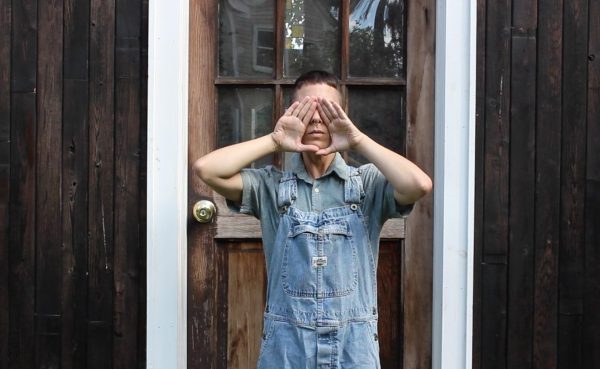
DEVYNN EMORY: [devynn says, ‘Hello my name is devynn emory in Lenape] Hello in my native Lenape tongue, I’m relearning and coming home to a theme of this evening. It has been an incredible journey being a performer in this project and I really thank you for engaging us and joining me in this closing blessing. I am grateful to be with you in today’s showering of blessings as I believe we all really need it. I really need it. And as I guide you through this last blessing of the evening, I’ve developed to hold me, you, and us, I ask that you take care of your body in the ways that center your needs, so you can join me in body, spirit, sitting or standing or witnessing if you prefer as I move us through a set of gestures that nod to the seven sacred directions. I’ve called this, “The Seven Movements.” I’m going to go ahead and stand. You can follow along and join me. We start with one, hands at our hearts, this is a gesture to come home to any time we need recentering and regrounding to remind us of all of our ancestors and lines and lineages and others’ ancestors who came in to touch us and our spirits tonight, as it did tonight. This is two, this is a gesture to remind us that the energies around your body and your ancestral vessel are right here when you need them, you can call in any energy when you like, and you can shift it and push out energy that you’d like also. This is always here for you. Three, I’m going to make those two circles overlap. This gesture is just outside of our containers. So, you can do this outside or inside, but it is including the energy that is a little further away from you, so all of the trees that have been here for hundreds of years before us, all of the air and the wind that circulates and filters the air protecting our bodies every day. This is four, this is a reverse prayer. This is a reverse prayer to receive all of the blessing that we received this evening, all of the blessings that we receive every day, especially the ones that we don’t even know about. Five, this is a prayer from me to you and you to me, this gesture we can do daily as a reminder that any energy we put out to others affects others and others and others. Six, this is the sacred triangle that is you, me, and us. Seven, our final gesture, this releases all of this. Because we remember that ceremony and prayer and blessings is also a simple gesture. We often—I often can spend a lot of time in ceremony, thank goodness, and when I don’t have time, it can also be really simple. So, I ask you to follow me in these seven movements. Let us begin.
[music in background]
One, two, three, four, five, six, seven. One, two, three, four, five, six, seven. Let’s do it one more time. One, two, three, four five six, seven. Thank you for joining me. I invite you all to turn off your cameras now as we close. Thank you.
Related Event
Related Content
-

Video
Last Audience: A Performance Manual #1
Get a sneak peek of a canary torsi's Last Audience: a performance manual.