Exhibition
UBS 12 x 12: New Artists/New Work: Oli Watt
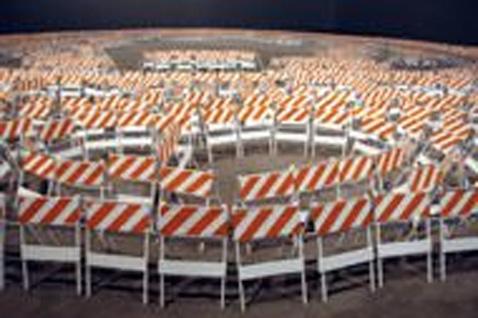
Oli Watt, Dear Prudence (detail), 2001
Courtesy of the artist
Oli Watt manipulates and simulates familiar everyday objects to call attention to aspects of the surrounding social landscape that have become so commonplace that they seem invisible. Dear Prudence, his installation for the MCA, is composed of more than one thousand miniature orange and white street barricades arranged on the floor.
Watt attended the University of Florida, Gainesville, where he received a BFA and a BA in Art Education. In 1998, he earned an MFA in Printmaking from the School of the Art Institute of Chicago.
Related Content
-
A Life Less Ordinary
A Zen monk was asked, “What did you do before you became enlightened?” He said, “I used to chop wood and carry water from the well.” And then he was asked, “What do you do now that you have become enlightened?” He said, “I chop wood and carry water from the well.” The questioner, puzzled, asked then what the difference was in his life as a result of the enlightenment.
The Master said, “The difference is in me. The difference is not in my acts as it is in me. But because I have changed all my acts have changed. Their significance has changed, the prose has become poetry, the stones have become sermons and matter has completely disappeared.
—Wu Li (Zen master)
Like this proverb about a Zen monk whose transformation was prompted by a shift in perception rather than by physical change, Oli Watt’s work urges viewers to overcome frustrations through an appreciation of the details of daily life. Watt manipulates and re-creates familiar everyday objects to call attention to aspects of the surrounding social landscape that have become so commonplace that they go unnoticed. At the same time, he addresses the hazards, real or perceived, of daily life, appropriating public warning signs, such as orange and white street barricades, and violent images from mass media. Often, he juxtaposes media imagery of car crashes, airplane disasters, and war with children’s objects such as coloring books, toy soldiers, and jigsaw puzzles, presenting benign objects that convey a sense of peril. There is a glimmer of humor and hope that stems from Watt’s references to toys and their associations with childhood innocence. Watt also inserts humor into mundane subject matter in objects such as American History (1999), a school desk with colorful chewing gum all over it, and Bad Timing (1997), a wrist watch depicting an airplane crashing into the ocean.
Dear Prudence stems from Watt’s earlier project Proceeding with Caution, in which he manipulated the design of life-size orange and white barricades by replacing the standard diagonal with zig-zags and polka dots, and then left them on the streets as an aesthetic intervention into the world of traffic signage. In the current work, Watt brings the barricades from the street into the gallery. Two paths of footprints continue infinitely in concentric circles. The shapes of footprints within the circles are made with the miniature barricades: in the outer circle they create empty (negative) foot-shaped spaces and in the inner circle they comprise solid (positive) footprints. While barricades block movement, they can also cause heightened awareness of one’s surroundings.
The title of the work was taken from the Beatles song written by John Lennon while the group was on a meditation retreat in India. On this trip, Prudence, the sister of actress Mia Farrow, would not come out of her space. Lennon wrote “come out and play, look around and round, look around and round.” Dear Prudence suggests that it is only when we are forced to stop or slow down that we begin to notice the details along the way.
Watt enlisted the help of friends to construct the 1,800 miniature barricades that he designed and silk-screened, a time-intensive process that recalls road repairs. Despite the skill involved in creating this piece, Watt does not think of the barricades as delicate objects. In the gallery, the function of the barricades—to obstruct and guide movement—remains in tact. If placed on the street, however, they would not block anything, only arouse curiosity. The shift in context and scale forces one to look at these familiar objects in a new way. While at first Dear Prudence presents an example of frustrating circular repetition, Watt encourages viewers to delight in the mundane.
—Julie Rodrigues
Funding
Sponsored by

Additional support for Oli Watt has been provided by the Orbit Fund.