Exhibition
UBS 12 x 12: New Artists/New Work: Melissa Oresky
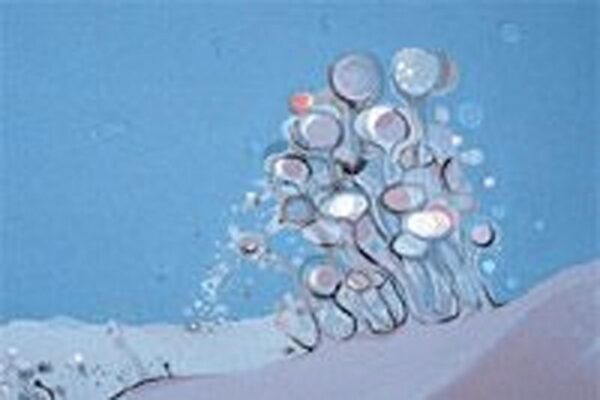
Melissa Oresky’s paintings suggest imaginary landscapes, with visceral blobs and folds of paint that contrast with the precise, computer-generated forms of scientific diagrams. With colors, shapes, and forms that resemble organic or biological matter set against dark, nebulous backgrounds, Oresky’s works provoke reflection on the increasing influence of technology on our bodies. They also suggest the influence of science fiction.
Oresky received her MFA in 2000 from the University of Illinois at Chicago and her BFA at the School of the Art Institute of Chicago in 1996. She also studied at the Bezalel Academy of Art and Design in Jerusalem in 1995.
Related Content
-
Before and after Science:
The Paintings of Melissa OreskyOur knowledge of worlds invisible to the unaided eye, such as cellular biology, the inner workings of the human body, and the furthest reaches of space, is informed by imperfect visual interpretations. These representations—diagrams, medical illustrations, and maps, for example—necessarily privilege details over the ambiguous substances or environments that make up the “reality” of organic or astronomical phenomena. Science fiction crosses this representational gap between indescribable natural phenomena and empirical scientific details by combining elements of both. Fictional interpretations of science often anticipate actual discoveries or technological developments, further blurring the already fraught boundary between reality and fantasy.
Melissa Oresky’s paintings question the boundary between science and science fiction, presenting detailed depictions of the natural and technological world (culled from actual scientific illustrations) amid thick layers of paint. Her work often depicts imaginary landscapes and environments, using paint to suggest the vastness and limitlessness of the universe. However, the tangibility of the paint on the canvas brings the viewer back into the world of the here-and-now, creating a greater awareness of the physical presence of the paintings themselves. Oresky’s work is also informed by a growing awareness of the social and cultural construction of science. The paintings thus prompt a more physical and sensory understanding of both the real and fictional approaches to science through the palpable presence of paint on the canvas, subtly evoking the subjectivity of science as well as its ability to transport people away from the everyday world.
Oresky’s use of color is diametrically opposed to the current fashion in contemporary painting for the Day-Glo and neon of popular culture. Her color combinations range from swampy or murky hues to subtle, flat fields of closely related lighter tones. She uses a mixture of drab grays, browns, and fleshtones to represent natural substances. Oresky effects numerous variations of texture on the painting surface, interrupting flat expanses of color with blobs and folds of paint resembling fluids that have congealed and solidified into a sculptural mass. Her use of computer-based drawing programs to design the figurative elements in her work adds a paradoxically technological and draftsmanlike dimension to an otherwise physically oriented painting process.
In Frontier (2001), for example, Oresky presents brainlike forms that appear to emerge from within various layers of colors. The work is reminiscent of images from science textbooks that depict minute organisms perceptible only through a microscope. Oresky’s dense, overlapping, dark folds of color provide an abstract backdrop for this imaginary activity. In Supervision (2001), clusters of satellites float ominously within a strange and undefined atmosphere. Broad stretches of shiny black paint with the appearance and consistency of tar contrast with the more linear and mechanical drawings of satellites. This effect complicates the viewer’s ability to enter into the fictional world of the painting by asserting the physicality of the paint itself.
In Lookout (2001) figures that resemble brain-stems are bunched together and seemingly rooted into the ground on the left side of the image. The title gives these figures a human function—looking out for the imminent arrival of someone or something from another part of the landscape. These anthropomorphic figures prompt a consideration of the “posthuman”—a transcendence of notions of human, technological, and biological. The dialectic of the human and nonhuman in Lookout (as in other paintings by Oresky) reminds us of our existence as part of nature, despite our growing dependence upon technology. Oresky’s work seems to propose that we exist in an ambiguous state before and after science, as essentially the same human beings that we have been for centuries, who have still been undeniably changed and altered for the future by technological, biological, and chemical interventions.
—Dominic Molon
Funding
Sponsored by