Exhibition
UBS 12 x 12: New Artists/New Work: Laura Mosquera
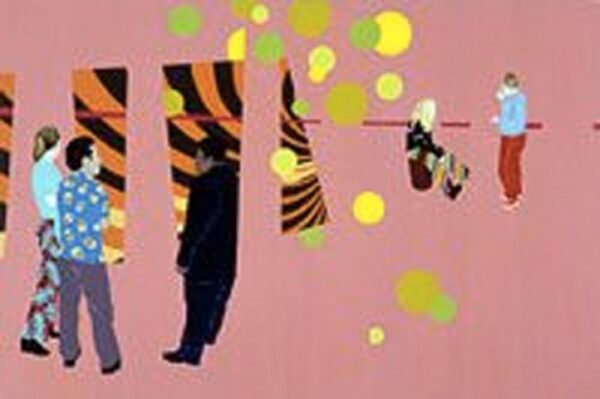
Laura Mosquera’s paintings and drawings feature people drawn from contemporary culture adrift in fields of color and patterns that combine to form an unreal background of spatial dislocation. Depicting a web of relationships with no set narrative, Mosquera’s work describes the anxiety of detachment while representing the beauty of shared experience.
Mosquera studied architecture at the University of Illinois at Chicago, and received her BFA in 1996 and MFA in 1999 in Painting and Drawing from the School of the Art Institute of Chicago.
Related Content
-
Synthetic Socializing in Acrylic Atmospheres:
Laura Mosquera’s Paintings and DrawingsParadoxically, social situations can be among our most alienating experiences—despite the physical proximity to others, a sense of estrangement and isolation often overtakes us. This ironic affect extends from recess on the school playground to sophisticated social events such as art openings or dinner parties. For many, this sense of estrangement is acutely felt in the midst of a great metropolis where even among throngs of people one can still feel isolated and alone. The pleasantries of social interaction often create gaps and interstices in the flow of communication, exposing moments of exclusion, incomprehension, and a failure to connect that form the psychological residue of interpersonal exchange.
Laura Mosquera’s paintings present images of an impossibly Technicolor world where people chat amiably, pretend to be interested, survey the scene, strike a pose, but never seem to connect. Her anonymous figures are conspicuously bedecked in the height of contemporary fashion and set adrift against dramatic architectural backdrops in her paintings. Mosquera’s drawings explore the subtleties of pattern, setting its relationship to the position and form of the human figure against a stark white background. The elegant compositions of the paintings and drawings and the complex relationships between colors on the picture plane give her work a sense of aesthetic balance and harmony, placing the social disconnectedness of her subjects in greater relief.
In her site-specific wall painting for the MCA, Interesting Things Will Begin to Develop (2001), Mosquera used the large scale of the 10-by-24-foot wall to relate the figures and their surroundings directly to the viewer. One feels encompassed by the orange and red curves that enclose the imaginary space of the painting, and by the arcing green lines that swoop from left to right. Details within the painting often separate the figures from one another; the vertical bar of varying horizontal shades of purple on the right side of the wall, for example, serves as a curtain-like barrier between a young man and two women. The people also appear to “interact” with these abstract details of the painting: the young man is positioned just in front of the striped bar, while the women seem to be emerging from behind it on the other side. Another genderless figure in the left-center of the wall painting appears to be standing on one of the dynamic green arcs that swerves through the composition.
Alternating colors and patterns also suggest architectural structures in Can You Feel It (2001). Mosquera studied architecture before concentrating on painting, and the spaces that she constructs in her works are similar to the real or conjectured spaces of architects such as Zaha Hadid and Greg Lynn. Once again, abstract elements within the painting serve a dual purpose, separating colors and color fields from one another but also becoming poles, columns, and other structural forms on which the figures in the painting lean, sit, or stand. The other abstractions that proliferate in Mosquera’s paintings—the multicolored patterns of the clothing—provide vibrant and jarring interruptions of the larger fields of color. The patterns also define the figures in terms of the kinds of fashion decisions that are determined by age group and class. Mosquera’s use of highly-stylized and often retro-chic fashions focuses attention on contemporary urban culture, recalling the representations of the city populace a century ago by impressionist painters such as Gustave Caillebotte, Edouard Manet, and Georges Seurat. While impressionist painters chose to celebrate the leisure activities of a burgeoning middle-class, Mosquera depicts their twenty-first century equivalents in moments of meditation, strained enjoyment, and social disconnection. Her generalization of the features of her subjects, use of psychedelic colors to create their surroundings, and hyperattentiveness to the spectacular ornamentation of their clothing combine to present the shimmering, alienating veneer of contemporary society and the interpersonal tensions that lie just beneath its surface.
—Dominic Molon
Funding
Sponsored by