Exhibition
Interactions: A Four Month Series of Artist and Audience Activations
Artwork Images - Full Size Images
This unique four-month series of performances, interactive installations, and sound pieces explores the evolving relationship between artwork and audience. Each week through May 1, Interactions features an artist or group of artists—most of who are Chicago-based—who create innovative ways to connect with viewers. By incorporating the audience in the conception, production, or presentation of their artwork, they expand how we experience performance, visual and sonic art, as well as communal interaction.
Interactions is curated by Tricia Van Eck, Associate Curator
Schedule
-
January 4–9
- Lou Mallozzi: Outpost
Tues 6–8 pm; Wed–Sun 1–3 pm
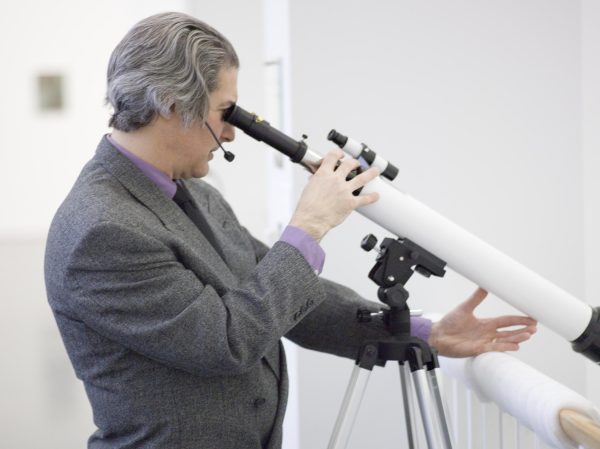
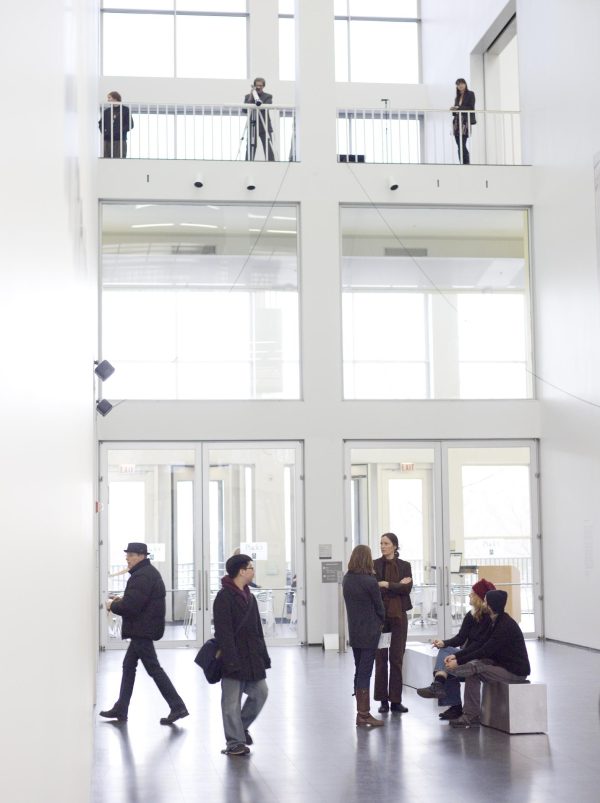
A telescope is set up on the fourth-floor mezzanine above the galleries with a microphone connected to loudspeakers by the entrances to the galleries at ear level. For two hours each day, the artist looks through the telescope and focuses on audience members, describing them in as much detail as possible using the microphone. When the artist is not present the system is available to the public, with simple instructions to look through the telescope and describe what you see. In this way, audiences act as both subjects and objects, observers and the observed.
January 11–16
- Mark Jeffery and Judd Morrissey: The Labors
Tues–Sun, 10:30 am–12:30 pm and 2:30–4 pm
Ten invited artists perform a site-specific dance relating the course of human and celestial bodies. A computer generates notation for the dance based on a celestial map. While star data coordinates the dancers’ position in terms of footwork, visitor interviews about their own work guides their gestures, marking the passing of time through the movements inherent in human labor.
January 18–23
- Sara Schnadt: Drafting Universes
Tues 6–8 pm; Fri–Sun 3–5 pm
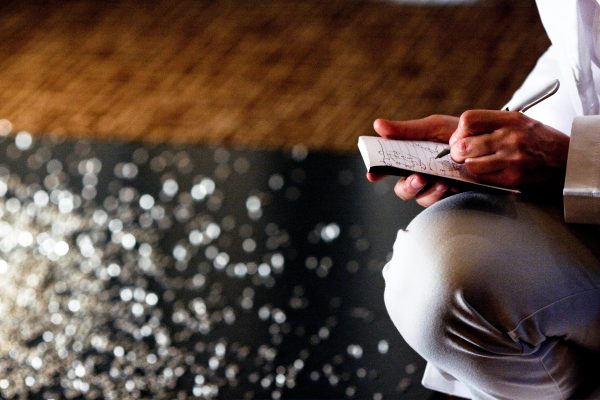
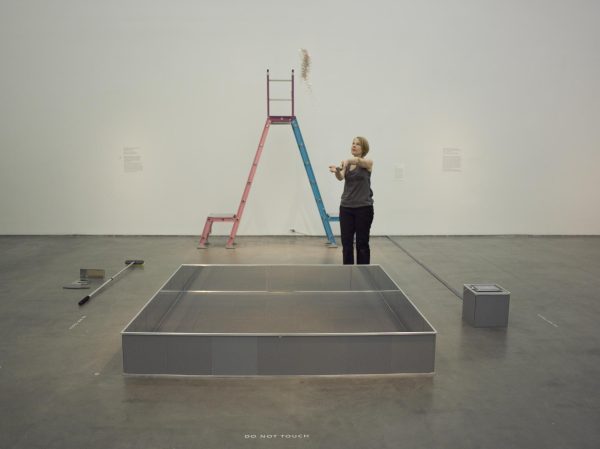
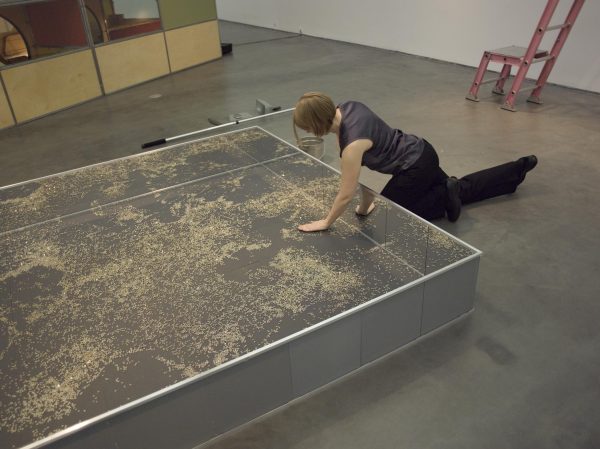
This process-based performance—a gesture of repeated creation, explosion, and removal—is an attempt to approximate the universe within a 7-foot-square grid on the floor. Referencing Carl Andre’s Zinc-Lead Plain (1969) and Dan Peterman’s Ground Cover (1995), Schnadt’s mirrored, tiled grid implies a field of measurement that when filled with “stars”—tiny metal nuts that are scattered—becomes an approximation of the experience of looking at the night sky. The “stars” are created by scattering hundreds of the nuts onto the surface of the grid, which then resemble the distribution of stars within a constellation. Through this repeated gesture that is simultaneously clinical, evocative, and absurd, Schnadt considers the diligence, imagination, and hubris of the scientific process as it tries to define the unknown.
January 25–30
- Justin Cabrillos: Following Dance
Tues 5–7 pm; Wed–Sun 2–4 pm
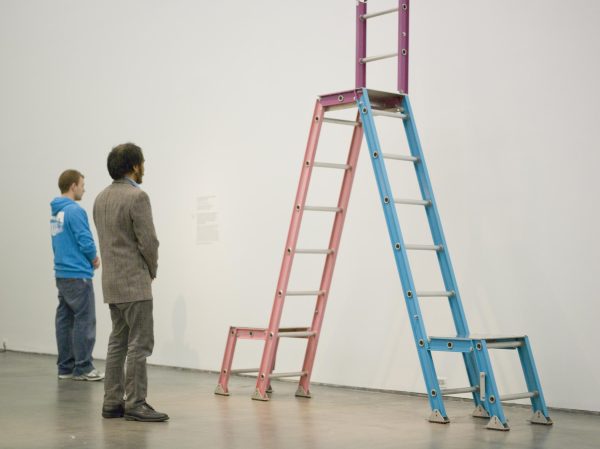
Named after Vito Acconci’s Following Piece, in which Acconci followed the public, Cabrillos observes gestures of the audience in the exhibition. These gestures and physical movements become source material for choreography performed on and around Vito Acconci’s ladder, Bridge Chairs for Sex and Gender. This site-specific choreography follows, repeats, recombines, and amplifies the MCA visitors’ past and real-time interactions with the exhibition.
- Lou Mallozzi: Outpost
-
February 5
- Nance Klehm: Culture of Soil
3 pm
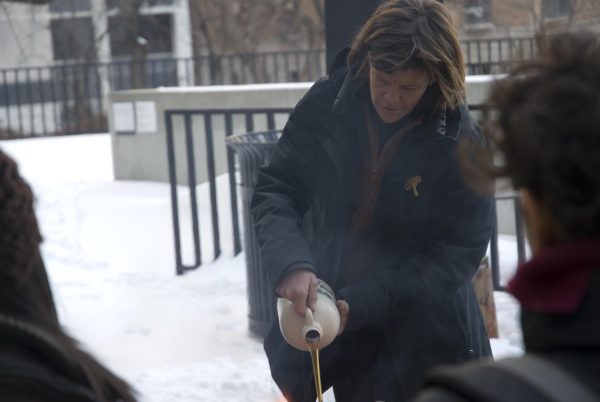
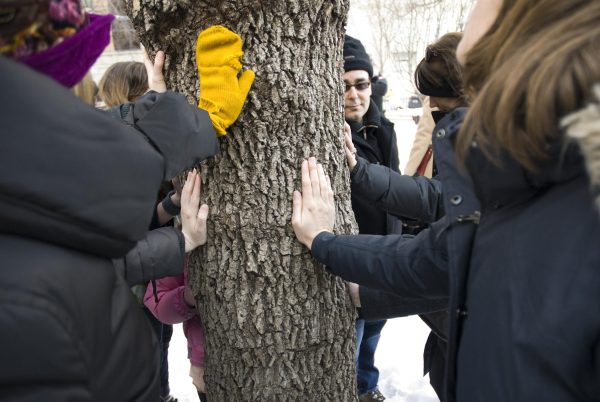
In traditional agricultural communities, the new moon marks the beginning of spring when the tree sap starts running. On Saturday at 3 pm, Klehm hosts an outdoor fire in the MCA’s Sculpture Garden where maple syrup tea is made and shared, then the work continues on a walk where Klehm tells stories about the uses of trees within the urban landscape.
February 8–13
- Coppice (Noé Cuéllar and Joseph Kramer): Vinculum (Coincidence)
Tues, 1–3 pm and 5–7 pm; Wed–Sun 1–3 pm
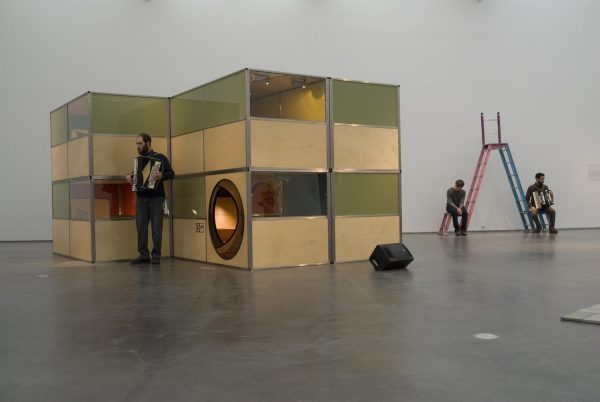
Live performances for two accordions with four speakers play back pre-recorded sounds. The gallery is filled with multiple sounds, all at a moderate volume. The score is procedural, deriving its instructions from coincidences between two accordions as they intersect with the pre-recorded material and the activity in the space.
February 15–20
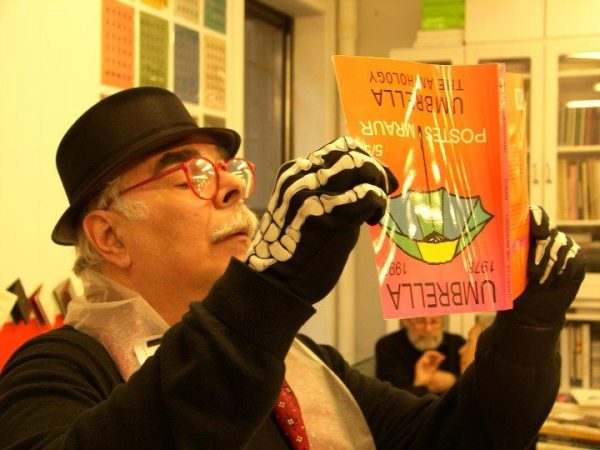
- Keith A. Buchholz, Picasso Gaglione, and Fluxus Artists: FLUXFEST
Tues, 12:31 pm and 6:35 pm; Wed 12:03 pm; Thurs, 12:15–3:15 pm; Fri, 12:36 pm; Sat, 12:34 pm; Sun, 12:33 pm
This exploration of Fluxus activity includes contemporary re-interpretations of classic Fluxus scores and actions; new Fluxus performances by Fluxus artists; and a presentation of the Postal Art Network. Performers include the Chicago Fluxus Ensemble and invited Fluxus artists.
February 22–27
- Luna Negra Dance Theater: interaction APPLE
Tues–Sun, noon and 4 pm
Dancers from Luna Negra perform site-specific choreography inspired by some of the works of the exhibition, including Dan Peterman’s Villa Deponie and Ground Cover.
February 26
- International Contemporary Ensemble (ICE): The Mathematics of Resonant Bodies
9:30 pm
This special late-night concert in the gallery explores the acoustic properties of percussion instruments. Performed by master percussionist Steve Schick, this 65-minuts piece is divided into seven movements, each of which is performed in a different area of the gallery. Tickets $10, with White Silence ticket $5
- Nance Klehm: Culture of Soil
-
March 1–6 & 8–13
- Kirsten Leenaars: On Our Way to Tomorrow
Tues, noon–7 pm; Wed–Sun noon–4:30 pm
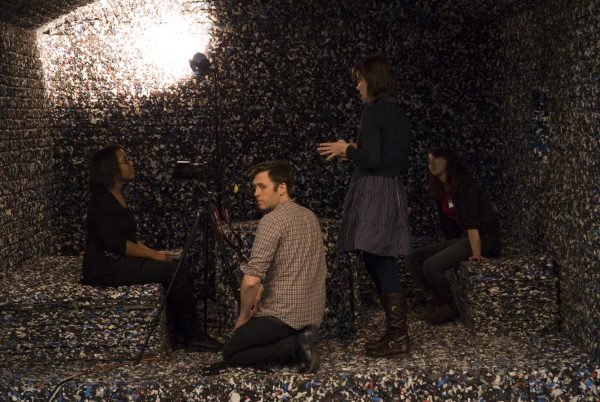
This performance is a soap opera based on real-life drama, to be filmed on location at the MCA, using MCA staff and visitors as the core actors and extras. The plotlines and characters in the soap opera unfold as determined by input from the visitors, since each day a new episode is filmed and a scenario for the next episode is developed. Watch every episode at http://vimeo.com/user5754735.
March 15–20
- Dexter Bullard: The Dialogues
Tues 7–8 pm; Thurs–Sat 3–4 pm
These performances involve pairs of well known Chicago-rooted performers who have a conversation over the phone, not knowing who they are talking to. The audience listens in on the conversation while a guest sound artist mixes a hypnotic sonic sound, adding an additional dimension to the changing tone of the conversations.
March 22–27
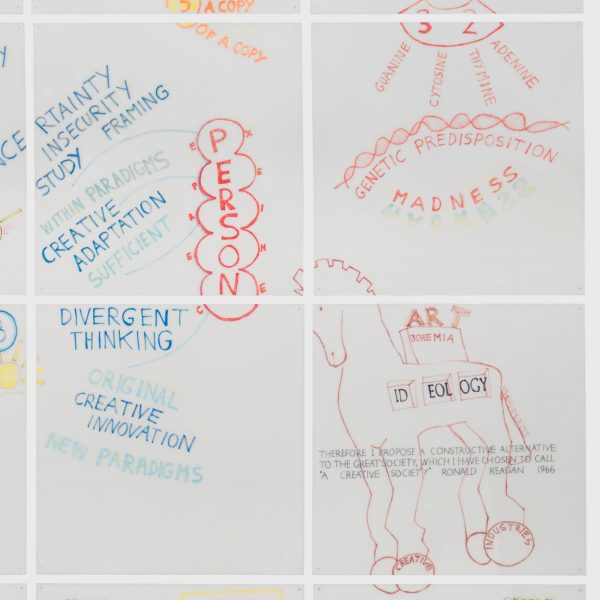
- Adelheid Mers: Talking about Creativity
Tues, 10 am–noon (open seminar), 12:15–12:45 pm (lecture), 1:30–3:30 pm (conversation); Wed–Sun, 12:15–12:45 pm (lecture), 1:30–3:30 pm (conversation)
Mers presents a series of lectures each day of the week on the theme of creativity. The lectures are a response to current thinking about the role of creativity in contemporary society which postulates that artists may be the key to jump-starting a new global economy. Diagrams illustrate the lectures and visitors are invited to modify them during conversations.
March 29–April 2
- Jonathan Chen: 19 situations for six improvisers: a system for hearing
Tues 7–8 pm; Thurs and Sat, 2–3 pm
In this improvisational work each musician is provided with a pair of headphones to listen to another performer. The musicians improvise in response to the other musicians they hear, although this changes throughout the performance. Audience members are able to use the headphones to hear exactly the same sound as the musician they are near. The audience can experience the multiple perspectives central to the work by moving between the spaces occupied by each musician and listening to what the musicians are hearing through the headphones.
- Kirsten Leenaars: On Our Way to Tomorrow
-
March 29–April 2
- Jonathan Chen: 19 situations for six improvisers: a system for hearing
Tues 7–8 pm; Thurs and Sat, 2–3 pm
In this improvisational work each musician is provided with a pair of headphones to listen to another performer. The musicians improvise in response to the other musicians they hear, although this changes throughout the performance. Audience members are able to use the headphones to hear exactly the same sound as the musician they are near. The audience can experience the multiple perspectives central to the work by moving between the spaces occupied by each musician and listening to what the musicians are hearing through the headphones.
April 5–10
- Jan Tichy
During museum hours
Using video projection as a time-based source of light, Tichy creates physical and psychic spaces. Exploring themes of exposure, concealment, and the seen and unseen, Tichy creates an architectural projection of light on Vito Acconci’s ladder Bridge Chairs for Sex and Gender, with which the audience can interact.
April 12–17
- Amber Ginsburg and Lia Rousset: Viewing Soundscapes: Tapping the Audience
During museum hours
Tapping the Audience invites the audience to slip on a pair of tap shoes, amplifying the gallery experience and creating an audible acknowledgment of our physical patterns of viewing.
April 16
- Trisha Brown: Early Works
3–4 pm
Free with museum admission or performance ticket
In a rare event, dancers from the Trisha Brown Dance Company perform signature works from the company’s forty-year history, including Accumulation (1971) set to the Grateful Dead’s “Uncle John’s Band”, Sticks (1973), and Spanish Dance (1973) set to Gordon Lightfoot’s “Early Mornin’ Rain” performed by Bob Dylan.
April 19–24
- Sara Black: Object Recovery
Tues–Wed & Fri–Sun, noon–5 pm
For this performance-based project addressing notions of loss, repair, concession, and renewal, Black repairs a broken object, which she fixes in collaboration with the audience member who brought in the object.
April 26–May 1
- Katrina Chamberlin: Mnemonic
Tues, 11 am–2 pm and 3–8pm; Wed–Sun, 11 am–1 pm and 2–5pm
Chamberlin invites the public to participate by receiving an actual tattoo of a small black dot. Responding to the ephemeral nature of performance, the ‘mnemonic’ as tattoo is a constant reminder of the original performance. This event, in turn, creates a permanent mark on the city, documenting the movement of the visitors to the museum, as well as creating permanent proof of something larger than themselves.
- Jonathan Chen: 19 situations for six improvisers: a system for hearing
-
Jonathan Chen: Amplified
For this work, visitors may use a microphone and a small amplified speaker so that when speaking, their voice is lightly amplified.
Carousel: Installation Views - Full Size Images