Exhibition
Gillian Wearing: Mass Observation
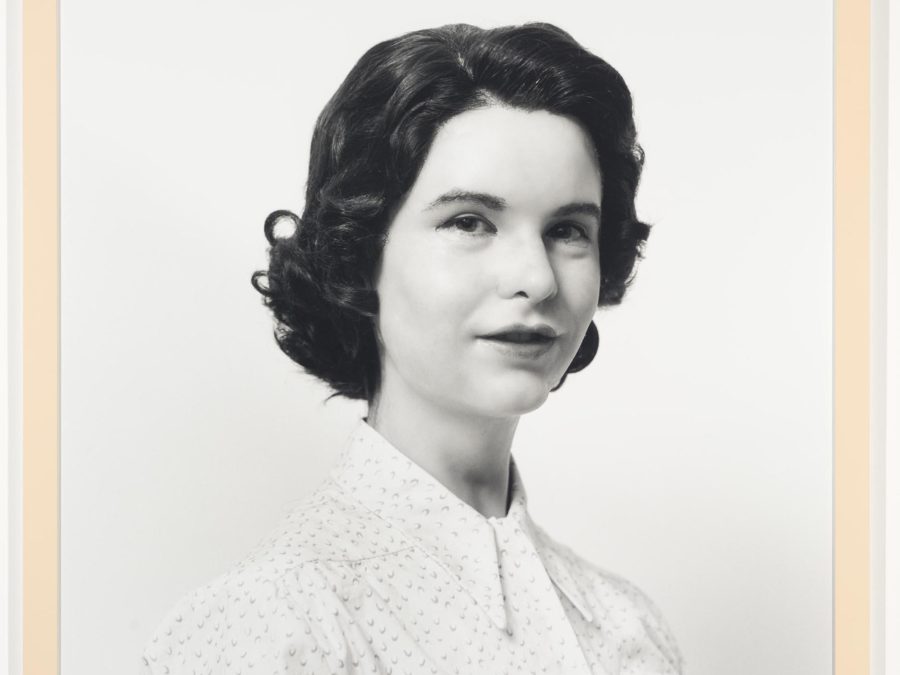
Gillian Wearing, Self-Portrait as my Mother, Jean Gregory, 2003. Gelatin silver print; 53 1/8 x 45 5/8 in. (134.9 x 115.9 cm). Collection Museum of Contemporary Art Chicago, restricted gift of the Collectors Forum in memory of Tom Ruben, 2003.8. Courtesy of the artist and Regen Projects, Los Angeles.
Photo: Nathan Keay, © MCA Chicago
Gillian Wearing has emerged as one of the foremost British artists of her generation, creating video installations and photographic works that explore the strange humor and wrenching tragedy of everyday life. Her work often uses the techniques of documentary films and television to frame alternately unsettling, disturbing, comical, and unpredictable actions and words of various ordinary people drawn from London. Winner of Britain’s prestigious Turner Prize in 1997, Wearing has exhibited extensively in the United States and internationally. This is the first solo museum exhibition of Wearing’s work in the United States, presenting a survey of her photography and video work from 1992 to 2002.
Gillian Wearing was organized by MCA Associate Curator Dominic Molon. After its run at the MCA, the exhibition travels to the Institute of Contemporary Art in Philadelphia at the University of Pennsylvania (September 4–December 14, 2003).
Curatorial Essay
-
“Don’t wear your trainers,” Gillian Wearing cautioned me after agreeing to serve as my guide to Broad Street, the nightclub district in her hometown of Birmingham, England, and the subject of her most recent video installation, Broad Street (2002). After meeting with her in London to discuss the logistics of her upcoming exhibition at the MCA, I donned the appropriate footwear and made my way up to Birmingham. We met for dinner and, braving the gale force winds and rain ripping through Britain that February, ultimately made our way to the nightclub Brannigan’s, where much of Broad Street‘s action takes place.
We arrived at Brannigan’s around eleven o’clock. What struck me first was what undoubtedly made the club so important for Gillian—the decidedly unfashionable nature of the place. The majority of art made in recent years about clubbing and nightlife has attended to its hipper components—the style and substance of modish techno and electronica culture — rather than those that fashion and time forgot. In Brannigan’s Gillian found the ideal place to document the effect that the social ritual of nightclubbing has on human behavior. That’s certainly what occurred to me as I absorbed the cheesy décor of the sprawling interior and winced more than once at the DJ’s similarly outdated musical selections (exemplified, perhaps, by a medley from the late-1970s musical film Grease.) “I’m not letting you leave here without dancing,” Gillian informed me, which was fine with me, provided something remotely danceable eventually worked itself into the mix. Securing a couple pints, we snaked our way through the crowd to a decent vantage point near the multilevel dance floor in order to watch the action. Gillian occasionally pointed out some of the regulars who appear in the video, one of whom was line-dancing with her friends.
For the entire time we were at the club, I was involved in an exercise of split visualization — observing the activities in front of me and trying to imagine how they might be translated into Gillian’s video installation. While I witnessed none of the more dramatic forms of human behavior that one sees in Broad Street—furtive romantic interludes, lovers’ quarrels, drunken fisticuffs, and shivering girlfriends abandoned by their dates—I did get a new sense of the spectacular sociability that such places inspire. This aesthetic and philosophical contemplation was interrupted by a remix of Earth Wind and Fire’s “September,” a favorite of mine since childhood and, as I duly informed Gillian, a song finally worthy of introducing my dancing “talents” to the United Kingdom. As we made our way to the dance floor, I became aware of my transformation from detached observer to participant in the festivities and began to feel more than a little self-conscious. In a sense, Gillian’s insistence that we dance was utterly in keeping with her artistic practice, requiring viewers to recognize their own participation in the tragicomedy of human existence by observing the behavior of others in her work.
Broad Street demonstrates how a particular place shapes human behavior (or conversely, how people tailor their behavior to their experience of a particular place). Though Gillian and I maintained a level of studious detachment from the proceedings, the surrounding space was charged with genuine spiritedness, which made the walk home through the empty, rainswept streets of Birmingham that much more quiet. And while the next day’s destination—Manchester’s Old Trafford stadium for an afternoon soccer match—reinforced the relationship between space and social conduct in a British context, my evening with Gillian on Broad Street remains one of most unforgettable and enjoyable forms of “exhibition research” that I’ve ever done.
Funding
This exhibition is generously supported by Margot and George Greig, Robert and Sylvie Fitzpatrick, the Elizabeth Firestone Graham Foundation, and the British Council.

Air transportation is provided by American Airlines, the official airline of the Museum of Contemporary Art.