Exhibition
UBS 12 x 12: New Artists/New Work: Andreas Fischer
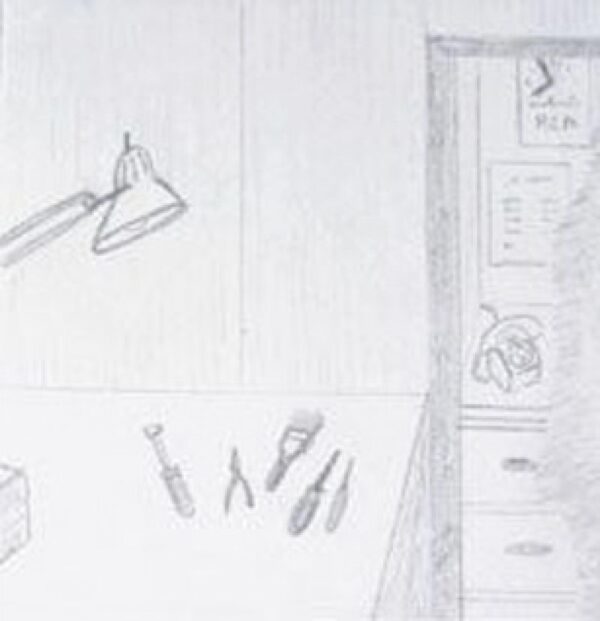
Andreas Fischer’s project for the MCA, which began with his uncle’s experience of seeing a ghost, includes a drawing and descriptive text by his uncle with additional materials about specific ghost sightings. A related painting by Fischer is installed on another floor in the museum.
Fischer received an MFA in Studio Art from the University of Illinois at Chicago and is currently pursuing an MA in Art History from UIC.
Related Content
-
What Lies beneath Andreas Fischer’s Paintings
Throughout the history of modern art, artists have used abstraction to challenge the representational illusionism of previous generations of painters. Among the most avant-garde artists of their time were those who revealed the process of painting. In the 1950s, an abstract expressionist such as Jackson Pollock made his process evident on the surface of the canvas, with drips of paint, cigarette butts, footprints, and other debris mapping his gestures. In the 1960s and 1970s, minimalists such as Jo Baer (American, b. 1929) and Robert Ryman (American, b. 1930) addressed the physical process—building a stretcher, priming the canvas—of constructing a painting to emphasize its properties as an object, rather than as a window onto an imaginary world. Conceptual artists such as Rudolf Stingel (Italian, b. 1956) democratized the process of painting (contrary to the notion of the artist as an innate genius), with works such as Instructions (1989) and Untitled (1998)—a rubber Buddha that holds the tools necessary to make a painting. Andreas Fischer (American, b. 1971), an emerging Chicago artist, not only reveals the process and context of making paintings but also examines their interpretation. He debunks the idea that works of art can be completely understood through visual information, without supplemental information.
For Fischer, the subjects he depicts include what he calls the “context” of the painting, the events that surround its production. Fischer’s training as an art historian—he has undergraduate and graduate degrees in both studio art and art history—becomes apparent when analyzing the complex way he approaches painting. His works are original in the way he addresses painting’s authorship, style, subjectivity, technique, relationship with the viewer, and site of display and ultimately examines the various ways that paintings obtain their meaning.
His investigation into context began with Friday night doodle redrawn by 100 people (unfinished) (1999), which recalls a surrealist exquisite-corpse, a collaborative drawing, followed by Drawings of my ex-girlfriends by my current girlfriend, made with my current girlfriend’s lipstick (1999) and Reproductions of colored pencil and marker drawings that sorority girls I hired did of their underwear patterns, number 5: pinks and purples (2000), among others. He invites people to participate in his art making, often assigning them a project, then appropriating their drawings into his paintings (some participants, such as the sorority girls, were unaware of the purpose of their drawings). His titles imbue the works with meaning not readily apparent in the imagery and offer clues to his relationship with the subjects. Because Fischer appropriates others’ drawings, each work has a distinct style, which contrasts with the usual notion of artists having a signature style of painting. Interweaving his collaborators’ work into the painting, Fischer brings transparency to his process.
Fischer first investigated the relationships that informed his paintings, but he soon considered the importance of a painting’s site of display. Self–portrait that was installed in a girls’ fitting room, May 1999–January 2001 (20 prom dresses, 12 bridesmaid’s dresses, 3 homecoming dresses, 6 pairs of shorts, 132 skirts, 212 pairs of pants, 40 casual dresses, 5 nightgowns) (1999–2001) includes in its title the painting’s placement, making a direct correlation between its site and meaning, as well as implicating Fischer as a voyeur. This painting foreshadows Fischer’s project for the MCA in which he posits a new approach to understanding how paintings derive meaning by exemplifying his idea in a physical installation.
For his project at the MCA, Fischer turned again to his roots in art history. He proposed that the methodologies of researching the material and social and political culture of historic paintings can be used to interpret contemporary paintings. His work for the MCA, I’m not saying for sure it’s a ghost but I didn’t have an explanation. Maybe an interdimensional traveler—a flawed appearance from a parallel universe—a remote viewer—maybe just me from the future looking back at my life. Maybe, even just someone walking by outside in the dark just as car headlights lit him up and created a shadow moving across the doorway (2003) is an installation and a painting. Fischer used his uncle’s ghost sighting as a point of departure (the title is excerpted from a letter he wrote to Fischer about the experience).
For the installation, Fischer placed a 1980s video of That’s Incredible!, a 1713 musical score Giuseppe Tartini claimed was written by the devil, a drawing of a yeti (abominable snowman) by Fischer’s friend Rosy Winterer, images of a haunted painting for sale on Ebay, a drawing and model of where the ghost was sited, and a photocopied excerpt of Hans Belting’s Likeness and Presence behind a wall, which recalls a blank canvas, to represent what happens behind the scenes during his creative process. Viewers, like investigators, can examine the evidence in the installation and draw their conclusions based on these source materials and their own experiences. These materials reflect the context for the development of his painting, the other part of the exhibition. Fischer placed the painting in a separate location among other artworks emphasizing how paintings are typically displayed with other artworks in a gallery and not with source materials. He included the objects in the 12 x 12 gallery to suggest their importance in contributing to an artwork’s meaning and in enhancing the references available for interpretation. Similarly, his unusually long titles provide information about the painting that is not visible. Fischer was additionally interested in the content and placement of didactic labels as tools for interpreting the works. Together, the parts of the exhibition reveal how a painting is the result of thoughts, decisions, relationships, processes, and events.
Fischer’s choice of ghosts as a subject is also metaphoric. He used them to make an analogy about how the importance and effect of art relies on belief. Ghost sightings are often followed by searches for evidence of the ghost. Likewise, looking at paintings is like looking at the shadow of a ghost: we must consider all evidence before drawing a conclusion, yet begin the process with at least a modicum of faith.
—Julie Rodrigues Widholm, Curatorial Assistant
Funding
Sponsored by