Editorial
Three Dead-End Adjacent Tunnels, Not Connected
by CJ Salapare, Curatorial Fellow
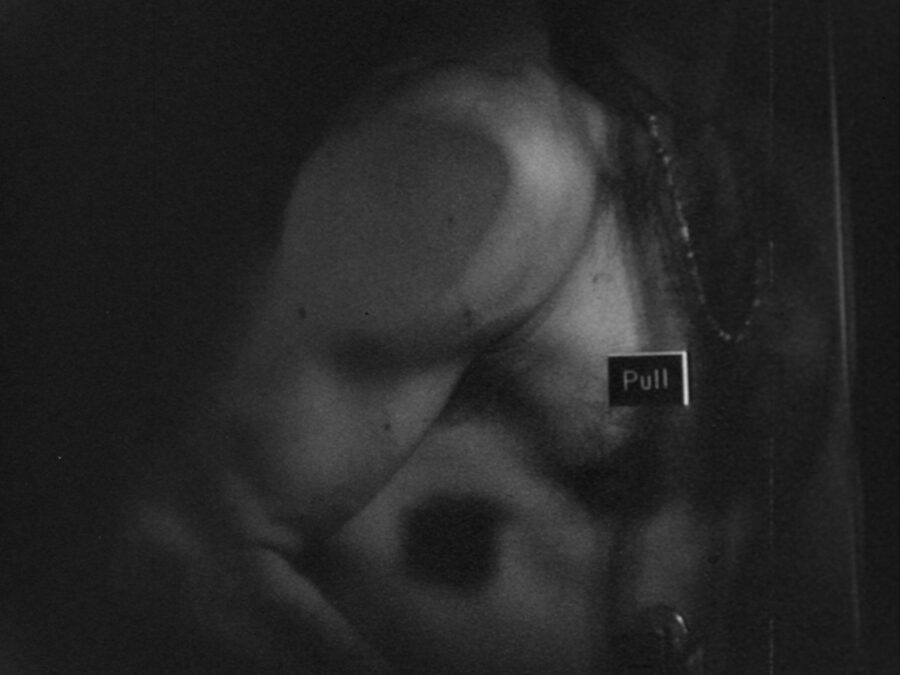
Still from video documentation of Robert Morris, Slow Motion, 1975.
Video: David Katzive, © MCA Chicago
The MCA DNA Research Initiative is a multi-year curatorial program, supported by the CHANEL Culture Fund, that invites early-career curators and writers to the museum for interdisciplinary research projects related to the institution’s collection. Focused on the intersection of visual art and performance, this initiative surfaces overlooked art historical narratives within the organization’s history while foregrounding the cross-disciplinary ethos that has been integral to the museum since its founding in 1967.
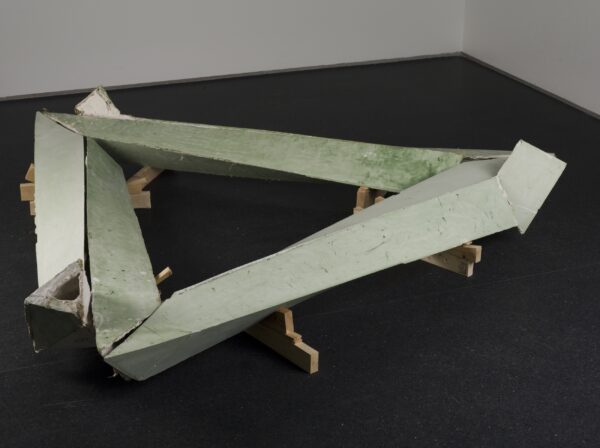
Three twisting, sharply angled forms rise but never fully converge. What emerges is a triangular void, framed by shafts and torqued segments. The experience of this sculpture shifts as the proximity of these parts, wholes, and holes reveals a precarious balance at work. Bruce Nauman’s title for his artwork explains yet still confounds: Three Dead-End Adjacent Tunnels, Not Connected (1979; fig. 1). Unlike his corridors, which one can physically enter, this model is equally perceived and projected by those who encounter it. A situation opens at the intersections of sculpture, unbuilt structure, and imagined movement.[1] Entering Nauman’s inhospitable world means reckoning with his structures of experience, shaped by the uneasy triangulations of art, architecture, and performance.
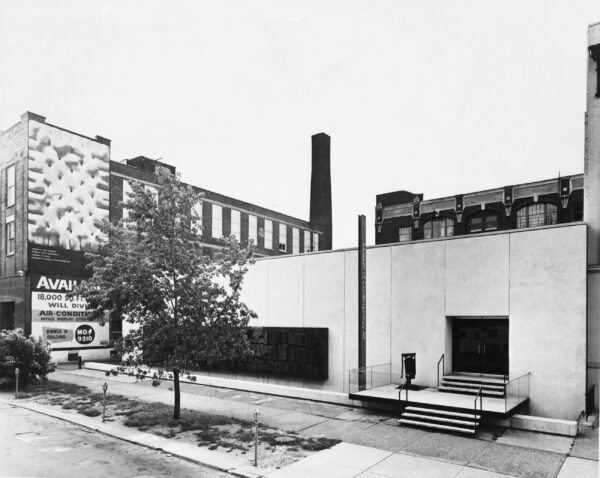
Twelve years earlier, in 1967, the MCA was established as a museum of the “new,” sited in a former bakery turned headquarters for Playboy turned avant-garde incubator at 237 East Ontario Street. It was founded as a non-collecting space that could display and foster the emerging art of now, distinct from the Art Institute and Arts Club, its more established peers. That same year saw a wider interrogation of space, system, and structure unfolding. Bertrand Goldberg’s five-building complex Marina City was completed—now a fixture of the Chicago skyline, and known structurally for its “City within a City” design where places of work, play, and leisure coexist in the same compound. Artforum published Jack Burnham’s “Systems Esthetics” and Sol LeWitt’s “Paragraphs on Conceptual Art,” while Lucy Lippard and John Chandler completed their essay “The Dematerialization of Art,” to be published in Art International the following year. Shifts in relation and definition were underway, reshaping matters of objecthood, and more immaterial concerns.
1967: is it an origin story, a series of unrelated events, a system of meaning in the making? Taken together, these developments invoke Lippard’s “ideas in the air,” the shared conditions and resonant sensibilities of this moment.[2] The “work”—the artwork, its process of making, its afterlives—was opening onto worlds beyond and beside itself, alighting in ways that institutions like the MCA sought to cultivate, rather than merely collect and contain.[3]
In keeping with these shifts, the museum’s inaugural director, Jan van der Marck, decreed: “I do not believe in making the new museum a showcase for one art form at the exclusion of another,” which informed his desire to place the visual arts and performance on equal footing.[4] The MCA’s early history attests to an institution not only building, but dwelling within this indeterminate space. “Showcasing,” van der Marck’s portmanteau of choice, conjures the conditions of staging and display into his nonhierarchical vision.[5]
Among the many accounts of the MCA, architecture has often remained secondary to—or been treated separately from—discussions of the visual arts and performance, when not addressed as a distinct field altogether.[6] Understood as brick-and-mortar, architecture invokes the conditions of display often made neutral and/or invisible, given the prevalence of the modernist “white cube,”[7] or conversely heightened by site-specific interventions.[8] Approached as structure, it also calls to mind the discursive and contingent circuits that make it legible, relational, and sensible—the paradigm of architectonics.[9]
If Nauman builds a structure that is about the experience of structure, architectonics invokes the architecture of architecture. This approach opens onto the ways in which formal, spatial, institutional, and ideological relations are assembled, and by extension, made apprehensible. These considerations are simultaneously prompted, in terms of conditioned typologies and frames; built, in the physical substance of a space; and experienced, in real time by its inhabitants.
A building becomes a double entendre in this light: both structure and event, static place and untapped potential, spatial constraint and condition of liveness. These conditions inform the sites of inquiry and imagination for artists, curators, and audiences alike. In its formative years, the MCA was constructing new models of what an institution devoted to contemporary art—intermedial, interdisciplinary, inchoate—might become. Revisiting familiar and lesser known episodes in the museum’s history through select exhibitions, public interventions, and works in its collection affirms its role as a catalyst for experimentation rather than merely its container. This approach as such foregrounds artists who make architecture’s terms and architectonic thinking their material alongside their more well-established concerns in performance, conceptualism, and other interdisciplinary modes. The MCA, in this light, emerges as an institution defined less by fixed categories than by a continual negotiation between artistic practice and institutional form to meet its ongoing moment.
Commingling Conditions
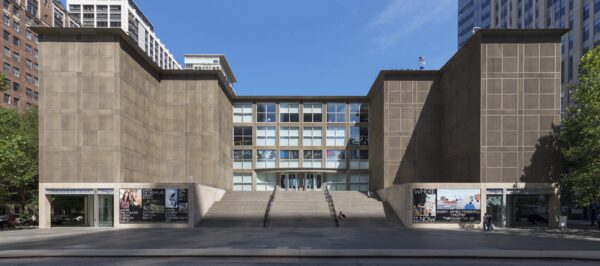
Today, the MCA can appear as a stable, established institution, made concrete in 1996 by the construction of Josef Paul Kleihues’s modernist building. Moments across the MCA’s history, however, reveal the sustained flux grounding this institution-in-the-making. Each iterative step recalibrated its institutional practices: from starting a collection in 1974 to separating art and performance through Kleihues’s purpose-built theater in 1996. These acts of definition are often counterbalanced—and contested—by artists, arts workers, and audiences who think subversively alongside structures, physical and ideological, that can codify and cement.
In this dialectical vein, “building” operates as both noun and gerund, denoting the museum’s physical presence and the institution’s active process of self-definition. Architecture and architectonics serve as vehicles for making this dynamic apparent. An institutional program—in terms of architectural typology, its slate of exhibitions and displays, its priorities and philosophical underpinnings—is often understood as linear, developmental, and self-confirming. A building serves its purpose; an exhibition advances its agenda; a set of ideals incarnates as an institution. Moving beyond this notion entails seeing the museum as more uneven and searching in nature, existing somewhere between structure and scaffolding. This indeterminate space restores openness and contingency to narratives that can otherwise seem inevitable or fully resolved.
Conditions of liveness take on a different valence in light of the regulatory and obstructive tendencies that are common to entering museum spaces. The built environment doubles as a social enclosure of codes and protocols, with those who enter becoming participants in upholding or complicating these very structures. Artists have often relied on performance’s terms—the threshold, the liminal space, the staging ground—as ways of revealing of these interfaces between ideology and institution.[10]
Slow Motion (1969) was Robert Morris’s contribution to Art by Telephone (1969), a landmark group exhibition of conceptual art at the MCA where artists delivered the instructions to make their works by phone. Morris laid out the mise-én-scene to be filmed. A man, naked from the waist up, would press himself repeatedly against a glass door at the museum, performing seven actions that focalize parts of his body. Vignettes of confrontation and contortion ensue. The camera’s frame, fit to the door’s width, blurs the camera lens, filmed surface, and physical space in the final film. One sees a Vitruvian man in fragment, close up, slowed down, structured at a point of figurative collapse and reconstitution. The filmed body becomes sculptural in form and architecture—metonymized by the glass door—becomes architectonic, an expression of the conditions for this structural blurring to take place.[11] As Chrissie Iles notes, “Morris brings the surface of the body and the surface of the institution together, so that instead of containing and displaying the artwork, the physical architecture of the institution becomes an inextricable part of it.”[12]
If Morris reveals the threshold as an interface between body and institution, Marina Abramović approaches it as a site of social and ethical interpellation. In the video documentation for Imponderabilia (1977), the door of the Galleria Communale d’Arte Moderna is replaced with a narrower passage, the only means of entry. Artists Abramović and Frank Uwe Laysiepen (known professionally as Ulay) stand there with about a foot of space between them. Visitors are forced to enter the museum through that space as the artists, fully nude, force visitors between their bodies. The audience cannot pass by walking straight. In a few seconds’ span, they are forced to turn sideways, sidle, and come face-to-face with either performer. Instinct, conditioned bias, and matters of discomfort commingle uneasily in this means of passage. It is only after a visitor inevitably becomes a participant, or after their role as a participant is made explicit, that they can carry on. The effects of crossing this threshold remain elusive even in its documentation and restaging. Its title denotes matters that cannot be precisely measured or determined, and its subjective experience brings the imponderable into being.
Taken together, Morris and Abramović reimagine the threshold as an institutional condition rather than mere architectural element. Entry into the museum becomes inseparable from entry into the systems—spatial, social, and disciplinary—that organize these aesthetic experiences. The institution therefore takes shape as a qualifying platform that positions and inflects the art within it, with matters of individual agency remaining an open question.
The MCA’s development of its own spaces expresses this self-definition—an ideology connected to its changing physical form. Following the MCA’s establishment on Ontario Street, subsequent stages marked expansions and new eras for the nascent institution, each of which took on distinctly spatial forms: expanding beyond its original footprint in 1977; expanding again in 1978 (immortalized by Gordon Matta-Clark’s spatial interventions in soon-to-be-demolished townhouses); moving into its current home off the Magnificent Mile, with its Kleihues-built structure, in 1996 (fig. 4); and expanding its auxiliary functions through Johnston and Marklee’s renovation in 2014. The institution’s many thresholds, tangible and potential, disclose the points when architecture and system cease to enclose but instead open onto dynamics of transformation.
Entry, enclosure, experience. These are not separate categories so much as concatenating conditions, each orienting the body in relation to its environment. In the same way that these conditions connect spatial and experiential factors, performance—as an experiential mode—plays a key role in demonstrating architectural and architectonic parts of the institutional whole.
Kaprow’s Moving (1967), presented in tandem with the MCA’s inaugural exhibition Pictures to be Read, Poetry to be Seen, was a happening that spanned four days and six offsite locations.[13] Furniture–beds, chairs, carpets–were moved by the artist and performers across different spaces: the store, streets, and three empty apartments. Then, the artists worked through a slate of scripted events. The stuff of life unfolded. Bedrooms were slept in, dinners eaten, and attics filled and locked. As the installation gave way to inhabitation, matters of daily life and design crossed into the threshold of art’s remit. In Kaprow’s instructions, home becomes a staging ground, furniture turns into props, and the acts of temporary dwelling become everyday events—sited between and beyond the institutional frame. Although taking place outside of the MCA’s physical spaces, Kaprow’s happening bridged the typological specters of the museum and home through performance, questioning where and how art could exist, and why such separations in behavior and context persist.
Within the framework of a museum, architecture often makes itself known when its neutral stability “fails,” or when fissures reveal the underlying systems and assumptions that are naturalized. Artists who claim rogue positions within these coordinates often call attention to these cracks and ruptures. Take 1993 at the MCA as an example. In the heat of summer, visitors to the MCA were caught by surprise: Two spacious galleries were stripped of their white walls and modernist leanings, replaced by architecture of a bygone era. This environment of millwork, wood paneling, and picture rails with paintings by S.Y. Koshelev, a Russian folk artist, was strange and unnervingly familiar: fallen glory, Hermitage meets institutional neglect. All seemed in order save for the water dripping from the ceiling, caught in makeshift plastic tarps and bowls strewn about the scene.
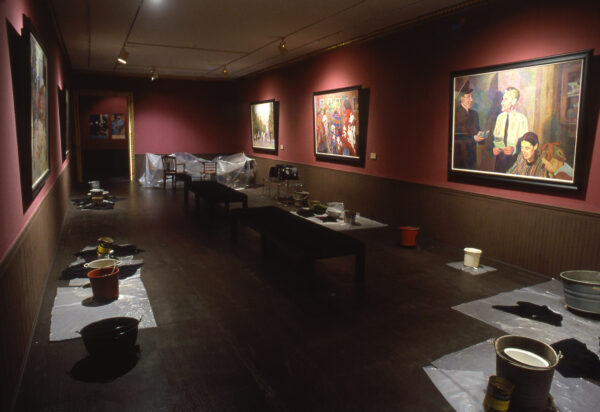
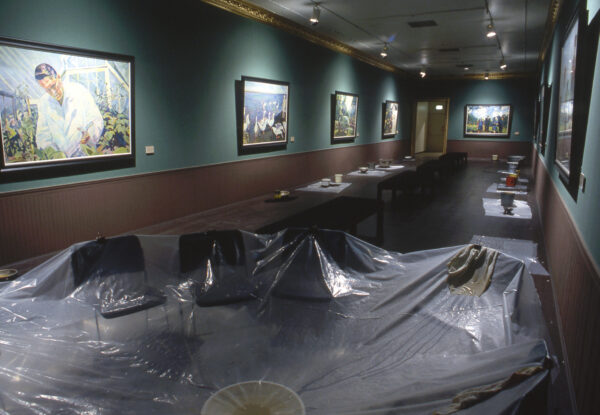
The Russian conceptual artists Ilya and Emilia Kabakov were responsible for this gash in the institutional fabric, which was their creative fabrication—Koshelev, vernacular trappings, and all. Their installation Incident at the Museum or Water Music (1992; figs. 5–6) revolved around a turn of events and hinged partly upon the parafictional impulse of surprise: water had seeped into the galleries from a heavy storm the night prior to the opening, so a makeshift solution had to be implemented.[14] While the tarp, chairs and bowls, and still-dripping water initially seem disruptive, they are actually central parts of a sonic composition orchestrated by musician Vladimir Tarasov. The expanded situation, therefore, becomes less about the work on the walls but more about the concatenation of elements, calling to mind the artists’ words: “A catastrophe, destruction, turns into construction, and contemplation with the sudden shift in point of view.”[15]
No matter how elastic a situation may appear—whether formal, perceptual, structural, institutional—it inevitably can be stretched to its limits. One incident at the MCA, Chris Burden’s performance of Doomed (1975; fig. 7), is one of the most infamous instances of such transgressions. For the Bodyworks exhibition (1975), many visitors came expecting visions of extremity: Burden had built a renegade reputation around actions like contorting himself into lockers, nailing himself Christ-like to a Volkswagen, and enlisting someone to shoot in him a gallery. They were met initially with a more bizarre set up, what some saw as a quiet letdown. A glass clock; a pane of glass, roughly six feet in width and diagonally propped against the wall; the artist, lying horizontal in the space between.
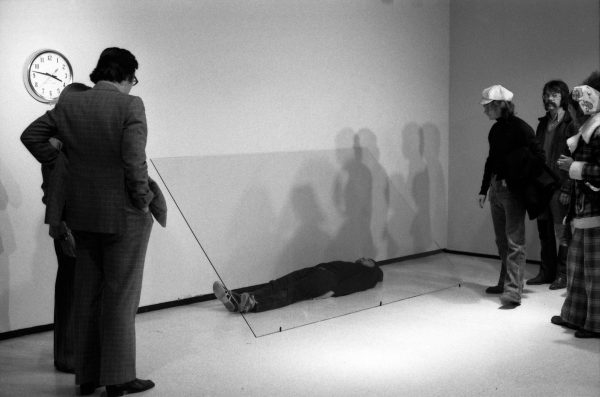
The drama took place in the work’s unfolding, over 45 hours and 10 minutes to be exact. People thought the performance would be over upon the museum’s closing, but Burden remained in the same position—without water, food, or breaks to relieve himself. A harmless beginning was inching closer to a more sinister end with every hour that elapsed, which museum staff eventually interrupted, thus marking the completion of the piece. Burden took the hammer and broke the clock, shifting the event into an instant, and revealed the instructions of the piece: “The responsibility for ending the piece rested with the museum staff but they were always unaware of this crucial aspect.”[16] The institution (embodied through its individual agents) sanctioning this performance would end up being interpellated as a performer in its own right, co-constituting the terms and conditions that Burden set forth.
The porous line between architecture and architectonics is especially pertinent here in this pioneering work of institutional critique. The glass is evocative of the skyscrapers surrounding the MCA, the logic of transparency and its institutional realities of opacity, made material and metaphorical within Burden’s situation. What feels within arm’s reach ends up seeming more impossible or inadmissible within a set of coordinates, whether those of performance, institutional behaviors, or codified scripts. To break the glass of the clock, therefore, is to shatter the reality of suspension that the parameters of art and performance uniquely permit.
The Ongoing Moment
Art, performance, architecture: three dead-end adjacent tunnels, not connected. The adjacency here is the operative force. What unfolds from placing these elements side by side are creative interventions that put stress on their underlying givens and assumptions, in ways that are both destructive and reconstructive. As Dan Graham presciently wrote, “The task of the work of art or architecture is not the resolution of social or ideological conflict in a beautiful artwork, and not the construction of a new ideological counter-content; instead the artwork directs attention to the seams in various ideological representations (revealing the conflicting variety of ideological readings).”[17] The fissures and cracks that often result are not meant to resolve or be further integrated; they gesture implicitly or make explicit the conditions of liveness that are integral to a unified art, architectural, and ideological experience.
The MCA itself remains a provisional, open-ended enterprise despite the ways it appears otherwise as an enclosed, “complete” system. If architecture makes the museum’s shape concrete, architectonics opens its totalizing form toward conditions of reshaping. The evolving parameters of this site-cum-situation create new ways of approaching and testing the institution’s edges. What feels important here is that these conditions of liveness are not necessarily and teleologically built upon enclosure and coherence, which often are the defaults for conventional approaches to architecture and art history. Something more expansive and entropic ensues, a history built on a series of ongoing moments. The MCA is not simply a historical inventory of disruptions; it is vitally a continuing record of iteration and process.
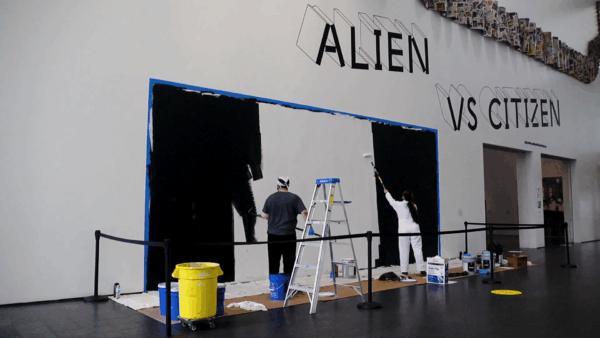
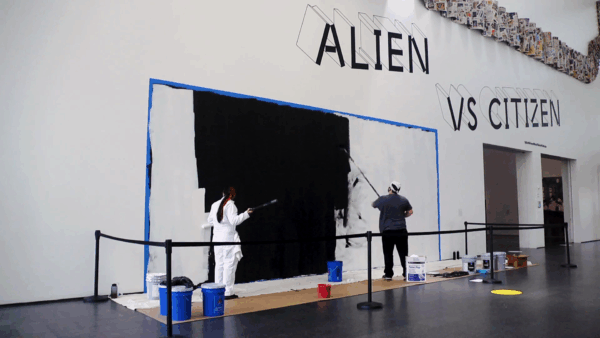
Carousel: Solakov’s Performance - Full Size Images
Nedko Solakov’s performance A Life (Black and White) (1998– ; figs 8–9) perhaps best exemplifies this ethos of vitality. The piece’s instructions are simple: two painters take a gallery as their shared canvas, with one painting its walls in white and the other following in black like clockwork, trailing one another in a balletic dance of yin and yang.[18] The work, therefore, is in a perpetual state of becoming: never at rest, layering time, labor, and gesture in ways that foreground the process’s ritual-like (re)construction—from observing the acts of painting in real time to seeing the painter’s implements-cum-props scattered about the installation. A balancing act of painting, performance, and architecture unfolds with every stroke and step.
The MCA DNA Research Initiative
This multi-year curatorial program invites early-career curators and writers to the museum for interdisciplinary research projects related to the institution’s collection.
Notes
I would like to thank everyone at the MCA for their insights, camaraderie, endless patience (and then some), and collaboration during my fellowship and beyond. Special thanks are due to Jamillah James, Nolan Jimbo, Mary Richardson, Marisa Szpytman, and Elijah Teitelbaum. I am also grateful for my inspiring conversations about art, performance, architecture, institutions, Chicago, and their endless interstices with Christopher Alessandrini, Joshua Chambers-Letson, Beatriz Cifuentes, John Corbett and Jim Dempsey, Stephanie D’Alessandro, Brendan Fernandes, Patrick Flores, Lulu Yao Gioiello, James Hosking and Jeremy Lybarger, Chrissie Iles, Bruce Jenkins, Min Sun Jeon, Colton Klein, Isabela Miñana Lovelace, B. Ingrid Olson, Lane Relyea, Samuel Shapiro, Charles Simonds, Becky Singerman, Deb Sokolow, Leah Sorkin, Mari Hagen Stokke, Catherine Sullivan, Elisabeth Sussman, Abraham Thomas, Adam Thompson, Lynne Warren, and Stella Zhong.
1. For more information, see Coosje van Bruggen, “Entrance, Entrapment, Exit: The Process of Bruce Nauman,” Artforum 24, no. 10 (Summer 1986), https://www.artforum.com/features/entrance-entrapment-exit-the-process-of-bruce-nauman-206924/.
2. Lippard, Six Years: The Dematerialization of the Art Object from 1966 to 1972 (Praeger: 1973), ix. Note: this is an extension of her and Chandler’s seminal essay from 1968.
3. This warrants a truncated discussion of the “open work” of the 1960s, following Umberto Eco, Anna Dezeuze, and Carter Ratcliffe, and the afterlives of conceptual- and systems-based thinking that informs my thinking. I follow the diverse camp of theorists, art historians, and artists whose understanding of conceptual art and thinking shifts beyond “dematerialization” towards other ontological and epistemological formations that admit, frustrate, and/or densify its very terms. This scope of thought includes the work of Andrea Fraser and Pilvi Takala; the exhibitions and catalogues for The Quick and the Dead (2009), curated by Peter Eleey at the Walker Art Center, and Stories of Almost Everyone (2018), curated by Aram Moshayedi at the Hammer Museum; Adrienne Edwards’s writing on lush conceptualism in the catalogue for Whitney Biennial 2022: Quiet as It’s Kept (2022), Eve Meltzer’s Systems We Have Loved: Conceptual Art, Affect, and the Antihumanist Turn (2013), and Johanna Gosse and Timothy Stotts’s edited volume Nervous Systems: Art, Systems, and Politics since the 1960s (2021), among others.
4. Reality of a Dream (MCA Chicago, 1966), 9.
5. It is important to note some of the historical precedents for this interrelation between the disciplines of performance and architecture beyond the frameworks of aesthetic experience. Bernar Tschumi, a pioneering figure in deconstructivist architecture, has written extensively on the performative axes of the building, emphasizing the latter part of spatiotemporal coordinates. One important historiographic crossover is his collaborations with curator and performance historian RoseLee Goldberg in 1970s London, from their exhibition A Space: A Thousand Words (1975) to the interdisciplinary initiative of Bridging Disciplines (1973–76).
6. These texts include Collective Vision: Creating a Contemporary Art Museum (MCA Chicago, 1996), the MCA’s webpage on its building (https://mcachicago.org/about/building), and the institutional archives and chronologies compiled by architect Dan Brenner, whose firm Brenner Danforth Rockwell designed the first permanent home for the MCA and its 1974 expansion.
7. See Brian O’Doherty, Inside the White Cube: The Ideology of the Gallery Space (Lapis Press, 1986).
8. See Miwon Kwon, One Place After Another: Notes on Site Specificity (MIT Press, 2002).
9. A historiography of architectonics, from its classical Greek roots to its philosophical developments via Kant and Popova, among others, is beyond this essay’s scope. For the current purposes, it is approached as the study of “the structure of structure,” toggling between axes of materiality, visibility, and sense.
10. For this view, I am indebted to the theoretical work of Richard Schechner and Adrienne Edwards.
11. I am grateful to Chrissie Iles for bringing this to my attention and offering her research on Art by Telephone for this essay’s purposes.
12. Chrissie Iles, “Slow Motion Vertigo: The Films of Robert Morris,” in Films and Videos by Robert Morris, exh. cat., ed. Chrissie Iles and David C. Duncan (Serralves Foundation, 2011).
13. This essay’s means of reapproach is directly inspired by the hermeneutic inversion in the MCA’s inaugural exhibition.
14. Carrie Lambert-Beatty, “Make-Believe: Parafiction and Plausibility,” October 129 (Summer 2009): 51–84.
15. “Incident at the Museum or Water Music,” Ilya Kabakov and Emilia Kabakov, 2019, https://www.kabakov.net/installations/2019/9/14/incident-at-the-museum-or-water-music.
16. Michelle Puetz, “In Support of Uncertainty: Chris Burden’s Doomed,” MCA Chicago, accessed August 17, 2026, https://mcachicago.org/stories/editorial/in-support-of-uncertainty-chris-burdens-doomed/.
17. Dan Graham, “Art in Relation to Architecture / Architecture in Relation to Art,” Artforum 17, no. 6 (February 1979): 22–29.
18. Instructions can be found at “A Life (Black & White),” Nedko Solakov, accessed August 17, 2026, https://nedkosolakov.net/content/a_life_black__white/.
Funding
The MCA DNA Research Initiative is supported by the CHANEL Culture Fund.