Tuan Andrew Nguyen: We like how mythology creates a space . . . that fact and fiction kind of operate simultaneously.
The Propeller Group was always meant to exist as several things at once: It was meant to be a collective of artists. It was meant to be an advertising agency. It was meant to be a media production company.
Matt Lucero: We were producing work for other artists: fabricating work, filming documentaries. It was a diverse sort of media practice. But it was commercially driven. And we set up a company to do that, to make it easier for us to film as well.
TAN: Since the beginning of our collective—and even before that—we’ve been interested in blurring the lines between modes of cultural production.
Phunam: The Cu Chi Tunnel is perceived in Vietnam by the locals as their way of telling their version of their story of what happened during the war.
ML: It was a big turning point in the American War in Vietnam.
TAN: The government has made a memorial park to this area and to that history.
P: We were in a group tour and we just watched the propaganda video. We just found out all the information we needed to know. And yet this young—maybe 20, mid 20s—I don’t know where he’s from, but he has a British or Australian accent, and he said to the tour guide . . . he patted him on his shoulder and he said, “So why did you guys lose?” And I thought that was an interesting perception from him.
And the tour guide turned to him and said, “We did not lose.”
TAN: Local, as well as international, tourists can come and experience the Cu Chi Tunnels in present day. So, they can crawl through the tunnels. They can shoot guns that were used during the Vietnam War.
ML: It’s turned into a commodity. The shooting of the bullets has turned into an experiential – you take away the experience of . . . what does it feel like to be a guerrilla? Or what does it feel like to be a US soldier?
TAN: We were able to bring a camera into the shooting range and place the camera on tracks in front of the targets, so that when tourists would come in and shoot at the targets we would film them shooting us.
ML: Being the target puts the viewer in the exhibition at an interesting perspective of becoming the target and not knowing: Who are these people role-playing? Who are these people? Where are they from?
For a project called AK-47 vs. M16 we worked with a ballistics lab in Maryland.
TAN: We focused our energies into just hitting and colliding bullets from the AK-47 and M16
ML: —two weapons that were found during the American War in Vietnam.
TAN: It took us a long time to actually get the bullets to hit each other, but once they started hitting—
ML: —because these projectiles move so fast, they just sort of shatter into a supernova.
TAN: We saw that they had a gel block, a clear FBI ballistics gel block in their lab.
ML: So we thought: What if we shot into that gel? Would that slow down the projectiles? Or would that give us a way to capture what that explosion that we’re seeing in open air is?
TAN: Once we saw that we finally got the bullets to collide inside the gel block, the results of the two bullets colliding was captured like a freeze-frame in a film still, or something. And we thought that was absolutely remarkable.
ML: It encapsulated a lot of conceptual ideas in terms of the moving image, violence, media, editing, performance, time, space. There was so much that happened in that block at that moment when we saw it that was completely unexpected.
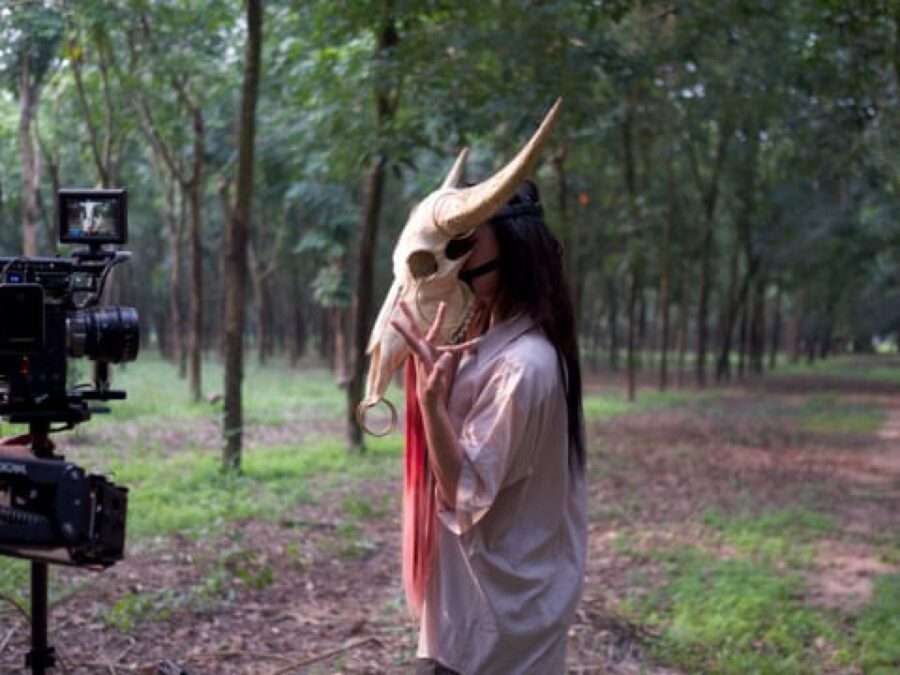
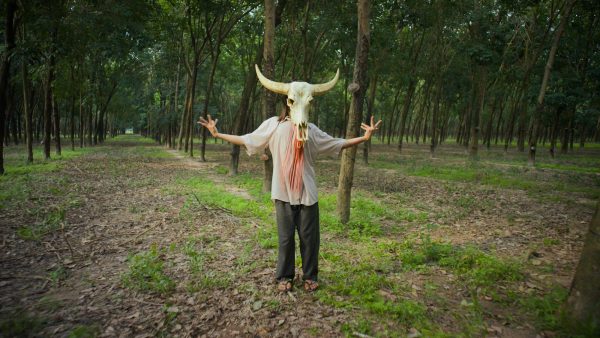
TAN: Our film The Living Need Light, The Dead Need Music was filmed over a month in the southern region of Vietnam.
ML: We were playing with documentary filmmaking. We were playing with fiction, with narrative, with storytelling. We were playing with elements of commercial filmmaking, which was the aesthetic of a music video. So everything was shot 120 frames per second and then brought in to edit. And everything has this really slow, fluid motion to it.
TAN: We structured the film in a way that follows the structure of a funeral ceremony. So we start off with the traditional music first. Then it goes into different performances and then it goes into the brass band and the procession of the casket to the grave. But of course our film is a very, condensed version of the longer ceremony, which could last from two days to sometimes up to nine days.
The idea of Saigon becomes something that exists and does not exist simultaneously. And I think the city operates in a very similar manner. Saigon is full of paradoxes.
ML: There’s different sites that we’re interested in. There’s different periods of history that we’re interested in. But I don’t think it just relates only to Vietnam; but it’s a global conversation, too.
TAN: One could say that we’re trying to produce new mythologies in our work: taking from various sources, various kinds of histories, and mythologies from the past to create new mythologies for the present, for the future.