Editorial
Sympathy for the Devil Playlist
The playlist below features music that either directly relates to work featured in the exhibition or demonstrates how rock musicians have cultivated more avant-garde and experimental tendencies familiar to contemporary art and music in their songs. Most of the selections below are available for purchase from iTunes. Please use the link to download the free iTunes player.
Playlist
-
Anderson brought the avant-garde performance art scene into mainstream pop-rock music with the success of this song from the 1982 album Big Science (Warner Brothers) and her stage work United States 1-IV (1984).
-
Bjorn Copeland, a member of Black Dice, is represented in the exhibition with collages that visually suggest the sonic sensibility of Black Dice’s music.
From the album Creature Comforts released by DFA
-
From 1980’s 4-song extended play Jealous Again album (SST Records) with a cover designed by Raymond Pettibon, original source drawing for which is featured in the exhibition. Pettibon’s visual sensibility perfectly matched the band’s aggressively sardonic take on dysfunctional social situations in 1980s America.
-
This homage to Andy Warhol (American, 1928–1987) is featured on the 1971 album Hunky Dory (Virgin Records) and suggests the influence that the famed Pop artist had on Bowie and many other rock musicians.
-
From the album Ege Bamyasi (United Artists) by the Cologne, Germany-based band associated with the musical genre “krautrock”—a name describing German experimental rock music groups of the early 1970s who created droning often long songs mostly created with electronic equipment. Can remain a significant influence on artists such as Kai Althoff (German, b. 1966) and many rock bands into the present day.
-
This song, from Beefheart’s landmark album Trout Mask Replica (Reprise Records), set new standards for the incorporation of experimental sounds and sensibilities in rock music.
-
This song is characteristic of the abrasive yet still somewhat danceable music of New York’s “No Wave” scene of the late 1970s and early 1980s. Robert Longo (American, b. 1953), whose works on paper in the exhibition from 1980 to 1981 feature figures with “contorted” movements reflecting the sensibility of this song, was an active part of the same scene as Chance and the Contortions and other figures from the no-wave scene. Adele Bertei from the Contortions is also featured among 1984’s Portraits by Richard Prince (American, b. Panama Canal Zone, 1949) in the exhibition.
From the 1979 album Buy (ZE Records)
-
Footage from a Cramps concert is featured in the exhibition in the video Bootleg (Cramped), 1995, by Douglas Gordon (British, b. 1966). The Cramps combine punk rock, surf guitar, and 1950s rock sounds with outrageous and provocative stage performances and an identity based on gothic, horror movie sensibilities.
From the 1990 album Stay Sick (Capitol/Enigma)
-
Devo emerged from Akron, Ohio, in the early 1970s, combining bizarre futuristic philosophies, quirky performances and costumes and electronic-based rock music. They achieved commercial success in the late 1970s and early 1980s with this cover of The Rolling Stones’ most famous hit from the 1978 Brian Eno-produced debut album Q: Are We Not Men?, A: We Are Devo (Warner Brothers) and the 1980 smash hit “Whip It.”
-
donAteller featured artists Mark Leckey (British, b. 1964; whose video Fiorucci Made Me Hardcore, 1999, is included in the exhibition), Ed Laliq (British, b. 1970), Bonnie Camplin (British, b. 1970), and Enrico David (Italian, b. 1966).
From the 7-inch single on High Society Records
-
This collaboration of avant-garde rock icon Byrne and the forward-thinking performer/producer Eno from their pioneering album My Life In the Bush of Ghosts (Sire Records) features a sample of an exorcism ritual being performed which is layered over complex electronic and funk-rock sounds.
-
Manchester, England’s The Fall are perhaps one of the most influential and important bands to have emerged as part of the “post-punk” phenomena (music from the late 1970s to the present featuring a more experimental and artistic take on the intensity of punk rock). Songs such as “Hip Priest” from their album feature a jagged guitar sound and the distinctively snarling nasal spoken vocals of Mark E. Smith (British, b. 1957).
Featured on the 1982 album Hex Enduction Hour (Resurgent)
-
This early song by Funkadelic from their 1971 album of the same name set the tone for their development of the kind of funk music featured on subsequent albums, including 1981’s The Electric Spanking of War Babies, featuring cover designs by Pedro Bell (American, b. 1950s) represented in the exhibition. Funk music of the 1970s was another of the many critical contributions of African-Americans to the genesis and development of rock and roll.
-
Gang of Four emerged in the late 1970s and their music reflects their exposure to art historical teachings at the University of Leeds in England that were influenced by the philosophy of Karl Marx (German, 1818–1883). Their music combining funk-oriented bass lines, slashing guitar sounds, and lyrics that reflect Marx’s emphasis on the relationship between power, society, and economics throughout history.
“To Hell With Poverty” appears on the 1982 album Another Day/Another Dollar (Warner Brothers).
-
“Gloomy Decade” demonstrates the kind of glib, understated humor found in Graham’s photograph in the exhibition, Awakening, 2006, in which he plays a down-and-out figure who becomes the source of ridicule from 1970s heavy metal rock superstars Black Sabbath (formed 1969, Birmingham, England).
From the 2003 album Rock is Hard (co-produced and released by the Art Gallery of Ontario, Toronto; the Museum of Contemporary Art, Los Angeles; and the Vancouver Art Gallery)
-
Jack Too Jack features two artists included in Sympathy for the Devil—Mark Leckey and Steven Claydon (British, b. 1969)—and Kieron Livingstone and Ed Laliq (British, b. 1970).
-
Joy Division lead singer Ian Curtis (British, 1956–1980) is depicted in Scott King (British, b. 1969) and Kevin Cummins’s (British, b. 1953) Futurama, 2004. Curtis’s emotionally intense and tragically short life (he committed suicide in 1980) is reflected in the dark and violent tones of the music of the 1970s Manchester, England-based band.
From the 1981 album Still (Factory Records)
-
One of the most influential German artists of the late 20th century, Kippenberger made numerous recordings in addition to his multidisciplinary work in painting, sculpture, drawing, artist’s books, and sculptural installation.
From his 1996 Greatest Hits album released by LB Records LTD. (Appears courtesy of the Estate of Martin Kippenberger; Galerie Gisela Capitain, Cologne.)
-
This song is characteristic of the German quartet’s combination of high technology, futuristic effects, and dispassionately robotic personae in their pioneering electronic rock.
Appeared on the 1978 album, The Man Machine, released on Capitol Records
-
Influential punk band from San Pedro in Southern California whose albums occasionally featured art by Raymond Pettibon, and whose songs featured angular harmonies and concise social and political commentary.
From the 1984 double-album Double Nickels on the Dime released on SST Records
-
From the 1973 album Neu! 2 (Brain) by the Dusseldorf-based band associated with the musical genre “krautrock”—a name describing German experimental rock music groups of the early 1970s who created droning often long songs mostly created with electronic equipment. Neu! remains a significant influence on artists such as Kai Althoff, featured in the exhibition as part of the group Workshop (formed 1980, Cologne, Germany), and many contemporary rock bands.
-
This song appears on the album Power, Corruption & Lies (Factory Records). Source materials for the distinctive design of the album’s cover by Peter Saville (British, b. 1955) are included in the exhibition.
-
The New York Dolls are alluded to in two works in the exhibition: New York Dolls (from the series Thieves Like Us Series), 2004, by Daniel Guzman (Mexican, b. 1964) and Sympathy for the Devil, 2006–07, by Adam Pendleton (American, b. 1980). Associated with early-1970s Glam Rock for outrageously donning women’s clothing and make-up, their music anticipated the intense and energetic sound of the punk rock that followed later in the decade.
This song appears on the album New York Dolls, released in 1973 by Mercury Records.
-
Pere Ubu are named after a character from the avant-garde play Ubu Roi, 1896, by Alfred Jarry (French, 1873–1907) and emerged in the mid-1970s from Cleveland, Ohio. Their music was heavily informed by the industrial decay of their home city and was also characterized by oblique and often absurd lyrics and angular and dissonant sounds.
This song appears on the 1985 album Terminal Tower: An Archival Collection, Non-LP Singles & B Sides 1975-1980 (Twin/Tone).
-
The Poetics were developed by Mike Kelley (American, b. 1954)—included in the exhibition as part of the Destroy All Monsters Collective—and Tony Oursler (American, b. 1957; also included in the show) as students at Cal Arts in the mid-1970s. The group combined aspects of comedic performance and a wide variety of musical sensibilities—aspects of early electronic and industrial music, Captain Beefheart, disco and funk, and the more theatrically weird elements of rock music.
This song appears on the 1996 Compound Annex album Poetics: Remixes of Rare Recordings 1977-1983.
-
This song by the punk band The Ramones appeared on the 1979 album End of the Century (released by Sire Records), which was produced by legendary record producer Phil Spector (American, b. 1940). Spector—whose production was defined by its totalizing acoustics known as the “wall of sound”—is memorialized in Jack Pierson’s (American, b. 1960) 2007 sign-lettering work, PHIL SPECTOR, featured in the exhibition.
-
This song is by Mayo Thompson’s (American, b. 1944) legendary art-rock entity The Red Crayola, which was formed in Texas in the late 1960s but in its 1990s Los Angeles phase included an impressive list of that city’s most prominent artists such as Stephen Prina (American, b. 1954), Christopher Williams (American, b. 1956), and Sharon Lockhart (American, b. 1964), as well as international figures such as Albert Oehlen (German, b. 1954) and Werner Büttner (German, b. 1954), and premier musicians from its punk scene such as George Hurley (American, b. 1958; formerly the drummer for The Minutemen).
The song appeared on the 1995 Drag City album Amor and Language.
-
In a radical gesture for the time, Reed departed from his more melodic reflections on New York street culture and recorded the Metal Machine Music album in 1975 (released by RCA) featuring multiple combinations of reverberating electronic sounds. In doing so, he took the kind of experimental sound compositions of avant-garde figures such as Tony Conrad (American, b. 1940) and LaMonte Young (American, b. 1935) into the mainstream.
-
Hell (American, born Richard Meyers, 1949, who contributed an essay on the legendary New York punk club CBGB to the catalogue of the exhibition) formed his band the Voidoids in the mid-1970s. This and his former band, Television (listed below), combined an emotionally raw yet sophisticated literary sensibility with frantic and visceral musical sounds.
From the album Blank Generation released in 1977 by Sire Records
-
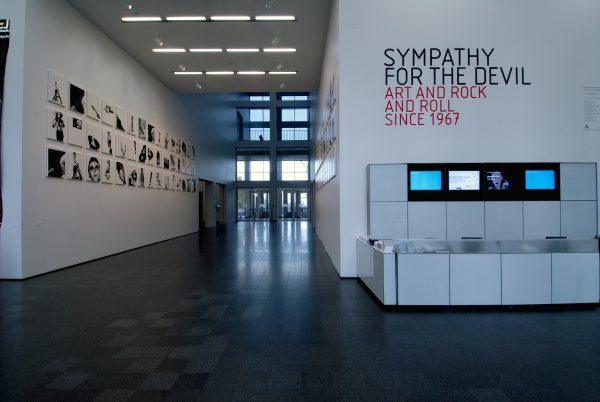
The song that inspired the title of the exhibition, its lyrics were inspired by passages from the 1941 Russian novel The Master and Margarita by Mikhail Bulgakov Russian, 1891–1940) about a visit from the Devil to the fervently atheistic Soviet Union. The song was also the “subject” of a 1968 film of the same name by French New Wave director Jean-Luc Godard (French, b. 1930) that inspired works in the exhibition by Mika Tajima/New Humans (Tajima: American, b. 1975; New Humans formed 2003, Brooklyn, New York) and Aida Ruilova (American, b. 1974).
The song appeared on the album Beggars Banquet (released in 1968 on ABKCO Music & Records, Inc.).
-
Roxy Music were perhaps the premier proponents of Glam Rock in the early 1970s, creating distinctively campy guitar-based music (complemented by Brian Eno’s outlandish electronics) and emphasizing wildly stylish costumes and performances. Both Eno and Bryan Ferry (British, b. 1945) had backgrounds in England’s art schools.
This song appeared on their For Your Pleasure album (released on EG Records in 1973).
-
Rita Ackermann (who presents a wall painting in the exhibition) created cover art for Royal Trux and artist Dan Graham (American, b. 1942, and represented in the show by his 1982–84 video, Rock My Religion) cites them as one of his favorite rock and roll bands. Formed in Chicago in the mid-1980s, their music combined 1970s-style rock music with layers of distortion and noise.
From the 2000 Radio Video EP (Drag City)
-
This is the best-known song by maverick blues-rock icon Screamin’ Jay Hawkins (American, 1929–2000) who emerged in the mid-1950s. Also known for his theatrical performance stunts, including emerging out of coffins, he is depicted in the exhibition in Karl Wirsum’s 1968 painting Screamin’ Jay Hawkins, as a frenzied figure, vibrating with the same electric intensity of his music.
This song appears on the album At Home with Screamin’ Jay Hawkins (Okeh, 1957).
-
The New York–based band Sonic Youth has since the early 1980s successfully bridged the gap between the artistic avant-garde and the musical mainstream both in their application of experimental sonic strategies and in their interactions with contemporary artists (in the exhibition, for example, this includes work by Richard Kern (American, b. 1954), Tony Oursler, and, indirectly, Jay Heikes (American, b. 1975).
From the 1983 album Confusion is Sex/Kill Yr Idols (DGC)
-
Comprising Martin Rev (American, birthdate unknown) and Alan Vega (American, b. 1948) who had both been a part of the performing arts scene in New York City’s Lower East Side in the early/mid-1970s, Suicide’s music featured Rev’s reductive, strange, and hypnotic keyboard and synthesizers, and anxious and allusive lyrics sung in manic fashion by Vega. Their early use of technological means to make rock music would be enormously influential on new-wave and industrial rock music of the 1980s and 1990s.
Appears on Suicide [First Album] released by Red Star.
-
Talking Heads were a fixture in New York’s downtown art and music scene in the late 1970s and early 1980s. Their unassuming presence, art-school backgrounds (three members went to the Rhode Island School of Design) and high-strung music and lyrics (evident in this song) contributed to their distinctive style. Band members David Byrne and Tina Weymouth (American, b. 1950) appear in Richard Prince’s Portraits, 1984, and an interview with Byrne also appears as part of Tony Oursler’s Synesthesia, 1997–2001, interview works in the exhibition.
Appears on the 1979 album Fear of Music (Sire Records)
-
Combining Lydia Lunch’s (American, born Lydia Koch, 1959) aggressively shrieked and moaned lyrics and gratingly dissonant music, Teenage Jesus and the Jerks were one of the most significant and extreme bands to emerge from New York’s No Wave music scene of the late 1970s and early 1980s.
Originally appeared on the 1978 Brian Eno–produced compilation, No New York (Antilles)
-
Television, with Patti Smith (American, b. 1946) and Richard Hell and the Voidoids, brought highly original and literary lyrical sensibilities together with the intense guitar-based sound of punk rock in the mid-1970s.
Appears on the 1977 album Marquee Moon (Elektra)
-
Throbbing Gristle pushed social, aesthetic, and musical standards to their limits, with performances that featured a sonic and visual assault on the audience, and the cultivation of an public identity through the circulation of other forms of communication such as posters, announcement cards, and albums (released on their own label, Industrial Records) that strove to undermine and critique the dominant social structure in a highly sophisticated manner.
D.O.A.: The Third and Final Report of Throbbing Gristle (Mute Records)
-
Running almost 21 minutes long, this song by Chicago-based Tortoise demonstrates the influence of such avant-garde rock phenomena as the minimalist approach of Tony Conrad and German krautrock bands of the early-1970s such as Can and Neu! It is a classic example of so-called “post-rock” of the mid-1990s which emphasized an understated use of instrumentation and vocals and has a visual equivalent in the photographs of Melanie Schiff featured in the exhibition.
From the album Millions Now Living Will Never Die (Thrill Jockey)
-
Represented in the exhibition in both Andy Warhol’s Exploding Plastic Inevitable, 1966, by Ronald Nameth (American, b. 1942) and separate Screen Tests, 1966, by Andy Warhol, The Velvet Underground and Nico are perhaps the first and most important intersection of art and rock music throughout its 40-year history. Warhol not only produced the 1967 album The Velvet Underground & Nico (Verve) from which this song is taken, but also designed the distinctive banana peel album cover art.