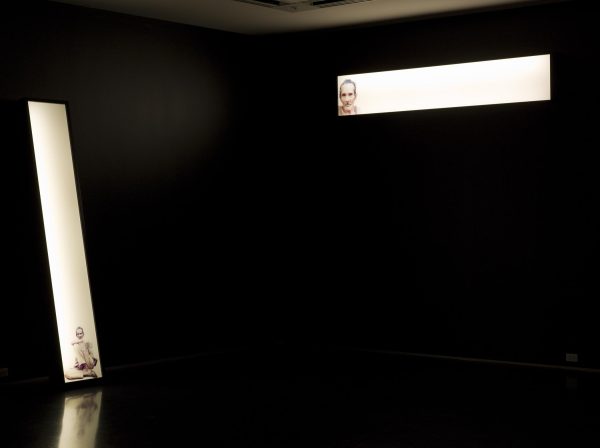
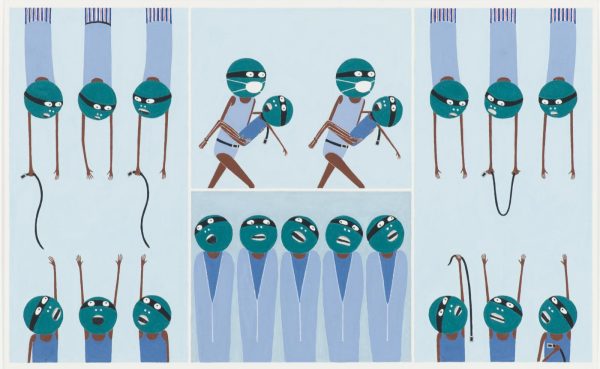
The name Coyote comes from a Hopi story about how the coyote got its yellow eyes.
After realizing the extent to which our website—which relies heavily on images, like any art museum website—excludes those who are blind or have vision impairment, we decided to create an open source toolkit called Coyote for producing image descriptions. With the help of Sina Bahram and his team at Prime Access Consulting, we have been able to make our website an engaging space for visitors who would otherwise be prevented from accessing our visual resources. We believe these image descriptions will ultimately interest anyone who wants to learn more about contemporary art, even works they already know.
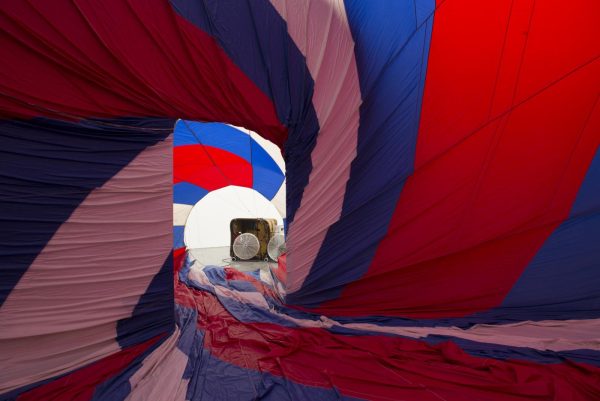
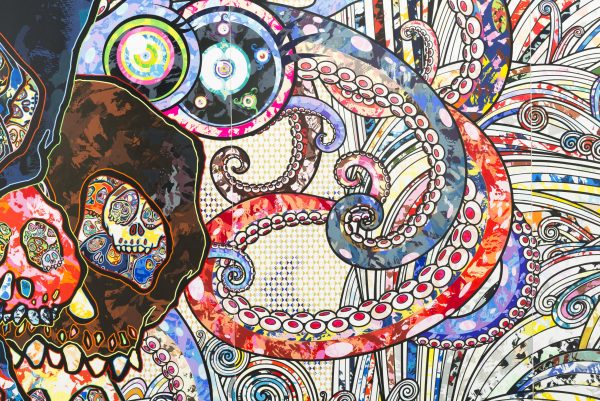
Our goal is to provide descriptions for every image on our website. (We’ve got our work cut out for us!) Below is an example of alt text being read by a screen reader as well as a few descriptions of artworks in our collection. Over the next year, we will post the most interesting Coyote descriptions we craft for the MCA and other cultural institutions. And as we receive feedback, hone our descriptions, and master the new software, we will share what we learn along the way.
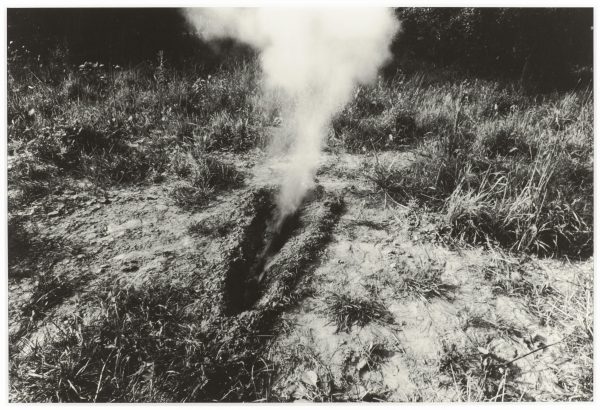
In the photograph you seem to stand in a small clearing sparsely populated with flattened weeds in the fore and middle grounds and with an uneven arc of wild grass two-thirds up the image. An impenetrably dark row of trees fills the horizon. The photograph is black and white and strongly lit, so that each blade of grass and clump of dirt casts an intense shadow. At your feet lies a short, crudely dug trench, whose excavated soil remains, forming a rim around it. The shallow slit, dug from bone-dry earth, lies in the middle of the image and tapers at the end nearest you. From the trench’s pitch-black interior, a blast of opaque, white smoke streams out, billowing directly up and off the photograph’s top edge.
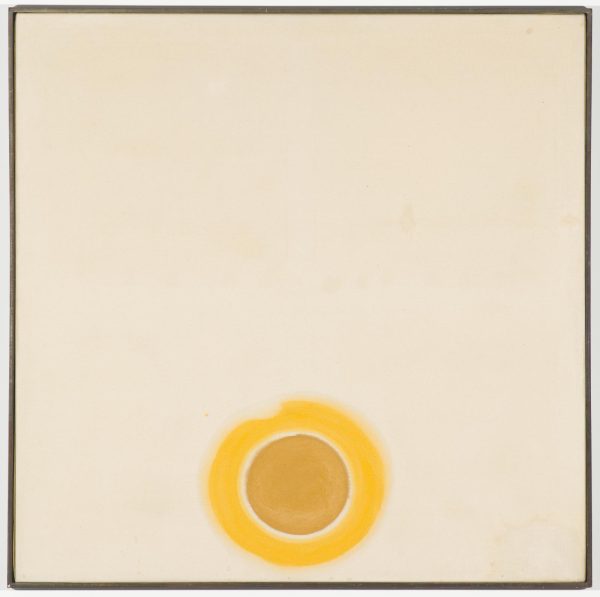
You see a beige, square canvas with a slender, dark wood frame. A large, dark orange circle nestled within three concentric rings occupies the bottom center of the painting. The innermost circle is a solid, yellow-orange, resembling the yolk of an egg. The next ring is thin and white, uniformly encircling the center. The next ring is also the largest; it is bright yellow and broad, almost the width of the center circle’s radius. It is an imperfect ring, with a small, rounded bite missing at the 11 o’clock position. A fourth ring, slightly darker beige than the canvas, appears faint and transparent; the effect is less a shadow than a secretion spreading from the paint. The circles are vivid and immediately draw your eye, but they show no illusion of depth, and the overall effect of the painting is very flat. As you look closer, you notice a tiny dot of bright yellow floating to the upper left of the circles, like a planet orbiting a many-ringed sun.
Sheila Majumdar is Senior Editor in the Design, Publishing, and New Media Department at the MCA.
Art in your inbox.
Manage Consent
To provide the best experiences, we use technologies like cookies to store and/or access device information. Consenting to these technologies will allow us to process data such as browsing behavior or unique IDs on this site. Not consenting or withdrawing consent, may adversely affect certain features and functions.
Functional
Always active
The technical storage or access is strictly necessary for the legitimate purpose of enabling the use of a specific service explicitly requested by the subscriber or user, or for the sole purpose of carrying out the transmission of a communication over an electronic communications network.
Preferences
The technical storage or access is necessary for the legitimate purpose of storing preferences that are not requested by the subscriber or user.
Statistics
The technical storage or access that is used exclusively for statistical purposes.The technical storage or access that is used exclusively for anonymous statistical purposes. Without a subpoena, voluntary compliance on the part of your Internet Service Provider, or additional records from a third party, information stored or retrieved for this purpose alone cannot usually be used to identify you.
Marketing
The technical storage or access is required to create user profiles to send advertising, or to track the user on a website or across several websites for similar marketing purposes.
To provide the best experiences, we use technologies like cookies to store and/or access device information. Consenting to these technologies will allow us to process data such as browsing behavior or unique IDs on this site. Not consenting or withdrawing consent, may adversely affect certain features and functions.
Functional
Always active
The technical storage or access is strictly necessary for the legitimate purpose of enabling the use of a specific service explicitly requested by the subscriber or user, or for the sole purpose of carrying out the transmission of a communication over an electronic communications network.
Preferences
The technical storage or access is necessary for the legitimate purpose of storing preferences that are not requested by the subscriber or user.
Statistics
The technical storage or access that is used exclusively for statistical purposes.The technical storage or access that is used exclusively for anonymous statistical purposes. Without a subpoena, voluntary compliance on the part of your Internet Service Provider, or additional records from a third party, information stored or retrieved for this purpose alone cannot usually be used to identify you.
Marketing
The technical storage or access is required to create user profiles to send advertising, or to track the user on a website or across several websites for similar marketing purposes.