Editorial
Now Found: On Faith and Wonderment in Deana Lawson’s Messier 81, Return of the Dove
by Jovanna Jones
This essay is part of the website built on the occasion of the exhibition Fragments of a Crucifixion at the Museum of Contemporary Art Chicago, May 25–November 3, 2019.
“And we were able, the church told us, to dream beyond the narrow confines of our world and to realize our dreams. . . . The elders would sit in the pews applauding us as we marched down the aisle, black angels wearing wings made of wire and halos formed from coat hangers.”[1]
I learned religion in the expansiveness of solitude and space, and I sometimes say “the Universe” to mean what others mean when they say “God.” The capital “U” lends an air of specificity and glory often reserved for God yet capable in all things.
My own father—a pastor—stepped away from the pulpit for many years to write about ways of being and the sacred practices that he referred to as “resting in the storm,” “savoring pace,” and “holy play.” Every Sunday when we stayed home from church, I’d wake up in my room above his office, attentive to either the silence of his meditation, the sounds of his favorite jazz albums, or the faint clicks of the keyboard while he typed. On Mondays, my siblings, my mom, and I would wake up to a yellow, green, or pink index card tacked next to our doors or placed on our nightstands. The card might say something encouraging like “Dare to be great,” or the phrase might emerge from something my dad had read early that morning or late the night before like “Listen to the sound of the genuine.” The time of my childhood could be counted by those sacred traces of music and message occupying my room whenever I woke up. I no longer live at my parents’ home, so my dad has taken to texting the phrases, lyrics, and images that catch his eye.
One day many years later, now an adult, I am sitting at the kitchen table with my dad. During a pause in our conversation, he reaches for a napkin; a twinkle in his eye signals that what was coming next was either a joke or something profoundly serious delivered with the silliness of a joke. That’s his way. He places the napkin on the table between us and says, “See that?” He leans closer and points to a small smudge. I play along and look into the napkin. “That little speck is us!” he says. “Pretend this napkin is the entire cosmos. That speck right there—that’s Earth, that’s what we’re living on.” So much occupies our minds every day, he proceeds to say—so much pain and suffering and joy while living on this earth, “And all we are is this little speck.” (I’d learn later that he’d recently binge-watched the reboot of Carl Sagan’s Cosmos: A Spacetime Odyssey. That’s his way.)
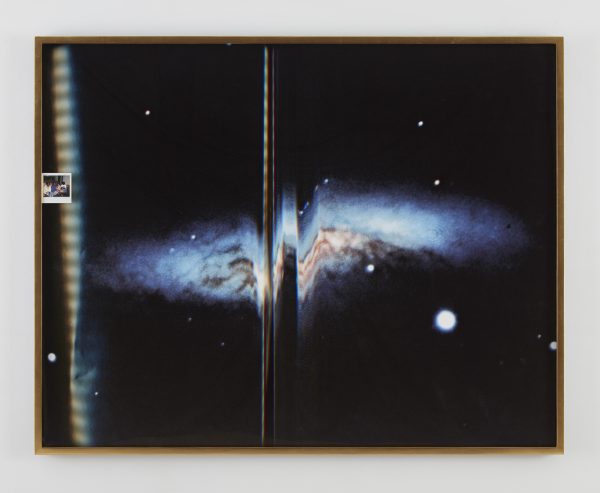
In the 2018 monograph Deana Lawson, the image of Lawson’s Messier 81, Return of the Dove (2018) does not include the small Polaroid that is now affixed to the work’s gold frame.[2] To create the initial iteration of this work, Lawson enlarged a found photograph of the cosmos. Stars glow inkless in a black sky that encircles the Messier 81 galaxy in this image, but a printing glitch obscures its center, resulting in a sharp, thin schism trailing from top to bottom and echoing a parallel ribbon of light on the far left side, perhaps another printing error. The glitch’s distortion warps the gaseous cloud of Messier 81 into what appears to be the shape of a dove in flight. The wayward twist of the glitch also recalls the sine wave of human speech oscillating between higher and lower frequencies.
Sometimes divine messages emerge in the tension between bodies, between worlds. “I am sending you out like sheep among wolves,” Jesus told his 12 disciples before sending them out to teach and heal in resistance to the sovereignty of the government: “Therefore be as shrewd as snakes and as innocent as doves. . . . But when they arrest you, do not worry about what to say or how to say it. At that time you will be given what to say, for it will not be you speaking, but the Spirit of the Father speaking through you” (Matthew 10:16–20, NIV).
I don’t refer to the Bible much, but like Lawson I am drawn to the idea that some people walk with the humility of an open vessel and the glory of a vision revealed; we delight in bearing witness when we find them in our presence. “People are creative, godlike beings,” Lawson responded to Arthur Jafa when asked about the capacity for human engagement through photography. “I don’t feel like we carry ourselves like that all the time, or that we know how miraculous we are. When I speak of potential, teasing out this incredible, powerful person in front of me, I am trying to locate the magnificent and have it come through the picture.”[3]
But Messier 81, Return of the Dove does not appear to be about the glory of the black being and body that is characteristic of Lawson’s portraits and, as I think of it, her theology. This work compresses what we can see in it into a warped galaxy, a dove, and maybe even a message that takes an earnest practice of spirit and sight to interpret. Some visual historians of celestial images refer to this as the astronomical sublime: the nationalistic, scientific, and spiritual desire to not only pursue awestruck and fearful observation in the face of the unknown, but to also compose something that makes the unknown seem knowable and, more troublingly, perhaps even conquerable.[4] While most celestial phenomena are not visible to the naked eye, scientists and photographers alike have sought to fashion color, contrast, and detail from a composite of telescopic images in order to “present the universe as one might see it.”[5] The faith of the astronomer, the disciple, and the photographer is equally speculative, therefore, requiring work beyond the limits of what one can see. But is it the perfected picture of cosmic imagination that holds our awe, or, as Lawson’s work suggests, do we find instead the very glitch that makes a new field of vision possible?
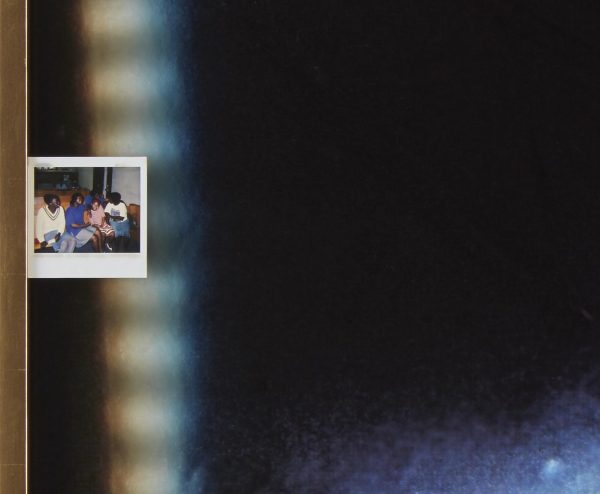
If Lawson’s original found image enacts the process and politics of transcendent visualities, then the appended Polaroid tethers such sight to a specific scene of black girl joy. Lawson’s practice often relies on images and objects that catch her attention—a well-worn couch or a postcard of George Washington’s dentures, for example, which conjure and meld people, histories, and affects across time and space. It is this spark of the fantastic in mundane materials and moments that draws Lawson toward her photographic subjects as well. These are the strangers whom she invites to participate in highly staged portraits of intimacy in domestic interiors or lush local landscapes. “These psycho-spiritual moments can be found in the places where we live,” Lawson has explained, “you don’t have to search far.”[6]
The scene snapped in time by the Polaroid tells a story of connection and, more specifically, the sacred intimacy between girls sharing a moment of their own. Though sitting in church, the girls sport the kind of casual attire often reserved for church program rehearsals, vacation Bible school, youth group meetings, or convenings in the sanctuary before heading out to the amusement park for a field trip. The energy in this small group is electric with delight. The girl sitting apart in the second pew leans forward like she’s hearing the word on the street, turning her attention toward the storyteller. The older girls lean both toward each other and toward the younger child in the middle, who smiles broadly at the camera while she basks in the protective center of her inner circle. At the same time, these older girls seem to be having a conversation of their own, while “Little Bit” makes the camera her priority. Perhaps this moment is another site of the artifice or staged interaction like that which one finds in Lawson’s portraiture: the moment where the community photographer—or whoever has the camera in the group—asks the kids to just do what they were doing before in order to restage and capture a candid moment worth savoring. While the older girls continue with the conversation, the younger one cannot help but shine, striking a gleeful and cutesy pose with arms crossed over her lap and head tilted to the side. One older girl drapes a hand across her shoulder tenderly; she could be nudging the younger girl to “act natural,” as a photographer might have requested, or maybe this gesture from one girl to another serves to keep her connected, included, acknowledged.
Far behind this young group, two women inhabit the recesses of the picture. One wears a blue blazer, and the other a floral blouse. Rows of empty pews separate them from the girls. From what I can see, the women look straight ahead, perhaps talking with each other as they watch the girls interact just out of earshot. Growing up, the observation of such women often made me feel policed in church, but more frequently I felt loved just by being seen. These church women were our mothers and aunties, our pastors and pianists, our deaconesses and First Ladies, our Sunday school teachers and our Praise Dance leaders. The church pew itself became a site to notice and discuss the contours of black sociality and social performance in our place of gathering. And I could count on my girls being there in our spots every time—our worlds unfolded in the notes we wrote to each other in our Bibles and on our prayer cards.
Hanging on at the edge of the cosmos, black girls can be found enjoying each other’s company in both the close quarters of the church pew and the far reaches of the universe. I would love to hear Lawson herself share how she came across the photograph, as well as how and when and why she chose to add it to the spatial abstraction of a galaxy millions of light-years away. Maybe when Lawson came across the image that she would eventually add to Messier 81, Return of the Dove, she felt something akin to wonder. Maybe she shared in the giddiness of this church crew. I feel it, too—I know it. If Lawson fixes such images into her frames to insert “domestic mementos,” as Helen Molesworth calls them, into the conventions of art gallery display—the clues that unravel the bigger picture—then black interiority, black girl joy, and black church space are meant to tell us something about the Universe, about accidental glitches and happenstance encounters that reveal mundane ephemera and unknown subjects to be sights of wonder and care.[7] Specks in the Universe, yet divine matter all the same.
Notes
1. Gloria Wade-Gayles, Pushed Back to Strength: A Black Woman’s Journey Home (Boston: Beacon Press, 1993), 7.
2. Conversation with curator Chanon Kenji Praepipatmongkol, June 6, 2019. For more on the piece included in the monograph, see Deana Lawson: An Aperture Monograph (New York: Aperture, 2018).
3. Deana Lawson, quoted in “A Match Made in Heaven: Deana Lawson and Arthur Jafa on Destiny, Intuition, and Influence,” excerpted interview, GARAGE 15, September 4, 2018.
4. Elizabeth A. Kessler, Picturing the Cosmos: Hubble Space Telescope Images and the Astronomical Sublime (Minneapolis: University of Minnesota Press, 2012), loc. 335, Kindle.
5. Ibid., loc. 89.
6. Deana Lawson, quoted in “Deana Lawson’s Portraits of Everyday Black Life,” by Thomas Gebremedhin, Wall Street Journal Magazine, September 19, 2018.
7. Helen Molesworth, “Helen Molesworth on Deana Lawson at Sikkema Jenkins,” Artforum, December 2018.