Editorial
Keep On Keepin' On
by Sylvia Chivaratanond, Curatorial Assistant
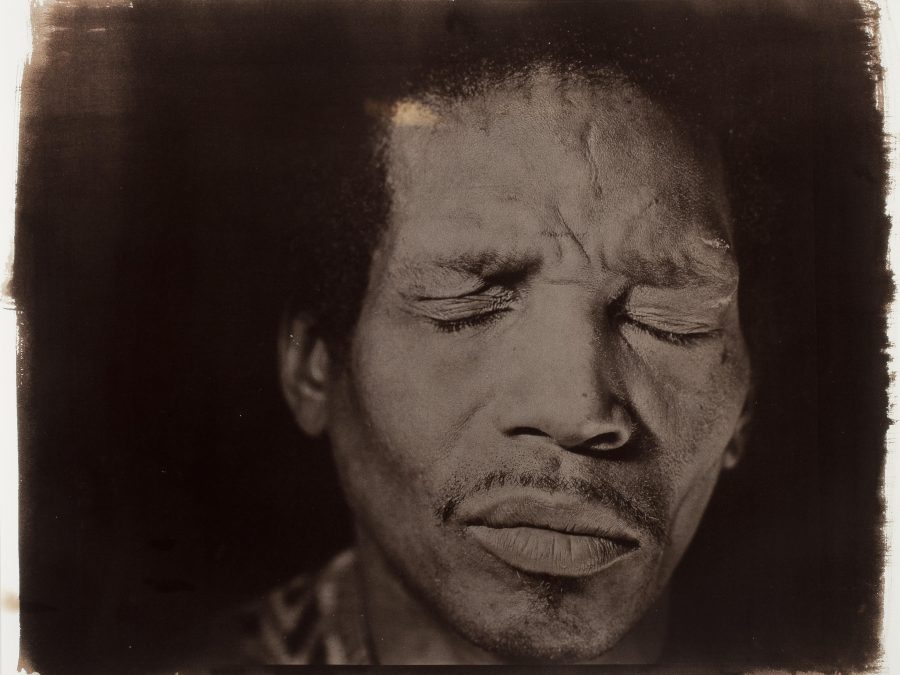
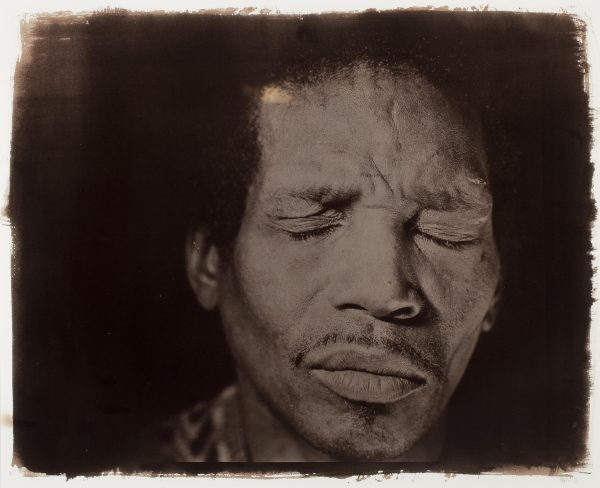
Rashid Johnson, Jonathan with Eyes Closed, 1999. Toned silver gelatin print; 21 ½ x 27 ½ in. (54.6 x 69.9 cm). Collection of Paul and Dedrea Gray, Chicago.
Photo: Michael Tropea, Chicago
In Melvin Van Peebles’s 1970 film Watermelon Man, Jeff Gerber, a white, middle-class insurance salesman wakes up to discover that he has become a black man. Gerber experiences the bigotry he once engendered himself as his family, home, and job are systematically taken away from him. While the drama/comedy addresses the black experience at the heels of the Civil Rights movement, it poignantly underscores, with wit and candor, the physical and psychological mechanisms needed by a black man for survival, and ultimately for liberation from his self-hatred. That Gerber had to become a black man in order to exorcise his white demons cuts to the core of Rashid Johnson’s work. Drawing on historical sources—the antebellum South and the African diaspora—as well pop culture—jazz, blues, and hip-hop— Johnson’s photographs are about the evolution of selfhood in this frenzied age of displacement.
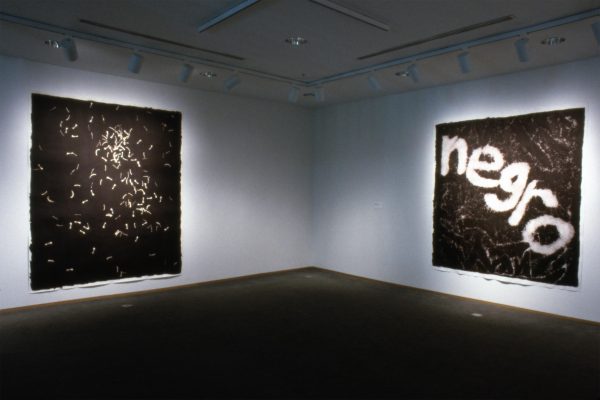
All of the photographic works in the exhibition employ the laborious nineteenth-century Van Dyke printing process. This process involves hand painting several layers of minerals onto paper before it is sun dried. Objects are laid on paper for further sun exposure, producing the ethereal photograms. Inspired by a recent trip Johnson took to the Mississippi Delta, this body of work was made using materials that are particular to the South. In Negro, black-eyed peas and cottonseeds are used to spell out the word “Negro” in fat graffiti-like letters. The look and feel of this work calls to mind the height of hip-hop in the 1980s, the characteristic early guerrilla works of Keith Haring and Jean-Michel Basquiat, and the irreverent lifestyle that accompanied this time period. In the vernacular, “negro” connotes an ironic distance inhabited by the artist’s generation—the post-Civil Rights era—reminding us that language constantly shifts, and how complex notions of blackness fluctuate. The materials themselves evoke another era—that of slaves working in the cotton fields, and black-eyed peas, rice, and fried chicken as food staples. Although the references to food are culturally specific, the compositions are purposely abstract, reinforcing the nebulous nature of identity itself. Operating on an additional level, the artist engages with the materials as he moves them on the paper throughout the lengthy photographic process, referencing the body as a performative tool.
In his trip to the South, Johnson shot the footage for United Boogie Down Baptist B-boy Beathouse Crew. Filmed in a rural Baptist Church, the edited video documents a religious service replete with a choir. The work juxtaposes spiritual moments of several people inhabited by the Holy Ghost with the rap music of Boogie Down Productions (BDP). Originally a duo comprising KRS-ONE, a rapper, and DJ Scott LaRock, BDP was arguably one of the most politically conscious rap groups in the 1980s. Combining street rhymes with powerful messages that invoke the Black Power Movement, they coined the term “edutainment,” acknowledging the potential of hip-hop as a conduit for political and social change. By combining the sacred and the profane, the film captures a vestige of the origins of hip-hop, from gospel to rhythm and blues to rap. Just as Johnson’s intricate connections are composed of culturally specific tropes—music, clothes, language, and food—it uniformly resists easy categorization as it vacillates from the historical realm to “edutainment.”