Editorial
In Conversation with Lakshmi Ramgopal
by Laura Paige Kyber
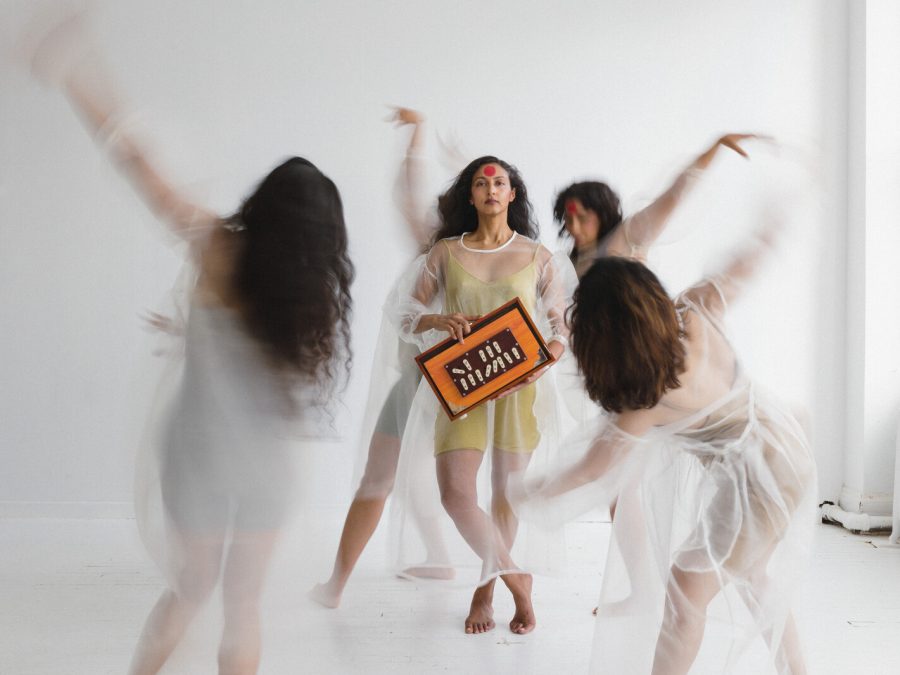
Lykanthea. Photoshoot for Some Viscera.
Photo: Stephanie Jensen
Assistant Curator Laura Paige Kyber speaks with Lakshmi Ramgopal of Lykanthea ahead of her performance at Chicago Performs.
Laura Paige Kyber: Some Viscera is a collection of song and movement that explores childhood, kinship, and memory in the contemporary Indian American diaspora. It follows the structure of the arangetram, a rite of passage for students of classical Indian dance and music. What does the arangetram entail, and why does it structure this work?
Lakshmi Ramgopal: Some Viscera uses shared experiences and events from three generations of my family as lenses to explore childhood, kinship, and memory in the contemporary Indian-American diaspora. One of these lenses is the experience of training in Indian classical dance and music. (I’m sure this is common outside of the US, but I’ll speak to what I know!) From a very young age, students pursue this training out of a deep love of these arts. From their parents’ perspective, this training is a way for their children to learn the culture of the homeland; it also brings prestige to the whole family. Classical dance and music culture becomes a formative space in which young artists forge relationships and perceptions of who they are that impact them for the rest of their lives.
“Arangetram” is a Tamil word that literally means “ascending the stage.” Speaking very generally, the arangetram is a two- to three-hour solo performance in which a classical Indian dancer, musician, or vocalist debuts as a mature artist. The arangetram also initiates a new phase in the artist’s career. The pieces that make up an arangetram in dance generally follow an established sequence and feature the choreography of the dancer’s teacher. It’s exhilarating to challenge yourself in this way and show the world that you’ve grown into an accomplished artist. But the arangetram is also arduous and lonely to train for. Suddenly you’re separated from your fellow students (in my case, girls with whom I’d been dancing in a group for years) and under the laser eye of your teacher for months of daily rehearsal. It’s also often a large and expensive social event, with hundreds of guests and catered food. The pressure and competition can be overwhelming.
I applied the structure of the arangetram to Some Viscera because it fits its context, which is a premiere. It also draws renewed attention to the institution of the arangetram itself: to how deeply it is embedded in and upholds traditional power structures, the prestige that families seek to derive from it through their children, its caste and class affiliations, how it can feel like it’s about everything but the art. At the same time, I want to speak to the power and profundity of training to be an artist and how the experience shapes your relationship to your past, to your people. The arangetram is a complex experience and a cultural phenomenon that is worthy of thoughtful criticism.
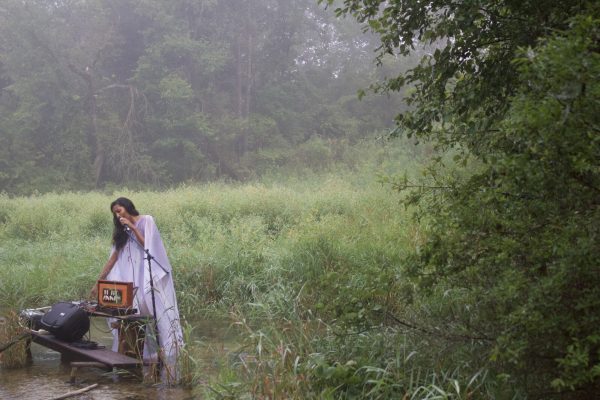
LPK: For some of your previous performances you’ve been immersed in nature—whether that’s the lush environment of Chicago’s Garfield Park Conservatory, or on the bucolic grounds of the ACRE Artist Residency in Steuben, Wisconsin. What draws you to making work in those natural spaces and how will the MCA’s theater be transformed to reflect the environments in which you began work for this project?
LR: The natural environment invites introspection and aspects of natural environments, like the songs or flight patterns of birds, to create and evoke specific memories. Natural environments draw out from us the adventurous curiosity of children, and sometimes the anxiety of getting hurt or separated from others. Through song and dance, my work articulates these feelings of reflection and childlike wonder, these ideas. I want the spaces in which I perform to express them, too.
In indoor environments like art galleries, we use real jasmine, roses, and lotuses to transform the space. These are flowers featured in Hindu ritual contexts of birth, marriage, and death, so their scent and appearance are very evocative for those who’ve participated in such events. At the MCA, we’re using these flowers in choreography that recreates and then destabilizes these ritual environments. We’re also using them in a ceiling installation so that the stage looks set up for an arangetram, only to subvert that visual expectation with a performance that, from the standpoint of Indian classical dance, is very non-traditional!
LPK: In your day job, you’re a history professor specializing in Roman history. What aspects of your profession have influenced or inspired this work?
LR: As a historian, my job requires me to think deeply about the past and how we know about the past—about the nature of the evidence. This has made my work as an artist research-oriented and has made research itself—especially about family histories—an object of focus. What can I learn about my great-grandmother from her letters to my grandmother and mother about how they all missed each other while scattered across the world? I’m fascinated by my family’s history in India and want to know: How did family members oppose British rule? How did they adapt to or benefit from it? Will I have any legacy among the younger members of my family? What will it be if I’m not a mother? Some Viscera explores these ideas by learning about medieval Sanskrit poetry, the literature of the Indian independence era, and the birds and flowers of the Indian subcontinent to re-present events in my life and that of my family’s life, and contextualize them within wider, impersonal currents of historical change.
LPK: A version of Some Viscera was shown at the MCA back in 2019 as a part of the In Progress series. How has the work developed since then?
LR: Some Viscera now includes more pieces, such as “Water, Wind, Waves, Snow” and “Garuda.” It now deals much more explicitly with the experience of being a young classical Indian dancer. Before that, it was primarily focused on events in my life and that of my family’s history. Thanks to the MCA’s support, we’re now able to work with a larger number of dancers. This has helped Asha and I, as Lykanthea’s principal dancers and choreographers, to more fully realize the role of movement in the project. It also means we can tell multiple related stories at the same time; Kinnari, Shalaka, and Tuli have backgrounds in dance that are quite different from mine and Asha’s and bring with them their own distinctive experiences as artists and members of the Indian diaspora in the US.
LPK: Lykanthea is a music and dance collective. Who are the other members of the collective and how do they contribute to the work?
LR: In addition to myself, the core ensemble is made up of vocalist and dancer Asha Rowland, cellist Erica Miller, and violinist Johanna Wiesbrock. I also play the sruti box (in a very unconventional manner) in all our pieces. I bring the songs in a basic form to the rest of the collective and together we build them out. On the movement side, much of what Asha and I do is improvised in accordance with a predetermined structure.
For Chicago Performs, our ensemble also includes Kinnari Vora, Tuli Bera, and Shalaka Kulkarni, three incredibly talented dancers working in forms like ballet, Bharatanatyam, kathak, and modern dance. They’re bringing their stories as artists and as members of the heterogeneous Indian diaspora in the United States to Some Viscera and realizing the full complexity and depth of this project.
LPK: What do you hope your audiences will take away after experiencing this work?
LR: I want our audiences to feel as if they’ve gotten lost in a beautiful, whimsical, unpredictable world in which they feel joy, surprise, grief, and longing. I want them to see the immersive beauty of South Asian and Indian culture. I want them to have questions: What did I just see? What did I just hear? What are the lineages of these sounds and movements? In short, I want our audiences to come away transformed.