Editorial
In Conversation with Jonas Becker
by Laura Paige Kyber
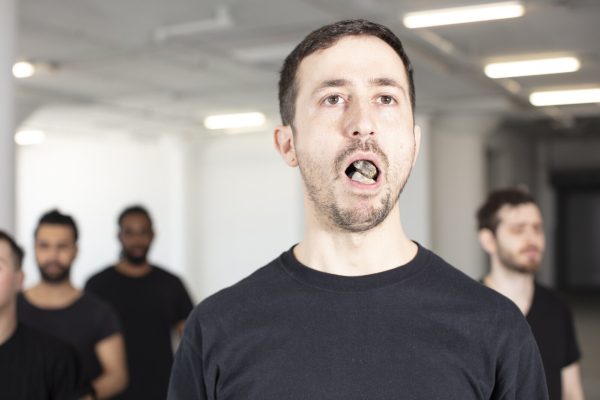
Jonas Becker, New Normal, 2019. Performance still.
Image courtesy of the artist
Jonas Becker speaks with Curatorial Associate Laura Paige Kyber about his performance ahead of Chicago Performs 2023. Their conversation, which took place on August 7, 2023, has been edited and condensed for clarity.
Laura Paige Kyber: Your piece is called New Normal. Tell me about how you chose this title.
Jonas Becker: I started working on this project in 2019, and at the time, “new normal” was a term I was hearing in pop culture more and more. Since then, the evolution of that phrase, and its usage, has exploded. I’m interested in it as an idea because, to me, it describes the experience of slow violence. It’s the slow, maybe gradual, but nonetheless persistent, degradation of conditions and what we’ve come to expect as our social contract—whether that’s environmental conditions, civil liberties, the safety or the self-governance of our own bodies, or other issues, and it felt important to think about this through the lens of the body, and how we process as both a group and as individuals in our own bodies.
In contrast to sudden ruptures and headlining news, this sort of slow shift feels dangerous to me because it’s so much harder to notice. Really, this line of inquiry goes back even further for me to the 2016 presidential election; on the one hand, people around me were outraged, devastated, and surprised, but other parts of my community were saying the disenfranchisement that many were feeling in that moment had been happening to them all along. Something that runs throughout this work is this idea that the “new normal” is something that’s incredibly subjective based on your level of privilege and experience.
LPK: There are different moments of awareness for different people.
JB: Yes. Some radical bodies resist normalization and, for others, the “new normal” is nothing new. So, we have to think about who the “we” is when we think about which “new normal” we’re talking about.
LPK: There are a lot of intergenerational mashups in the songs you’re bringing into the work.
JB: Yes, totally. More broadly, my works often address how different generations are related—whether that’s generations of extractive practices around land or how politics are passed down. In New Normal, music is one way the piece brings attention to the way I’m thinking about generations. There are a lot of different generational and cultural references in the songs, ranging from the 1930s up until yesterday. One of the arrangements that I’m working with right now transitions from “This Land is Your Land” into “We Didn’t Start the Fire.” By bridging those two moments in history I want to bring up thoughts about land, responsibility, what it means to be a “we,” and how that’s shifted over time. What did radicality or idealism look like in the 1950s, 1960s, and 1970s, versus today? I think there’s a lot being erased through that song, “This Land Is Your Land,” and maybe that’s something we can only see through the eyes of today, but that’s part of what’s happening in the pairing. I want to look across those two generations and see what’s shifted.
LPK: The piece is structured into a series of gestures. Previously I think you had nine gestures, and this time you’re creating more, rearranging them and iterating on them, combining them with songs and vocalizations. How did you determine those gestures and how do they represent the ideas in the work?
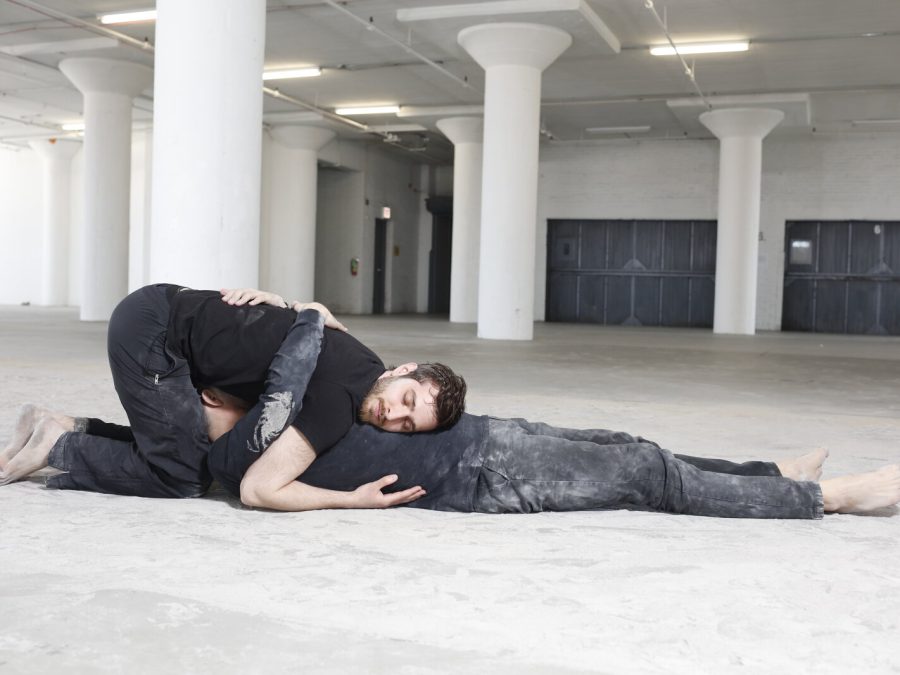
JB: When I started this project, I was really interested in how this slow violence, whether it’s toward the environment, civil liberties, or access to healthcare for transgender folks, could look in the body. As I worked with my ensemble a few themes came to the surface, one of which was endurance and another was illusion; so, the ways we use illusions to help us endure the day to day, the things we say to ourselves to make it better. After that, we started to think about struggle and support. You’ll see us struggle against each other and ideas we feel are harming us, but then we also support each other in community. By pairing those two sets of ideas, we generated most of the gestures that are in the piece—they are meant to either highlight the process of slow violence or reflect on various coping processes.
Also, it was important to me to create gestures that were decidedly not virtuosic. The people in this cast are experienced performers, but I wanted to create a bridge to the audience that let them know that even though this is a set of very considered, deeply researched, and rehearsed gestures and choreography, these are also movements that might happen in our everyday lives.
LPK: Typically, you are known as someone who makes photographs and films, and now, here you are making performance. Why was performance the right discipline for this set of ideas?
JB: I identify as an interdisciplinary, conceptual, and research-based artist over any one medium, but yes, I have often worked in lens-based media—which includes photography and film—and I often think about what it means to look and to be seen. But mostly in my work, the idea comes first, and the medium is about finding a form that is suitable for the inquiry.
The questions in New Normal came out of a photographic project I have called Better or Equal Use. I’m photographing 23 former mining sites in Appalachia that have been redeveloped into prisons, golf courses, and strip malls, after having been ravaged by mining. Driving around the region making the photographs, I was struck by the coal dust filling the air and streams I had grown up drinking from filled with chemicals. Our bodies are 98 percent water, but what water? And I began to see that we are also becoming increasingly made up of the land itself; there is no way to regard land and our bodies as separate. At this point, my practice shifted towards performance where I felt like, at least for this work, I could address both the environment and the body together. For New Normal, the mediation of the body that occurs in photography didn’t make sense.
LPK: Who are the people that you are centering in this work? How did you go about casting New Normal?
JB: The first time I put this work together in 2019, it was really a relational process. The first person I was working with was somebody who had been a former student and became a collaborator, and then from there it kind of branched out; they asked somebody and so on. Through that we built this close-knit conversation, which was important because the work came out of a conversational fluency with one another. Those who were available are performing with us now, and others have continued to stay part of the work’s evolution more informally.
For this new iteration, I wanted to shift the piece’s meaning by thinking about who I invited to join the cast. I had this experience while driving back to Chicago from North Carolina, and I stopped to visit a friend in Knoxville, Tennessee. We went to a drag show, which was going to be the last legally presented drag show before the ban on drag came down, and I felt this sense of urgency. New Normal applies to many communities, aspects of the environment, many things, but it felt urgent to address parts of my own community, and to specifically address issues of trans identity and embodiment in 2023, so that’s why I put the casting call out for all transmasculine folks. Each member of our new cast has brought a unique perspective and contribution to the work that’s made the work grow.
Though not new to the project, my work with Vocal Director Adrian Wood was important for the expansion of New Normal—one of the goals for this iteration was to introduce more vocal elements. We sifted through protest music and pop songs, considering how lyrical meaning could be altered or even inverted through movements, bringing attention to specific topics like the environment and queerness and creating moments of camp.
LPK: Making a performance is such a collaborative process. How is that different from your experience of making photographs or video? Have you had to adapt your practice?
JB: Yeah. When I teach Intro to Photography, for example, everybody says they want to freeze or capture a moment. It’s about this immediate taking of the embodied, taking of the transient, and fixing it. And for me, performance is the exact opposite. It’s an experience where, if you weren’t there, you missed it. There’s a demand that’s made by being in space with another human body that is not possible in any other medium. I don’t know that it’s changed my practice, but I think it’s a great alternative when that sort of immediacy is called for. I think it’s much harder to desensitize ourselves to standing in front of another human being.
I think another thing I’m really interested in is how performance can be integrated into the presentation of visual art objects. I don’t necessarily think of them as separate.
LPK: When you showed the work in 2019 it was in a public space, and now it’s going to be in the MCA’s theater. How do you think this changes the framing of the work?
JB: In any presentation of my work, I consider the particular architecture and cultural context. New Normal is an iterative performance meant to be presented in both public space and stage, but the different contexts change the way the work is experienced. New Normal pairs illusion and endurance as ways of coping with slow violence. In the theater, the idea of illusion is framed differently than in a public space, because our expectations around artifice are different in the theater. This time I’ve amplified certain gestures and moments that reference queer club culture. There’s a moment where we sing an arrangement of “Like a Prayer” by Madonna, and another where a performer has a solo singing “End of the World,” originally sung by Skeeter Davis in the 1960s, and those moments get campier in the theater.
I’m interested in how to create an embodied experience of this concept of “new normal” for the audience as well—I want them to notice a shift in their own physical conditions. In public space the performance and audience comingle, and the space that the audience is standing in gets more and more crowded. In the theater it’s really about the light, which is something I’ve been excited about working with and integrating into the piece. The light will shift very slowly from dark to very light, and the idea is, do you notice? Maybe you notice at the end when things become uncomfortable, but did you notice as it was building and you maybe could have done something?
LPK: What do you hope audiences will leave with after they’ve experienced this work?
JB: Really simply, some amount of empathy for, or reflection on, the things we accept on a daily basis, even if it’s something as small as how the lunch hour gets eaten by emails, or incremental shifts in the deeply urgent issues around the safety of our bodies, or the degradation of the environment, or the rapidly evaporating rights of transgender people. I don’t think the piece is necessarily a call to action as much as a call to awareness, especially for how this slow shift impacts some communities more greatly than others.