Editorial
In Conversation with Irene Hsiao
by Laura Paige Kyber
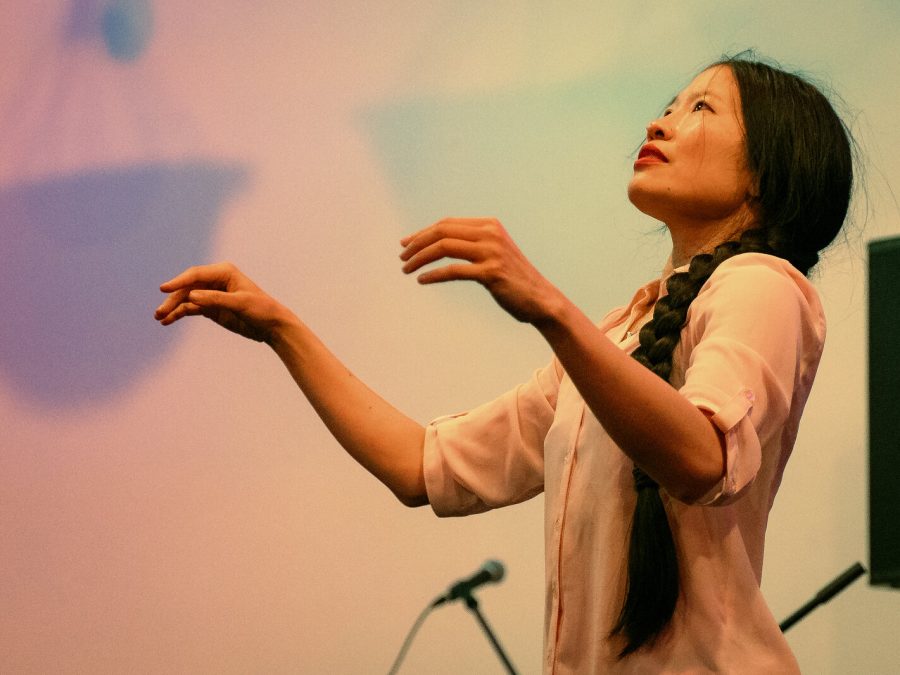
Irene Hsiao
Photo: Ricardo Adame
Irene Hsiao discusses her work with Curatorial Associate Laura Paige ahead of Chicago Works 2023. Their conversation, which took place via email throughout August 2023, has been edited and condensed for clarity.
Laura Paige Kyber: How did Blue Alice begin?
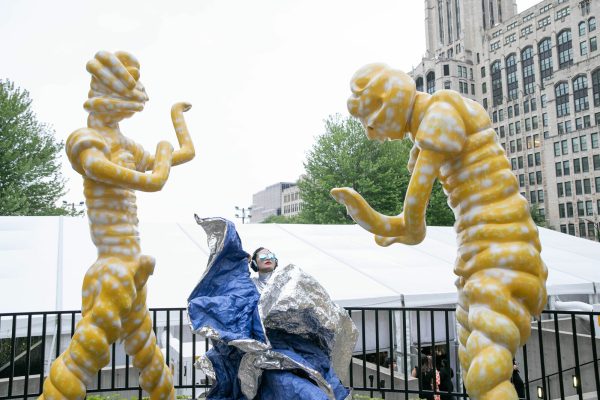
Irene Hsiao: Blue Alice was initially inspired by materials in Almost Studio’s design for the 2021 Ragdale Ring, specifically a blue tarp that was covering an orange carpet laid out in the parking lot to be flattened for use in their architectural design. I was drawn to the way the color popped against the bright macaroni-orange of the carpet, as well as the mirrored elements in their design. When they told me the tarp was not part of their work, I decided to wear it as my costume, which was created by Vin Reed. The mirrors are rendered in mylar, a material I had played with extensively in a 2018 project at the Art Institute with Philippe Parreno’s My Room Is Another Fish Bowl, an installation of mylar balloon fish. The movement for this performance was initially driven by the texture, sound, and properties of these materials, as well as words by Simone Weil—“Only the light that falls continually from the sky gives a tree the energy to push powerful roots into the earth. The tree is actually rooted in the sky”—which gave me the insight I needed to perform the work with a severe injury.
I first began to understand Blue Alice as a character within the Pop Stars! exhibition at 21c Museum Hotel, as their first artist in residence in 2022. As a shiny surface, an outsized being, and a product created from everyday materials, Blue Alice developed an interiority in dialogue with the other images of celebrity within the exhibition, the concept of pop art, and the hybrid space of 21c, a museum and a hotel that combines contemporary art, commerce, events, and touristic yearning, for amusement. At 21c, the piece also unexpectedly acquired some wonderful collaborators who explored Blue Alice through the camera, including Ricardo E. Adame, Christina Demos, Justin Jones, and Nigel Barker.
In gala performances at the MCA and Lookingglass Theatre, Blue Alice became a curious guest at the party, functioning as a mediator between the hubbub of the festivities and the other reality of the space—as a gallery for contemporary visual art, as a closed theater under construction in a space with a water pump on the Magnificent Mile on Michigan Avenue.
In this iteration at the MCA, the piece changes again according to its context. Stripped of companions, muted in sound, barred from entering the galleries, and staged as an event, I wonder what she will become this time—perhaps only a meditation on a color Yves Klein described as “the invisible becoming visible . . . beyond the dimensions of which other colors partake.”
LPK: How do you identify as an artist? Which artists do you look to as peers or predecessors?
IH: I work in dance, photography, video, and writing, all of which are ways of being, knowing, and discovering. My work is experimental and unfolds in response to artworks, objects, materials, architectural space, and time. What I create emerges as an improvisatory process driven by curiosity, which is often piqued by observation and refined through obsession—often an obsession with returning to the same space or seeing the same object or artwork again and again in all its lights and aspects.
Visual art guides my practice: how does the material move? How does its form shape our motions? What can its concept and process teach us? In my experiments, I strive to create uncanny situations that cause people to slow down and look, to question what they perceive, and to respond with their own creativity.
I began my independent practice as a museum visitor, and my work frequently comes from the perspective of a curious visitor. I often invite other visitors to participate in my practice of perception and experimentation by offering scores, art materials, props, and other opportunities, for others to interpret, redirect, and modify the work.
Ultimately, this means I share a process rather than a product. The results have shown me that when people collaborate, unexpected beauty, insight, and community occur. I am inspired by visual art and places where art is experienced. I’m curious about process, presence, collaboration, connection, and community. And I’m committed to sharing my work in ways that are free to the public and open to participation, evolution, and discovery.
As a dancer, I have been fortunate to perform with Kinetech Arts, Labayen Dance, Winifred Haun & Dancers, Alma Esperanza Cunningham Movement, Lenora Lee Dance, Erica Mott Productions, Yin He Dance, Nejla Yatkin, South Chicago Dance Theatre, Meadows Dance Collective, Carole McCurdy, Freedom From and Freedom To, and others. This fall I will be performing in Freedom From and Freedom To and the Instigation Festival, as well as with Mandala South Asian Performing Arts, in a new work by Nejla Yatkin.
I also serve as a witness and chronicler for many artists as a freelance writer, often at the Chicago Reader.
LPK: What types of spaces do you usually place your work in?
IH: Museums inspire me as cultivated social spaces for the contemplation of objects, where visitors have autonomy over the distance, duration, and depth of their engagement, and alter the conditions of the place by their choices. I also create outdoors, where I am similarly held by an environment of change—changing light, changing wind, changing beings, changing time.
LPK: What do you love about performance in Chicago?
IH: As both a performer and an audience member, I love the opportunity to be present with others in a moment that is created by all of us, together, in this time and space.
LPK: How do you approach collaboration in your work?
IH: I think the most exciting collaborations occur as spontaneous encounters that produce something unexpected, resulting in something that could not be created without the unique individuals, objects, sites, and environments present.
LPK: What do you want audiences to take with them after experiencing your work?
IH: I don’t know. Each iteration of the work is a new experiment. I hope we share a moment we create together. I am curious to find out.