Editorial
In Conversation with cat mahari
by Laura Paige Kyber
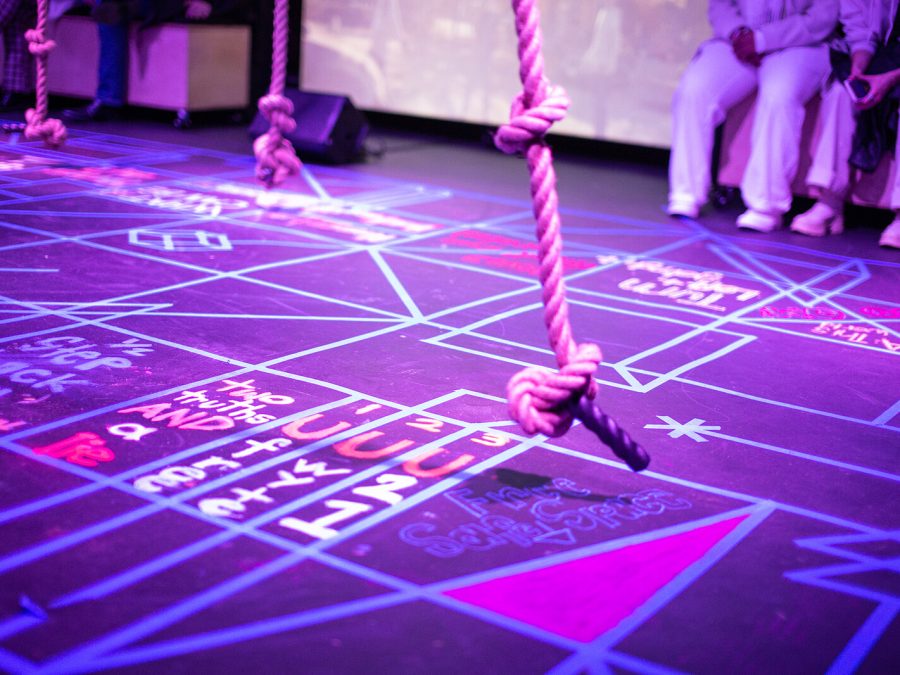
Photo: Lívia Sá, courtesy of Culture Hub
Assistant Curator Laura Paige Kyber speaks with cat mahari ahead of her performance at Chicago Performs.
Laura Paige Kyber: How did this project begin?
cat mahari: blk ark began as an interest into what ties, binds, and distinguishes community practices of liberation and play. I was interested in how social and political mechanisms can stimulate and further deeper understanding the interconnectedness of marronage, hip-hop, and Blk Anarchy. Basically asking, how can we abide, and how have we abided, in resistance? What are the ways of reflecting, living, etc., we use to get “there”? . . . to that space/place of liberatory practice.
LPK: Your background as an artist takes a winding path, with explorations through many fields of research and creative disciplines, including Black social dance forms like hip-hop and house dance, as well as electronic music and cultural theory. What throughline among these various avenues of exploration brought you to create the work you’re performing today?
cm: I’m always so interested in what will happen if I address this or another aspect of my life, my psychomateriality. I like adventures that are internal and externally impactful to my world and the perception of those around me. It’s somewhat in fun, definitely in rebellion, and always in a need to provide me with greater cultural grounding and sense of expansiveness. I get hurt by what I don’t know or understand about myself and the world.
LPK: You’ve talked about the “anarcho-choreographic” as a driving force in your work. What is that and how does it show up in the work you create?
cm: The anarcho-choreographic is the refusal of colonial apparatuses in performance and performativity. I think of it as a goal, more so than a current en masse or even personal designation. As someone brought up within the colonial world, with many of its afflictions, I also am a student of peoples whose politic (of course that includes cultural expressions) are manifestly anti-colonial. Hip-hop, as cultural formation, is anti-colonial—I strive to maintain that and I do not give ground in as many ways as I can. In my work, that shows up through the dynamics of audience-performer expectations, as well as through presentation.
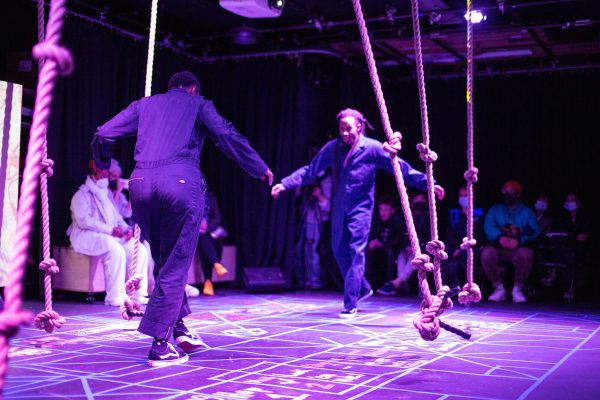
LPK: An element of the stage design for this show involves an intricate set of lines taped to the floor that the dancers traverse. You’ve called this tape outline a “rhythmmetics board.” What is rhythmmetrics and how do participants use the board?
cm: Rhythmmetrics is an embodied philosophy and movement practice created by Sekou Heru (a legendary dancer, artist, and teacher based in New York, NY) and realized through space/place interactions in the club, of the street . . . connecting ancestry, connecting people, connecting you to yourself. There’s multiple ways to use the board. . . . I’ve definitely not found nor mastered them all. I use it when teaching and when creatively exploring to get into a deeper, yet more expansive, way of moving, of reflecting, and of listening. In blk ark, the board’s shapes and directions are grounding jump-off points for my collaborator Jarius King and I to change our relationship.
LPK: What do you want people to take away after having experienced blk ark?
cm: I think that this work speaks to many people, but it’s heavily “worded” in specific Blk languages, paradigms, and paradoxes. Everyone can get free, but I want us to ask how. The how as in what, where, when, and why we practice (express) with each other what we do. I want people to get fired up enough to risk this world . . . soon.