Editorial
In Conversation with Anjal Chande
by Laura Paige Kyber
Anjal Chande
Photo: Samir Mirza
Anjal Chande speaks with Curatorial Associate Laura Paige Kyber about her performance ahead of Chicago Performs 2023. Their conversation, which took place on August 3, 2023, has been edited and condensed for clarity.
Laura Paige Kyber: Tell me about the work you’re presenting as a part of Chicago Performs. What do you want people to know about it?
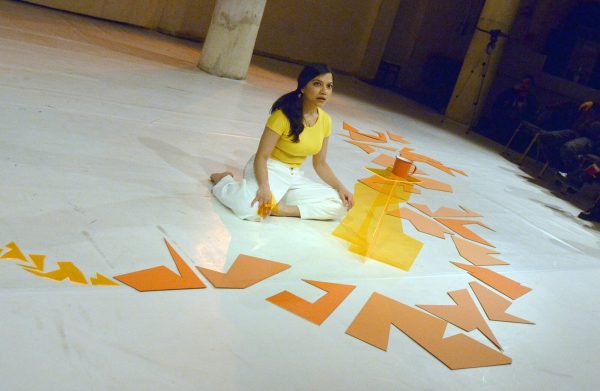
Anjal Chande: I am performing a project that is, I just tallied, seven years in the works. The first iteration was in September 2016, so it’s really wild to look back at a project that has had such a sense of longevity to it. It’s one of the few projects that I’ve allowed myself the opportunity to sit with for a really long time and just iterate on. It’s called The Next Cup of Tea. So much of our inner, lived experience is just a constant toggle between different energies and reckonings and contradictions, and I think in the simplest sense, the act of making tea is sort of a container for sitting with what is emerging for us daily: what is surfacing, what we are feeling, what we are reckoning with, what we are chewing on, what is keeping us up at night. So the act of making tea is a chance to sit with all this stuff. The piece creates an entryway into a juxtaposition of the very ordinary and mundane with the more kaleidoscopic, interior chaos of our emotional thought planes. In doing so, it also reveals that mundane moments or recurring emotions are in fact not that ordinary, but are actually charged and special and demanding of our attention, if only we were to heed the call. So, from there I began a sort of zigzag into this project.
LPK: I didn’t know you started this piece in 2016, and now here we are! The time you’ve been thinking in this mode precedes the time of the pandemic. Were you, and are you now, thinking about domestic life or domestic labor in relation to this piece?
AC: Yeah, I think that’s an interesting association. I feel like that word, “domestic,” has a lot of connotations that don’t resonate for me. It’s often framed, especially in terms of domestic labor, as what’s valued or not valued or what is gendered in particular ways. I think I’m more concerned with the act of slowing down as something that’s not legible to or even debated by capitalism. I want to think about the act of drinking tea in any context. So whether you’re in your own familiar home space and you’re pausing to make yourself a cup of tea, or you are out adventuring in the world and you find a little hill station where they can brew you some steamy chai, or you are here, in the theater, and all that is available is the cafe’s espresso machine—that becomes the entry point into a moment of stillness. It’s wherever you are, whatever the beverage might be, that it becomes the opening into opportunities to sit still and take pause and be with. Of course, there can be a very commodified aspect to how we engage with tea and coffee shop culture, but I’m more interested in how if we can peel back the boxes of our commodified relationship to tea, we might get to a more elemental place.
LPK: How do you identify as an artist?
AC: At this point in my life, I identify as simply an artist, and I feel pretty clear about shedding any disciplinary attachments. I feel like I’ve arrived at a more anti-disciplinary relationship to my art, and the word “artist” feels like the most all-encompassing term for the different creative impulses we have throughout our lives. Sometimes we are more producers or creators, or editors, or we are holders of other people’s things that need to be held. Everything is in my toolbox, and I’m tired of categorizing or qualifying it. While growing up, my attachment to the notion of being a dancer was sort of put on me, and I think it sort of stifled my ability to make art because I was always ranking who was I first; I’m a dancer first, and then I’m a musician second, but then I compose music, and I also write, and so on and so forth. I always needed to have a list, or internal hierarchy, for some reason. Maybe I was catering to some kind of legible disciplinary allegiance, but I’ve since let go of all that, and I’m starting to see my broad, unboxable artistic impulses as what drive my artistry.
LPK: What elements of your creative practice show up in this work?
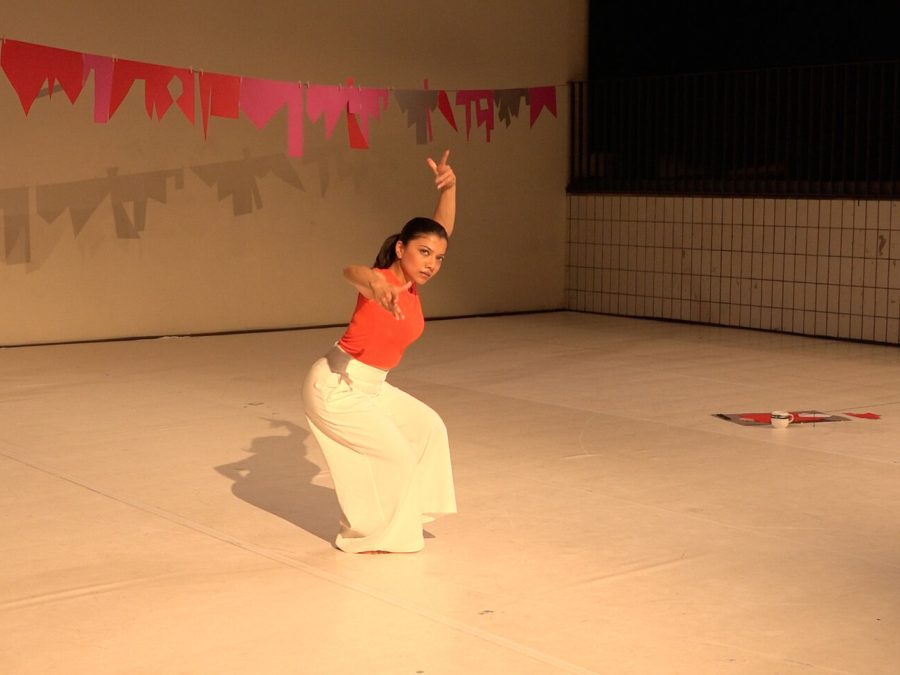
AC: The work will have dance, humming, live music, poetry, prose, spoken word, rhythmic footwork. We’ll have performance art, we’ll have playing, and a lot of improvisation. I’ll be grappling, asking questions, getting out of the way, making space for the power of these creative tools to just erupt in the space, and to be with a lot of dissonance. As opposed to much of what I’ve made in older projects, which had more fixed choreography, planned composition, predetermined crafted repertoire, and narrative throughline with a resolution.
LPK: Is the text autobiographical?
AC: Yeah. It’s funny, there was a point where I was like, can you make a dance-theater memoir? Can you make a performance memoir? And I think there were moments in this process where I was like, is that what I’m doing? There’s some of that energy, but I think it’s not so filled in.
LPK: You’re based in Chicago now, but your life has taken you to lots of geographic locations. I know you spent time in Germany, and you just used the term dance-theater, which has particular meaning in that country. Tell me more about the trajectory you’ve been on, and how these various places in your life coalesce into who you are now as an artist.
AC: Chicago is where I grew up dancing, and inevitably you inherit ideas of what dance is, or what the field is, or what it means to be an artist. I’m not sure if I can attribute this to the location itself. I lived in New York for a time, and I felt like there was a relationship to creative energy there. I was not actually focused on dance while in New York, so my relationship to creativity—across genre—was very visceral, and I thought, “this is what creativity, and active, alive community feels like.” When I was back in Chicago I fell back into my patterns, and it wasn’t until I was in California, in the Bay Area, where I began to experience more blurring of the lines of genre. It’s easy to feel boxed into what your peer artists are doing, and who you consider your peer artists to be. Something about being elsewhere was able to help me expand these notions. And fortunately, I was able to experience a lot more comradery or genuine curiosity in each other’s work. Living abroad in Berlin was so liberating because nobody knew me, and I wanted to be in a place where I could truly shed the sort of subconscious holding of how other people were understanding me and my work. That’s where my improvisational practice took off. I was dancing for myself, and that opened up my ability to tune into my own inner voice and slowly start to discern the shackles I had been carrying for a long time. Also, Berlin has an expansive notion of what dance is, and that definitely fed into the sense that everything’s on the table. I went to Berlin on a Fulbright to find out what it was about that place that made it so conducive for artists. I wanted to understand the historical, economic, political, and ideological factors that led to the conditions that built the creative city.
I think being in Berlin helped to challenge the myopia I felt of being an American. For me, that myopia was so intense, and impossible to be aware of without consciously trying to step outside of it. This arc of being in a few different places, and then coming back from Berlin has allowed me to become a very different person, and I’ve now had the opportunity to build conviction and clarity around what matters to me as an artist that’s become unshakeable. I think the luxury of making art over one’s modest lifetime, and to explore and situate that work in different contexts, and then distill who are you and what your impulses are, has allowed me to arrive at a place where I’m no longer as susceptible to just falling in line or back into old, habituated paradigms. That feels so refreshing and celebratory, that when I returned to Chicago in 2019 I was able to build a very different relationship to the Chicago dance community, and I could explore it on my own terms and according to my value system.
LPK: Because you have so many different aspects to your artistic practice, when do you choose performance? Why is performance the right medium for one idea, or writing for another? What does performance do that another form doesn’t?
AC: I think the biggest thing, and it’s thematically present in my work, is the notion of presence. I think live performance and gathering is powerful because we are present with each other, and we become aware of our neighbor sitting next to us, or the performer, or the witness. I explore in my project my relationship with my grandfather; we didn’t do much, but we got together, we sat next to each other, and the way in which his presence could fill up a room, even if only a few words were exchanged. That is so powerful, and that’s one of the superpowers of performance. What can be exchanged—in terms of energetic, emotional, inspirational exchange—is just so different when you have that ingredient of presence.
LPK: Who are you collaborating with in this work, and how do you approach your collaborative relationships?
AC: I just started working with Sharon Udoh, and I’m so thrilled by what is becoming possible in this relationship. Sharon’s a brilliant pianist and singer, and a very emotionally literate soul who is so committed to intuitively supporting the dear and detailed moments of this work. It’s been so wonderful to find someone willing to build this intuitive bridge between their piano and my vocalizations, as well as between their musical lineage and mine, which is heavily influenced by South Asian traditions. I get so excited by what’s possible in the interlingual space between musical approaches, and we’ve been having a great time braiding and bridging our sonic languages.
I’m also working with a friend, David Ofori-Amoah, who is just a wonderful person and a very brilliant designer. When I had the impulse a long time ago to start to work in the material dimension, he just took my ideas and made them real and fantastic. It probably began with me taking a piece of construction paper and cutting it up into different shapes, and then figuring out what that was doing for me, then taking the idea to him and finding a way to turn that into props and a set. That’s been amazing and so fulfilling. I’m increasingly more interested in the material world; I’m learning carpentry, and I just want to be more knowledgeable about how things are built. I feel this really visceral relationship to the physical architecture of space and felt weight of objects, so it’s very exciting to have a collaborator who works in product design building real tactile objects, and to find this kind of creative exchange with David.
LPK: What does being in this space, the MCA’s theater, allow for the work? To what extent does it prompt you to reimagine the work? Does being a part of Chicago Performs shift your practice?
AC: Yeah, I mean, I’ve never had access to a piano! I’ve gotten such a kick out of the fact that I can just email the staff here and request things like the piano and a lavalier microphone for this rehearsal, which is eight weeks prior to the show. To have access to that support for my experimentation is so unique for me.
LPK: Does it open up possibilities for how you envision projects in the future?
AC: The answer is kind of dark. I feel like every future project that doesn’t have this sort of resource attached to it is going to take me back to thinking small. But it gives you permission to be honest about what you really want and crave, if it helps to experience something, to then know the value of it, and then to know if you want to really assert that as a need in a future project. So often we, as artists, are faced with taking an opportunity because something’s better than nothing, even if the conditions aren’t ideal. I think having the MCA supporting a project with the lifespan of this one is meaningful and allows me to reconsider what kind of timeline I need to be on when building work.
This opportunity at the MCA also makes me imagine what it would be like if such resources were decentralized across community arts organizations, and what kind of creative possibilities that could unleash. It is not lost on me, the institution I am sitting inside of, and I remain curious about producing models for redistributing those privileges.
LPK: You spoke earlier about your relationship to the dance community in Chicago. Tell me about the rehearsal space you run, Soham Dance Space. What does “soham” mean?
AC: It’s a philosophically abstract word. It’s a Sanskrit word that means “I am that,” which is like, I am that state of bliss, or consciousness, or contemplation, or joy. I am that fierceness. I’m that which I need or seek, whatever that might be. It can be used as a mantra. To me, it’s the idea of making space—literally and figuratively—for whatever we yearn for. I founded Soham in 2007, and I am personally at a point of reflection, thinking about how I understand what that project has been. I have thought of it as an Etch A Sketch; this vehicle, umbrella, container that you can sketch your way through, shake it all out, and build anew, allowing it to be a responsive organization to my own needs as an artist, but also to the creative moment, the political moment, the urgent questions, the necessary reallocation of resources.
LPK: Is Soham Dance Space a project that you would’ve done in any city or is it something that you felt was necessary for Chicago?
AC: I’m not sure about that. I think it’s something that I needed to do to create an alternate reality. I was responding to contexts that didn’t feel right for the kind of art that I valued. It was a way to create a different paradigm and to keep asking the questions of: How do you do that? How do you do it differently? I think, regardless of location, it felt like the way to make my art that was practical to me. It was a thing that I had to do. I needed it.
I think that across the work I do at Soham and my creative work, I have a strong desire to turn the light on where creativity lives in our society, and how we can locate our innate, creative capacities. It seems oxymoronic to me that one would need to tap into their creative capacity, but there are hierarchies and systems that create this sense of limited access, of who gets to do the thing and in what way. I just want to rip that apart and give us back the sense that you don’t need permission; it’s you and who you are. I feel like it’s related to the politically oppressive systems that we are always swimming inside of. We can’t solve all of these depressive dynamics if we can’t imagine our way towards solutions. If we’re constantly waiting for permission to be creative and trust our own inner voice, then we’re never going to have the courage to dismantle everything: the Islamophobia, the transphobia, the fatphobia, just every fricking problem, racial capitalism, every single system that is literally turning ourselves against ourselves. We’re not going to find a way out. I think Soham is what I’m doing to enact that in a really embodied way. I think solidarity is a big driver of a lot of the choices that I make. It’s a real commitment to just turning things around and not being afraid of our own imagination.
LPK: This sounds very related to what you’re thinking about in The Next Cup of Tea. What do you want audiences to take away after they experience this work?
AC: I guess the first thing that comes to my mind is permission to cry, to grieve, to reckon. Permission to ask difficult questions. To have the fearlessness to sit with things that are really hard to sit with, to find increased comfort with discomfort, the sense of urgency to lead with care, and the courage to find ways to come together. Those things would be cool. Yeah, I don’t know. Those things would be really cool.