Editorial
Get a Robot to Do It: Humor in the Art of De Gruyter and Thys
by Erik Wenzel
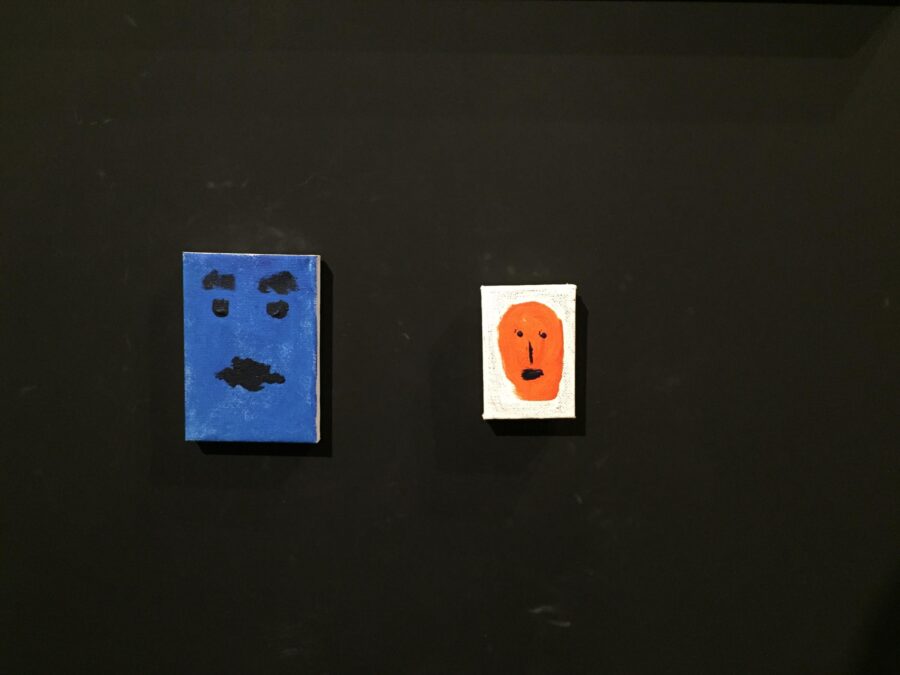
All photos: Installation view, MCA Screen: Jos De Gruyter and Harald Thys, MCA Chicago, Aug 8, 2015–Jan 17, 2016
Images courtesy of the author unless otherwise noted
I love to laugh.
—Everyone
Look at anyone’s dating profile and, in addition to specifying that they like to go out, but also like staying in, follow sports, and are really into food and whiskey, they state that they also love to laugh.
Not only that, but of the qualities they seek in a mate, having a sense of humor is almost always on that list. Yet that’s a little vague. There are many, many kinds of humor. Saying you love to laugh is like saying you love, well, food. Everyone does. But people love a variety of foods and laugh at many different things.
Laughter in an art context is not as common. Laughing at art though? Maybe. The cliché of dismissively laughing at something because its construction seems to require the wherewithal of a fictitious child is less about humor and more about lashing out at something the viewer is just intimidated by, doesn’t understand, or doesn’t want to do the work to understand. Art can make us actually LOL though. And a lot of contemporary art is meant to. David Shrigley, an amazing humorist, comes to mind.
View this post on Instagram
We tend to think art is supposed to be serious. It might be about stirring emotion, but levity isn’t one of them. It’s hard to know if it’s OK to laugh; especially if we aren’t sure whether it’s a joke or not.
It is this uncertainty and uneasiness that makes Das Loch – Im Reich der Sonnenfinsternis (The hole – In the empire of the solar eclipse, 2010–11) by Jos de Gruyter and Harald Thys so great.
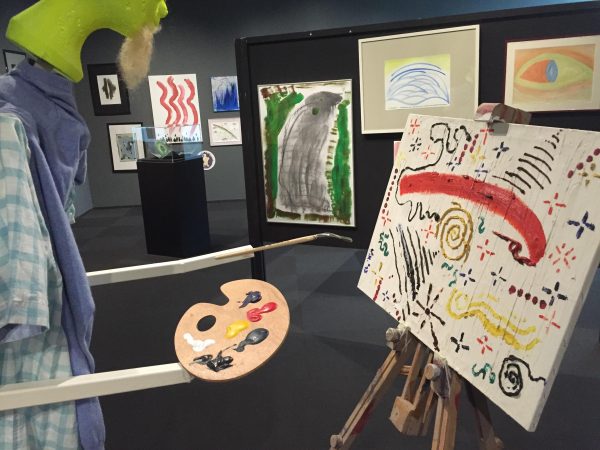
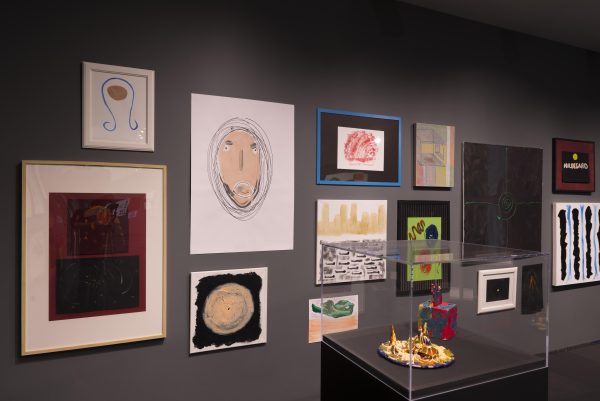
“The hole – In the empire of the solar eclipse” is an installation of paintings and sculptures that is accompanied by a video (on view at the MCA through Sunday, January 17, 2016). The paintings were made by the artists’ fictitious character, Johannes, who stands in the middle of the gallery, at work on his final masterpiece.
The works are hung on portable dividers, the kind you’d find at a school or community center “art exhibit.” A lot are framed or matted and affixed to the walls and bulletin boards with L-brackets, again contributing to an amateur vibe. Here’s the thing though—the paintings are good. While they may look like the kind of ironic or pathetic abstract paintings a lot of people are making today, these ones have life, which is all the more an achievement considering they are “fakes” or props made by the artists to accompany the character they created.
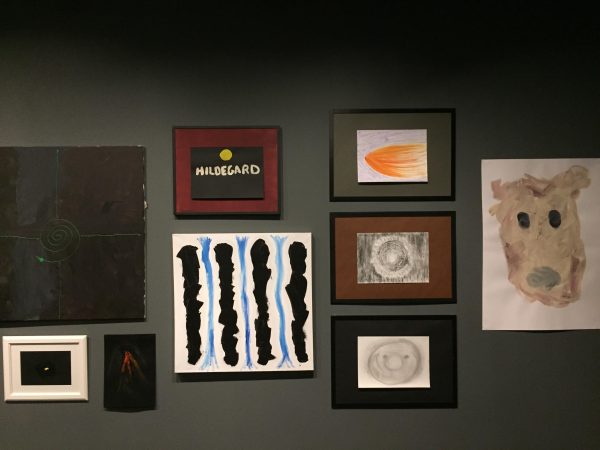
Maybe being part of an installation lowers the stakes on each individual piece, or maybe it allows them room to breathe, but these are some of the most interesting, free, and lively paintings I’ve seen in quite a while. Some are simply funny, but a lot of them capture the energy, ambivalence, and playfulness found in the work of many modern and contemporary painters. As much as Johannes is meant to be an ineffectual modernist, his work shows an awareness of and participation in art history.
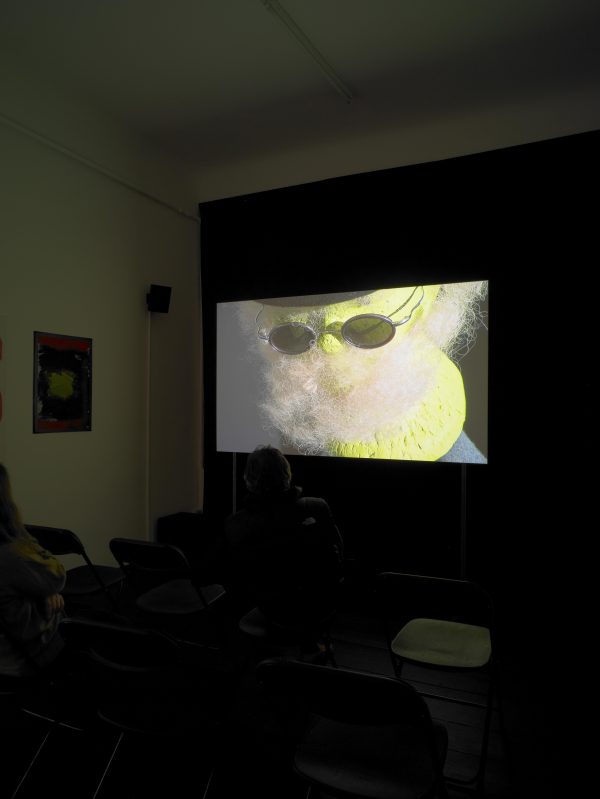
The installation leads us to the video, Das Loch, which depicts Johannes as a failure who only wants to express the love and beauty of nature even though his wife thinks he should give up and, “make a video film like Fritz.”
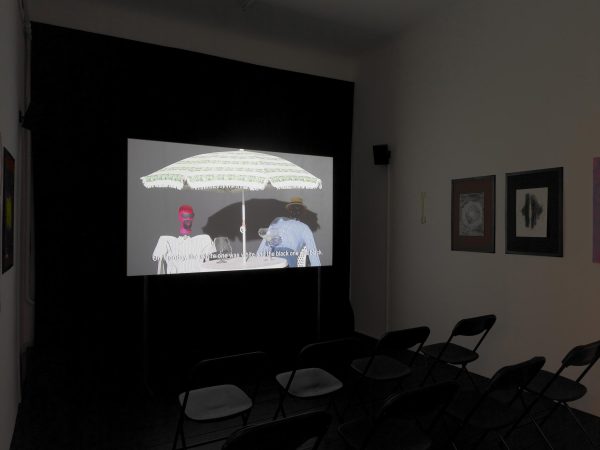
Silent and long, the work consists of still shots: A close-up of Johannes with his scraggly curly blonde beard and old-fashioned sunglasses stays on screen for what seems like minutes. His head is pointed down, staring into space. The silence is finally broken by a slow, digitally distorted woman’s voice. In deep German she drones, “Johannes, why are you so unhappy? Johannes, why won’t you look me in the eyes?” This cuts to a shot of the woman. She has a vulture on her shoulder, a wig not unlike an English judge’s and, beneath her glasses, a pair of googly eyes that stare blankly out at us. Hildegard, Johannes’s wife, consists of a Styrofoam head, paint, and a few other props. Johannes is made of a similar head painted neon yellow. This is the same Johannes standing in the gallery; his oddly bent brush poised at a painting on his easel.
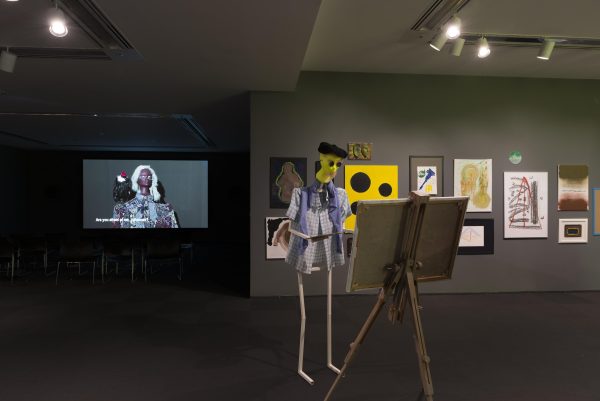
Each of the characters in the video is similarly constructed–a painted Styrofoam head atop a crude scaffold dressed in thrift store clothing and completed with items you’d find at a dollar store. De Gruyter and Thys show us how very little it takes to anthropomorphize something. It’s curious, but these characters all emote. Their performances are lifeless, they are inanimate objects after all, but that is precisely what makes them evocative. For example, the despondent and defeated Johannes is flat and lifeless because he is depressed; literally and figuratively just a bunch of junk. The footage is perfectly lit and filmed in high definition, a stark contrast to the crude construction of the “actors.” It is this juxtaposition that gives the video a dramatic tension. And ultimately, it is the way the artists shot and edited the work that brings these characters to life.
View this post on Instagram
The work may be about Johannes, but the star is Fritz. Nothing more than a bright red head with wrap-around sunglasses and a black beard, he tells us horribly long shaggy dog jokes with groan-inducing punch lines. They are dragged out through his slow, monotone computer-synthesized German voice. He faces us, completely still, as he relates the story of a friend on a quest to find the proper device to save his high-resolution images. It is the mechanical pace of his speech and the total lack of intonation and action, that make the jokes so hilarious. The timing is all wrong, or all right. This is what makes the video so compelling, so weird, and so good—both as comedy and as art.
While some things aren’t for everybody—both in humor and in art—I think we can all agree that if you want to tell a deadpan joke properly, build a robot to do it.
Related Exhibition
About the Author

Erik Wenzel is an artist, writer, and curator. His work has been presented at the 12th Havana Biennial in Havana, Cuba; VBKÖ in Vienna, Austria; 65GRAND in Chicago; and the Werkstadt Kulturverein in Berlin, Germany. In the spring of 2015 he curated Documentia at Sidecar Gallery in Hammond, IN. His writing appears in Akademie X (Phaidon, 2015) and How to Write About Contemporary Art by Gilda Williams (Thames & Hudson, 2014). Wenzel coedited and contributed to Internal Necessity: a reader tracing the inner logics of the contemporary art field (Sternberg Press, 2010). He teaches Art in the Department of History and Philosophy at Roosevelt University.
Wenzel is also cohost of I Don’t Hate This, the avant-est garde podcast, which can be found wherever you download podcasts.