Joey Orr: So, Chris, why do you want a potato to go back and forth across a wall?
Chris Bradley: That’s a good question.
I like to look at the potato as a signifier that the environment is not what one assumes it is. It allows anything to be possible after a potato is crawling on the wall.
I like to think of how I approach making my work as an invitation to depart from the real, slightly, just enough. And I also like that it can look normal enough that it’s almost boring at times. And not everyone’s gonna give it a chance, but I like that subtle reward—or the reward when you find the subtlety in that it’s not real.
JO: So let me just ask you this question: Why not just go out and buy one of these?
CB: Takes the fun out of it.
For me it’s about problem solving. That’s part of my practice, is figuring out how to manipulate materials in different ways to arrive at a different effect.
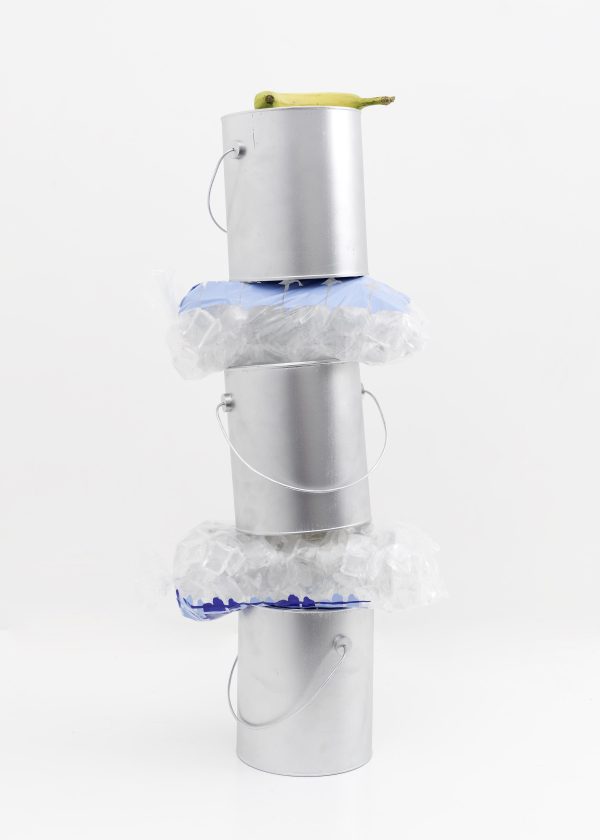
So the original stack was:
paint can,
ice bag,
paint can,
ice bag,
paint can,
banana.
And the ice bags are – I custom make the bag, and then glass represents the ice. And then the banana was cast bronze, and kinda just laid on top. So in a way you could read the whole thing as a podium for banana.
JO: And why paint cans?
CB: Why paint cans?
Paint can was originally a can of contact cement. I started calling ‘em paint cans because that’s how people understand them. But to me, it’s just a gallon can, and anything can be in that gallon can. The contact cement that I was working with, was called Sta’-Put. And I liked this idea of like this material keeping something in place, like staying put.
And that’s what being in the freezer was about, for me, was being like kinda stuck. Some sort of stasis. So it kinda spoke to this idea of being frozen. And that’s kinda where the can came from.
JO: I don’t think I’ve ever seen you put your objects on nightstands before. That’s new, correct?
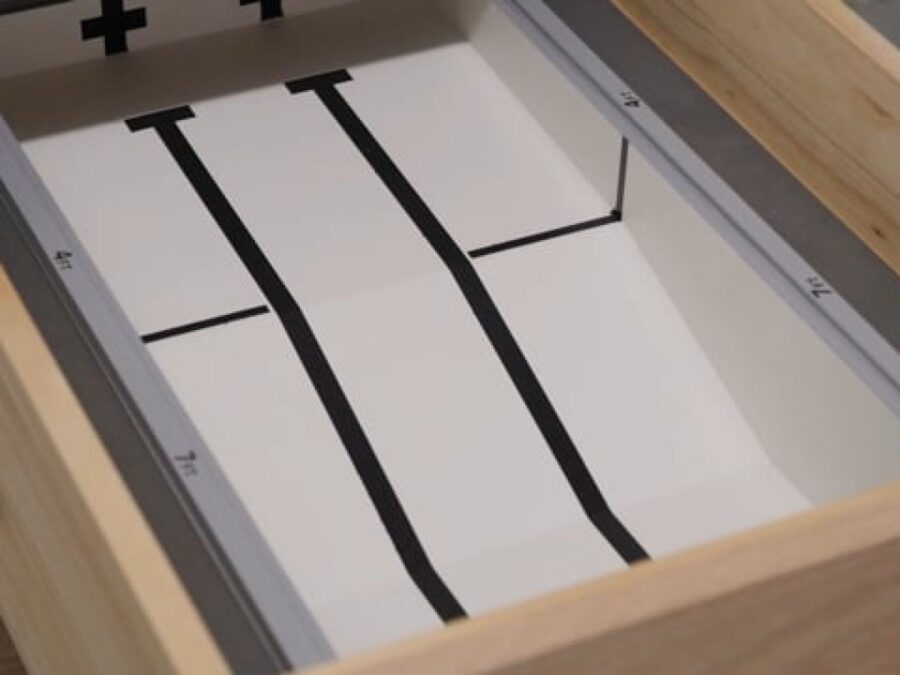
CB: It’s a new thing. If a sculpture needs a pedestal, that’s not part of the original conception of the work, it’s a tricky thing. And the nightstand was that; the nightstand as something that accompanies one as they sleep, as something that bookends the bed. And I like the idea of the drawer of the nightstand being a site for imagination or the unconscious. And so the idea of having a miniature pool within your drawer that, actually, you could swim in. Or it’s kinda like an invitation. The nightstand becomes a vessel for far-fetched reality.
JO: But also, I think I’ve heard you talk about how you’re interested in people looking at the everyday world while they’re awake with more imagination.
CB: Very much so. Yeah. I would say that’s most important to me, is trying to incite imagination within a viewer to get them looking at the world differently.