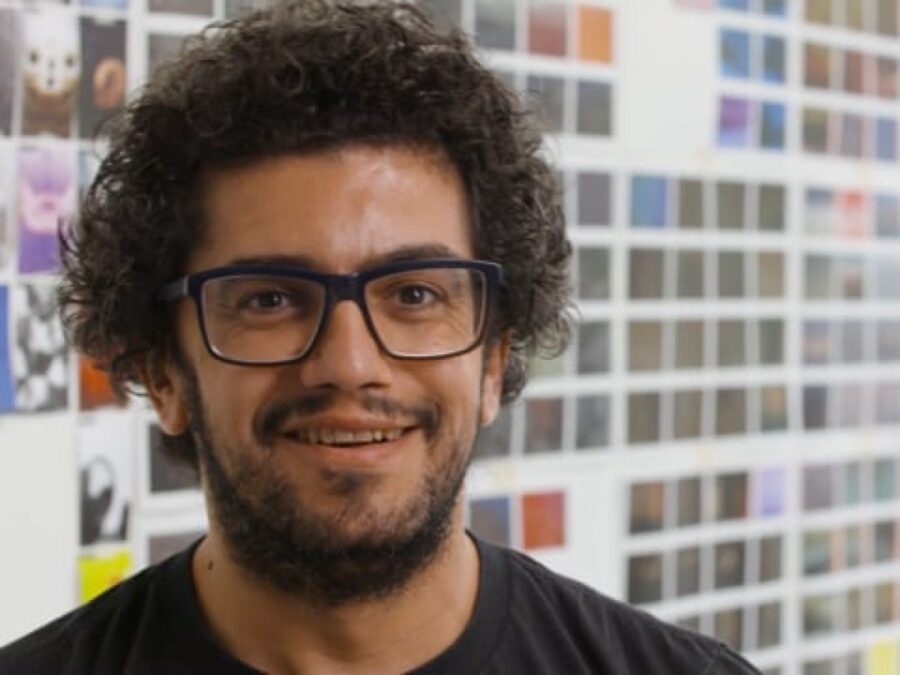
I’m Basim Magdy.
I am an artist.
And I make art.
The title of my exhibition is
The Stars Were Aligned for a
Century of New Beginnings.
A new beginning insinuates the future
and the passing of time.
And, for me, the stars were aligned is
also something about chance and
the fact that we can control things
and you can just like do whatever you want,
but then things change and
things happen the way they want.
I have two visions that are different
but are also kind of connected of the future.
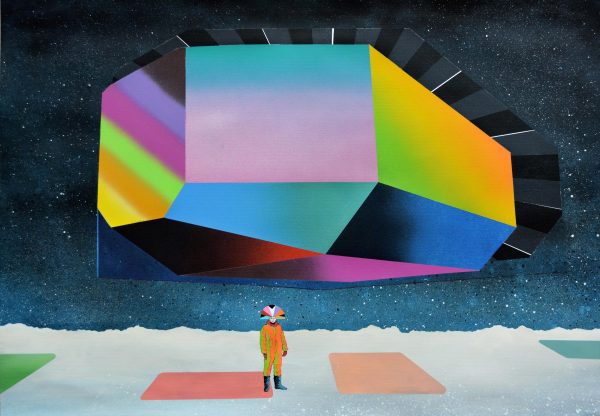
One: the future that never arrived.
So visions of the future that started in the late sixties
with the first moon landing and
all those illustrations and very fictional kinds of
visions of moon colonies and Mars colonies
and floating cars.
Of course this future
was supposed to arrive now and it hasn’t
because it wasn’t rooted in the realities of the sixties.
So the works on paper deal with this.
I try to take elements from those visions
and put them in different contexts.
And then the titles are really important
for those works.
The way I think of it is,
I want people to look at it
and then see the title and think,
“Oh, that’s a different way of seeing this.”
For the films and the photographs,
I’m dealing a lot more with
a more realistic future, which is rooted
in the present of today, where I believe
history repeats itself.
We move in cycles.
The mistakes of the past
have been made and they are being made again
today precisely the same way,
just – you change a few things and
you change the people,
you change the location.
But it’s exactly the same.
And in the future the same things will happen.
It’s kind of like this vision
that the future is not going to be that much different
because all the elements are the same.
We’re still humans; we’re the same species
that was there for thousands of years. And
we live in cities and we have the same aspirations
and we have the same dreams
and we have the same failures.
And even if the technology in the future will be different,
it’s still coming out of the technology of today.
So I work a lot with the ideas of collective failure
and collective aspiration;
and how also individuals within these
contexts perform and what their roles are
and how they see their roles as individuals and their
personal failures and their personal aspirations.
The Dent is mainly about this;
and it’s very fictional
and has a lot of different layers and
there’s a small town that tries to host the Olympics
and there’s an elephant that wakes up
to find itself a zebra.
So there’s a lot of fictional elements in it,
but in the end it’s about this group of people
who fail and fail and fail.
And eventually they realize they’re failing
and they have to choose between
trying something different
or accepting their fate of failure.
And they make a choice.
This is the future that I’m interested in talking about.
But also, I don’t know, in the future
maybe I will be thinking about a different future.
[Audio recording]
One. Never assume or pretend to understand anything. You all know you don’t just like we don’t.
[End of audio recording]