Celeste Rapone: One of the most incredible things that painting offers you is the opportunity to do things over, and have full control, and if something doesn’t work, you get to try it again. You don’t have that in life, and I think that is a very generous thing that painting is able to give me.
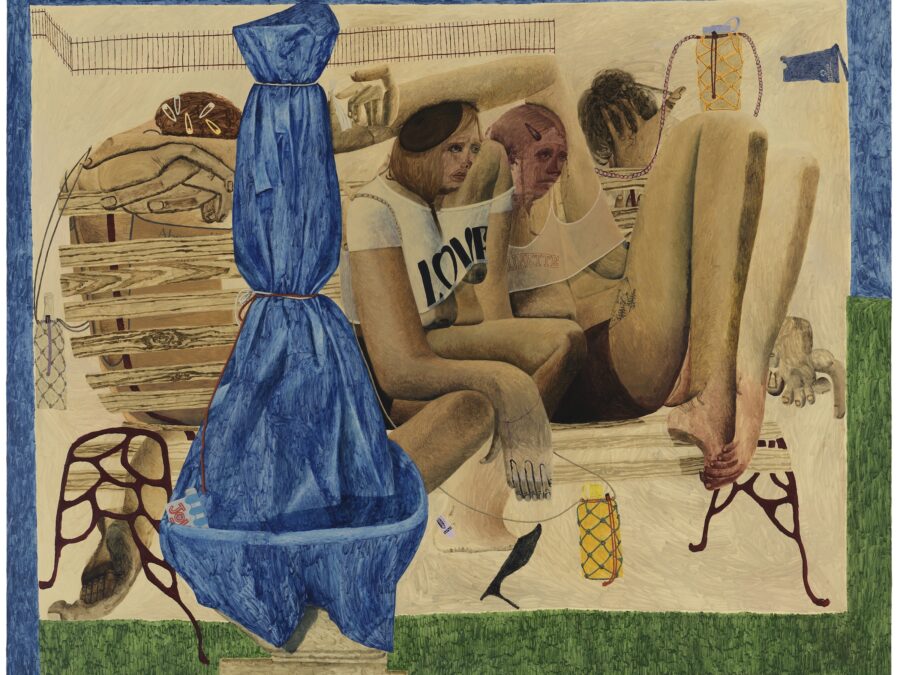
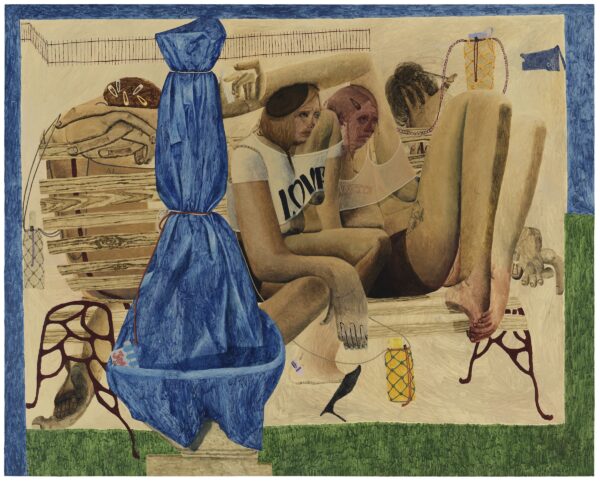
The painting “Sideline” after Ben Shahn was made as part of a larger show that I made in 2025 for Marianne Boesky Gallery, and also around that time, as a reminder, a constant reminder that I was approaching middle age, I was getting an influx of ads on my Instagram feed, and catalogs in the mail of clothing companies, furniture and house decor companies that were really all about neutrals, beiges, tans, colors that I don’t really wear or decorate with, or use much in painting, and so I sort of saw that as a signifier that, you know, it’s time to start fading out. And so I decided to re-create this Ben Shahn painting.
The painting is of four men sitting on a bench dressed in suits as if they’re prepared for anything, but nothing is coming. They have their suitcases, there’s sort of a real sense of longing in the painting that I was really interested in tapping into. I’m a year-long biker, and I was biking to studio every day last, or January ’25, I guess, at this point, and all the houses that I would pass had their fountains tarped for the winter. If you’re from Chicago, you’re familiar with Chicago gray, where, you know, the sky and the salted pavement sort of become one, and this blue tarp was like a beacon of saturated color. As someone who sort of paints based on the mundane activity of the everyday, it’s important for me to get things into the paintings that I see every day. The water bottles in the painting, I sort of wanted to think about stand-ins as the suitcases, you know, these women who are really prepared. There’s the small Joy ice cream wrapper that was laying on the floor in my studio, I don’t know how long it had been there, and then the recycling bin, the Chicago Parks District.
When I’m starting a painting, I don’t know what direction it’s gonna go in, in terms of mark-making, or what level of realism versus abstraction it’s gonna be, and it varies from painting to painting. Not knowing is a way that keeps me really excited and engaged in the studio. There’s a parallel there with also not being sure what’s going on in the subject’s minds or thoughts. So even though I’m the one creating these figures, I’m really only creating them to a point. I don’t know their history, I don’t know their future, I mean, they’re really suspended in paint for the rest of their lives. You only know to a certain point about anything that you make.