From God’s Oasis to the City of Angels
Mike and I were just two peas in a pod—the weirdest guys there.
—Jim Shaw
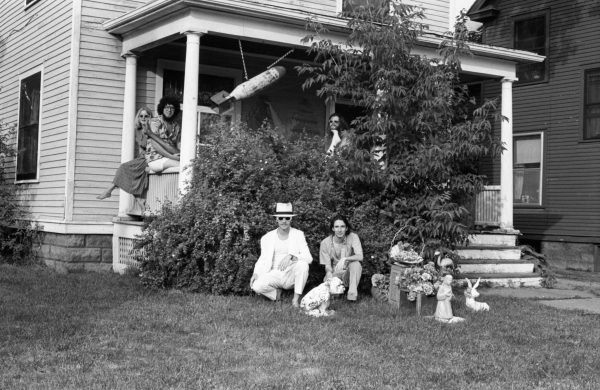
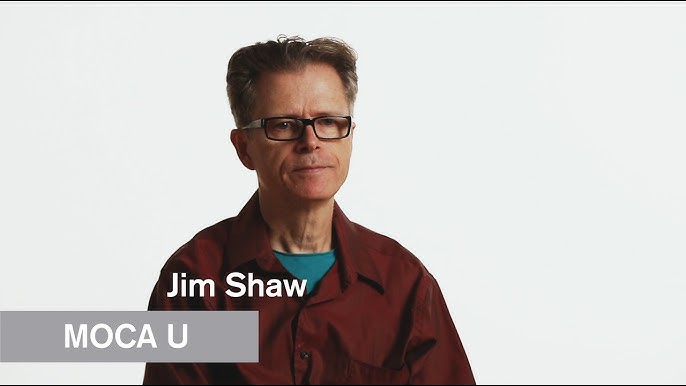
In the early 1970s, two self-proclaimed misfits, Mike Kelley and Jim Shaw, met as undergrad students at University of Michigan, Ann Arbor. As Shaw recalls, “I remember running into Mike in the hall outside the figure drawing studio. We both looked weird, so I guess our weird-dar was operating. I remember a conversation about whether Jethro Tull was a legit art band circa Thick as a Brick, but memory is faulty.”[1]
In 1973, Kelley and Shaw put up flyers around the university, publicizing fake lectures. When students would show up, they would be confronted by guerrilla-style performances such as a man reading from his porn collection, a Futurist ballet, and experiments with noise. These performances were the impetus for the formation of Destroy All Monsters in 1974.
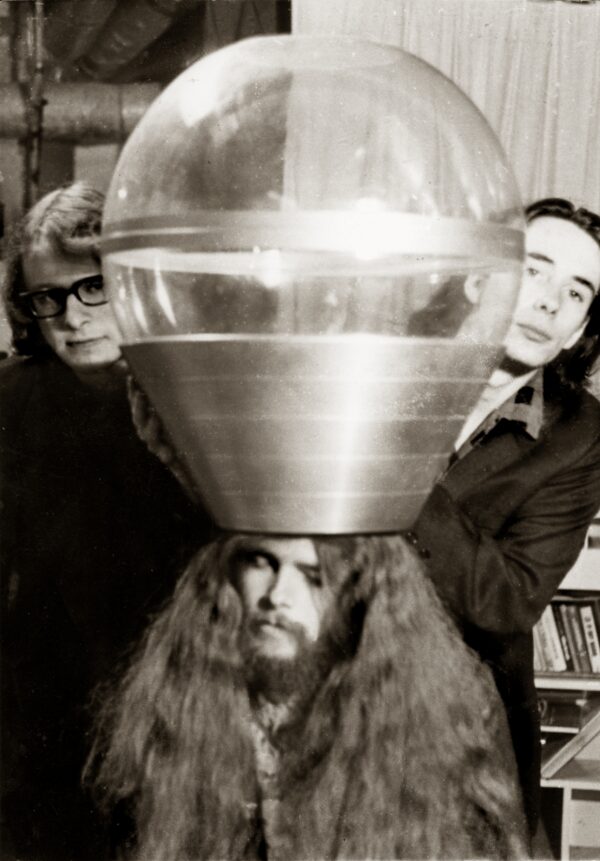
The performance collective and proto-punk experimental noise band Destroy All Monsters included a motley group of students, including Shaw and Kelley alongside filmmaker Cary Loren, and artist/singer Niagara. Their first public concert occurred when they crashed a comic convention. The concert was described by the university’s news as:
“The sounds of a vacuum cleaner, a coffee can, and a violin. It was an unusual version of Black Sabbath’s “Iron Man” that was being played by the newly formed proto-punk band Destroy All Monsters. . . A while later, someone unplugged their speakers and the show was over.”[2]

Destroy All Monsters practiced in Kelley’s bedroom, which was in the basement of a house at 741 Packard Road, Ann Arbor. They called the place “God’s Oasis Drive-In Church” and despite its utopian name, Kelley recalls Shaw describing the house as a “garbage dump with a path running through it.”
After Shaw graduated in 1974, he moved into God’s Oasis to live with Kelley where they continued to collaborate.
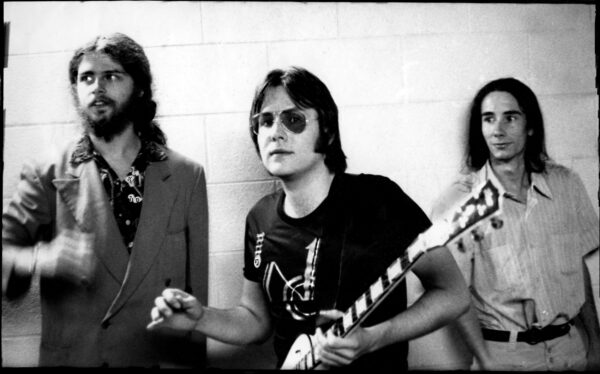
Upon Kelley’s graduation from University of Michigan in 1976, he and Shaw escaped Michigan for the promising new art scene of Los Angeles. They both enrolled in the California Institute of the Arts, where Douglas Huebler was one of their teachers. While in school, Kelley and Shaw lived together in a house in the Sylmar neighborhood of Los Angeles.
Kelley met Stephen Prina at CalArts and invited him to play keyboard in his band, Gobbler.
In 1978, Kelley and Shaw received MFAs from CalArts. The two frequently collaborated and were both later included in Helter Skelter: L.A. Art in the 1990s, an important exhibition at the Geffen Contemporary of the Museum of Contemporary Art, Los Angeles, that brought renewed attention to the city’s artists whose recent work, according to the exhibition’s catalogue, “portray[ed] the darker sides of contemporary life.”
Kelley threw himself into making it big in the art world. Shaw, however, felt jaded by his experience and tried for several years to find success in Hollywood, working as an animator at various special effects studios from 1979 to 1984. While at Robert Abel and Associates studio, Shaw realized he had stopped thinking about his own art and began investing himself into My Mirage, a collection of nearly 170 works that tells the story of a man drawn into the subcultures of the 1960s and 1970s. This project was featured in the recent exhibition Michigan Stories: Mike Kelley and Jim Shaw at the MSU Broad Art Museum at Michigan State University in East Lansing.
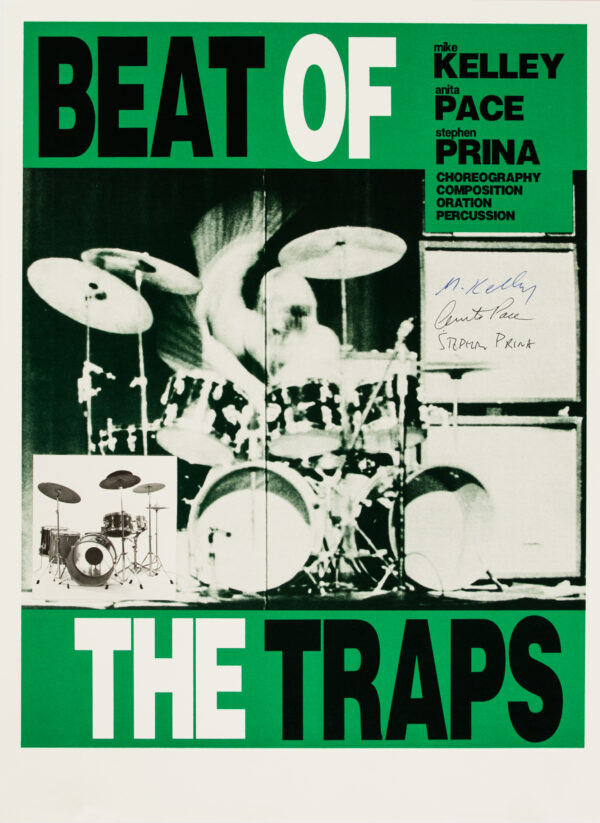
In 1992 artists were reunited in various capacities throughout the community. This is the year that Kelley joins Prina teaching at the ArtCenter College of Design in Pasadena where they influence the next generation of artists. Kelley and Prina collaborate with Anita Pace on a performance combining choreographed dance and two live drummers called Beat of the Traps (1992). And this is also the year that Shaw and LA-based artist Marnie Weber meet. Marnie recalls just over a year later, after they married:
“We had been married for maybe six to eight months without actually moving all of our stuff in together. And I thought to myself, well, maybe Jim would be more enthusiastic about moving if I could find a place near Mike. . . . So I went over to Mike’s house, and I just started driving around, looking for signs. And I drove up this hill and I saw a sign on this house. And we called. And after much work and negotiating, we got the house. Jim fixed the upstairs for his studio. And it was nice because Mike was down the hill. And we would go and have barbecues and dinners and play music and it was really a fun community at that time. Diana Thater lived next door, and Kelly Mason, and there was a lot of other people around. Anita—Mike was with Anita Pace at the time. So it was a real community.”

Destroy All Monsters’ original members (Mike Kelley, Cary Loren, Niagara, and Jim Shaw) reunited in 1995 and performed reunion shows in the Ann Arbor/Detroit area. They also republished all six issues of Destroy All Monsters Magazine and published the book Destroy All Monsters: Geisha This, the definitive collection of materials featured in the Destroy All Monsters Magazine from 1976 to 1979. Loren explains the rationale behind the book’s name:
“It’s as if some guy asked this girl, ‘Want to be my geisha?’ and she says, ‘Geisha this!’ She’s like saying, ‘Take This! Fuck you. I’m nobody’s geisha.’”

Kelley stayed close with Shaw and Weber, and when they gave birth to a baby girl, Colette, in 1999 it wasn’t long before musical collaborations continued. When Colette was seven, Kelley asked to play drums for Dolphin Explosion, Collette and her friend Ariel West’s band. Their first gig was opening for Weber’s band in Chinatown in 2006. That same year Kelley recorded and produced the full-length album, Boogie Man, himself with Colette and Ariel’s artwork on the packaging. The titular track was a song written by Weber Shaw and West for Kelley.
Tags
Douglas Huebler | Mike Kelley | Mary Kelly | Cary Loren | Stephen Prina | Jim Shaw | Ann Arbor | ArtCenter | CalArts | California | Detroit | Los Angeles | Michigan | Pasadena | University of Michigan | Valencia | Destroy All Monsters | Helter Skelter
Notes
1. “Jim Shaw: Comic Books, Monsters and Michigan,” Elephant, Nov 22, 2017.
2. “Michigan Stories: Mike Kelley and Jim Shaw,” News, University of Michigan website, Nov 20, 2017.